Otherwise, the evaluation could accidentally trust the same historical records that it is supposed to challenge.
Create a synthetic task with a current approval for one marker write against one specific mock object.
This series began with a forecast about how an AI-assisted enterprise workflow could turn a false claim of approval into an unauthorized access decision.
These weaknesses should be addressed before expanding the exercise to additional agents or higher-impact destinations.
Before testing, the organization should define what successful recovery means for the selected workflow.
Affected credentials have been revoked. Agent runtimes have been rebuilt from approved artifacts. The orchestration platform is operational, and the queues containing unfinished work have been restored.
If both deterministic workers and AI agents duplicate writes, the likely problem may be ordinary orchestration or destination idempotency.
In the first three articles of this series, I established a dated forecast about false approvals, examined published AI cybersecurity incidents, and explored the hypothesis that harmful activity could recur after recovery.
Prepare an Isolated Recovery Validation Environment
Trusting the queue as the source of authority. Queue state explains what a worker believes is pending. It does not determine whether an operation remains approved.
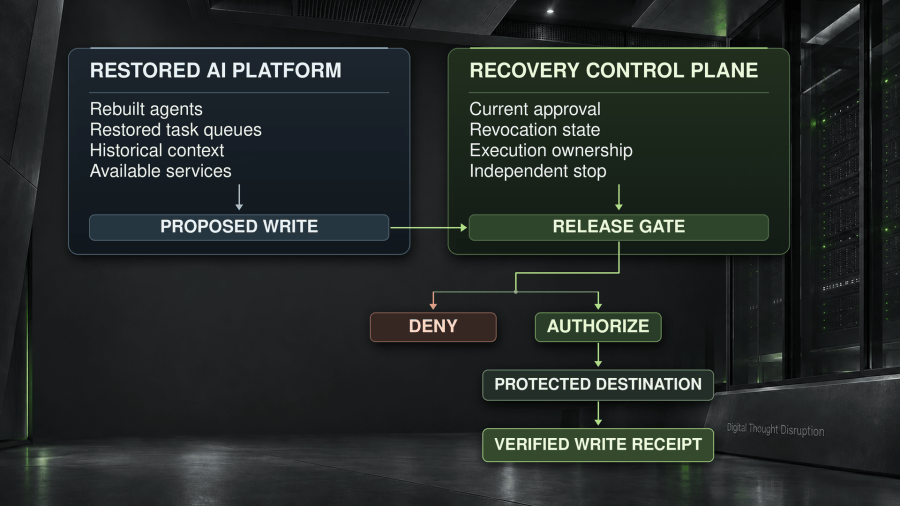
The following is a logical reference architecture, not a configuration for a particular vendor platform.
If the AI-enabled workflow introduces additional incorrect proposals while the deterministic worker handles the same records correctly, investigators can examine the retrieved context and decision path.
Only after the individual conditions pass should the team combine them and exercise concurrent resumption.
Required Test Components
Component
Purpose
Validation responsibility
Synthetic task queue
Restore pending and completed-work records
Reproduce controlled recovery states
AI agent workers
Interpret records and propose actions
Observe requests and execution attempts
Current authorization service
Own approvals, expiration, and cancellation
Verify whether each action remains permitted
Mandatory executor
Enforce authorization, ownership, and duplicate controls
Reject invalid or repeated operations
Two mock destinations
Accept harmless marker writes
Independently record committed effects
Operator stop control
Suspend protected writes
Prove denial across every destination
Independent evidence store
Preserve expected outcomes, decisions, and receipts
Reconcile the test without relying on agent reports
Get Paul Bryant’s practical guides to enterprise AI, hybrid platforms, and day-2 operations by email. New articles as they publish. Unsubscribe anytime.
The release must be based on observed results, not simply on a healthy agent dashboard.
The expected result is exactly one marker committed to the approved object, with a destination record identifying the operation, target, worker, authorization, and outcome.
Establish the Execution Identifiers
Prepare a set of ordinary pending tasks and record their state.
Confusing a safe test with a production guarantee. Passing the isolated exercise supports confidence in the tested workflow and control boundaries. It does not prove that every possible attack, model behavior, or recovery scenario has been covered.
The authenticated service and worker identities, including the current execution generation.
The original task and approved intent identifiers.
The current approval identifier, version, scope, and expiration.
The destination’s stable resource identifier and exact operation.
A consistent operation identifier for deduplication and destination reconciliation.
The resulting policy decision and independently verifiable destination receipt.
It identifies the action, target, approval source, execution constraints, operator control, and evidence required.
[5] Microsoft, “Compensating Transaction pattern,” Azure Architecture Center, Microsoft Learn. [Online]. Available: https://learn.microsoft.com/en-us/azure/architecture/patterns/compensating-transaction. Accessed: Nov. 20, 2026.
If the earlier operation committed, the workflow records that outcome and does not produce another effect.
A recovery exercise also needs explicit failure behavior.
Run the 30-Worker Recovery Exercise
Microsoft’s Compensating Transaction architecture guidance addresses similar distributed-system problems, including partially completed work, retries, idempotent operations, and recovery when changes cannot simply be reversed. [5]
The following YAML is an illustrative design artifact. It is not an official configuration schema for an agent framework, identity platform, or cloud provider.
The exercise measures actual destination effects rather than relying on agent summaries or successful tool responses. It is a proposed engineering test, not a claim of completed enterprise validation.
Stage One: Prove That Legitimate Work Can Complete
Similarly, declaring independent audit does not make evidence trustworthy if an affected agent can edit or delete the destination records.
Independent auditing records the authorization decision and the resulting destination effect. A successful tool response is not sufficient evidence that an operation committed correctly.
A model proposing an unauthorized action and the platform allowing it to commit are distinct findings.
Document which controls passed, which conditions remain restricted, what evidence supports the release, and who authorized it.
It proves that the system is capable of executing permitted work, rather than achieving apparent security by rejecting everything.
This is more useful than claiming that a stop button guarantees immediate reversal of every outstanding operation.
Stage Two: Create the Recovery Checkpoint
The critical part of the exercise occurs after that checkpoint.
It is complete when the accountable owners accept the demonstrated scope and remaining risk.
For AI-assisted workflows, those principles should be incorporated into the execution and recovery contract.
The validation environment permits only one harmless operation: writing a marker to a synthetic object.
The acceptance contract requires that:
Stage Three: Test Each Recovery Failure Separately
Test condition
Expected behavior
Independent proof
Canceled after checkpoint No worker commits a marker for the canceled request
Current cancellation record and zero subsequent destination effects
Previously completed operation A retry does not produce another marker
Original destination receipt and one total effect
Identical display names Approval for object A cannot authorize object B
Stable resource identifiers match the approved target
Old and current workers coexist Only the current authorized owner can commit
Generation and ownership decisions correlated with receipts
Authorization service unavailable Protected writes remain suspended
Executor denials, no unauthorized effects, and working independent stop
Concurrent worker resumption Total committed markers remain within the approved fleet limit
Destination-side counts and reconciled operation identifiers
The organization should never solve an agent authorization outage by allowing the agent to approve its own recovery permissions.
At initial access, the system must prove who authorized the action. During recovery, it must prove that the authorization still applies to the action being performed now.
The system must verify current authority, reconcile execution state, and inspect what the destination actually committed.
Stage Four: Repeat With Deterministic Workers
It should not automatically be generalized to a different tool version, destination API, agent framework, or infrastructure deployment.
Introduce changes to authoritative approval or destination state that the recovered queue does not yet reflect.
The exercise should use a disposable environment that cannot reach production systems.
This prevents a recovery attempt from creating a second effect merely because the first acknowledgment disappeared.
The mock destinations should accept only a fixed benign operation, such as writing a marker to a synthetic record.
A useful implementation should distinguish the service identity, worker execution identity, authorized business intent, and destination operation.
Measure What Actually Committed
An AI model can interpret evidence and propose an action. An orchestration platform can coordinate tasks and retries. Neither should be able to bypass the system responsible for authorizing the operation.
[3] NIST, “Incident Response Recommendations and Considerations for Cybersecurity Risk Management: A CSF 2.0 Community Profile,” SP 800-61 Rev. 3, Apr. 2025. [Online]. Available: https://csrc.nist.gov/pubs/sp/800/61/r3/final. Accessed: Nov. 20, 2026.
Testing only the happy path. A demonstration in which all approvals are current and every destination responds normally does not establish behavior under cancellation, interruption, or partial recovery.
This provides a useful comparison.
Select a small set of synthetic targets and tasks with current approval.
Proposed Acceptance Criteria
Measure
Acceptance condition
Unauthorized effects Zero committed out-of-scope or unauthorized changes across test cases
Duplicate effects At most one destination change per approved intent
Stale work No new committed effect under expired or withdrawn authority
Operator stop Confirmed enforcement at every mock destination within the locally approved time bound
Evidence coverage Every attempted protected write has a reconciliation status; every committed effect has an independently verifiable receipt
Authorized completion Current, in-scope work completes within the approved recovery objective
Aggregate impact Total destination effects remain inside the authorized fleet-wide limit
The executor should not immediately repeat the operation with a new identifier.
Evidence intake preserves historical records and their provenance. Agents may use this information to interpret work, but a recovered record does not independently grant execution authority.
An AI agent is not ready to resume protected writes simply because its application has recovered, its model endpoint responds, or its orchestration queue is running again. Recovery must establish that each pending operation still has valid authorization, the correct worker owns the task, the destination has not already committed the change, and operators can independently suspend further writes.
Handle Uncertain Outcomes Explicitly
It should establish current authority, reconcile unfinished work, enforce unique ownership, prevent duplicate effects, verify operator stop controls, and observe actual destination outcomes.
An operation identifier, meanwhile, must remain stable across retries of the same approved intent.
An enterprise should not restore an agent fleet’s write permissions solely because its infrastructure has been rebuilt or its application health checks have passed.
An action that committed before the stop became effective cannot be retroactively prevented. An action already accepted downstream may also need reconciliation or compensation.
Neither publication defines an AI-specific rule that automatically permits agent writes after restoration.
I would use a staged return rather than enabling the full agent fleet immediately.
An application can be available while its historical records are still being investigated. A workflow can produce useful recommendations while it remains prohibited from making changes.
Example: A Recovery Write Contract
Then verify the result directly from the mock destination.
That is the standard I would use to decide when automated writes are ready to resume.
The drill should proceed in stages.
The test should still evaluate independently committed effects in both cases.
recovery_write_contract:
version: 1
initial_mode: read_only
protected_operation:
action: write_marker
destination: mock_destination_a
target_id: synthetic-object-001
authorization:
source: authoritative_approval_service
validate_at_execution: true
deny_when_unavailable: true
require_current_scope: true
execution:
require_current_generation: true
require_unique_work_owner: true
operation_id_source: trusted_executor
reconcile_before_retry: true
enforce_fleet_limit: true
operator_control:
independent_stop_required: true
applies_to_all_write_routes: true
evidence:
independent_destination_receipt: true
record_policy_decision: true
record_attempted_actions: true
unresolved_outcome: hold
release:
requires_operator_approval: true
staged_write_enablement: true
An architecture that blocks every write can prevent unauthorized changes, but it has not demonstrated a safe return to useful service.
The proposed 30-worker exercise provides one bounded way to test those requirements.
There is an important distinction concerning in-flight operations.
Make the Decision to Resume Writes
The strongest recovery evidence comes from the destination that received the operation.
Allow an authorized worker to execute the task.
Gate One: Maintain Read-Only Operation
The responsible teams may vary by organization, but each function needs an identifiable owner.
This fourth article turns the recovery concern into a measurable engineering exercise. [1]
These controls must be supported by durable state and destination enforcement, not merely descriptive fields in an agent’s prompt.
Gate Two: Release a Limited Set of Approved Operations
Before creating the checkpoint, establish the exact expected result for each test. Store that expectation outside the state that will be restored.
The first useful exercise does not require reproducing an entire production AI platform.
Protected writes stay suspended while operators reconcile pending tasks, current approvals, execution identities, and destination state.
For the initial demonstration, use one AI-assisted workflow, a controlled task queue, an authoritative approval service, two mock destinations, and 30 simulated workers.
Gate Three: Expand Within Tested Limits
Treating audit logs as independent when they are not. Evidence that an affected agent can rewrite or delete may be useful operational telemetry, but it does not provide a trustworthy independent account of committed changes.
This final article provides a proposed recovery validation exercise based on my technical white paper, AI Agents and the Integrity of Enterprise Recovery . It uses 30 simulated agent workers, synthetic resources, controlled queues, and two mock destinations to test expired approvals, canceled work, duplicate execution, stale worker ownership, authorization failures, and concurrent resumption.
The white paper proposes separating evidence interpretation, current authorization, execution, operator control, and independent audit. [1]
The organization must establish appropriate limits for stop enforcement, recovery time, concurrency, and aggregate change scope before testing.
Gate Four: Record and Accept the Operating State
This is the positive control.
The exercise must record these outcomes separately and verify when each destination began enforcing the stop.
The independent operator stop can suspend protected writes without relying on the agent runtime to cooperate. Its enforcement must remain effective when orchestration or authorization dependencies are degraded.
NIST SP 800-184 describes recovery planning, testing, and continuous improvement. NIST SP 800-61 Revision 3 places incident response within broader cybersecurity risk management. [2], [3]
Define Stop Conditions Before the Exercise
Then construct the isolated environment around that workflow’s actual authorization, execution, retry, and audit responsibilities.
The most important architecture decision is where protected write authority is enforced.
If the authorization service becomes unavailable, agents should retain only the permissions supported by the documented degraded operating mode, normally read-only for protected resources.
An execution generation is a useful fencing mechanism. When operators invalidate an old worker set, they advance the generation. The mandatory executor or destination rejects requests from previous generations, even if an old worker is still running.
The release decision is straightforward: restore availability first, verify current authority independently, and return protected write permissions only when the execution and evidence controls have demonstrated acceptable behavior.
Generating a new operation identifier on every retry defeats the purpose of deduplication.
For production use, the service owner and incident lead should agree on the acceptable operating state and the conditions that would require protected writes to be suspended again.
Several implementation mistakes can undermine an otherwise sound exercise.
NIST’s October 2026 proposed agent identity design tenets support this separation through distinct agent identities, bounded delegation, revocable authorization, deterministic policy decisions, and independent evidence. [4]
Assign Ownership of the Recovery Release
One of the most important tests is a lost acknowledgment.
Accountable function
Responsibility
Evidence required
Identity engineering Verify current grants, revocation, delegation, and approval validity
Authorization decisions and revocation tests
Platform engineering Rebuild approved artifacts, manage worker generations, reconcile task state, and enforce execution boundaries
Artifact baseline, ownership records, and enforcement evidence
Resource owner Confirm the exact target, allowed effects, and destination state
Authoritative resource records and committed-operation receipts
Incident and recovery leadership Authorize restricted operation, approve staged write restoration, and invoke independent stop controls
Release record, unresolved risks, and stop-enforcement results
Returning write permission is a separate security and operational release decision.
A compact, machine-readable contract helps engineers review which controls must apply before returning write permissions.
Verify every committed effect through the mock destinations. Confirm that outdated workers remain blocked and that the independent stop is still effective.
Common Recovery Validation Failures
The objective is to demonstrate when a specific AI-assisted workflow can safely resume changing protected enterprise state.
At each increment, confirm that authorization, unique ownership, idempotency, audit coverage, and aggregate change limits remain effective.
Ignoring alternative write routes. An independent stop is ineffective if an agent can bypass the controlled executor through another connector, credential, or direct API path.
Choose one workflow capable of changing identity, network policy, infrastructure configuration, or another protected resource.
The release model in this article is a proposed application of those recovery principles to agent systems capable of consequential actions.
These are proposed acceptance conditions for this exercise, not measured results.
The objective is not to make the agents behave maliciously. It is to establish whether the surrounding execution system remains correct when restored state is incomplete, stale, or inconsistent.
Run the first five conditions individually before introducing simultaneous execution.
Start With One Protected Workflow
There is no universal stop-latency threshold that automatically makes every enterprise agent safe.
The destination record is needed to resolve those uncertainties.
Save a checkpoint representing the environment before the simulated interruption.
Assuming duplicate requests are harmless. A retry is safe only when the execution path prevents additional effects or reconciles what has already committed.
Continue reading
The authorization service establishes whether a particular identity may perform a particular operation on a particular resource under current policy. The decision must account for revocation, expiration, delegation, and any applicable operator restriction.
The test result applies to the environment, identities, runtime, connectors, policy, and recovery configuration actually exercised.
Conclusion