Designing Private Cloud SLOs in VCF Operations: Fleet Observability Without Dashboard Sprawl
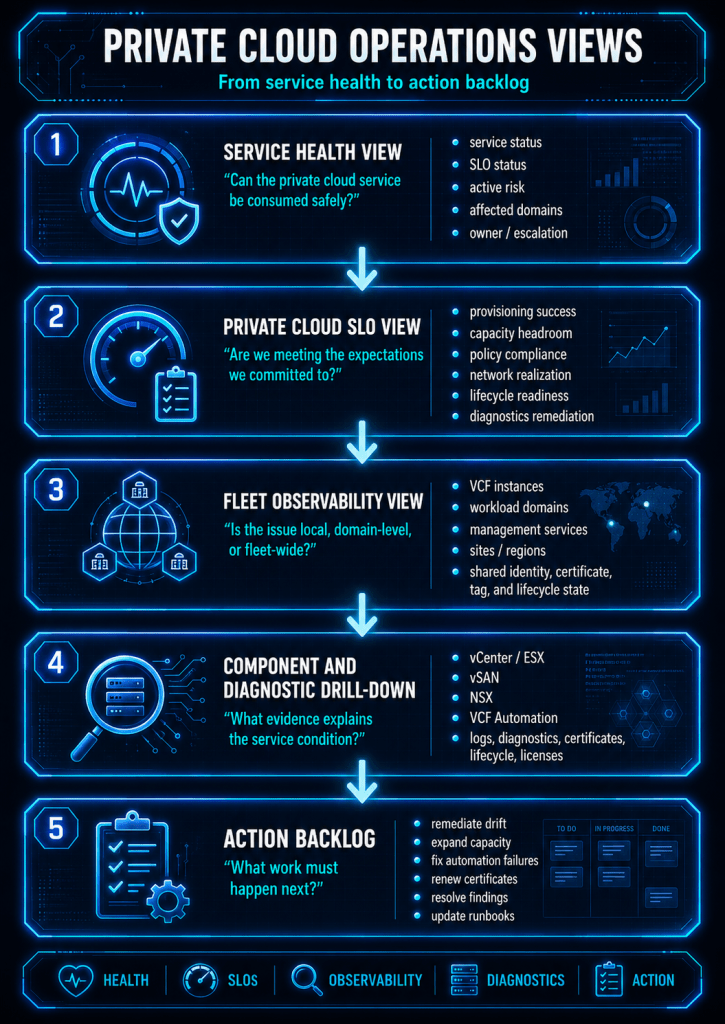
The first step in modernizing VCF Operations dashboards is changing the entry point from tools to services.
It should show:
VCF Operations gives platform teams an opportunity to connect fleet observability, diagnostics, capacity, lifecycle, tags, and component health into a service-oriented operating model. The dashboard strategy should reflect that.
It should show:
An SLO is only useful if the underlying indicator is meaningful.
The better approach is to define a small set of service-specific SLIs, observe real behavior, and tune the SLOs after the team understands the baseline.
TL;DR
This is more important than the visual layout.
A beautiful dashboard with no contract will eventually become noise. A plain dashboard with a strong contract can drive real operational behavior.
If the dashboard does not pass this checklist, it may still be useful. It just is not ready to become a service health or SLO dashboard.
That is where SLO design starts.
Start with the Service, Not the Metric
Do not try to redesign every dashboard at once.
These are not universal targets. A lab environment, developer landing zone, production regulated workload domain, and management domain should not all share the same SLOs.
The values below are examples. They should be tuned to the environment, business criticality, operational maturity, and available telemetry.
For a VM provisioning service, useful first indicators might be:
Private Cloud Service
Consumer
Production VM landing zone
Application teams
Developer VM landing zone
Engineering teams
Management domain service
Platform operations
Regulated workload domain
Compliance-sensitive application teams
Edge connectivity service
Network and application teams
Backup-protected VM service
Business application owners
Automation catalog service
Self-service consumers
The mistake is forcing one reliability target across every service.
Start with one important private cloud service.
That does not mean every finding becomes an incident. It means findings should be evaluated through the service model.
Can workloads be provisioned?
Is there enough placement headroom?
Are storage policies compliant?
Are network policies realized?
Are required tags present?
Are certificates, identity, and lifecycle state inside the operating window?
Are there active diagnostics findings that threaten the service?
Is there an owner for every remediation item?
Many infrastructure dashboards start with available metrics.
The VCF Operations Observability Stack
The dashboard should influence what the team does next.