The Re-entry Test: Verifying Cyber Eradication After Containment
TL;DR
A proposed 30-day assurance plan can help organizations organize that work.
No one owns the residual risk. Security completes its investigation while platform, application, and supplier owners assume another team is responsible for remaining restrictions.
Delayed Activity Does Not Require a Scheduled Attack Date
This article develops an evidence-driven post-incident assurance process using a proposed 30-day operating cycle.
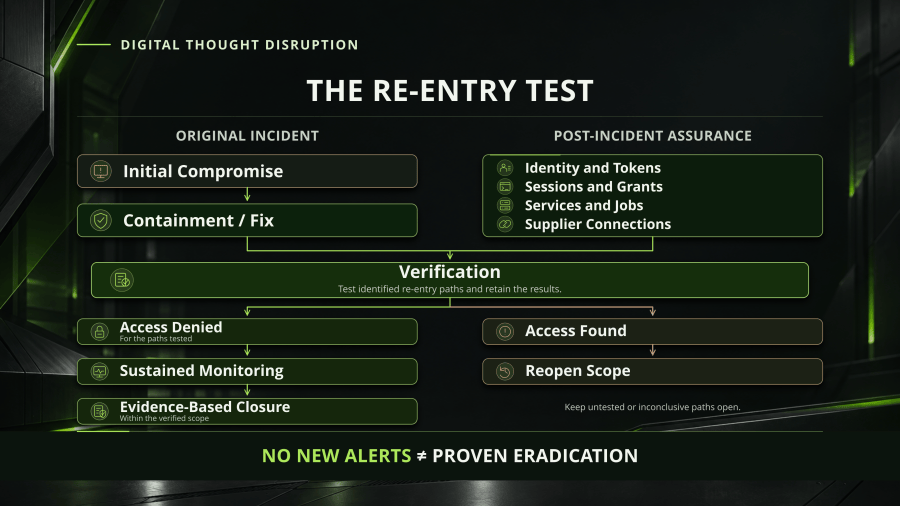
Post-incident assurance asks whether those actions produced the intended security state and whether that state remains intact as the environment returns to normal operation.
Recovery plans should continue to validate trusted administrative access and required business-service restoration.
Security operations monitors relevant authentication and resource activity through the defined observation period.
Consider a hypothetical enterprise that uses a multitenant backup application to protect Microsoft 365 data.
A persistent mechanism may be waiting for an execution condition.
It extends the AI cyberattack series from response and recovery into the evidence needed for sustained operational assurance.
Build the Re-entry Hypothesis Before Starting the Watch
That is the foundation for post-incident assurance.
This is the difference between a generic watch period and an engineering assurance process.
The absence of alerts is not treated as equivalent to verified observation unless the relevant collection and detection paths were operating.
The end of enhanced monitoring should not mean that the organization stops looking for the original failure mode.
The enterprise restricts the affected tenant-local integration, investigates service-principal activity, and later authorizes a replacement application.
A security incident may be contained, technically remediated, operationally recovered, or administratively closed.
This calendar identifies operational changes that can make previously inactive access usable again.
This division is important.
The Re-entry Hypothesis Contract
For example, not every new service account is suspicious. A new service account created outside the approved provisioning path, with high-privilege permissions related to the original compromise, requires attention.
Field
Question it answers
Prior compromise
What unauthorized activity was actually established?
Residual-access hypothesis
What other authority or execution could remain?
Affected boundary
Which identity, application, endpoint, management system, or supplier relationship is involved?
Activation condition
What event could cause the mechanism to execute or become usable?
Intended restriction
What should no longer be possible?
Verification method
How can the restriction be tested without causing harm?
Observation source
Which independent records should show use or attempted use?
Coverage gap
What cannot be observed or tested with the available tooling?
Accountable owner
Who investigates an exception and approves the result?
Reopen condition
What finding would require renewed containment or investigation?
The team should distinguish the expected policy denial from unrelated technical errors.
Supplier integrations, automation, remote management, and recovery services are operating with accepted authority.
An incident owner must evaluate the evidence and decide whether the defined acceptance conditions have been met.
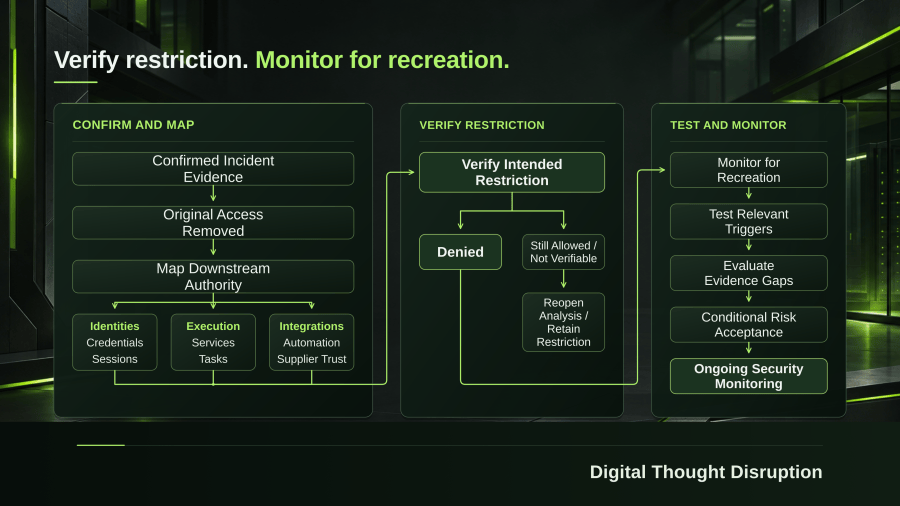
The Re-entry Verification Chain
It begins with a bounded hypothesis for each access path.
Researchers recovered one sample programmed to wait until a hard-coded future date, months later, before communicating with its command-and-control infrastructure.
Examples include an administrator account reappearing, a deleted application credential being replaced, an unauthorized remote-support client registering again, a stopped service restarting unexpectedly, or a removed network-policy exception returning after a configuration deployment.
CISA’s federal incident-response playbook explicitly warns that attackers may maintain multiple persistence mechanisms and return through areas thought to be clean. It recommends continued detection and analysis after eradication, with renewed containment and investigation if adversary activity reappears. See CISA’s eradication and re-entry guidance.
Across these platforms, the verification must distinguish:
The problem is not unique to remote-management software.
One clean scan becomes a universal clearance. The scan may not cover identity grants, supplier systems, unsupported appliances, or future-triggered execution.
The application owner therefore needs to establish whether the relying application ends its own session, synchronizes account disablement, or has a separate deprovisioning procedure.
Many persistence mechanisms are event-triggered instead.
The original indicator list defines the entire investigation. An attacker using new infrastructure or another credential may not trigger any of the original indicator rules.
The frequency of these controls should be determined by criticality, the execution and change patterns of the systems involved, and the consequences of an undetected recurrence.
Extend Assurance Beyond the Observation Period
It does not.
It establishes that one defined class of relevant activity is observable.
A new successful backup does not prove the previous integration has been fully restricted.
Use approved changes, independently retained records, and trusted configuration sources to establish the intended current state.
The assurance record should identify who receives an exception and who can authorize containment.
The technical work that removes the initial compromise and the operational work that verifies the resulting environment should therefore have separate acceptance criteria. See NIST’s incident-response risk-management guidance.
The normal security operations process has accepted the remaining detections, exceptions, and escalation triggers.
The identity owner verifies authorized application and permission state.
The 30-day duration is a planning example, not a universal technical or regulatory requirement. High-consequence incidents, incomplete evidence, long-dormant mechanisms, and contractual obligations may justify a longer or different observation model.
The supplier reports compromised application credentials.
Conclusion
The post-incident assurance question is whether unauthorized access can continue or be recreated.
Developer-platform engineering may own repository hooks and pipeline execution.
Monitoring coverage, retention, detection tests, and material gaps are recorded.
Mandiant’s BRICKSTORM finding demonstrates a particularly important edge case.
Those conditions require specific deferred tests or longer-term controls. They should not be marked safe merely because the scheduled observation period ended.
Consider a hypothetical managed service provider that investigates unauthorized access through a trusted remote-management platform.
The response should establish the cause.
Microsoft’s service-principal sign-in logs provide relevant evidence, while application audit logs record permissions and credential changes. See the service-principal sign-in documentation and application security-operations guidance.
A management appliance may contain a backdoor that has not yet begun communicating.
If responders recorded a compromised configuration as the baseline, later monitoring may incorrectly treat that configuration as normal.
An automation platform may re-create an unauthorized account from a modified configuration repository.
External References
Exporting logs to a supported destination can extend retention, subject to the destination’s configured policies.
Cyberattack Tracker 2026: Confirmed Incidents, Attribution, and Connections
Track documented cyber incidents through November 18, 2026, separating confirmed exploitation, attempted access, AI involvement, attribution, and shared defensive patterns.
Read the article →
New access created during the original compromise has been investigated.
Make your next architecture decision with confidence.
These failures are operational, not merely technical.