The VCF AI Sovereignty Citadel: Building a Governed Private AI Boundary on VMware Cloud Foundation 9.1
Start by defining which jurisdictions, facilities, service providers, support organizations, and administrators are permitted. Document where data may be processed, where backups may exist, who controls encryption keys, and how emergency access works.
Automate the Approved Pattern
A credible implementation should start with one bounded service and expand through repeatable patterns. Building a generic enterprise AI platform before selecting an anchor workload often produces impressive infrastructure with unclear ownership and no measurable outcome.
The inner keep is where approved models become usable enterprise services. Broadcom’s VCF 9.1 private AI direction includes model delivery and runtime capabilities, RAG-oriented data services, agent and tool integration, GPU-backed consumption patterns, and governance around Model Context Protocol connectivity.
Prove Auditability and Recovery
External connectivity should be treated as a controlled gate, not a convenience setting. Model downloads, package repositories, software updates, telemetry, support access, external APIs, and hosted AI services all need documented egress paths, inspection, ownership, and revocation procedures.
Govern establishes ownership, policy, risk tolerance, approval gates, exception handling, and evidence requirements. In the citadel model, this is where the organization defines who may approve models, data sources, tools, external connections, and production releases.
Operational Ownership Is Part of the Boundary
Observability still needs boundaries. Prompts, retrieved passages, model outputs, and tool payloads may contain sensitive information. Logging everything can create a second data-leakage path. The platform should define which fields are captured, which are redacted, who may search them, how long they are retained, and whether the logs themselves must remain in a sovereign zone.
The platform owner operates VCF, clusters, accelerators, namespaces, storage, networking, automation, and lifecycle.
The model owner approves model artifacts, runtime configuration, evaluation, promotion, rollback, and retirement.
The data owner approves knowledge sources, classifications, retention, lineage, and permitted use.
The security owner defines identity, segmentation, secrets, egress, tool access, logging, and incident controls.
The business owner accepts service risk, funds capacity, defines the outcome, and decides whether the AI service remains appropriate.
For architecture purposes, a sovereign AI boundary should be evaluated across six control domains:
Failure Modes That Turn a Citadel into Theater
Direct GPU assignment is selected without lifecycle analysis. Exclusive access may meet performance needs while reducing mobility and complicating maintenance and recovery. The performance decision must include an operations decision.
It is not automatically the best fit for every workload. Early experiments may move faster on a managed service. Globally elastic workloads may benefit from public cloud capacity. Organizations without mature platform operations may achieve stronger sovereignty through a qualified sovereign cloud provider rather than building and operating every control themselves.
The design objective should be deny-by-default connectivity with a small set of approved paths. A RAG service should reach only the model endpoint, approved knowledge sources, required identity services, logging, and explicitly permitted tools. Agentic workloads need even tighter controls because tool access can turn a text-generation system into an operational actor.
The VCF sovereignty model is a strong fit when the organization already operates VMware at scale, has sensitive or regulated data, needs predictable locality, wants consistent operations across virtual machines and Kubernetes, and can support the platform engineering and governance work required for production AI.
It is particularly compelling when data gravity makes external movement expensive or risky, when model or prompt intellectual property matters, when low-latency access to internal systems is important, or when the organization needs to prove infrastructure and administrative control.
Measure evaluates model quality, security, resilience, privacy, performance, bias, retrieval accuracy, tool behavior, and operational health. Infrastructure metrics are necessary, but they do not prove that the model is safe or useful.
The platform should not assume that every downloaded model is trusted or that every model registry is authoritative. An approved model process should capture source, license, checksum, version, security review, evaluation results, intended use, prohibited use, deployment owner, and rollback artifact. The same discipline should apply to embedding models, rerankers, guard models, agent frameworks, container images, and tool connectors.
These domains turn sovereignty from a slogan into a testable architecture requirement. They also expose why a single product cannot solve the entire problem. VCF can enforce and observe many infrastructure controls, but legal interpretation, data classification, model risk acceptance, business accountability, and regulatory evidence remain organizational responsibilities.
AI storage is not one data class. Model weights, training sets, retrieval indexes, source documents, prompt logs, inference outputs, application databases, scratch data, and backups have different performance, resilience, retention, and confidentiality requirements.
Where the VCF AI Citadel Fits
VCF Automation can expose approved catalog items and repeatable service patterns for AI workstations, GPU-backed Kubernetes clusters, inference services, networks, storage policies, and supporting dependencies. The important architectural move is to encode policy into the provisioning path. The requester should select an approved workload class, data classification, model profile, network pattern, and service level rather than assembling an unreviewed stack from individual components.
The following YAML is an illustrative design artifact, not a native VCF product schema. It shows the information a platform team should capture before a sovereign AI workload is accepted into production.
The decision should be based on measurable criteria: data sensitivity, jurisdiction, latency, scale, accelerator economics, integration needs, operational maturity, recovery requirements, and exit strategy. The goal is not to keep AI private at any cost. The goal is to place each workload where the organization can control its risk and operate it responsibly.
Conclusion
Compliance is confused with platform configuration. VCF can provide controls and evidence, but it cannot certify the organization’s process, interpret every regulation, or guarantee that an AI use case is lawful and appropriate.
For data, document ingestion, classification, transformation, indexing, retention, deletion, backup, and recovery. The original document repository, vector index, prompt logs, and generated outputs should not be treated as one uniform dataset.
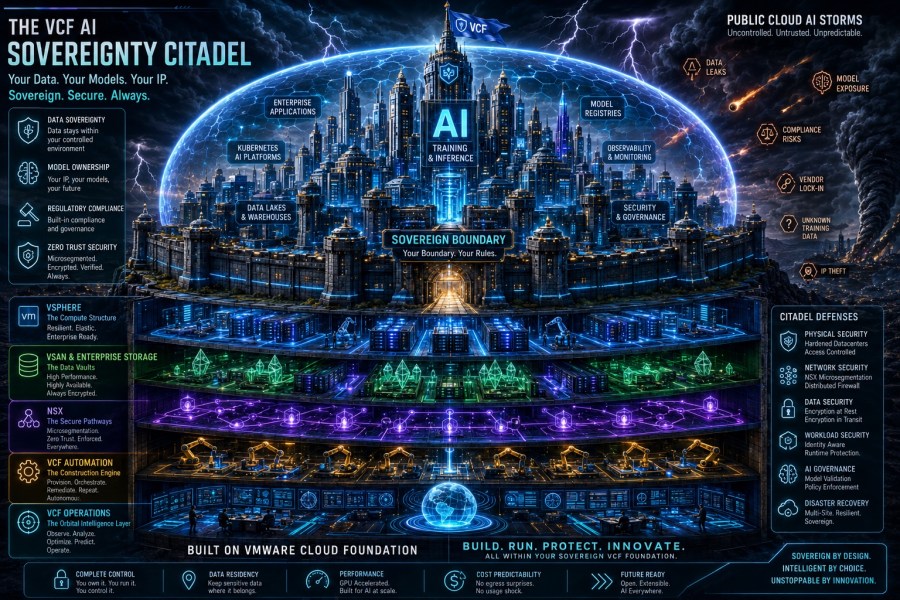
The diagram below shows the practical structure behind the image. The most important point is that the sovereign boundary surrounds the complete AI service, not only the GPU cluster or model endpoint.
The VCF AI Sovereignty Citadel is useful as a mental model because it shows that private AI needs more than GPUs and a model endpoint. The defensible boundary includes data, models, identities, networks, automation, observability, recovery, and accountable ownership.