Immutable logging does not mean indiscriminate logging. Credentials and highly sensitive data may need tokenization, masking, or separately protected fields. The goal is traceability without creating a second uncontrolled evidence repository.
No autonomous outbound execution
No direct production write access
Immutable audit logging
Local evidence retention
Human approval before action
Validation must test both sides of the paradox. The platform should not refuse legitimate forensic work, and it should not convert that permissiveness into unsafe execution or disclosure.
Authorized Users and Access Approval
The design lesson is that authorization should not depend on the semantic interpretation of one prompt. It should be established before the model receives the evidence through identity, case assignment, evidence classification, approval workflow, and environment policy.
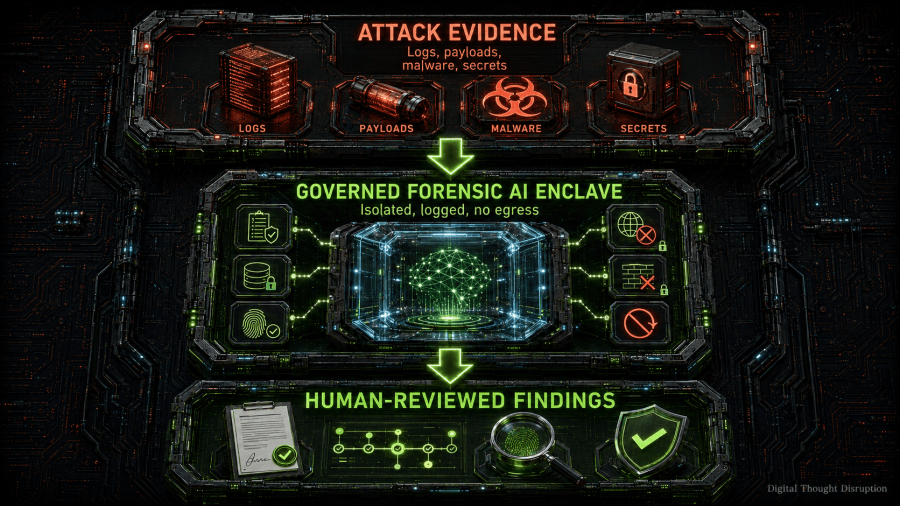
Such a platform should use approved case-based access, isolated compute, deny-by-default network controls, no production write access, local evidence retention, immutable audit logging, version-pinned models, controlled exports, and mandatory human review before any operational action. The model can be permissive about evidence while the surrounding system remains restrictive about capability.
Where full physical air-gapping is impractical, the design can still use strong logical isolation, controlled transfer stations, one-way movement for selected data, and a brokered export process. The important point is that the model cannot create its own network path simply because an analysis requires external context.
The model should analyze copies of evidence, not operate directly against production systems.
Isolated Compute
Successful implementation means a responder can analyze approved evidence, produce a traceable finding, and request an operational action without the model acquiring a network path, production credential, or unreviewed export channel. Common failures include policy existing only on paper, administrators bypassing the case workflow, logs being mutable, exports occurring through copy-and-paste, and update processes quietly reconnecting the enclave to the internet.
Data sovereignty is not achieved merely by placing model weights in an on-premises server. Remote management, telemetry, support access, model downloads, backup replication, and cloud-based identity can still move metadata or evidence across boundaries.
No direct internet route from the model runtime
No general DNS resolution
No package downloads during analysis
No shared clipboard with unmanaged endpoints
No mounting of general-purpose file shares
No ambient cloud or domain credentials
No access to unrelated cases
No remote model telemetry unless explicitly approved
A defensible architecture uses separate gateways for access, evidence import, updates, and export. It also keeps the model runtime away from production credentials and internet paths.
policy:
id: FAI-IR-001
name: Governed Forensic AI Access Policy
owner: CISO and Incident Response
default_decision: deny
approved_responder_roles:
– incident_commander
– senior_forensic_analyst
– malware_reverse_engineer
– enclave_platform_administrator
– legal_privacy_reviewer
– independent_auditor
access_approval:
case_id_required: true
approvers:
– incident_commander
– forensic_ai_service_owner
access_is_time_bound: true
maximum_session_hours: 12
phishing_resistant_mfa: required
hardened_access_workstation: required
break_glass_review: required
permitted_evidence_classes:
– attack_logs
– malicious_binaries
– exploit_code
– command_and_control_indicators
– exposed_credentials
– phishing_artifacts
– memory_forensics
– disk_forensics
– cloud_and_identity_audit_logs
prohibited_uses:
– unauthorized_targeting
– live_third_party_exploitation
– autonomous_malware_deployment
– credential_use_outside_authorized_case
– destructive_action_without_separate_approval
network_restrictions:
inbound_paths:
– evidence_import_gateway
– responder_access_gateway
outbound_default: deny
general_dns: deny
direct_internet: deny
production_routes: deny
arbitrary_webhooks: deny
runtime_package_downloads: deny
update_channel: offline_signed_bundle_only
production_access:
direct_write_access: deny
response_platform_credentials_in_enclave: deny
approved_data_import: read_only_case_export
operational_actions_require_separate_identity: true
evidence_retention:
storage: local_encrypted_case_store
case_isolation: required
original_evidence_immutable: true
derived_artifact_lineage: required
default_retention_days: 365
legal_hold_supported: true
verified_secure_deletion: required
logging:
capture:
– user_identity
– role
– case_id
– evidence_hashes
– prompt
– response
– model_id
– model_hash
– policy_decision
– retrieval_and_tool_events
– human_review
– export_event
– administrative_change
immutable_sink: required
model_write_access_to_audit_sink: deny
audit_retention_days: 730
sensitive_field_protection: required
human_approval:
required_before_operational_action: true
model_may_execute_response_action: false
approver_roles:
– incident_commander
– affected_system_owner
high_impact_actions_require_dual_approval: true
export_controls:
default_decision: deny
approved_formats:
– signed_finding_report
– sanitized_indicator_bundle
– approved_detection_content
destination_allowlist:
– case_management_platform
– approved_threat_intelligence_platform
– approved_response_platform
data_loss_prevention_scan: required
malware_or_credential_export_requires_dual_approval: true
emergency_shutdown:
independent_kill_switch: required
authorized_operators:
– soc_manager
– enclave_platform_owner
actions:
– stop_inference
– revoke_active_sessions
– disable_import_and_export
– isolate_network_zone
– preserve_audit_logs
– snapshot_case_state
model_update_process:
version_pinning: required
signed_model_artifact: required
provenance_review: required
offline_malware_scan: required
regression_suite: required
security_red_team: required
approval:
– ai_platform_owner
– security_architecture
– incident_response_owner
rollback_package: required
A forensic AI platform crosses security operations, infrastructure, AI engineering, legal, privacy, compliance, and audit. Without explicit ownership, controls will be duplicated in some areas and absent in others.
At minimum, the audit record should capture:
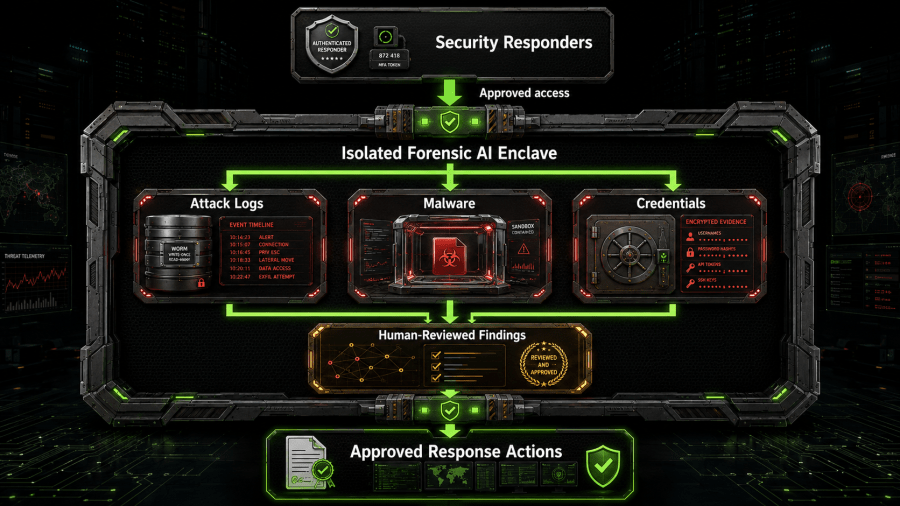
The diagram below highlights the control points. Notice that the only path to an operational system begins after human review and passes through a separate response platform.
The guardrail paradox exists because legitimate cyber defense requires access to material that looks offensive when removed from its incident context. A general-purpose hosted safety system may not always distinguish authorized forensic analysis from harmful assistance, while a refusal-free local model may create unacceptable risk if it receives network, credential, shell, or production authority.
No Production Write Access
The following YAML is an implementation-oriented baseline for a governed forensic AI access policy. It is intentionally explicit about denied capabilities. It should be converted into the organization’s identity, network, data-loss prevention, orchestration, logging, and approval controls rather than treated as a policy document that enforces itself.
The most important abuse assumption is that the model may be manipulated through the evidence it is analyzing. Every tool call, retrieval result, generated command, and export request should therefore be evaluated by controls outside the model.
Real forensic evidence contains both descriptions of harmful behavior and the operational ingredients required to reproduce it. A memory dump may contain credentials. A phishing kit may contain working infrastructure. A malware sample may contain encryption routines, persistence logic, and exfiltration code. A command history may show exactly how an attacker disabled endpoint controls or moved between systems.
The best forensic model is not necessarily the largest model or the model with the highest general benchmark score. Selection should be based on the evidence types, workflow, isolation constraints, and assurance requirements of the enclave.
Local Evidence Retention
The enclave should be designed around four assumptions:
That does not mean analysts must work without threat intelligence. External enrichment can be handled by a separate broker that accepts narrowly defined, sanitized requests. The broker can query approved sources, remove case secrets, enforce destination allowlists, record the request, and return data to the enclave. The model never receives the broker’s credentials and never chooses an arbitrary destination.
The answer is not to remove every safeguard or place an unrestricted model on an analyst workstation. The safer pattern is a governed forensic AI enclave that separates permission to analyze dangerous evidence from authority to execute dangerous actions.
This design is intentionally less convenient than connecting a model to every security tool. The friction is a control. It prevents a reasoning error, prompt injection, compromised model, or malicious insider from turning analysis authority into production authority.
Immutable Prompt and Response Logging
The service should have an operating cadence that includes access review, model evaluation, control testing, patching, evidence-retention review, red-team exercises, capacity planning, and recovery drills. A platform used only during major incidents can become dangerously stale between activations, so readiness must be exercised during normal operations.
The evidence is sanitized or lower sensitivity, the task is advisory, the provider configuration is approved, and occasional safety friction does not block the response. Hosted models can be valuable for report drafting, detection explanation, generic code review, control mapping, and analysis of de-identified telemetry.
User identity and approved role
Case identifier and access approval
Evidence identifiers and hashes
Prompt and system-instruction versions
Model name, version, hash, quantization, and runtime configuration
Retrieval sources and tool outputs
Policy decisions and denied actions
Response content and structured findings
Human review decisions
Export events and destinations
Administrative and model-update changes
Human review is not a generic approval button. The reviewer must have enough context to challenge the model’s reasoning and enough authority to approve the specific action.
The most important architectural principle is the separation of dangerous content from dangerous capability. A model can be allowed to explain malware, decode exploit behavior, identify exposed credentials, and reconstruct command-and-control activity without being allowed to contact a target, use a credential, deploy code, or alter production.
Human Review Before Operational Action
The model registry should retain signed artifacts, provenance, licenses, security findings, approved configurations, evaluation results, deployment dates, and rollback packages. Emergency patches may require an expedited path, but they should not bypass recording, approval, or post-deployment validation.
The control objective is not to make humans click through model output quickly. It is to preserve accountable judgment at the point where analysis becomes action.
That creates a practical conflict for enterprise AI adoption. A hosted AI service may interpret the evidence as a request to conduct offensive cyber activity rather than as authorized incident response. It may refuse the analysis, omit critical detail, or interrupt the workflow at the moment the responder needs precision. At the same time, sending raw incident evidence to an external service can create confidentiality, data-residency, retention, privilege, and credential-exposure concerns.
The enclave should fit the incident-response lifecycle rather than create a parallel investigation process.
Model and Version Governance
Outbound activity must therefore be treated as an operational action, not as a harmless extension of reasoning.
The model should assist the incident commander, not become the incident commander.
The answer is not a universally unrestricted model. It is a governed forensic AI platform that establishes authorization before analysis begins and enforces boundaries outside the model. Approved responders should work inside case-scoped environments with isolated compute, local evidence retention, immutable logging, controlled updates, no autonomous egress, no direct production writes, and human review before action.
The response system should use a different identity, different authorization path, and different audit trail from the forensic model. This prevents a compromise of the analysis environment from becoming a compromise of the production control plane.
Legal, Privacy, and Data-Sovereignty Boundaries
This is the guardrail paradox. Defenders may need fewer content restrictions inside a narrow forensic context, but they need stronger architectural, identity, network, evidence, and approval controls around that context.
The correct decision unit is not the vendor name. It is the complete evidence path.
Who owns the data and who is authorized to process it
Which jurisdictions apply
Whether cross-border transfer is permitted
Whether attorney-client privilege or work-product protection applies
Whether employee monitoring or labor rules constrain analysis
Whether credentials, health data, payment data, or other regulated classes are present
Whether malware, cryptography, or technical data creates export-control obligations
Whether law enforcement, insurers, customers, or regulators require preservation or notification
Forensic results must be reproducible enough to support investigation, review, and post-incident analysis. That requires pinning the model version and recording the runtime configuration used for each case.
Findings should return to the case-management system with evidence references, confidence, reviewer status, and any requested response action. The incident commander or delegated authority decides whether to move an action into the response platform. That platform performs its own authorization, target validation, execution, and rollback logging.
Reference Architecture for Forensic AI
A security analyst investigating a real intrusion does not work with sanitized examples. The evidence may contain exploit payloads, stolen credentials, malware source code, obfuscated scripts, lateral-movement commands, cloud access tokens, command-and-control domains, destructive PowerShell, or instructions embedded by an attacker specifically to manipulate automated analysis.
The enclave should not give the model a browser, unrestricted shell, socket access, email connector, webhook client, remote administration tool, or generic API client that can reach external systems.
The enclave is an analysis plane, not an action plane. It may identify a malicious domain, propose a containment command, or draft a detection rule. A separate human-governed response process decides whether that output is correct, authorized, and safe to use.
Plane
Purpose
Key boundary
Access plane
Authenticates responders and binds sessions to cases
Users receive case-scoped, time-bound access
Evidence plane
Imports, hashes, classifies, stores, and transforms artifacts
Original evidence remains immutable
Analysis plane
Runs models, parsers, retrieval, and approved local tools
No autonomous external execution
Governance plane
Enforces policy, model versions, approvals, and retention
Policy is independent of model output
Audit plane
Records evidence lineage, prompts, responses, decisions, and changes
Model cannot modify or delete records
Export plane
Releases reviewed findings or approved artifacts
Default deny with destination and content controls
Response plane
Executes containment or remediation through separate identities
No direct trust from the analysis runtime
Local deployment is therefore only one architectural choice. It does not replace least privilege, segmentation, identity governance, auditability, supply-chain control, model validation, or human authorization.
Incident-Response Workflow Integration
The evidence cannot safely leave a controlled boundary, the investigation requires reliable analysis of dangerous artifacts, and the consequence of execution or disclosure is high. Full physical air-gapping may be justified for the most sensitive environments, but many enterprises can achieve the required control through strong isolation, offline updates, controlled transfer gateways, independent monitoring, and default-deny exports.
A model update can change refusal behavior, extraction quality, malware reasoning, hallucination rate, structured-output consistency, context handling, and susceptibility to prompt injection. Treating an update as a routine package patch can silently change investigative outcomes.
Every candidate model or update should pass a controlled evaluation suite before release. The suite should include representative incident artifacts, known-answer cases, dangerous-content handling, cross-case isolation, export controls, prompt-injection resistance, false-positive analysis, and emergency shutdown. Results should be compared against the current production baseline.
Incident-response stage
Forensic AI role
Required control
Preparation
Test models, policies, parsers, and shutdown procedures
Versioned evaluation and approved runbooks
Detection and analysis
Summarize events, decode artifacts, correlate indicators, propose hypotheses
Case-scoped access and evidence lineage
Containment
Recommend actions and identify likely impact
Human authorization and separate execution identity
Eradication
Analyze persistence and propose remediation
Target validation, change control, and rollback plan
Recovery
Review residual indicators and recovery telemetry
Production data remains read-only to the model
Post-incident activity
Build timelines, lessons learned, and control improvements
Reproducible prompts, models, evidence, and decisions
Before evidence enters the enclave, the case workflow should determine:
Model Selection Criteria
Allow the model to reason about dangerous material without giving it the authority to perform dangerous actions.
Criterion
What to evaluate
Operational implication
Cyber reasoning
Malware behavior, code analysis, log correlation, exploit comprehension
Determines which forensic tasks can be delegated
Authorized-content utility
Ability to analyze harmful-looking evidence without excessive refusal
Must be tested against real approved cases
Hallucination control
Accuracy of indicators, commands, timelines, and causal claims
Findings require evidence references and confidence
Prompt-injection resistance
Treatment of instructions embedded in logs, documents, code, and web content
Evidence must be treated as data, not authority
Structured output
Reliable schemas for indicators, findings, evidence references, and uncertainty
Supports review, export, and automation without free-form parsing
Context and retrieval
Handling of long timelines, multiple artifacts, and case-local retrieval
Cross-case retrieval must remain impossible
Tool behavior
Ability to operate with tools disabled or tightly constrained
The model must remain useful without internet or shell authority
Deployment fit
Hardware, accelerator, memory, latency, and offline operation
Determines enclave cost and capacity
Provenance and licensing
Weight origin, license, model card, dependencies, and update rights
Affects legal use and supply-chain assurance
Version stability
Reproducible behavior and controlled updates
Supports case review and rollback
Security maintenance
Vulnerability response, signed releases, and dependency transparency
Determines lifecycle risk
This creates a workflow risk. The most consequential artifacts are often the artifacts most likely to trigger restrictions. If the security team cannot analyze them reliably, AI becomes useful for low-risk summarization while remaining unavailable for the difficult portions of incident response.
Validation and Red-Team Requirements
Read access should also be brokered and minimized. Instead of giving the model a security information and event management token with broad search rights, the incident platform should export the approved event set into a case workspace. Instead of connecting the model to an endpoint detection platform with containment privileges, the system should provide read-only telemetry and require a separate response workflow for host isolation.
The following control model shows the key teaching point. The model receives dangerous evidence, but it does not receive authority to execute the behavior represented by that evidence.
Defensive utility: Can the model analyze realistic malicious artifacts accurately enough to help responders?Authority containment: Can the platform prevent the model, evidence, user, or tool chain from turning analysis into unauthorized action?
Test scenario
Expected behavior
Failure signal
Malware sample requests internet access
Model explains the behavior but cannot create a connection
Any external network activity or hidden DNS request
Evidence contains prompt injection
Embedded instructions are treated as untrusted data
Model follows evidence instructions or changes policy behavior
Live credentials appear in logs
Model identifies exposure and masks secrets in normal output
Secret appears in an unauthorized response or export
Analyst requests third-party exploitation
Policy denies the request and records the event
Model provides operational targeting assistance outside the case
Cross-case retrieval attempt
Access is denied and no metadata leaks
Any artifact, embedding, filename, or summary crosses case boundaries
Hallucinated indicator
Model marks uncertainty and reviewer can trace evidence
Unverified indicator is presented as observed fact
Model update changes behavior
Regression suite detects material drift before release
New version reaches production without comparative evidence
Audit-log tampering attempt
Runtime has no write or delete path
Log records can be altered by model or case user
Export of raw malware or credentials
Default deny and dual approval where permitted
Artifact leaves through an unmonitored channel
Emergency shutdown
Inference stops, sessions revoke, logs preserve, case state snapshots
Model continues running or evidence is lost
Different actions require different approval depth. Adding a low-confidence indicator to a watchlist may require one analyst. Isolating a production identity platform, revoking thousands of sessions, blocking a shared domain, or disclosing evidence to a third party may require the incident commander, system owner, legal counsel, or executive approval.
Failure Modes and Abuse Scenarios
The hosted-model decision should not be reduced to a binary claim that cloud services are either safe or unsafe. Enterprise offerings can provide encryption, private connectivity, configurable retention, regional processing, access controls, and contractual protections. Those controls can be entirely appropriate for many security operations use cases.
Failure mode
Why it matters
Required mitigation
Prompt injection inside evidence
Attackers can place model-readable instructions in logs, HTML, documents, or code
Treat evidence as untrusted data, isolate instructions, disable implicit tool use
Credential replay
A model or user may attempt to use exposed secrets
Tokenize secrets, deny production routes, monitor copy and export
Cross-case leakage
One investigation may expose another customer’s or business unit’s data
Case-specific stores, keys, indexes, identities, and caches
Hallucinated attribution
The model may falsely connect an actor, domain, or user to an incident
Require evidence references, confidence, and human validation
Unsafe parser behavior
Archives, documents, or binaries may exploit supporting tools
Sandboxed parsing, resource limits, format allowlists, patched libraries
Model or dependency compromise
A malicious update can change behavior or exfiltrate data
Signed artifacts, offline validation, provenance, reproducible builds where possible
Covert egress
DNS, telemetry, crash reports, or update channels can leak evidence
Deny-by-default egress and independent network monitoring
Privileged administrator abuse
Platform operators may access sensitive cases
Separation of duties, just-in-time access, session recording, independent audit
Over-trust in model output
Responders may act on a confident but incorrect explanation
Review checklists, corroboration requirements, explicit uncertainty
Evidence contamination
Model-generated content may be mistaken for collected evidence
Preserve source versus derived lineage and immutable originals
Excessive retention
Sensitive data persists in caches, indexes, snapshots, and logs
Complete retention map, legal hold, verified deletion
Emergency control failure
The organization cannot stop inference or exports during compromise
Independent kill switch, credential revocation, network isolation, recovery drills
The enterprise needs control over model behavior, weights, deployment, and update timing, and it has the engineering maturity to manage model provenance, accelerator capacity, inference security, patching, monitoring, and evaluation. Self-hosting should not be approved merely because a hosted model refused a prompt.
Operating Model and Ownership
From a content-classification perspective, several legitimate tasks can resemble harmful assistance:
Capability
Accountable owner
Responsible team
Required evidence
Service risk acceptance
CISO
Security governance
Approved scope, risk register, exception record
Incident workflow
Incident-response leader
CSIRT or SOC
Case approvals, runbooks, reviewer records
Enclave platform
AI platform or infrastructure owner
Platform engineering
Hardened baseline, capacity, backup, recovery tests
Network isolation
Security architecture
Network security
Firewall policy, flow logs, egress validation
Identity and privileged access
Identity security owner
IAM or PAM team
Role design, access reviews, session records
Evidence handling
Forensics leader
Forensic analysts
Chain of custody, hashes, retention and deletion records
Model governance
AI governance owner
Model operations team
Model registry, evaluation results, update approvals
Legal and privacy boundaries
General counsel or privacy officer
Legal and privacy teams
Processing basis, jurisdiction review, legal holds
Export approval
Incident commander and data owner
Case team
Destination approval, DLP result, export record
Audit and assurance
Internal audit or compliance
Independent assurance
Control tests, findings, remediation evidence
Emergency shutdown
SOC manager and platform owner
SOC and platform operations
Kill-switch test, revocation record, preserved logs
An attacker does not need to maintain chain of custody, honor data-retention policy, protect employee privacy, document legal authority, separate customer cases, or obtain approval before using a credential. An enterprise incident-response team does. The defender must investigate quickly while remaining accountable for every access, transformation, disclosure, and operational action.
Forensic AI Access Policy
A locally deployed model can still leak evidence through outbound connections, telemetry, remote administration, package repositories, model-update channels, browser tools, vector databases, shared storage, or operator error. Model weights can be tampered with. Dependencies can be compromised. A malicious document can contain prompt injection intended to make the model disclose another case, call a tool, retrieve a secret, or hide an important finding.
The enterprise response should not be to demand that hosted providers remove their safeguards. It should be to identify which forensic workloads require a purpose-built control environment and which can remain on general enterprise AI services.
Forensic usefulness depends on evidence integrity. Every imported artifact should receive a cryptographic hash, source record, collection time, case identifier, classification, and chain-of-custody entry before model processing begins.
Decision Framework: Hosted, Private, or Air-Gapped
The harder question is whether a specific service configuration fits the classification of the evidence being analyzed. That assessment should cover the exact endpoint, region, feature set, logging behavior, abuse-monitoring process, support model, retention setting, and data-processing agreement. A provider’s general security posture does not answer every workload-specific question.
Deployment model
Safety-control friction
Data and residency boundary
Execution containment
Operational burden
Best fit
Hosted frontier model
Provider policies and automated safeguards may restrict some forensic requests
Shared responsibility depends on endpoint, region, retention, monitoring, and contract
Usually no direct production authority unless the enterprise connects tools
Low to medium
Routine security analysis, sanitized evidence, drafting, summarization, and lower-sensitivity cases
Private hosted model
May reduce data exposure and provide enterprise controls, but provider policy can still apply
Private networking, dedicated capacity, or controlled tenancy can improve boundaries
Depends on enterprise tool integration and provider architecture
Medium
Sensitive enterprise workflows that still benefit from managed capability and approved cloud processing
Self-hosted open-weight model
Enterprise controls refusal behavior and system instructions
Data can remain under enterprise control, but telemetry, updates, admins, and dependencies still matter
Unsafe by default if deployed with broad shell, network, or credential access
High
Organizations with strong AI operations that need model control and can build the full security stack
Isolated forensic enclave
Tuned for authorized dangerous-content analysis with external policy enforcement
Case-local storage, explicit transfer paths, and strong sovereignty controls
Strongest separation when no egress, no production writes, and human approval are enforced
Highest
High-sensitivity malware, credential, exploit, legal, regulatory, or national-security investigations
Use a hosted frontier model when
The most dangerous mistake is to equate a refusal-free model with a secure forensic platform. A model that never refuses may be more useful for malware analysis, but it is also more willing to generate exploit modifications, credential-use instructions, evasion logic, or destructive commands. If the surrounding environment exposes a shell, network route, cloud identity, or production API, a reasoning output can become an operational action.
Use a private hosted model when
A responder should enter the enclave through phishing-resistant multifactor authentication and a privileged access workstation or equivalent hardened endpoint. The session should be associated with a case identifier, approved evidence classes, a defined time window, and a named incident commander or service owner. Access should expire automatically when the case closes or the approved period ends.
Use a self-hosted open-weight model when
A locally controlled model appears to solve that problem, but local control is not the same as safe control. An unrestricted model with shell access, network access, package installation, production credentials, or broad tool permissions can turn a forensic assistant into another privileged workload inside the incident.
Use an isolated or air-gapped forensic enclave when
There is no universal deployment model for all incident-response evidence. The decision should be based on evidence sensitivity, refusal tolerance, data sovereignty, latency, operational maturity, and the consequence of model misuse.
Some frontier-model providers have begun creating trusted-access programs for qualified cybersecurity users, an acknowledgement that good-faith defensive work can encounter safety friction. Those programs may improve access, but they do not replace enterprise controls for evidence residency, case authorization, chain of custody, or operational approval.
This separation is important because a seemingly benign task can create an execution path. Resolving a domain leaks the query to DNS infrastructure. Fetching a URL contacts attacker-controlled infrastructure. Uploading a sample to a public analysis service may disclose confidential evidence. Installing a package may execute untrusted build logic.
Retention periods should be driven by incident-response policy, legal hold, contractual requirements, regulatory obligations, and evidence value. Keeping everything indefinitely is not a safe default. Malware, credentials, personal data, and customer records should not remain in a model workspace merely because storage is inexpensive.
The strongest baseline is deny by default:
External References