Better approach: Use higher-frequency collection for defined failure modes and critical services where the additional evidence changes response quality.
That is how a private cloud returns to the track quickly without gambling with the race.
Did lifecycle work become more predictable? Did incident handoffs decrease? Did the team detect capacity risk earlier? Did a validated automation reduce restoration time without increasing failed changes? Did security findings move from visibility to remediation? Did the organization reduce repeated manual work?
On this page
Introduction
That matters because the pit wall should not be isolated from the rest of the enterprise workflow.
The private cloud pit crew is a useful mental model because it connects platform capability to operational responsibility.
A VMware Cloud Foundation environment may have capable compute, storage, networking, automation, and security components. That does not automatically create a reliable operating model. The real test begins after deployment, when business applications are running, maintenance windows are limited, certificates are expiring, capacity is changing, vulnerabilities need remediation, and multiple teams are interpreting the same incident from different angles.
Authority should increase only after evidence quality, action quality, and recovery quality have improved.
The organization enables the shortest possible collection interval across the estate without a decision model.
Why the Pit Crew Is a Better Model Than a Control Room
The missing layer is service context.
Better approach: Standardize service language, SLOs, incident roles, maintenance states, and evidence requirements.
The same technical signal can require different operational actions.
However, high-frequency telemetry should be applied deliberately. More data creates processing, retention, review, and alerting costs. The correct question is not, “Can we collect every metric every two seconds?”
What service is affected?
Who owns the decision?
What action is permitted?
What is the rollback point?
What evidence proves the service is healthy again?
The dashboards are unified, but each team still uses different severity definitions, change criteria, and escalation paths.
Scope, Assumptions, and Guardrails
Better approach: Preserve canary groups, site and instance boundaries, maintenance waves, and independent stop conditions.
Area
Assumption
Platform baseline
VMware Cloud Foundation 9.1 terminology and operating model
Operations plane
VCF Operations is deployed and connected to the relevant VCF infrastructure sources
Environment
Enterprise private cloud with multiple infrastructure domains, service owners, and change controls
Automation
Automation is introduced progressively and remains bounded by policy, approval, validation, and rollback
Service ownership
Application teams remain accountable for application behavior; platform teams own the private cloud service and infrastructure controls
Security
Advanced compliance capabilities may depend on additional licensing and must be validated against the organization’s entitlement
Autonomy
Closed-loop operations means controlled feedback and execution, not unrestricted machine authority
Infrastructure health must connect to a service-level objective, an owner, a risk classification, and a permitted response. An ESX host alert may be urgent in one cluster and routine in another. A capacity threshold may represent an immediate business risk for a production database but only a planning issue for a development environment.
The operating model should be assembled deliberately.
The Private Cloud Operations Loop
Better approach: Validate platform health and business-service behavior before declaring success.
The API is the integration surface. The operating model still determines which systems may call it, what privileges they receive, what actions are permitted, and how every change is audited.
Fleet management becomes useful when the organization uses it to enforce that discipline.
A mature model reaches the final box. It records which action was taken, who approved it, whether the action worked, what evidence was produced, and what should change in the runbook, policy, threshold, or architecture.
Mapping the Race Team to the VCF Operating Model
TL;DR
A dashboard should exist because it supports one of these outcomes. Otherwise, it is probably an engineering view rather than an operational control.
Start with read-only and preparatory workflows. Then move into actions that are reversible, low-risk, and well understood. Use maintenance states, approvals, scoped credentials, and validation checks to prevent a technically correct workflow from creating an operationally wrong outcome.
What VCF 9.1 Adds to the Pit Wall
This model also provides a practical bridge to the VCF fleet-services, fleet-versus-instance ownership, private cloud SLO, and VCF 9.1 lifecycle articles already in the Digital Thought Disruption series.
Fleet Management Creates a Shared Control Surface
These workflows reduce toil while strengthening process quality.
Measure whether the service improved.
The platform does not remove the need for an operating model. Teams still need service outcomes, ownership, specialist roles, decision rights, maintenance choreography, rollback, and business validation. Automation should be earned through repeatability and evidence, not granted because an API exists.
The VCF Operations API exposes programmatic capabilities for inventory, monitoring, configuration, administration, findings, tasks, certificates, passwords, policies, recommendations, and other operational domains.
a defined owner
an approved method
a known scope
a pre-check
a maintenance state
a validation step
an audit record
VCF operating responsibilities should follow the platform hierarchy.
Lifecycle Management Becomes a Coordinated Pit Stop
A private cloud team should not measure success by the number of dashboards created, alerts closed, scripts executed, or upgrades initiated.
A “no” answer is not necessarily a failure. It identifies the next operating-model dependency.
A wall of dashboards can create the appearance of control while hiding weak ownership.
That can reduce the time between symptom and evidence, especially for short-lived performance events that disappear inside slower collection cycles.
Start with the private cloud service, not the product components.
VCF 9.1 adds real-time operational observability with configurable collection for ESX hosts down to very short intervals. It also brings metrics, logs, health findings, and infrastructure context closer together.
Real-Time Observability Shortens the Path to Evidence
Better approach: Require validation, hold conditions, and rollback criteria before execution privileges are granted.
The operating loop below is the center of the pit-crew model. The important point is not the number of tools. It is the continuity from signal to validated outcome.
The operational value is not merely fewer clicks. It is stronger standardization.
VCF Operations provides a central location for fleet management tasks. This gives the platform team a consistent control surface for work that crosses VCF instances and infrastructure components.
Which services have failure modes that require high-frequency evidence?
Which metrics materially change an operational decision?
How long must that data be retained?
Who reviews the signal?
What action follows when the threshold is crossed?
Several designs look efficient until the platform is under pressure.
APIs Create an Integration Boundary
Fleet-level work is repetitive, high-impact, and easy to fragment across teams. Identity, access, certificates, passwords, configuration state, and inventory should not depend on a collection of disconnected spreadsheets and one-off administrator habits.
The usual symptoms are familiar:
enriching incident tickets with topology and findings
opening a change record from an approved remediation
validating lifecycle readiness before a maintenance window
exporting evidence to risk and compliance workflows
generating fleet inventory for architecture and capacity reviews
triggering a bounded runbook after human approval
confirming post-change health before closing a ticket
This model keeps one principle visible:
Monitoring Is Not an Operating Model
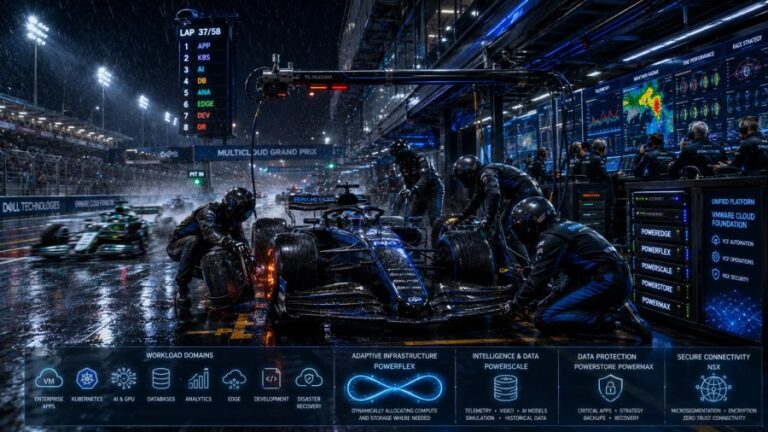
The metaphor becomes useful when each racing function maps to a real operational responsibility.
Continue with the path that best matches the architecture or operating challenge in front of you.
hundreds of alerts with no service priority
multiple teams looking at different data
no agreed incident commander
recommendations with no approval path
automation with no rollback evidence
maintenance declared successful because the task completed
recurring problems that never become engineering work
Without that separation, centralization becomes confusion.
The motorcycle pit-crew image provides a useful mental model for VMware Cloud Foundation 9.1. VCF Operations can centralize fleet management, lifecycle workflows, infrastructure visibility, diagnostics, logs, capacity insight, and API-driven integration. The platform provides the operational machinery, but teams still need service-level objectives, decision rights, runbooks, approval boundaries, rollback criteria, and evidence-based automation.
Examples include:
The change path should look like this:
From Reactive Repair to Bounded Automation
When everyone can see the issue but nobody owns the decision, central observability has only made the confusion more visible.
Maturity stage
Platform behavior
Required evidence before advancing
Reactive monitoring
Operators respond to alerts manually
Alert ownership, usable telemetry, basic incident records
Correlated diagnostics
Metrics, logs, topology, and findings are reviewed together
Repeatable diagnosis and reduced handoffs
Guided remediation
The platform recommends a runbook or next action
Approved runbooks, known prerequisites, validation criteria
Human-approved execution
Automation performs a change after explicit approval
Least privilege, dry-run capability, audit trail, rollback
Policy-bounded execution
Pre-approved low-risk actions run within defined conditions
Error budgets, stop conditions, blast-radius limits, continuous review
Closed operational loop
Outcomes tune thresholds, policies, and runbooks
Reliable evidence that automation improves service outcomes
The best first automation targets are usually repetitive, reversible, and easy to validate. Examples include inventory collection, ticket enrichment, lifecycle pre-checks, certificate-expiration workflows, configuration-drift reporting, and approved maintenance preparation.
Telemetry earns its place when it changes a decision.
The better questions are:
That is why the private cloud operating model should treat VCF Operations as a shared evidence plane, not as the final authority.
Building the Private Cloud Pit Crew
Fleet-level teams own shared governance, lifecycle policy, common identity patterns, fleet-wide credentials, certificates, licensing, and standard automation. Instance and workload-domain teams own local health, availability, capacity, network and storage behavior, and maintenance execution within their boundary. Application teams own workload behavior and business validation.
Define Service Outcomes Before Building Dashboards
That difference matters.
The worst first targets are ambiguous incidents with large blast radii and weak rollback paths.
provisioning success rate
workload readiness
capacity headroom
lifecycle readiness
certificate and credential hygiene
policy compliance
incident detection and restoration time
maintenance success rate
recovery validation
cost allocation completeness
Automation should mature in stages. Teams that skip directly from dashboards to autonomous remediation usually discover that the technical action was easier than the governance problem.
The first objective is not maximum automation. It is reliable automation.
Align Ownership to Fleet, Instance, Domain, and Service Boundaries
This table should be adapted to the organization’s structure, but the accountability should not be left implicit.
A control room observes. A pit crew observes, decides, acts, validates, and returns the system to service.
VMware Cloud Foundation 9.1 strengthens the technical pit wall through VCF Operations. Fleet management, lifecycle management, infrastructure operations, diagnostics, logs, observability, capacity insight, and APIs can be brought into a more unified workflow. That can reduce tool switching and improve the quality of shared evidence.
This is a mental model, not a replacement for product documentation, a support matrix, or an organization-specific responsibility assignment.
Standardize Incident and Maintenance Choreography
The goal is not a fully autonomous private cloud. The goal is a private cloud that can detect problems early, make decisions quickly, execute changes safely, and prove that service health was restored.
trigger and scope
required evidence
owner and incident commander
specialists to involve
decision and approval points
execution sequence
hold conditions
rollback criteria
service validation
audit evidence
follow-up engineering work
A workable operating model makes accountability explicit.
New articles
Automate Low-Risk Work First
Useful integrations include:
The pit-crew model assumes that detection is only the beginning. Every useful signal must eventually connect to five operational questions:
A faster maintenance window is useful only when the environment returns to a verified service state. Completion of the workflow is not the same as success.
collecting pre-maintenance health and capacity evidence
verifying software-depot readiness
detecting certificate and password risk
correlating findings with affected inventory
creating change records with required context
running an approved post-change validation
generating evidence for compliance and architecture review
This article uses the following scope:
All alerts flow to one operations team, regardless of service, severity, or ownership. The team becomes a routing function instead of a response function.
VCF 9.1 strengthens several functions that are essential to this operating model.
Before adopting the pit-crew operating model, the platform team should be able to answer these questions:
The practical objective is not to eliminate people from private cloud operations. It is to let people operate with better evidence, clearer authority, safer automation, and faster feedback.
Ownership and Decision Rights
Every high-value runbook should define:
Capability
Accountable role
Responsible roles
Required evidence
Private cloud service outcomes
Platform product owner
Platform operations and service owners
SLO scorecard, demand, risk, and roadmap
Fleet lifecycle policy
Cloud platform owner
VCF administrators and change management
Compatibility, pre-checks, sequence, rollback, validation
Compute, storage, and network health
Infrastructure service owners
Domain specialists
Topology, metrics, logs, diagnostics, service impact
Security posture and remediation
Security owner
SecOps and platform operations
Findings, exposure, exception, remediation, audit record
Automation policy
Platform automation owner
Platform engineering and operations
Code review, privileges, test evidence, rollback, action log
Incident command
Affected service owner
On-call lead and specialists
Timeline, decisions, actions, validation, follow-up
Business-service validation
Application owner
Application support and business representative
Transaction, user, dependency, and recovery checks
The platform team may see the whole estate, but local domain teams still understand the context of the workloads, failure domains, dependencies, and maintenance constraints.
VCF 9.1 moves more of this work into a unified operational plane. The architectural opportunity is significant, but only when the organization treats VCF Operations as more than a dashboard. It should become the pit wall that connects evidence to coordinated action.
Common Pit-Crew Anti-Patterns
The workflow is green, so the maintenance event is closed.
The Giant Alert Queue
Keep exploring
A certificate rotation, password change, configuration update, or identity assignment should have:
Automation Without a Recovery Contract
Receive new enterprise AI and hybrid platform articles when they are published.
Performance matters, but performance without coordinated operations is fragile. A successful race team needs live telemetry, a crew chief who understands priorities, specialists who know their systems, standardized tools, spare capacity, disciplined change procedures, and a clear decision about when the rider should stay on track or return to the pit.
High-Frequency Telemetry Everywhere