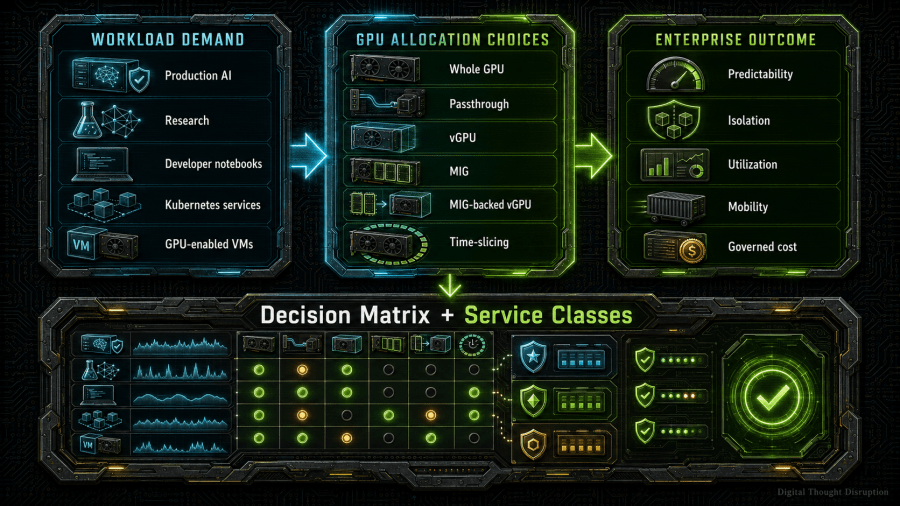
A normal extended-resource request for nvidia.com/gpu: 1 usually means exclusive allocation of one advertised GPU device to a pod. Kubernetes resource requests are integers, so the platform does not request 0.25 of a GPU through the standard device-plugin model.
This design is stronger than Kubernetes time-slicing for memory governance because framebuffer is assigned by profile. It is weaker than MIG for compute isolation because the physical engines remain shared unless the deployment uses a MIG-backed profile.
The most important distinction is between sharing and partitioning .
A vGPU profile’s framebuffer size is not a guaranteed percentage of SM cycles. The scheduler mode and co-resident workload count determine compute behavior.
TL;DR
The trust level of the tenant should directly constrain the allowed mechanisms.
Research needs flexibility, profiling, custom drivers, debuggers, and sometimes unsupported kernels. A dedicated research node pool with whole GPUs may be safer than weakening production clusters. Time-slicing can be useful for early experiments, but researchers should be able to request a temporary whole-GPU reservation when profiling or reproducibility matters.
Allocation mechanism: whole GPU, passthrough, vGPU, MIG, MIG-backed vGPU, or time-slicing.Service class: the technical contract for memory, compute, availability, observability, and support.Business entitlement: who receives guaranteed capacity, who may borrow, who may be preempted, and what evidence is owed.
Every service-class record should include:
The Decision Has Three Separate Layers
Choose MIG when:
NVIDIA currently lists MIG support for several Ampere, Hopper, and Blackwell products, including the RTX PRO 6000 Blackwell Server Edition, Workstation Edition, and Max-Q Workstation Edition. However, the NVIDIA vGPU supported-GPU list separately identifies which products support vGPU software. The RTX PRO 6000 Blackwell Server Edition is listed for vGPU, while workstation editions should not be assumed to support vGPU merely because they support MIG [3], [8].
This separation also prevents the catalog from becoming tied to one GPU generation. The business can retain stable service names while the platform team changes the underlying implementation from an L40S vGPU profile to an H200 MIG profile, for example, after testing and approval.
Collect peak and steady-state GPU memory, SM utilization, batch size, concurrency, queue time, latency, training duration, topology, profiler requirements, and data classification. Do not size from average utilization alone.
Allocation Mechanisms at a Glance
This article establishes that decision model for production AI, inference, training, research, interactive development, virtual machines, and Kubernetes. The current compatibility baseline is July 24, 2026. Exact GPU SKU, server, firmware, driver, hypervisor, guest operating system, Kubernetes, and NVIDIA software compatibility must still be checked before deployment because support boundaries change by release.
Allocation model
Primary boundary
Memory isolation
Compute isolation
Predictability
Mobility
Operational complexity
Typical best fit
Dedicated whole GPU
Scheduler or host assignment
High
High
High
Medium in Kubernetes, low in bare metal
Low to medium
Training, large inference, critical production
GPU passthrough
One physical GPU to one VM
High
High
High
Low
Medium
Exclusive VM workloads, appliances, legacy stacks
Standard NVIDIA vGPU
VM plus fixed framebuffer profile
High for assigned framebuffer
Medium or low unless scheduler policy guarantees a share
Medium
High when supported
High
GPU-enabled VM fleets, development, VDI, managed inference
MIG
Hardware GPU Instance and Compute Instance
High
High within profile
High
Medium through restart and rescheduling, not transparent state transfer
Medium to high
Partitioned inference, trusted multitenancy, predictable small workloads
MIG-backed vGPU
VM plus MIG hardware partition
High
High for a whole GPU Instance, lower if time-sliced within that instance
High to medium
Potentially high, but release-specific
Very high
VM-based tenant isolation with hardware partitioning
Kubernetes time-slicing
Shared process scheduling on one GPU
None between replicas
None as a guaranteed fraction
Low
Medium through pod restart and rescheduling
Low initially, high operationally
Trusted internal notebooks, bursty tests, low-duty-cycle jobs
These are a publication baseline, not a design shortcut. A production bill of materials should record the exact server model, GPU SKU, firmware, BIOS, GPU VBIOS, ESX or other hypervisor build, vGPU Manager, guest driver, Kubernetes version, GPU Operator, CUDA stack, and application runtime.
Sharing lets multiple workloads take turns using the same engines or device. Kubernetes time-slicing is sharing. Standard vGPU normally combines fixed framebuffer assignment with shared, time-sliced engines.Partitioning creates defined subdevices with assigned hardware resources. MIG is hardware partitioning. MIG-backed vGPU places a VM-facing virtual device on top of that partition.Dedication assigns the entire GPU to one scheduling unit or one VM. Whole-GPU Kubernetes allocation and passthrough are both dedication models, but their management boundaries differ.
Scope, Assumptions, and Terminology Guardrails
Choose passthrough when:
Whole GPU Does Not Automatically Mean Passthrough
Many AI pipelines are CPU, memory, storage, or network bound. Tokenization, document parsing, orchestration, preprocessing, API gateways, and vector-database operations do not automatically need a GPU. A CPU-only class prevents expensive accelerators from becoming the default answer to every AI workload.
A platform that reports forty allocatable shared GPUs from four physical GPUs should display both numbers. Capacity dashboards must distinguish physical devices, hardware partitions, virtual profiles, and shared access tokens.
vGPU Is Not a Synonym for MIG
Passthrough means a hypervisor directly assigns the physical PCIe device to one VM. The guest driver owns the GPU from the workload perspective, and the NVIDIA vGPU Manager is bypassed. Both models can provide exclusive use, but their lifecycle, monitoring, mobility, and failure-handling paths are different.
GPU-C should mean committed service, not simply a particular GPU model. It can be implemented by a dedicated whole GPU in Kubernetes, passthrough to a VM, or a full-GPU vGPU when mobility is required. The entitlement should define whether capacity is reserved continuously, available within a queue-time objective, or temporarily borrowable by lower-priority workloads.
Standard vGPU is primarily a virtualization and framebuffer-partitioning model with engine scheduling.
MIG is a hardware partitioning model.
MIG-backed vGPU combines hardware partitioning with virtual-machine delivery.
MIG Capability and vGPU Capability Are Separate Checks
Dedicated whole-GPU allocation assigns an entire physical GPU to one workload at a time. In bare metal, the workload runs directly on the host. In Kubernetes, a pod normally requests an integer extended resource, such as one GPU, and the device plugin makes the device available to the container.
NVIDIA GPU Operator time-slicing oversubscribes a GPU by advertising multiple replicas of one physical resource. Workloads receive shared access and interleave on the underlying device. NVIDIA explicitly states that replicas do not provide memory or fault isolation, and requesting more than one replica does not guarantee proportionally more compute [1].
Kubernetes Scheduling Does Not Create Physical Isolation
Whole-GPU allocation strands unused memory and compute inside an allocated device. This is visible and easy to explain. It can be reduced with shorter job durations, queueing, checkpointing, autoscaling, and moving interactive work to smaller service classes.
How Each Allocation Model Actually Works
Dedicated Whole-GPU Allocation
Training usually prefers whole GPUs because the workload benefits from full memory, full compute, high-speed interconnects, and topology-aware scheduling. Multi-GPU training may require GPUs connected through NVLink or NVSwitch and low-latency scale-out networking. Fractional allocation can disrupt communication topology and extend training duration.
A platform that maximizes utilization but cannot protect production latency, isolate customer workloads, or explain consumption is not efficient. It is merely busy.
Avoid whole GPU as the universal default when:
Choose standard vGPU when:
The model or batch genuinely needs most of the device memory.
Multi-GPU communication, NVLink, NVSwitch, GPUDirect RDMA, or topology-aware scheduling matters.
Latency or training duration is contractually important.
The workload is externally paid, regulated, or operationally critical.
Debugging, profiling, or unified-memory behavior must not be constrained by migration features.
The platform wants the simplest supported path with the fewest sharing layers.
MIG can be useful for small experiments, hyperparameter sweeps, unit tests, or independent jobs that fit a profile. It is not the default for distributed training that expects full GPUs or peer-to-peer topology.
Most workloads use a small fraction of memory and compute.
Developers hold GPUs idle for long interactive sessions.
The organization cannot afford the resulting capacity fragmentation.
A smaller, well-isolated MIG or vGPU profile can meet the service objective.
GPU Passthrough
GPU-M should have a defined memory profile and a measured performance envelope. MIG is the clearest implementation because the hardware partition is explicit. A whole-GI MIG-backed vGPU can provide a similar VM-delivered service. A standard vGPU can qualify only after the platform validates scheduler behavior and communicates that engine sharing differs from MIG.
The commercial offer must state whether memory, compute, performance, and fault isolation are guaranteed. “One GPU” is not a sufficient product description.
A whole GPU assigned to a Kubernetes pod is not the same thing as a whole GPU passed through to a virtual machine. A standard NVIDIA vGPU profile reserves framebuffer but generally time-slices GPU engines. Multi-Instance GPU, or MIG, partitions supported hardware into defined compute and memory instances. MIG-backed vGPU adds a virtual-machine delivery layer to a MIG partition. Kubernetes time-slicing creates more schedulable access tokens for the same underlying device, but it does not create independent memory or fault domains.
Service-Effective Utilization =
Useful GPU Work Delivered Within SLO
Where the GPU supports MIG and the workload fits a stable profile, use MIG for predictable fractional production. Standardize only a few approved layouts and maintain separate node pools if frequent reconfiguration would disrupt service.
One VM needs an exclusive physical GPU.
Full-device performance and compatibility are more important than live mobility.
The workload has a stable placement and maintenance model.
The VM owner can operate and monitor the guest GPU stack.
The organization wants a VM boundary without vGPU Manager and vGPU profile management.
As of the research date:
The service depends on frequent vMotion or automated host balancing.
Many small VMs need fractional GPU memory.
The platform needs to reclaim and repack capacity dynamically.
A failure of one GPU assignment would create an unacceptable recovery process.
Standard NVIDIA vGPU
Administrative isolation comes from the surrounding platform. A VM provides a stronger guest-operating-system boundary than two containers in one Kubernetes node. A Kubernetes namespace limits API objects and policy scope, but it is not equivalent to a separate cluster, VM, or physical host. External customer services should combine the GPU mechanism with identity, network, storage, secret, and control-plane isolation.
Use dedicated whole GPUs as the default for performance-critical training, large-model inference, externally committed services, and workloads that need predictable memory and compute behavior. Use passthrough when a VM needs direct exclusive control of a GPU and mobility is less important than simplicity and performance. Use standard vGPU when VM mobility, VM lifecycle integration, and framebuffer partitioning matter more than hard compute isolation. Use MIG when supported hardware can be divided into predictable hardware-isolated instances. Use MIG-backed vGPU when the organization needs both VM delivery and MIG isolation, and the exact GPU, vGPU release, and hypervisor combination is certified. Use Kubernetes time-slicing only for trusted, bursty, internal workloads that can tolerate contention and weak attribution.
GPU passthrough assigns an entire physical GPU directly to one virtual machine. NVIDIA defines passthrough as exclusive assignment that bypasses the vGPU Manager [4]. The VM sees a physical GPU, uses a guest driver, and controls the device for the duration of the assignment.
Production inference can use all six models, but the service objective decides which is safe:
Best effort: optimizes use of idle cycles but does not guarantee an equal or fixed compute share.Equal share: divides cycles among active vGPUs, but each share changes when the number of active vGPUs changes.Fixed share: provides a configured share on supported combinations, improving predictability at the cost of potentially idle cycles.
For enterprise use, set failRequestsGreaterThanOne to enforce that a pod cannot imply it receives twice the compute by asking for two replicas. Use admission policy to prevent production namespaces from requesting shared resources.
The allocation model determines what evidence the platform can collect and how confidently it can attribute usage.
The VM lifecycle is the primary operating model.
Fixed framebuffer allocation is sufficient for memory governance.
Live migration and host maintenance flexibility are important.
Workloads tolerate shared engines or use a supported scheduler policy.
The organization accepts vGPU Manager, guest-driver, and NVIDIA License System requirements.
A scheduler can only allocate the resource model it is given. The platform team must make that model explicit.
Paid customers expect hardware-partitioned compute isolation.
A hard performance floor cannot be achieved with the supported scheduler.
The application requires unsupported CUDA features during live migration.
Profile packing and licensing complexity exceed the value of VM mobility.
Multi-Instance GPU
Measure queue time, startup time, model load, tokens per second, requests per second, time to first token, p95 and p99 latency, throughput, error rate, memory pressure, GPU reset behavior, node drain, VM migration, checkpoint recovery, and telemetry attribution.
MIG-backed vGPU assigns a vGPU device to a VM from a MIG GPU Instance. This combines the VM boundary and lifecycle model of vGPU with hardware-level MIG partitioning. NVIDIA’s current vGPU documentation distinguishes two forms:
The strongest enterprise design separates the mechanism from the service class and the business entitlement. Consumers should request CPU-only, GPU-S, GPU-M, or GPU-C based on their workload objective. The platform team should decide whether that class is implemented with a whole GPU, passthrough, vGPU, MIG, MIG-backed vGPU, or time-slicing on the current hardware generation.
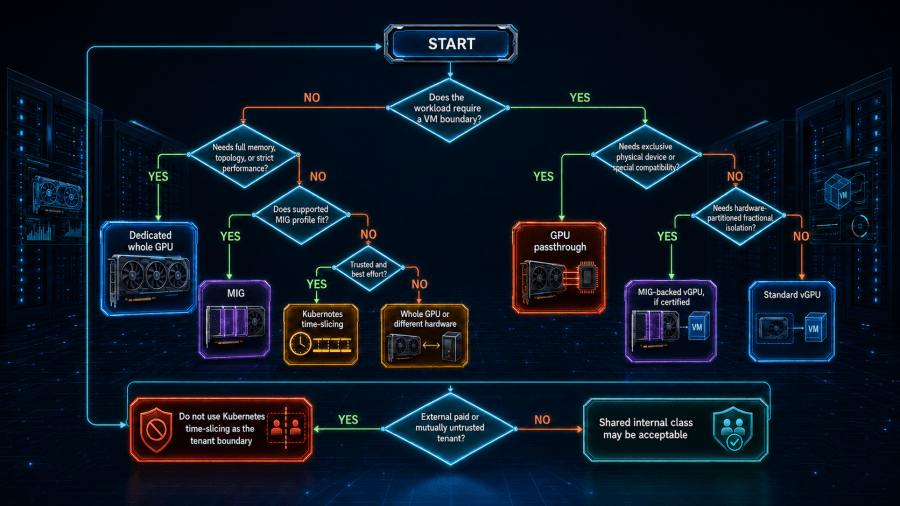
External customer services should not default to Kubernetes time-slicing. The platform should offer a clearly described partitioned or dedicated product:
apiVersion: v1
MIG partitions supported hardware into GPU Instances with isolated memory paths and defined compute resources. A MIG-backed vGPU exposes a virtual GPU to a VM from that MIG partition. Therefore:
The GPU is on NVIDIA’s supported MIG list.
Workloads fit predefined profiles.
Predictable fractional memory and compute are required.
Kubernetes or bare-metal services need stronger isolation than time-slicing.
The platform can manage MIG geometry, node drains, and profile lifecycle.
This distinction is critical. “MIG-backed” does not always mean one VM has exclusive use of the complete MIG instance. The profile and hypervisor support determine whether the GPU Instance is dedicated to one vGPU or time-sliced among several.
The workload needs the full device or changes size frequently.
The GPU model does not support MIG.
The profile geometry creates more stranded capacity than whole-GPU scheduling.
The organization cannot operationalize reconfiguration and monitoring.
MIG-Backed vGPU
Passthrough strands an entire GPU inside a VM assignment and adds host-placement constraints. It can also strand CPU and memory because the VM must fit on a host that owns a compatible free GPU and enough MMIO space.
A vGPU that occupies an entire GPU Instance and has exclusive use of that instance’s engines.
A time-sliced MIG-backed vGPU that shares engines with other vGPUs inside the same GPU Instance while still running in parallel with workloads in other GPU Instances [4].
A Kubernetes pod can receive exclusive access to a physical GPU through the NVIDIA device plugin without the GPU being passed through to a VM. The host driver owns the device, Kubernetes allocates the extended resource, and the container receives device access.
vGPU improves memory packing but introduces profile-placement rules. Heterogeneous profiles can reduce waste for diverse VMs, yet packing and alignment constraints may lower maximum density. NVIDIA’s current example shows that an L40S can host six 8 GB vGPUs in equal-size mode but only four of the same profile in heterogeneous mode [7].
There is no universal best GPU allocation mechanism because the mechanisms solve different problems. Whole-GPU allocation and passthrough provide dedication. Standard vGPU provides VM integration, fixed framebuffer assignment, and configurable engine scheduling. MIG provides hardware-partitioned memory and compute. MIG-backed vGPU combines MIG with VM delivery. Kubernetes time-slicing provides oversubscribed access without memory or fault isolation.
Internal developers working under the same enterprise security policy can often use time-slicing or standard vGPU. The platform should still enforce namespace RBAC, network policy, storage boundaries, secrets isolation, image policy, runtime controls, and quotas. Time-slicing should be labeled best effort and should not host sensitive workloads alongside untrusted code.
VM delivery and lifecycle integration are mandatory.
Standard vGPU compute sharing is insufficient.
The exact certified stack supports the required MIG-backed profile.
The organization can operate the additional compatibility and monitoring layers.
Tenant or customer isolation justifies the complexity.
MIG-backed vGPU has the highest operational complexity in this article. The administrator must align server certification, GPU SKU, firmware, vGPU Manager, guest driver, license service, MIG mode, GPU Instance profile, vGPU profile, hypervisor, guest operating system, and migration behavior.
A standard whole-GPU VM or standard vGPU already meets the requirement.
The platform lacks disciplined version and compatibility management.
The team assumes every MIG-capable GPU is vGPU-capable.
Mobility requirements have not been proven on the selected profile.
Kubernetes Time-Slicing
Create at least one whole-GPU pool, one MIG pool, and one shared development pool. Add vGPU and MIG-backed vGPU pilots when VM services require them. Keep the pools small enough to change but representative enough to test real workloads.
Every allocation model fragments capacity differently. The goal is not to eliminate fragmentation. The goal is to understand which kind of fragmentation the service can tolerate.
This means a time-sliced “GPU” is not a fraction in the same sense as a MIG profile. It is a scheduler-visible access token. On a four-GPU node configured with ten replicas per GPU, Kubernetes can advertise forty shared resources, but the hardware still contains four physical GPUs. The community thread supplied for this article illustrates why this can surprise operators: the count looks like capacity, while each pod still sees access to one underlying GPU and shares it with other processes [16].
One process can consume most or all available GPU memory.
A fault or reset can affect all workloads sharing the device.
The scheduler cannot infer true compute demand from replica count.
DCGM Exporter cannot associate GPU metrics with containers when time-slicing is enabled through the NVIDIA Kubernetes Device Plugin [1].
A pod requesting multiple replicas may not receive more effective compute.
Intentional headroom has value. It absorbs bursts, protects tail latency, enables maintenance, provides failure capacity, and avoids profile repacking. The platform should measure idle capacity and challenge waste, but it should not automatically eliminate every idle cycle.
Time-slicing can make a node appear to have many allocatable GPUs. This reduces scheduler-visible scarcity but does not create more framebuffer or aggregate compute. The fragmentation becomes runtime contention, out-of-memory risk, and unpredictable queueing inside the device.
Tenants are trusted and internal.
Workloads are bursty, low-duty-cycle, or disposable.
Memory use is bounded by application policy and testing.
The service is explicitly best effort.
The platform collects model-server, request, queue, and process telemetry to compensate for weak container attribution.
A namespace can limit a team to four GPU resources. It cannot make four time-sliced replicas become four memory-isolated devices. Dynamic Resource Allocation can improve device selection and claim handling, but it does not turn time-slicing into MIG or passthrough.
Tenants are external or mutually untrusted.
Workloads can allocate most of GPU memory.
Performance or latency is committed.
Per-tenant billing requires precise device-level attribution.
Fault isolation is part of the service promise.
Isolation Must Be Evaluated by Dimension
Time-slicing should be treated as an internal oversubscription policy, not a security partition.
Mechanism
Memory isolation
Compute isolation
Performance isolation
Fault isolation
Administrative isolation
Suitable for hostile multitenancy
Whole GPU in Kubernetes
Strong while exclusively allocated
Strong
Strong
Good at GPU level, node still shared
Namespace and cluster dependent
Sometimes, but dedicated node may still be required
Passthrough
Strong
Strong
Strong
Good for assignment, host and PCIe remain shared
Strong VM boundary
Better, but dedicated host may be required
Standard vGPU
Strong framebuffer boundary
Shared engines unless scheduler guarantees a share
Medium
VM isolated, physical GPU reset can affect neighbors
Strong VM boundary
Conditional, depends on trust and controls
MIG
Strong hardware memory paths
Strong predefined compute allocation
Strong
Stronger than time-slicing, whole-device faults remain
Container, process, or VM boundary dependent
Good for many use cases, not equivalent to dedicated hardware
MIG-backed vGPU
Strong VM and MIG memory boundary
Strong for whole-GI profile, shared within time-sliced GI
Strong to medium
Stronger tenant boundary, physical board remains shared
Strong VM boundary
Strong fractional option when certified
Kubernetes time-slicing
None between replicas
None as a hard partition
Low
Low
Namespace only controls Kubernetes objects
No
Memory Isolation
Kubernetes does not normally ask vCenter to create an arbitrary vGPU profile for each pod through the standard device-plugin path. The VM class or worker-node design determines the vGPU capacity visible inside the cluster. The supplied NVIDIA forum discussion reflects this boundary and is useful as an operational clarification, but the current NVIDIA and Broadcom documentation should govern production design [15].
Compute Isolation
vGPU is valuable when the VM is the enterprise service boundary. It integrates GPU assignment with VM templates, VM classes, guest operating systems, backup workflows, access controls, and vMotion. VMware vSphere can live-migrate supported vGPU VMs when compatibility prerequisites are met. The destination requires compatible GPU type, framebuffer configuration, hypervisor and driver versions, and available profile capacity. Certain CUDA features, including unified memory, debuggers, and profilers, can restrict live migration [4], [7].
Passthrough is attractive when the application needs a VM boundary but does not benefit from vGPU sharing. It can also simplify compatibility for software that expects a full physical device. In VMware environments, the GPU is configured for passthrough on the ESX host, then attached to the VM or to a GPU-enabled worker-node class [5], [13].
Fault Isolation
This distinction explains much of the confusion seen in community discussions. A GPU may support bare-metal MIG but not MIG-backed vGPU on a particular hypervisor. A GPU may support standard vGPU but not MIG. A product family name alone is insufficient; the exact SKU and software matrix govern.
Administrative Isolation
With MIG, Kubernetes can advertise profile-specific resources, such as a defined MIG instance. The resource name describes a hardware profile, not a percentage. The scheduler must find a node with a compatible free instance and valid profile placement.
Cryptographic and Confidential-Computing Isolation
Memory isolation answers whether one tenant can consume, corrupt, or observe memory allocated to another. Whole GPU and passthrough avoid co-resident GPU tenants. Standard vGPU gives each vGPU exclusive framebuffer allocation. MIG creates hardware-partitioned memory paths. Kubernetes time-slicing does not create a memory boundary.
Hardware, Hypervisor, and Kubernetes Requirements
The GPU model alone does not determine support. vGPU Manager, guest driver, NVIDIA License System, hypervisor build, firmware, and application CUDA dependencies must remain compatible.
Mechanism
Hardware requirements
Hypervisor requirements
Kubernetes requirements
Driver and licensing considerations
Whole GPU
Supported GPU and server; topology matters for multi-GPU
None for bare metal; VM worker may use passthrough or vGPU
NVIDIA device plugin or GPU Operator; compatible container runtime
Data center driver or NVIDIA AI Enterprise stack as applicable; no vGPU license solely for whole-GPU device-plugin use
Passthrough
IOMMU, PCIe/MMIO support, qualified server and GPU
Supported DirectPath or PCI passthrough implementation
GPU Operator supports VMs with passthrough; worker VM owns the physical GPU
Guest driver required; vGPU Manager bypassed; enterprise software licensing may still apply
Standard vGPU
GPU listed for vGPU and certified server
Supported hypervisor, vGPU Manager, compatible host build
Kubernetes can run inside a vGPU-enabled worker VM
vGPU Manager and guest driver compatibility; NVIDIA License System and appropriate entitlement
MIG
GPU listed in current MIG support table
Optional for bare metal; passthrough and vGPU support vary
GPU Operator MIG Manager or equivalent; single or mixed MIG strategy
Supported driver, firmware, VBIOS, CUDA, and profile configuration
MIG-backed vGPU
GPU supports both MIG and vGPU
Exact hypervisor and vGPU branch support required
Kubernetes may run inside VM and sees assigned vGPU or MIG-backed device
Highest compatibility burden; vGPU license required
Time-slicing
Any supported GPU that can run the required CUDA stack; MIG not required
Bare metal, passthrough VM, or vGPU VM supported by GPU Operator
Device-plugin time-slicing config, node labels, and admission policy
No additional vGPU license on bare metal solely for time-slicing; vGPU environments retain vGPU licensing
Current Release Baseline
Time-slicing provides sharing, not memory or fault isolation. It is inappropriate as the primary boundary for untrusted paid customers.
NVIDIA vGPU 20.1 is the current production release, while vGPU 19.5 is the current long-term-support release [6].
NVIDIA GPU Operator 26.3.x is the current supported operator branch in NVIDIA’s platform-support documentation [9].
The same GPU Operator documentation validates bare metal, VMs with GPU passthrough, and VMs with NVIDIA vGPU, and lists current Kubernetes and VMware vSphere Kubernetes Service support ranges [9].
Broadcom’s current platform family is VMware Cloud Foundation 9.1 and vSphere 9.1, but NVIDIA’s exact vGPU and GPU support matrix still governs whether a specific board and ESX build are supported [8], [13].
MIG provides hardware fault isolation between instances for many classes of failure, but physical device, driver, firmware, PCIe, power, cooling, and host failures can still cross instance boundaries. Standard vGPU and time-slicing share the physical GPU fault domain. Whole-GPU and passthrough reduce co-tenant blast radius because only one tenant owns the device, but a failed board can still affect the host.
Scheduling Behavior Changes the Meaning of a GPU Request
For vGPU, include the scheduler mode in dashboards. A 16 GB profile under best effort does not have the same compute contract as the same profile under fixed share. For MIG, record the GPU Instance and Compute Instance profile, not only the memory size.
Whole-GPU Kubernetes Requests
Fine-tuning spans a broad range. Parameter-efficient methods may fit a MIG profile or large vGPU, while full-model fine-tuning may require multiple whole GPUs. The decision should be based on peak memory, optimizer state, sequence length, batch size, precision, checkpoint behavior, and interconnect needs, not on the model parameter count alone.
MIG Resource Requests
The tradeoff is stranded capacity. A notebook using 6 GB of a 96 GB GPU may hold the entire device. A small inference service may run at 10 percent average utilization but still block other workloads. That is not always a design failure. The idle headroom may be the capacity required to protect p99 latency, absorb bursts, complete a training stage on time, or reduce the blast radius of a fault.
Time-Sliced Requests
This separation reduces accidental cross-class scheduling and makes capacity evidence easier to interpret.
MIG provides strong intra-GPU isolation, but it is not a dedicated-host guarantee. The PCIe device, board, driver, firmware, power domain, cooling path, and physical host remain shared. Some faults can still affect the whole GPU or node. External hostile multitenancy or stringent compliance may still require dedicated GPUs or hosts.
This article assumes NVIDIA data center or enterprise RTX accelerators in enterprise servers, with workloads delivered through bare metal, virtual machines, Kubernetes, or Kubernetes worker nodes running as VMs. It does not treat consumer desktop GPUs as equivalent substitutes for certified data center deployments.
vGPU Placement
For every candidate design, verify the server, GPU SKU, firmware, BIOS, VBIOS, hypervisor, vGPU branch, host manager, guest driver, Kubernetes version, GPU Operator, CUDA runtime, application framework, and license entitlement.
Avoid standard vGPU when:
Kubernetes worker VMs receive vGPU devices from the hypervisor, then the NVIDIA device plugin exposes those devices to pods.
A VM-based workload consumes the vGPU directly without Kubernetes.
GPU-S should be marketed as shared access. Its contract should state that compute performance varies and that the service may be preempted. When implemented with Kubernetes time-slicing, it must not promise isolated memory. When implemented with a small vGPU, it may promise framebuffer capacity but still needs a compute-sharing statement.
Dynamic Resource Allocation
Use standard vGPU for enterprise VM fleets that need lifecycle integration and mobility. Choose the scheduler mode deliberately. Do not treat framebuffer size as a compute guarantee. Use MIG-backed vGPU only after exact compatibility and migration testing.
Fragmentation and Stranded Capacity
VMware vSphere 9 support for MIG-backed vGPU begins with NVIDIA vGPU 19.0 in NVIDIA’s current deployment guide. That does not mean every MIG-capable GPU, vGPU profile, VMware release, and migration function is supported. The product support matrix must be checked for the exact GPU and ESX build [5], [8].
Whole-GPU Fragmentation
For time-sliced services, chargeback based only on advertised replica-hours is misleading. Replica-hours measure entitlement or access duration, not useful work. Add model-server metrics such as requests, tokens, batch size, latency, queue time, memory allocation, and active execution time.
Passthrough Fragmentation
Create CPU-only, GPU-S, GPU-M, and GPU-C contracts. Define guarantees, limits, priority, preemption, isolation, monitoring, and support. Then map mechanisms to classes.
vGPU Profile Fragmentation
A practical enterprise default can be expressed as a small set of rules.
The most important design rule is to separate three layers:
MIG Geometry Fragmentation
Compute isolation answers whether one tenant has dedicated SMs or a guaranteed compute share. Whole GPU, passthrough, and MIG provide the clearest answer. Standard vGPU shares engines unless the scheduler policy supplies an enforceable share. Time-slicing provides neither dedicated SMs nor a proportional guarantee.
Time-Slicing Hides, Rather Than Solves, Fragmentation
Choose time-slicing when:
An unconstrained profile catalog creates packing failures and operational churn. Standardize a few profiles aligned to measured workloads.
Monitoring and Evidence Limitations
MIG divides supported GPUs into predefined GPU Instances and Compute Instances. NVIDIA describes dedicated memory paths, L2 cache, memory controllers, DRAM address buses, and assigned compute resources that provide predictable throughput, latency, quality of service, and fault isolation [2].
Mechanism
Best evidence source
Main limitation
Whole GPU
DCGM, DCGM Exporter, nvidia-smi, pod and node metadata
One allocation can still host multiple application processes
Passthrough
Guest DCGM and application metrics, hypervisor assignment inventory
Host has limited process visibility; tenant must expose guest telemetry
Standard vGPU
Hypervisor vGPU metrics plus guest metrics and VM identity
Compute sharing must be interpreted with scheduler mode and co-resident profiles
MIG
DCGM with MIG-aware entity identifiers, Kubernetes profile metadata
Ampere-era nvidia-smi process attribution can be limited; use supported DCGM versions
MIG-backed vGPU
Hypervisor, guest, MIG entity, and VM profile telemetry
Multiple identity layers complicate end-to-end attribution
Time-slicing
Application, model-server, pod, process, queue, and node metrics
DCGM Exporter cannot associate metrics to containers through device-plugin time-slicing [1]
This makes MIG the strongest fractional-GPU mechanism in the comparison. A workload receives a real hardware partition rather than a scheduling token. The instance appears as a schedulable GPU resource to containers, processes, or supported virtualized deployments.
Maximum utilization is not the goal. The goal is predictable, secure, supportable, and measurable useful work. Sometimes that means sharing a GPU aggressively. Sometimes it means leaving deliberate headroom. Sometimes it means dedicating an expensive device to one workload because the cost of contention, missed latency, failed recovery, or weak tenant isolation is higher than the value of the idle cycles.
Security and Multitenancy Policy
The cost is reduced mobility and placement flexibility. Direct device assignment constrains host maintenance, DRS placement, and migration. The platform should treat live mobility as unsupported unless the exact hypervisor, GPU, firmware, and feature combination explicitly documents it. Operational recovery usually means shutting down, detaching, reassigning, or restarting the VM on a compatible host.
Trusted Internal Development
An enterprise GPU platform exists to deliver business workloads, not to produce a beautiful utilization graph. A GPU running at 95 percent can still be poorly managed if production requests queue behind experiments, customer latency varies unpredictably, or no one can attribute consumption.
Internal Production
The following decision tree deliberately starts with service requirements, not utilization.
Regulated Workloads
Avoid passthrough when:
External Paid Customers
“Isolated” is not a single technical property. The platform should evaluate at least six dimensions: memory, compute, performance, fault, administrative, and tenant-security isolation.
MIG for hardware-partitioned container services.
MIG-backed vGPU for VM-delivered fractional services where certified.
Standard vGPU only when the contract accurately describes shared engines and the scheduler policy.
Whole GPU or passthrough for premium isolation and performance.
Dedicated host when the threat model or contract requires a physical boundary.
Avoid MIG when:
Training, Inference, Development, and Research Fit
Large-Scale Training
Kubernetes Dynamic Resource Allocation is now a stable framework for richer device claims and device classes [11]. It can improve device selection, claim lifecycle, and structured resource parameters. It should not be marketed as an isolation mechanism. A DRA claim for a shared GPU is still backed by a shared GPU unless the driver allocates a partitioned or dedicated device.
Regulated workloads require evidence that the complete trust boundary is acceptable. MIG can strengthen intra-GPU isolation, but compliance may also require dedicated nodes, separate clusters, restricted administrators, encrypted storage, network segmentation, confidential computing, controlled images, and audit retention. Do not present MIG alone as a compliance solution.
Fine-Tuning
Avoid time-slicing when:
Production Inference
vGPU live migration has prerequisites and feature exclusions. MIG-backed profiles require their own validation. Passthrough should be treated as mobility-constrained unless explicitly proven otherwise.
Whole GPU for large models, strict latency, predictable bursts, or premium service.
MIG for smaller models with defined memory and throughput needs.
MIG-backed vGPU for VM-based isolated inference.
Standard vGPU for VM mobility when engine sharing is acceptable or fixed-share scheduling is validated.
Time-slicing for internal low-duty-cycle endpoints without hard latency guarantees.
Passthrough for a VM-based inference appliance needing exclusive control.
Interactive Development and Notebooks
This is why “vGPU on Kubernetes” usually means one of two things:
Research and Experimental Workloads
NVIDIA vGPU allows multiple VMs to receive virtual GPU devices from one physical GPU. Each vGPU profile receives a fixed framebuffer allocation that remains exclusive to that vGPU while it exists. On a standard single-instance GPU, vGPU processes share the GPU engines through time-sliced scheduling [4].
Workload-to-Allocation Decision Matrix
Workload or tenant pattern
Preferred allocation
Acceptable alternative
Usually avoid
Decision rationale
Distributed foundation-model training
Whole GPU
Passthrough to dedicated training VMs
Time-slicing, small MIG
Needs topology, memory, bandwidth, and predictability
Single-GPU full fine-tuning
Whole GPU
Passthrough or full-profile vGPU
Time-slicing
Memory pressure and duration sensitivity
Parameter-efficient fine-tuning
MIG or whole GPU
Large vGPU
Time-slicing without memory controls
Can fit a partition but still needs reproducibility
Large-model production inference
Whole GPU
Passthrough or full-profile vGPU
Time-slicing
p95 and p99 latency plus memory footprint
Small-model production inference
MIG
MIG-backed vGPU or standard vGPU with validated scheduler
Uncontrolled time-slicing
Predictable fractional capacity
Internal low-volume inference
MIG or standard vGPU
Time-slicing
Passthrough unless required
Balance utilization and acceptable variability
Developer notebook
Small MIG or small vGPU
Time-slicing with idle timeout
Whole GPU as permanent assignment
Interactive duty cycle and memory guardrails
CUDA validation and CI tests
Time-slicing
Small MIG
Passthrough
Short, disposable, trusted workloads
Research profiling
Whole GPU
Passthrough
Standard vGPU with migration constraints
Needs direct metrics and profiler access
GPU-enabled enterprise VM
Standard vGPU
Passthrough
Kubernetes time-slicing outside the VM contract
VM lifecycle and mobility
External paid fractional GPU
MIG or MIG-backed vGPU
Standard vGPU with explicit shared-engine contract
Kubernetes time-slicing
Isolation and billable evidence
External paid dedicated GPU
Whole GPU or passthrough
Full-GPU vGPU where mobility is required
Shared profiles
Clear premium boundary
Regulated sensitive inference
Dedicated whole GPU, potentially dedicated node
MIG with full control stack
Time-slicing
Trust boundary and audit evidence
Bursty internal batch queue
Whole GPU with queueing
MIG or time-slicing for small jobs
Static passthrough
Scheduler can reclaim and backfill capacity
CPU-sufficient preprocessing
CPU-only
GPU-S for validated acceleration
Permanent GPU allocation
Avoid consuming accelerators for CPU-bound work
Service Classes Should Be Stable, Mechanisms Can Change
Internal production services should normally use whole GPU, MIG, standard vGPU with an appropriate scheduler, or MIG-backed vGPU. Selection depends on latency, mobility, and isolation. A low-volume internal API may be a good MIG candidate. A VM-based AI application requiring vMotion may fit standard vGPU. A large inference engine with strict p99 latency may require a whole GPU.
Service class
Intended consumer
Technical contract
Candidate implementations
Business entitlement
CPU-only
Preprocessing, orchestration, light analytics, non-accelerated services
No accelerator guarantee
CPU nodes or VMs
Standard quota, no GPU borrowing by default
GPU-S, Shared
Internal development, CI, light notebooks, bursty inference
Best effort, no hard compute guarantee, limited support objective
Kubernetes time-slicing, small standard vGPU, time-sliced MIG-backed vGPU where certified
Low or zero guarantee, borrowable, preemptible, usage cap
GPU-M, Managed Partition
Small production inference, controlled notebooks, paid fractional service
Defined memory profile, defined isolation, monitored capacity, documented performance envelope
MIG, whole-GI MIG-backed vGPU, fixed or equal-share vGPU after validation
Guaranteed quota, bounded borrowing, protected from lower classes
GPU-C, Committed
Critical production, large inference, training, regulated or premium customer
Dedicated device or equivalent full-capacity commitment, strongest performance and support objective
Whole GPU, passthrough, full-GPU vGPU when mobility is required
Guaranteed reservation, high priority, non-preemptible, explicit recovery objective
GPU-S Is an Access Product, Not a Fraction
MIG profiles occupy predefined geometry. A node can have free memory and free compute slices but still lack a valid contiguous placement for a requested profile. Repacking can require draining workloads and recreating instances. The platform should standardize a small set of supported MIG layouts rather than offering every possible profile.
GPU-M Is a Partitioned Product
Choose MIG-backed vGPU when:
GPU-C Is a Business Commitment
For every class, publish the actual isolation statement, resource name, supported workloads, SLO, quota behavior, monitoring limitations, and escalation path. Make the physical-to-logical capacity mapping visible to platform operators and consumers.
Business Entitlement Fields