VCF Edge Fleet Operations: Local Control and Resilient Recovery
Define Site Classes and Owners
Get Paul Bryant’s practical guides to enterprise AI, hybrid platforms, and day-2 operations by email. New articles as they publish. Unsubscribe anytime.
Build a Reproducible Baseline
Broadcom describes VCF Edge in the current VMware Cloud Foundation 9.1 documentation as an optimized VMware Cloud Foundation configuration tailored for edge use cases. That definition is useful, but the harder question is operational: how should a team design, manage, secure, update, and recover a fleet of remote sites without recreating a separate data center operating model at every location?
Pilot the Worst Reasonable Conditions
The mistake is selecting topology by rack space alone. A single host may be the correct design for a low-criticality site with strong external recovery. It is the wrong design when the business expects uninterrupted local service through a host failure.
Deploy in Release Rings
A clean lab is not an edge test. Introduce latency, packet loss, temporary isolation, limited bandwidth, delayed telemetry, interrupted updates, and partial hardware failure. Confirm what continues, what queues, what fails safely, and what requires intervention.
Reconcile, Do Not Improvise
Telemetry should answer practical questions: Is the workload still serving users? Is the site running from a degraded network path? Is storage capacity approaching a local threshold? Did an update fail partially? Is the hardware environment outside temperature or power limits? Is a certificate or credential approaching expiration?
Operational Risks and Guardrails
A Single Host Is a Footprint Choice, Not an Availability Strategy
That minimum state must be explicit. For a retail location, it may be transaction processing and local inventory synchronization queues. For a factory, it may be production-line control, quality inspection, and local buffering. For a clinic, it may be local application access with delayed central replication.
Centralized Management Can Become a Hidden Dependency
A remote site may contain one host or a compact cluster. It may run virtual machines, containers, local data services, inference workloads, operational technology integrations, or a mixture of all of them. It may need to continue processing local transactions even when centralized visibility is incomplete. It may also need to receive policy, software, certificates, configuration, and lifecycle updates from a core platform without allowing every site to drift into a unique configuration.
Physical Conditions Matter More at the Edge
Edge fleets rarely have one uniform requirement. Some locations need only a single host and a small workload footprint. Others need local resilience, maintenance flexibility, or higher storage performance. Treating every site as either a full data center or an identical appliance usually produces waste in one group and insufficient resilience in another.
Network Diversity Must Be Designed, Not Assumed
The primary edge workload should not stop merely because the central dashboard cannot currently see it. Local compute, local networking, and local data paths should support the minimum business service state during a management-link interruption.
GitOps Does Not Remove Artifact and Connectivity Requirements
This is not a promise of unlimited disconnected operation. It is a design principle that forces architects to identify which functions must be local, which functions may be delayed, and which functions require central reachability.
Security Controls Must Survive Degraded Operations
Stay informed
A Practical Implementation Path
A fleet rollout magnifies mistakes. A configuration that fails once in a lab can fail hundreds of times when deployed broadly.
A useful boundary test is to classify each dependency into one of three groups:
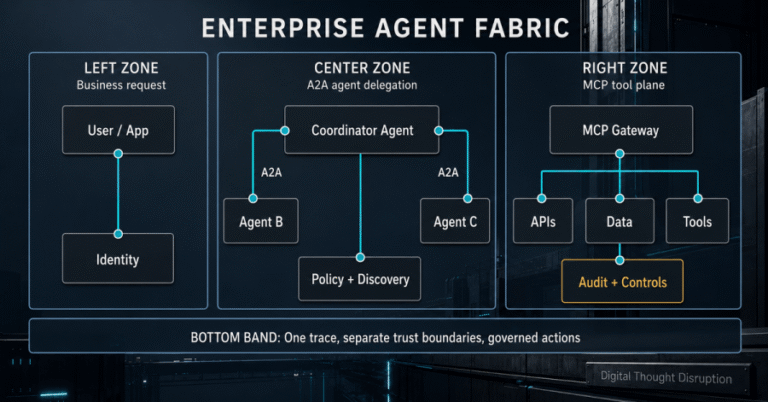
The value of the metaphor is not the imagery. It is the separation of concerns. A successful edge platform coordinates the entire system without pretending every component has the same role.
Build automation around the site class. Treat configuration, deployment intent, software versions, and validation tests as controlled artifacts. Use release rings and measurable exit criteria.
VCF Edge should therefore be designed as a fleet, not as a set of isolated small data centers. Central operations should define intent, software baselines, lifecycle policy, and evidence requirements. Edge sites should execute local workloads, preserve the minimum business service during degraded connectivity, and reconcile when fleet services return.
Remote infrastructure may face heat, dust, vibration, unstable power, limited rack security, and delayed replacement parts. Hardware monitoring, environmental thresholds, spare strategy, and remote-console access are part of the architecture, not facilities footnotes.
Conclusion
Distributed edge infrastructure works the same way.
TL;DR
The answer starts with a different mental model.
Local service must remain close to the point of work, while operational control must remain consistent across the fleet.
External References
The wrong design assumes that local workload execution automatically means full management independence. The better design documents the degraded mode and validates it.
Management-Plane Failure: What Still Works When vCenter, Azure, Identity, or the WAN Is Unavailable
Map what continues, what stops, and what can recover when management services fail. Separate workload execution from new operations and recovery across vCenter, Azure, identity, and WAN dependencies.
Read the article →
At the edge, observability should also tolerate delay. Missing telemetry is itself a condition to alert on, but it should not immediately be interpreted as workload failure. The platform must distinguish between a silent site, a disconnected site, and a failed service.
Make your next architecture decision with confidence.
Current VCF Edge materials describe right-sized deployment choices that range from single-host sites to larger clusters. The supported option is not just a hardware decision. It is a business continuity decision.