TL;DR
Can the current operating model provision network and security policy at the same speed as compute?
Choose VMware vSphere Foundation 9.1 or VMware Cloud Foundation 9.1 according to the service the organization must operate. VVF supports a capable workload platform with organization-owned integration. VCF adds a broader private cloud model for networking, automation, consumption, governance, and lifecycle coordination. Compare the required control boundaries, existing integrations, and team responsibilities before choosing. More platform scope creates value only when it addresses a real requirement and the organization can support the resulting service.
The key is to be honest about the service model.
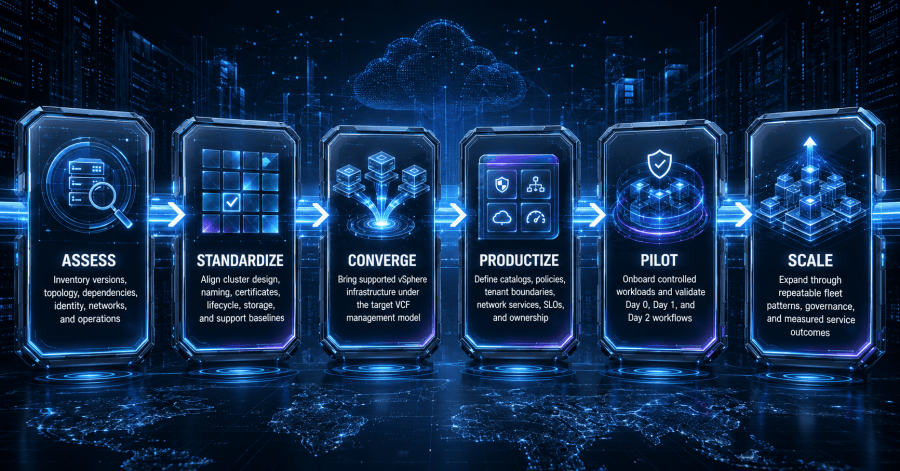
Begin by writing the service requirements and evaluating them against the comparison table. If VCF addresses a material gap, test a bounded service before expanding the operating scope. For lifecycle responsibilities that apply to that decision, see The City That Rebuilds Itself: VMware Cloud Foundation Lifecycle Management Explained.
The decision is about the service boundary
Several guardrails apply:
Detailed Platform Comparison
| Decision Area | VMware vSphere Foundation 9.1 | VMware Cloud Foundation 9.1 | Operational Meaning |
|---|---|---|---|
| Primary platform role | Enterprise workload platform for virtual machines and containers | Full-stack private cloud and infrastructure-as-a-service platform | Choose based on the required service-delivery model, not feature count alone |
| Compute and Kubernetes | vSphere and VMware vSphere Kubernetes Service | Same workload foundation integrated into broader cloud services and governance | Both support modern workloads, but VCF adds a wider consumption and control layer |
| Storage | vSAN and external storage integration | vSAN and external storage within a broader full-stack platform model | Storage architecture remains foundational in both platforms |
| Networking and security | vSphere networking with external integrations and processes as required | Integrated NSX routing, segmentation, firewalling, VPCs, and tenant isolation | VCF closes the gap between workload provisioning and network or security delivery |
| Automation | Automation built through APIs, PowerCLI, external tools, and team-defined workflows | VCF Automation provides catalog, policy, blueprints, orchestration, and extensibility | VCF moves automation into the supported private cloud control model |
| Lifecycle | Component and cluster lifecycle centered on vSphere lifecycle tools and operational procedures | Fleet-oriented lifecycle, configuration, and broader platform management | VCF is better aligned to repeated, standardized private cloud instances |
| Operations | VCF Operations capabilities for observability and optimization | Broader operations across infrastructure, networks, tenants, fleet, capacity, and cost | VCF supports a platform-wide operational view |
| Tenancy and governance | Primarily infrastructure and workload administration boundaries | Organizations, projects, delegated roles, quotas, policies, and isolated network constructs | VCF is better aligned to shared consumption across teams or business units |
| Private AI | Can host GPU-enabled virtual machines and Kubernetes workloads when properly designed | Adds integrated private AI services and automation patterns where supported and entitled | VCF can provide a governed AI platform layer, but hardware, data, security, and operations remain required |
| Organizational model | Infrastructure engineering and operations team | Platform product team serving multiple consumer personas | VCF value depends on service ownership and platform-product maturity |
Strong-fit scenarios include:
Where VMware vSphere Foundation Fits Best
VMware vSphere Foundation is usually the better fit when the organization has a clearly defined infrastructure scope and does not need to become an internal cloud provider.
This is why a VCF implementation can still fail when its underlying vSphere, vSAN, network, or operational design is weak. A private cloud control plane cannot compensate for poor infrastructure fundamentals.
- A centralized infrastructure team serving a limited number of application groups
- Primarily virtual machine workloads with selective Kubernetes adoption
- Existing network and security processes that already work effectively
- Mature external automation the organization intends to retain
- Environments where architectural flexibility matters more than full-stack standardization
- Smaller operational footprints where fleet-level cloud governance would be excessive
- Teams focused on infrastructure performance, resilience, lifecycle, and cost efficiency
This is why a VCF implementation can still fail when its underlying vSphere, vSAN, network, or operational design is weak. A private cloud control plane cannot compensate for poor infrastructure fundamentals.
- Multiple business units, tenants, or application teams requiring delegated consumption
- Self-service virtual machines, Kubernetes clusters, networks, and related services
- Standardized private cloud deployments across sites, regions, edge locations, or providers
- Integrated microsegmentation, routing, network isolation, and security automation
- Consistent lifecycle and fleet governance across a large environment
- Platform engineering requirements for catalogs, policies, quotas, approvals, and extensibility
- Governed private AI services requiring GPU-aware infrastructure, isolation, observability, and cost controls
- Service-provider or enterprise models requiring tenant operations, branding, showback, or chargeback
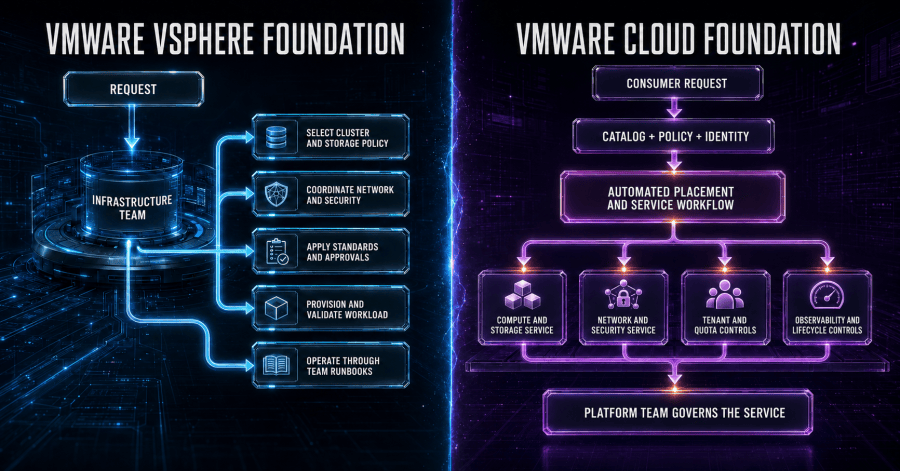
In a VMware vSphere Foundation environment, the infrastructure team commonly builds the operating model around the platform. With VMware Cloud Foundation, more of that model can be expressed through integrated automation, policy, tenancy, networking, fleet management, and lifecycle services.
A workload domain is an infrastructure and lifecycle construct. Tenant isolation also requires identity, authorization, networking, policy, and operational-access design. Likewise, terms such as self-healing and self-optimizing describe possible engineered workflows with limits, owners, and verification. They do not establish permission for unrestricted automated changes.
A Practical Decision Framework
Consumer Model
Without those capabilities, the organization may install the software without delivering the intended private cloud experience.
VMware vSphere Foundation provides strong workload and cluster lifecycle capabilities. VMware Cloud Foundation adds a broader model for coordinating platform instances, management services, policies, and fleet operations.
Get Paul Bryant’s practical guides to enterprise AI, hybrid platforms, and day-2 operations by email. New articles as they publish. Unsubscribe anytime.
Network and Security Model
When consumers submit requests through established workflows and the infrastructure team remains comfortable acting on their behalf, VMware vSphere Foundation may be entirely appropriate. Not every enterprise needs a self-service private cloud.
Is the organization prepared to operate a platform product?
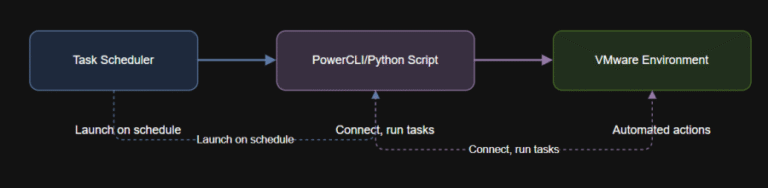
The following diagram shows the difference in request flow.
Lifecycle Model
Stay informed
Strong-fit scenarios include:
VMware Cloud Foundation builds on that workload foundation. It does not remove the need for sound cluster design, storage policy, availability planning, capacity management, identity integration, backup, recovery, or operational discipline.
Governance Model
Is the environment managed as individual clusters and tools, or as a standardized fleet?
This article compares VMware vSphere Foundation 9.1 and VMware Cloud Foundation 9.1 as enterprise platform choices. It focuses on architecture, automation, networking, security, lifecycle, governance, operations, and service delivery.
Private AI requirements need their own hardware, model, data, isolation, entitlement, and operational assessment. The ability to host GPU workloads and the availability of integrated platform services answer different questions. Keep either claim tied to the selected release and supported configuration.
Operating Team Model
The practical threshold is not environment size alone.
VVF is more than basic virtualization and can support substantial automation. VCF is broader than a product bundle, but its integration does not eliminate incident response, backup, application validation, network engineering, or change governance. High availability and successful provisioning should not be read as guarantees of application health.
Consider two illustrative organizations with comparable VM estates. The first has a centralized infrastructure team, established network and security workflows, and reliable automation maintained as part of its service. Application owners request capacity through a process that already meets their needs. The presence of many hosts alone does not establish a requirement for a broader private cloud control model.
Worked decision: two teams with similar infrastructure
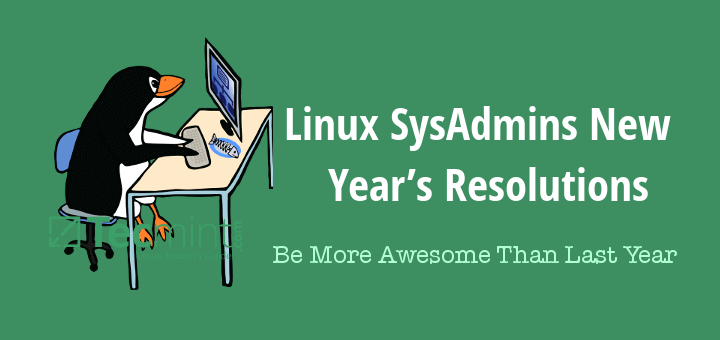
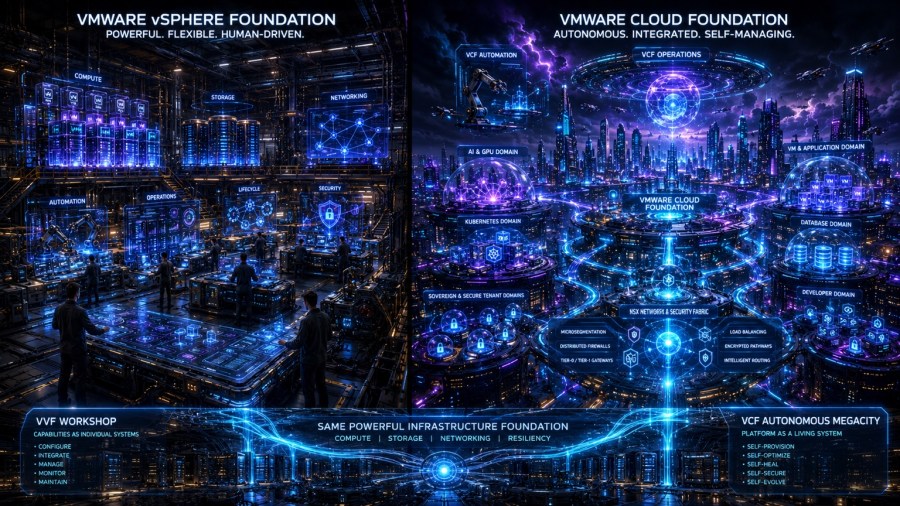
This is the main platform comparison. The workshop and private-cloud imagery helps explain the difference in scope: one emphasizes expert infrastructure operation, while the other organizes that expertise into repeatable services for consumers. Both still require architecture, maintenance, security, and recovery ownership.
Who consumes the platform?
Instead, it adds a broader control, networking, governance, and consumption model around those capabilities.
Qualify the capabilities before deciding
The official VMware feature comparison describes VMware vSphere Foundation as an enterprise workload platform that combines vSphere, vSAN, VMware vSphere Kubernetes Service, and VCF Operations capabilities. That creates a substantial platform for virtual machines and containers, infrastructure policy, cluster lifecycle, observability, optimization, and resource management.
VMware Cloud Foundation becomes more compelling when the infrastructure platform must operate as a shared, governed service across multiple teams, environments, or workload types.
Turn the comparison into a decision record
| Record | What to capture |
|---|---|
| Required service | Consumers, request types, availability needs, isolation, and lifecycle expectations. |
| Current fit | Requirements the present platform and integrations already meet. |
| Material gap | The specific missing capability or recurring coordination burden. |
| Candidate design | The product scope, external dependencies, entitlements, and supported configurations needed to close the gap. |
| Operating ownership | People responsible for service definitions, security, maintenance, recovery, and consumer support. |
| Validation | A representative pilot with acceptance evidence and a defined next decision. |