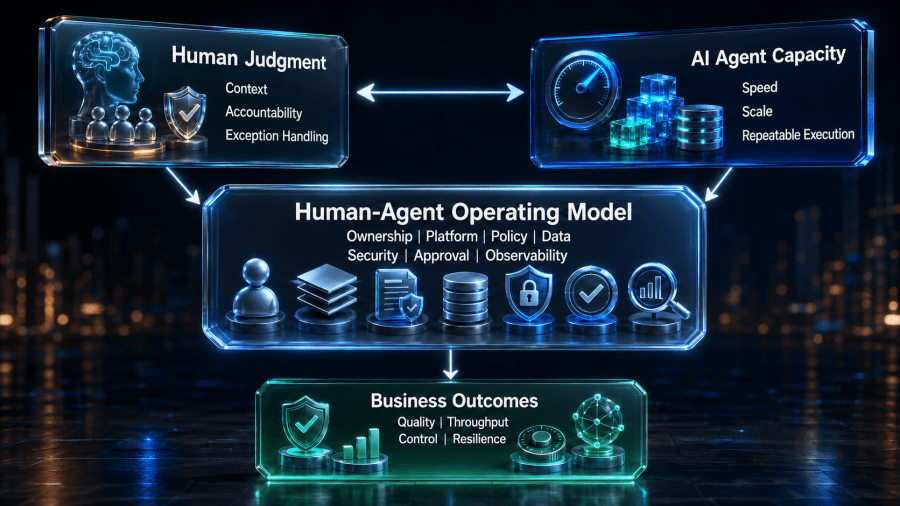
CIOs should resist two misleading ideas: that AI agents are simply digital employees, and that a central AI team can own every consequence of enterprise adoption. Agents are software actors operating through delegated authority. They can perform useful work at speed and scale, but accountability must remain with executive sponsors, application owners, employees, platform owners, security leaders, and data owners.
That does not mean security should approve every agent interaction. Mature controls should automate routine decisions and escalate only meaningful exceptions.
Allowing each team to innovate independently may accelerate the first pilots. It also creates duplicated platforms, inconsistent identity models, invisible agents, unmanaged data access, fragmented spending, and incompatible audit evidence.
- Which agents exist?
- Which identities do they use?
- Whose authority is being represented?
- Which tools and data sources can they reach?
- Which actions require approval?
- Where is execution denied by default?
- Can privileges be revoked without rebuilding the agent?
- Can operations reconstruct a complete run?
- Can the agent be isolated quickly?
- Who owns the incident after isolation?
A useful AI organization design does not create an isolated “AI team” that owns every decision. It distributes responsibilities while making the boundaries explicit.
The sponsor should own a defined business outcome.
That owner should be accountable for:
Security’s responsibility is to establish the non-negotiable boundaries, define assurance evidence, and verify that the deployed system matches its approved design.
- Reducing the time required to resolve priority incidents.
- Increasing the percentage of support cases resolved without rework.
- Shortening application delivery lead time.
- Improving architecture-review throughput.
- Reducing manual reconciliation effort.
- Improving compliance-evidence preparation.
- Reducing customer-response latency without reducing quality.
When those answers are explicit, AI agents can become a controlled source of organizational capacity.
A mature enterprise AI platform should provide:
An agent may be responsible for:
Decision Rights Across the AI Service Lifecycle
Central teams are useful for standards, platforms, assurance, enablement, and portfolio governance. They should not become permanent owners of every business workflow.
| Lifecycle decision | Accountable role | Primary delivery role | Required assurance |
|---|---|---|---|
| Select the business problem | Executive sponsor | Application or workflow owner | Business baseline and named outcome |
| Decide whether AI is appropriate | Application owner | Domain experts and architecture | Non-AI alternative considered |
| Define human and agent work | Application owner | Domain experts and process designers | Judgment, authority, and reversibility classified |
| Approve data use | Data owner | Application and platform teams | Classification, purpose, retention, and access review |
| Define agent authority | Application owner and security risk owner | Platform and application teams | Identity, tools, approval, and rollback controls |
| Approve production release | Application owner | Engineering and platform teams | Evaluations, operational readiness, and recovery test |
| Operate the shared platform | Platform owner | Platform engineering | Availability, capacity, cost, lifecycle, and telemetry |
| Operate the business service | Application owner | Product, operations, and support teams | Service levels, quality, user feedback, and incidents |
| Accept a material exception | Named risk owner | Security and application teams | Expiry, compensating controls, and evidence |
| Expand autonomy | Executive and application owners | Platform and workflow teams | Proven outcome and control performance |
| Retire the agent | Application owner | Platform, security, and data teams | Access revocation, data disposition, and dependency removal |
The most durable human-agent operating model can be summarized as:
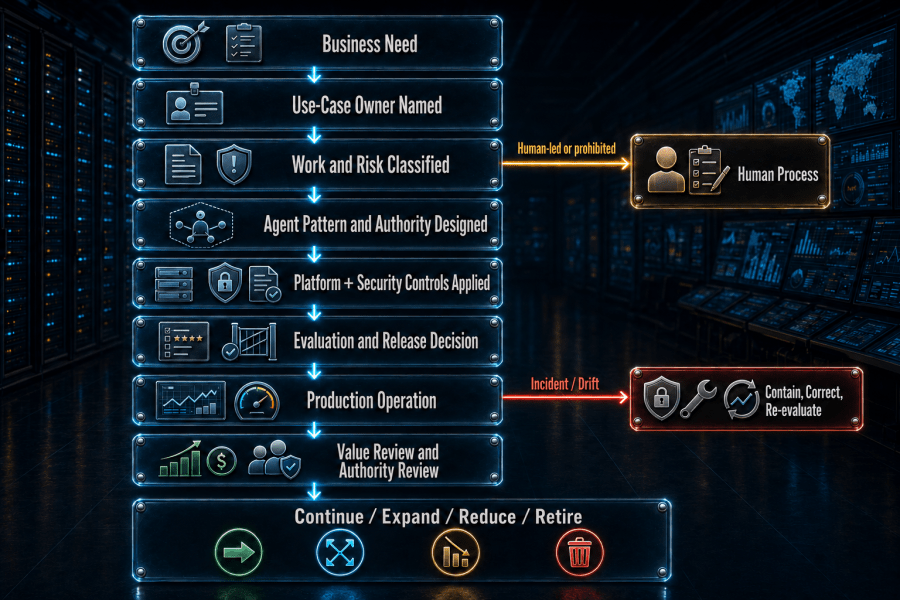
A Practical 90-Day CIO Implementation Plan
The better approach is to place the agent inside the work system while keeping accountability attached to human and organizational roles.
Days 1 to 30: Establish ownership and inventory
- Inventory known copilots, agents, AI-enabled applications, scripts, and autonomous workflows.
- Name an application or workflow owner for each production use.
- Record executive sponsor, business purpose, users, model provider, runtime, data sources, tools, identities, and environment.
- Classify each use case by judgment, authority, reversibility, and impact.
- Identify agents that have production access without a complete ownership record.
- Select two or three workflows with measurable baselines.
The CIO should provide the enterprise platform and control model. Business sponsors and application owners must remain accountable for the processes they choose to automate or augment.
Days 31 to 60: Build the shared control path
- Define approved agent patterns.
- Establish workload identity standards.
- Create a tool registry with named owners and risk classifications.
- Implement a tool broker for sensitive integrations.
- Define trace and audit requirements.
- Connect approval workflows to existing change, incident, or business systems.
- Create the production operating-contract template.
- Define unit-cost and outcome metrics.
- Train application owners and managers on their responsibilities.
Exit criteria: The selected agents can run only through approved identities, tools, policies, telemetry, and approval paths.
Days 61 to 90: Prove the model under operational pressure
- Run agents in shadow, recommendation-only, or read-only mode first.
- Evaluate representative and adversarial scenarios.
- Test approval expiry and exception routing.
- Exercise the kill switch.
- Simulate a tool compromise or unexpected agent action.
- Confirm that operations can reconstruct a complete run.
- Compare outcome, quality, human effort, and cost against the baseline.
- Hold a joint value and risk review before increasing authority.
“The agent did it” is not an operating model.
Common Operating-Model Failures
Treating the agent like an employee
The mistake is trying to force that actor into the organization chart.
Making the CIO accountable for every business outcome
Federation without shared controls becomes shadow AI by design.
An AI agent may perform work, but it cannot own the consequences of that work.
Creating a central AI team that owns everything
The agent cannot be accountable for:
Platform teams operate the paved road. Application owners decide where the road should lead.
Federating adoption without a paved road
Successful implementation means the organization can trace each contract element to an enforcement point or operating process. An allowed tool maps to a registry and authorization policy. An approval requirement maps to a workflow. A cost limit maps to runtime enforcement. A kill-switch owner maps to an on-call procedure. A review interval maps to a scheduled attestation.
The CIO owns the enabling technology and operating system.
Using human approval as blame transfer
Centralize the capabilities that should be consistent:
It is also broader than human-in-the-loop design.
Measuring activity instead of outcomes
Security should not be reduced to a final architecture review or a list of prompt-injection mitigations.
Examples include:
Expanding autonomy before proving operations
Keep accountability attached to people who have the authority to make decisions, correct the system, accept risk, and answer for the outcome.
The resulting workflow still needs an application or service owner.
The CIO’s Core Design Principle
For example, an operations agent might collect telemetry, correlate changes, identify a likely cause, prepare a remediation plan, and generate a dry run automatically. A human then approves the exact payload before the tool broker executes it.
Responsibility describes who or what performs an activity. Accountability identifies who must answer for the result, make the final decision, provide remediation, and accept the consequences.
A human-agent operating model is the set of decision rights, work-allocation rules, platform services, controls, ownership boundaries, and operating processes governing how employees and AI agents perform work together.
- Identity.
- Approved tools.
- Policy enforcement.
- Model access.
- Evaluation.
- Telemetry.
- Cost controls.
- Incident evidence.
- Disablement.
- Platform lifecycle.
An agent may interpret an objective, select a tool, retrieve data, generate an intermediate plan, call an API, retry a failed action, request approval, hand work to another agent, and retain state for later execution. It may act on behalf of an employee while authenticating through a separate workload identity. Its behavior may also change when its model, instructions, tools, retrieval sources, memory, or surrounding context changes.
- Use-case selection.
- Process design.
- Outcome ownership.
- Workflow-specific quality.
- Human decision points.
- User support.
- Value measurement.
- Service retirement.
The platform team should package these capabilities as services, templates, and policies that product teams can consume without negotiating every control from scratch.
Human-led work should remain the default when the task involves competing values, incomplete policy, material workforce impact, legal interpretation, public commitments, employee discipline, significant financial exposure, or irreversible production consequences.
Conclusion
This model avoids two common extremes.
Human approval is one control inside the model. The operating model decides which human should participate, what information that person needs, what authority they hold, how long a decision remains valid, and what happens when the person does not respond.
The business sponsor owns whether the use case is worth operating.
The executive sponsor should also define the acceptable risk envelope. The sponsor does not design tool scopes or logging fields, but must understand the implications of granting an agent access to customer data, production systems, financial workflows, or employee decisions.
When they are not, AI augmentation becomes invisible organizational debt.
Prompt volume, active users, agent count, and token consumption describe usage. They do not prove value.
A human-agent workforce changes the role of managers.
A successful demonstration proves that an agent can complete a path.
The first objective should not be enterprise-wide autonomy. It should be an enforceable operating model proven through a small number of real workflows.