Azure Local 2607 Architecture and Upgrade Advisory: Build 12.2607.1003.71, Known Issues, and Production Readiness
For iSCSI, Microsoft’s current implementation guidance requires:
Why Azure Local 2607 Is Architecturally Significant
Then export or document:
Design domain
2607 change
Practical interpretation
Workload networking
Azure Local VM can own a logical network DNS or gateway address
Enables guest-hosted DNS and NVA patterns, but does not create a native Azure-managed Layer 3 service
External storage
iSCSI documented as generally available for supported HCI and disaggregated configurations
Requires exact array, firmware, driver, adapter, MPIO, and fabric validation
Disaggregated placement
Local availability zones map nodes to customer-defined physical domains
Improves placement intent, but does not create independent Azure-style zones or eliminate shared SAN failures
Migration operations
New Azure Migrate roles and preview Terraform workflow
Improves least privilege and repeatability, but is separate from the 2607 cluster update
Disconnected operations
Static update packages can be imported
Reduces internet dependency, but does not include all container images
Security
Confidential VM preview and a stated 14-character local-account baseline change
Adds capability and policy impact, but the confidential VM feature remains preview and Microsoft’s password documentation is inconsistent
VM management
Multiple fixes for deletion, placement, networking, scale, and Arc resource bridge behavior
Potentially valuable for large environments, but still requires regression testing
The release also reinforces a harder lesson: production readiness cannot be inferred from a feature label or a release date. The target build, OEM validation, SBE, drivers, firmware, networking branch, immutable logical-network properties, Key Vault dependencies, storage support matrix, update connectivity, and workload acceptance evidence all influence the decision.
Networking Architecture: Guest DNS and NVA Support Without Overclaiming
The capability is generally available in 2607, but its scope must be described precisely.
The Azure Key Vault extension can remain in a Failed state after the 2607 update. Microsoft currently documents no workaround.
Active Directory Domain Services and DNS hosted on Azure Local VMs.
A guest network virtual appliance acting as the default gateway for a workload logical network.
Tenant or application segments that depend on appliance-based inspection, routing, or policy.
Brownfield designs where network functions must remain inside virtual appliances rather than move into a native SDN gateway service.
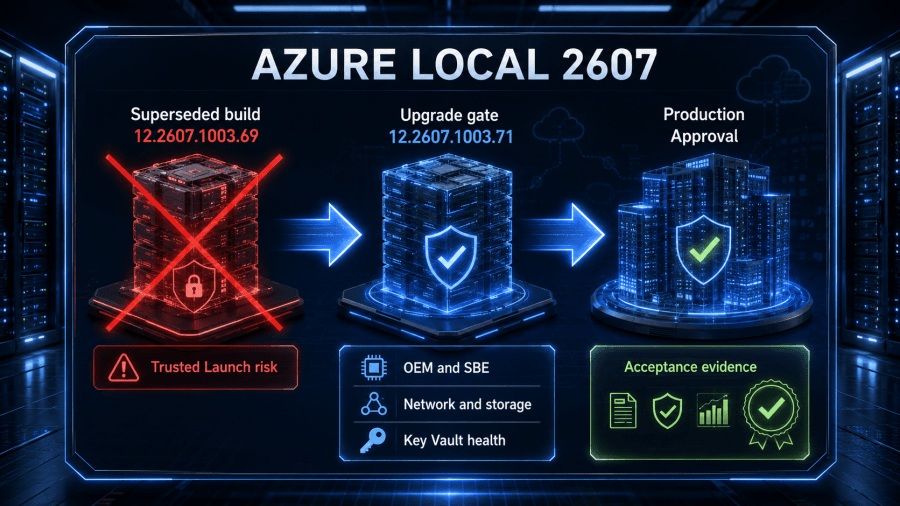
Do not import the .69 bundle into a production update repository. Wait for Microsoft to publish a .71-or-later bundle or obtain written instructions that identify a supported path and prove that the corrected solution components will be installed.
A disconnected-operations plan should identify:
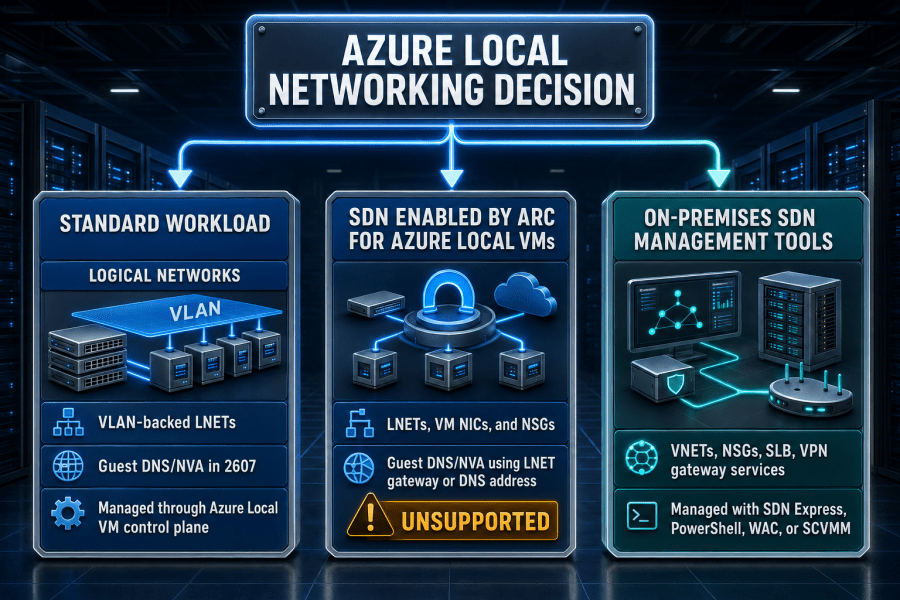
Azure Local has three relevant networking branches
Networking model
Workload management
Supported functions
2607 guest DNS or NVA status
Standard Azure Local workload logical networks, without SDN enabled by Azure Arc
Azure Local VMs through Azure control-plane tools
VLAN-backed logical networks, VM NICs, IP pools, gateway and DNS definitions
Supported
SDN enabled by Azure Arc
Azure Local VMs
Logical networks, VM NICs, NSGs
Unsupported when the guest uses the logical-network DNS or gateway address
A successful update is not simply a green update job. It is a set of proven platform and workload behaviors.
The local-account password baseline documentation conflicts
Azure Local 2607 should be approved conditionally, with the current approval target set to 12.2607.1003.71 or later.
Terraform support is also available in preview. Microsoft’s documented workflow currently requires Terraform 1.9 or later, AzAPI provider 2.4 or later, and Microsoft’s Azure Local migration pattern module.
A zone can represent:
If failure of the extension would leave the organization unable to operate, recover, rotate credentials, or satisfy policy, the update should not proceed without an agreed escalation and recovery plan.
Local administrator credentials.
Break-glass accounts.
Service or automation accounts using local identities.
Password vault policies.
Rotation workflows.
Deployment scripts and unattended configuration.
Current minimum-password-length policy.
Drift-control behavior.
Operational documentation that assumes shorter credentials.
VM management reliability improvements may justify a pilot
For every external array:
VM deletion.
Placement-setting preservation.
Network reconciliation.
Capacity checks.
Logical-network overlap validation.
DNS information display.
Arc resource bridge deployment timeouts.
Management and monitoring behavior at larger scale.
TL;DR
Before creating the logical network, the high-level design should define:
Microsoft also prohibits mixing the Arc-managed and on-premises SDN management methods. The architecture decision record should therefore state which branch governs the cluster before anyone designs the guest DNS or NVA pattern.
This advisory translates the 2607 release into architecture decisions, upgrade gates, and acceptance evidence.
The release affects several design domains at once.
Azure Migrate added two built-in roles for Azure Local migrations:
That removes the blanket prohibition, but it should not remove the test.
Whether the published CombinedSolutionBundle is .71 or later.
Where the CombinedSolutionBundle is obtained.
How hashes and provenance are verified.
How the bundle enters the controlled environment.
Which endpoints remain required.
How Arc resource bridge images are retrieved.
How AKS images are retrieved when applicable.
Whether proxies, firewalls, and allowlists permit those downloads.
What happens when a required image is unavailable during the maintenance window.
How the process is proven in a representative test environment.
Azure Migrate RBAC and preview Terraform support should proceed as a separate workstream. The 2607 limited-connectivity import should remain blocked while the public bundle table exposes .69, and any later package must still be described accurately because Arc resource bridge and AKS images remain outside the static payload.
Production Upgrade Gate for 12.2607.1003.71
A separate supported-SAN requirements page still states that external SAN supports only Fibre Channel and describes SAN-backed volumes using preview language.
Confirm the exact target build
Verify that the offered solution release is 12.2607.1003.71 or later.
Confirm OS build 26100.33158.
Reject a cached or imported .69 bundle.
Record package identity and hashes.
Confirm the release is offered through the supported Azure Local update workflow.
Do not use manual Windows Update, third-party host patching, or standalone node updates.
Inventory Trusted Launch workloads
Identify every existing Trusted Launch VM.
Record guest OS, security type, Secure Boot, vTPM, and business service.
Select representative VMs for the pilot.
Define pass criteria for stop, start, restart, migration, backup, and recovery.
Confirm that the pilot reports the .71 solution version before accepting results.
Baseline Azure Key Vault extension dependencies
Export extension names, versions, state, identities, and permissions.
Map secrets, certificates, recovery material, and automation dependencies.
Define the operational effect of a Failed extension.
Establish Microsoft escalation ownership.
Decide whether a Failed state is an automatic rollback, stop, or accepted-risk condition.
Validate the complete OEM and SBE stack
Confirm the exact server model and SKU.
Confirm that the OEM supports 2607.
Verify that the update is offered through the supported workflow.
Confirm that cluster-aware updating and OEM package sequencing remain supported.
Do not treat generic Windows Server 2025 driver compatibility as sufficient approval for the integrated Azure Local solution.
Regress the selected networking branch
There is also a release-distribution mismatch. As of July 30, 2026, Microsoft’s limited-connectivity bundle table still lists 12.2607.1003.69 for OS build 26100.33158 even though the release-information page identifies .71 as the current build. A static payload is not safe merely because it is the published download for that OS build.
Standard workload logical networks.
SDN enabled by Azure Arc.
SDN managed through on-premises tools.
It does not create the isolation properties of an Azure regional availability zone.
Logical networks.
Address spaces.
VLANs.
IP pools.
Gateways.
DNS servers.
Virtual switches.
VM NICs.
NSGs.
Static IP assignments.
Multi-NIC workloads.
Guest DNS or NVA ownership.
An advisory based only on the July 22 build would identify a hard Trusted Launch upgrade blocker. An advisory revalidated against the July 29 build must reach a different conclusion because Microsoft superseded the original package and marked the Trusted Launch startup issue as fixed.
Validate external storage precisely
Preserve the evidence with the change record. The purpose is not bureaucracy. It is to prove which combination of release, hardware, firmware, network, storage, and workloads was actually tested.
Confirm the exact supported model and protocol.
Verify controller firmware.
Verify NIC or HBA model, driver, and firmware.
Confirm MPIO policy and path count.
Confirm consistent LUN IDs across nodes.
Test path failover and restoration.
Verify TCP 3260 for iSCSI.
Verify MTU, VLAN, static routes, and isolated addressing.
Capture Microsoft and storage-vendor support ownership.
The limited-connectivity workflow allows an update package to be downloaded, imported, and discovered without every component being retrieved during normal online discovery.
Prove the limited-connectivity path
Confirm that Microsoft has published or explicitly approved a .71-or-later CombinedSolutionBundle.
Do not import the currently listed .69 payload.
Download and hash-verify the correct CombinedSolutionBundle.
Confirm that the bundle contains the intended superseding version.
Identify remaining Arc resource bridge and AKS image downloads.
Validate proxy, firewall, DNS, certificate, and endpoint access.
Run the process in a representative nonproduction environment.
Do not label the design offline unless all remaining dependencies are satisfied through a supported disconnected-operations architecture.
Pilot and batch the rollout
Use a representative nonproduction or low-risk cluster.
Match production hardware, SBE, networking mode, storage pattern, and workload security types.
Run pre-update health and capacity checks.
Update through Azure Update Manager or the supported Azure Local workflow.
Complete the acceptance test before approving the next cluster.
Roll out in small batches.
Stop on unexplained health, extension, storage, network, VM lifecycle, or Arc resource bridge failures.
Post-Upgrade Acceptance Evidence
This distinction matters operationally. A cached package, stale change record, OEM portal, disconnected repository, or previously approved implementation plan can still refer to .69 even after Microsoft has superseded it.
Domain
Required evidence
Stop condition
Version
Solution release reports .71 or later and expected OS build
Cluster remains on .69 or reports inconsistent version state
Cluster health
Nodes, storage, network, update services, and health faults are normal
New critical or unexplained warnings
Trusted Launch
Representative existing VMs start, restart, migrate, and recover
Any pre-existing Trusted Launch VM fails lifecycle testing
Key Vault extension
State and dependent workflows remain acceptable
Failed state causes operational, security, or recovery impact
VM lifecycle
Create, delete, resize, move, and placement operations succeed
Reconciliation, deletion, placement, or capacity errors
Logical networks
Portal and command-line views agree; IP pools and DNS are correct
Missing, overlapping, or stale network data
Data path
East-west, north-south, DNS, gateway, and multi-NIC traffic pass
Packet loss, asymmetry, route failure, or NVA instability
External storage
All expected paths are healthy; failover and restoration pass
Missing path, LUN mismatch, CSV error, or performance regression
Arc resource bridge
Management operations and deployment functions succeed
Timeout, unhealthy appliance, or failed reconciliation
Monitoring
Alerts, logs, metrics, and escalation workflows operate
Loss of visibility or incomplete evidence
External iSCSI support is one of the most important 2607 changes, but “generally available” does not mean “any iSCSI SAN is supported.”
Final Recommendation
Microsoft’s 2607 features page states that the security baseline enforces a 14-character minimum for local-account passwords.
The largest implementation-readiness concern is more direct: the disaggregated-zone configuration page labels its PowerShell commands as placeholders that must be replaced with final supported cmdlets.
That enables designs such as:
The decision flow below makes the gating logic explicit.
These changes should be tracked as migration-workstream improvements, not used as justification for a production-cluster upgrade.
Conclusion
The external-storage design still depends on a validated combination of array model, controller firmware, host adapter or NIC, driver, firmware, multipath software, switch configuration, cabling, and Azure Local release.
The superseded .69 package should be blocked. The earlier blanket Trusted Launch prohibition should also be retired because Microsoft now lists the startup issue as fixed. Existing Trusted Launch workloads still deserve explicit boot and lifecycle testing because the original defect had a high operational impact and the correction arrived through a rapid release revision.
For conventional hyperconverged clusters with validated OEM support, aligned SBE content, stable logical networks, understood Key Vault dependencies, and no unresolved storage concerns, a representative pilot followed by small production batches is reasonable.