That does not mean workforce impact should be ignored. It means the most useful leadership conversation starts somewhere more concrete: how work moves, where it stalls, who owns the outcome, what controls are required, and how value will be measured.
Who approves?
That distinction matters.
What data is safe to use?
Where does the final action get recorded?
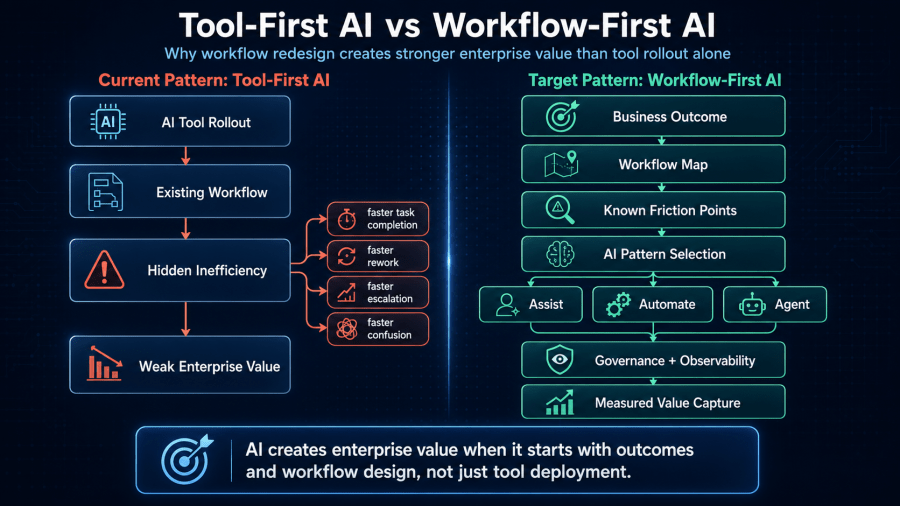
What matters in this model is the sequence. AI should not start with the tool. It should start with the outcome, move through workflow analysis, identify friction, select the right AI pattern, and then wrap that pattern in governance and observability.
It means the first-order leadership problem is not simply labor replacement. The first-order problem is operating model redesign.
The practical starting point is not a giant AI transformation program.
That is where AI produces durable value.
Why This Matters Now
A lot of organizations are still trying to bolt AI onto the same broken workflows they have tolerated for years. They are putting copilots in front of knowledge sprawl. They are putting agents on top of unclear ownership. They are summarizing meetings that exist because systems do not produce usable status. They are accelerating tasks without redesigning the process around the task.
AI can make bad workflows move faster.
AI operating model maturity.
The organizations that get meaningful value from AI tend to make one important shift:
The implication is straightforward.
That finding is useful because it pushes the conversation past broad claims.
That is where AI gets misread.
Do not build an AI strategy around generic productivity assumptions.
Gartner notes that organizations should measure AI impact with a wider set of metrics, including AI experience, worker wellbeing, cost, risk, and revenue indicators. (Gartner)
Some problems need summarization.
The Pattern at a Glance
The practical shift is from tool-first AI to workflow-first AI. The diagram below shows the difference.
Stanford HAI’s 2026 AI Index makes a similar point: productivity gains vary by task type, and AI agent deployment remains early across most business functions despite broad AI adoption. (Stanford HAI)
It is also a poor starting point.
The Wrong Question: “How Many Roles Can AI Remove?”
The organizations that win with AI will not be the ones that simply buy the most tools or launch the most pilots.
Enterprise AI needs instrumentation, not anecdotes.
Governance cannot live only in a PDF, steering committee, or quarterly review.
The headcount question is tempting because it is easy to explain on a slide.
This kind of artifact forces the right conversations.
That aligns with what many technical leaders are seeing in practice.
What decisions require a human?
It separates assistance from autonomy. It defines where the AI can operate. It identifies where humans remain accountable. It gives operations a rollback path. It also gives security, legal, risk, and platform teams something concrete to review.
Some need a deterministic workflow engine with AI assisting only at specific decision points.
The Better Question: “Where Is Work Losing Value?”
Not “AI adoption.”
That is the real shift.
Deloitte’s 2026 State of AI in the Enterprise report makes the same point from another angle: AI is delivering efficiency and productivity benefits, but only a portion of organizations are using it to deeply reimagine how business processes work. Deloitte also highlights that agentic AI adoption is rising while mature governance for autonomous agents remains limited. (Deloitte)
That is acceleration without architecture.
One reason AI strategy gets messy is that productivity gains are real, but uneven.
Productivity Gains Are Real, But They Are Not Uniform
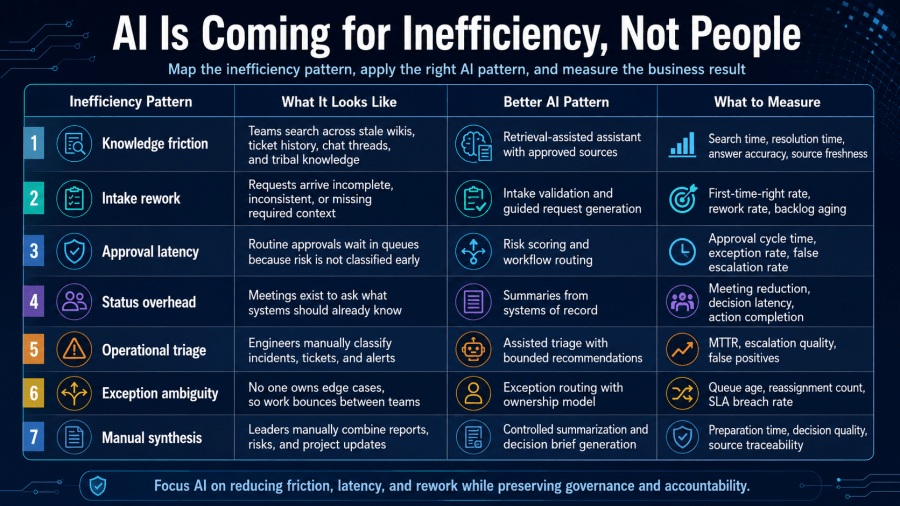
When organizations treat AI as a layoff mechanism, they often miss the larger value pool. Inefficiency is usually embedded in handoffs, data quality, approval paths, exception queues, stale documentation, inconsistent intake, redundant meetings, and unclear decision rights.
That redesign has several parts.
That is important because hours saved can become a vanity metric if the saved time does not turn into better throughput, lower risk, higher quality, faster decisions, or improved customer outcomes.
BCG’s AI Value Gap research points to a widening divide between organizations getting material value and those seeing limited returns. The higher-performing group is not just buying tools; they are committing leadership attention, building critical capabilities, reinvesting AI returns, and using AI to support reinvention as well as efficiency. (BCG Global)
Transformational? Not by itself.
Enterprise AI adoption is no longer a theoretical planning topic. McKinsey’s 2025 State of AI research found broad AI usage across organizations, but also found that many companies remain early in scaling and capturing enterprise-level value. The same research points to workflow redesign, leadership ownership, human validation, technology and data infrastructure, process embedding, and KPI tracking as characteristics of higher-performing organizations. (McKinsey & Company)
AI is not just another technology wave waiting for a procurement cycle, a license rollout, and a few enablement sessions.
That means looking for friction patterns.
The Operating Model Shift
This is where leadership discipline matters.
AI does not create the same value in every function, for every worker, or across every workflow. Structured work with clear inputs, measurable outputs, and repeatable decisions is usually easier to improve. Ambiguous work with high judgment, unclear policy, poor data, and many exceptions requires more careful design.
In practical terms, that means every production AI workflow should answer:
Outcome Ownership
For example, “reduce median ticket resolution time without lowering customer satisfaction” is a stronger objective than “deploy an AI service desk assistant.”
Before choosing the model or platform, map the workflow.
An outcome owner.
The first statement defines value and guardrails.
Some need classification.
It is a disciplined use-case portfolio.
It has to show up inside the workflow.
Workflow Mapping
That is why Gartner’s framing matters. The more useful AI conversation is not “how many people can this replace?” The better question is: where is the organization spending human effort on work that should have been simplified, routed, governed, or automated years ago? Gartner’s article argues that AI-related headcount reductions are still difficult to isolate, while meaningful productivity gains are appearing in teams that use AI effectively. (Gartner)
Pilots prove possibility.
That is not transformation.
A copilot that gets used heavily but produces unreviewed, low-quality work is not a success.
Not just a product owner.
It is framed around remove friction from a workflow.
This is where many AI pilots fail. The model is technically impressive, but the workflow around it is not production-ready.
Where does the request start?
They are the control plane for enterprise AI.
Pattern Selection
Then classify the AI pattern.
They stop treating AI as a tool rollout and start treating it as an operating model redesign.
Not every problem needs an autonomous agent.
They will use AI to remove friction, improve decision quality, reduce operational drag, and expose the hidden cost of complexity that people have been compensating for manually.
“Hours saved” is useful, but incomplete.
AI is coming for inefficiency.
Not AI as a shortcut around operating discipline.
Governance in the Flow of Work
Where do exceptions go?
That does not mean AI will have no workforce impact.
NIST’s AI Risk Management Framework is designed to help organizations better manage AI risk and improve trustworthiness across AI design, development, use, and evaluation. NIST’s Generative AI Profile extends that thinking to generative AI risk management through suggested actions across governance, mapping, measurement, and management. (NIST)
Some need a copilot.
- What data is allowed?
- What data is prohibited?
- Which actions can the AI recommend?
- Which actions can it execute?
- When is human validation required?
- What gets logged? How is quality reviewed?
- How is the workflow disabled if something goes wrong?
A summarization tool that saves meeting time but does not improve decision quality is only partial value.
The second statement defines a tool.
A Practical Control Example
The table is deliberately not framed around “replace a role.”
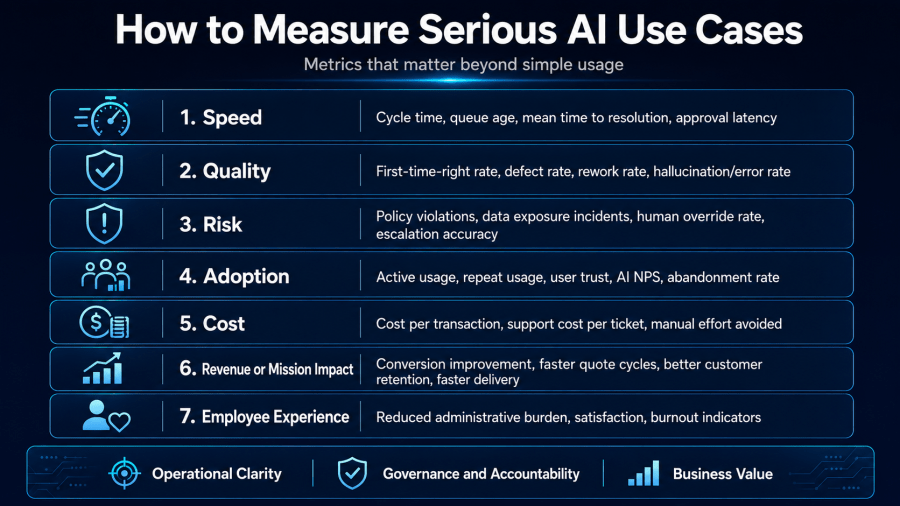
A better enterprise AI scorecard should include:
Agentic AI should be reserved for cases where the organization can clearly define the goal, allowed tools, permissions, boundaries, escalation logic, logging, and rollback path. OWASP’s GenAI Security guidance highlights risks such as prompt injection, sensitive information disclosure, supply-chain exposure, excessive agency, and misinformation, which become more important as AI systems gain more autonomy. (OWASP Gen AI Security Project)
That is the gap technical leaders need to close.
Metrics That Matter More Than “Hours Saved”
AI is coming for the inefficiency that people have been forced to absorb.
This is why the AI conversation has to move beyond pilots.
The first wave of AI experimentation usually creates scattered productivity pockets. Someone writes better emails faster. A service desk engineer summarizes tickets faster. A developer generates boilerplate faster. A project manager turns meeting notes into action items faster.
They will be the ones that redesign the workflow around the outcome.
Which systems hold the truth?
An agent that completes tasks quickly but creates new risk exposure is not a success.
Operating models prove value.
Those are not “people problems.”
A 2025 Quarterly Journal of Economics study of generative AI at work, based on data from 5,172 customer support agents, found that AI assistance increased worker productivity by 15% on average. The gains were larger for lower-skilled and newer workers, while the effect was smaller for more experienced or higher-skilled workers.
Where Technical Leaders Should Start
Gartner notes that less than 1% of announced layoffs in the first half of 2025 were attributable to productivity gains from AI, and Gartner forecasts a net increase in jobs from AI beginning in 2028. The more immediate impact is expected to come from job change rather than job shedding. (Gartner)
Every AI use case needs an accountable owner tied to a business or operational outcome.
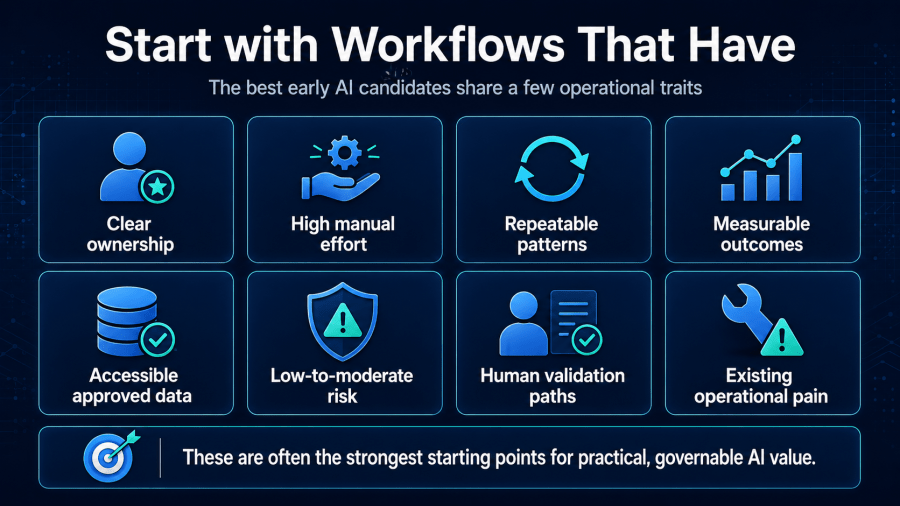
They are design problems.
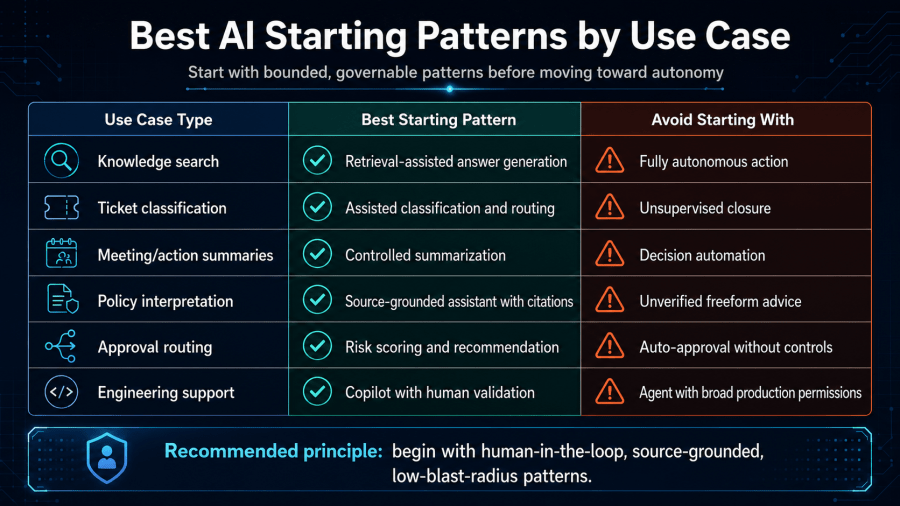
That is the difference between AI enthusiasm and AI readiness.
It is a pressure test on the way work actually moves through the enterprise.
The enterprise value shows up when AI becomes part of a redesigned workflow with clear ownership, governed data access, measurable outcomes, and operational feedback loops.
The key is to connect AI usage to operational evidence.
The Risk of Automating the Mess
Useful? Yes.
AI makes those design problems visible because it can only perform reliably when the surrounding system is clear enough to support it.
That is how AI becomes an operating capability instead of another disconnected productivity tool.

AI is not coming for people first.
The example below shows a simplified policy model for an AI-assisted service desk triage workflow. It is not meant to be a complete production policy. It is meant to show the kind of specificity needed before AI becomes part of operational execution.
Some need retrieval.
Conclusion
A stronger AI strategy starts by identifying where work loses value before it reaches the customer, employee, platform, or business process.
AI Is Coming for Inefficiency: How Enterprise Leaders Should Redesign Work Before Automating It
The lesson is not “spend more.”
Build it around workflow-specific value hypotheses.
Those questions are not bureaucracy.
Not just a platform owner.
The lesson is “operate differently.”