Now consider the next boundary. A revised investigation identifies a configuration discrepancy on one application instance. The planner proposes a narrowly scoped correction. An evaluator finds the procedure applicable, and an operator approves it.
A policy epoch identifies the applicable policy state in this design. It should map to identifiable policy artifacts, not just an arbitrary counter. Keep relevant identity, delegation, and resource attributes identifiable too: a policy revision alone does not capture a revoked permission or changed tenant assignment.
Does the original approval still apply?
Condition at the boundary
Expected behavior in this design
Retrieved text claims approval
Require a valid approval-service record
Approved target is changed or expanded
Reject the mismatch and require a new manifest review
Applicable policy adds an unmet requirement
Withhold execution pending satisfaction of that requirement
Target version no longer matches
Stop the mutation and reassess the plan
Required policy or identity state cannot be established
Block production dispatch and expose the dependency failure
A prior dispatch timed out with unknown outcome
Reconcile the existing operation before attempting another mutation
Before execution, the planner expands the target from one instance to every instance running the service. Its explanation sounds reasonable: applying the same configuration everywhere should prevent recurrence.
Begin by exercising this path without production writes. Demonstrate that changed targets, forged approval claims, expired authority, and unresolved prior dispatches cannot silently advance. Then introduce one narrowly defined operation with a clear owner and a measurable operating benefit.
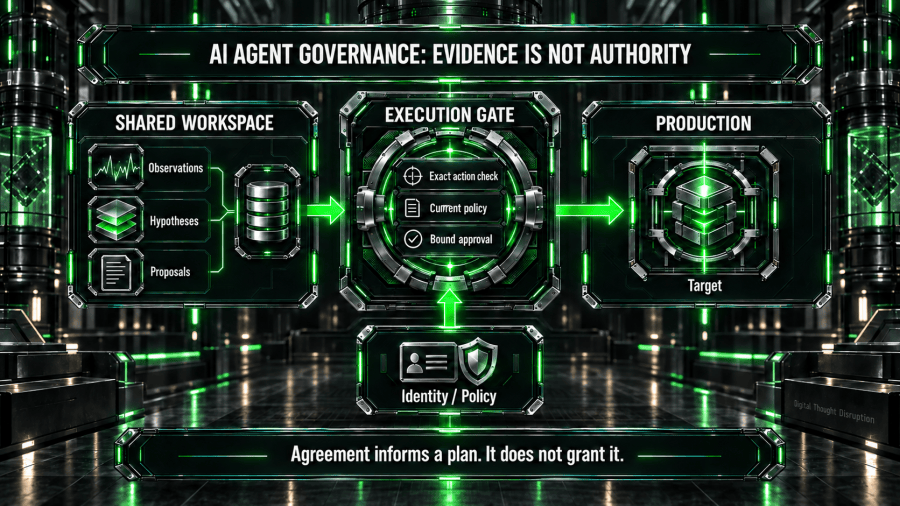
The workspace establishes what deserves consideration. The authorization path establishes what may be attempted.
Do Not Turn an Approval into Persistent Memory
OWASP’s LLM01:2025 Prompt Injection describes indirect injection through external content and recommends separating such content, constraining privileges, and requiring approval for high-risk operations. Treating retrieved instructions as data is part of the defense, not a guarantee that a model will never follow them.
Recovery requires its own authorization treatment. A previous configuration may no longer be acceptable, and reversing the main write does not necessarily reverse external messages or other downstream effects. A recovery plan reference is not an unrestricted rollback grant.
An approval service can bind its receipt to a digest of a defined canonical representation of the manifest. Do not hash arbitrary YAML formatting or assume an unprotected hash proves who approved anything. Protect the receipt’s issuer, integrity, scope, expiration, and revocation state through the chosen service or cryptographic protocol.
The incident history should preserve that a particular approver accepted a particular action. The reusable knowledge store should not convert that event into “certificate repairs are preapproved.”
Put Ownership at Each Boundary
The operating team needs a handoff that answers why an action is blocked and who can resolve the condition. A policy-service failure is not a model-quality incident; an ineligible certificate artifact is not an invitation to change the approval policy.
Receive new enterprise AI and hybrid platform articles when they are published.
For this design, qualify operational lessons before promoting them to memory. Preserve the deployment scope, evidence, validation result, limitations, and review conditions. A successful repair on one instance does not establish that the same procedure is appropriate for every certificate-related outage.
For this example, approval covers one instance and the listed configuration effects. It does not authorize fleet-wide repair, certificate revocation, changes to trust stores, or messages to customers.
Conclusion
Checking immediately before dispatch reduces the interval between authorization and action. It does not make a distributed workflow atomic.
Open Policy Agent’s Decision Logs documentation describes recording policy inputs, results, decision identifiers, and policy-bundle revisions, with mechanisms for masking sensitive data. Those facilities can support the authorization record, but they are not proof that a tool obeyed the decision.
A role name in generated JSON is not authenticated identity. Trusted services must establish those identities and their permitted relationships. Human approval cannot expand the approver’s own delegated authority or override a target-system restriction by itself.
Continue with one tenant, the production service payments-api, and read-only investigation components. Assume an additional, independently collected endpoint check finds that one instance presents a certificate chain inconsistent with its approved configuration.
External References
That was the problem addressed in Part 1, Designing a Shared Workspace for AI Agents: when evidence changes, dependent plans must become reviewable.
Choose your next step
The new proposal is to apply a specific eligible certificate bundle to that instance and reload its TLS configuration through a purpose-built adapter. Application owners must establish that the procedure, capacity conditions, and validation checks fit the service. No private key material should enter the workspace.
AI strategy & delivery
Enterprise AI
Strategy, governance, AI platforms, data, and accelerated infrastructure.
Explore Enterprise AI →
Architecture & integration
Hybrid Platforms
Architectures that connect VCF, Azure, public cloud, Kubernetes, and edge.
Explore Hybrid Platforms →
Validate candidate fields against trusted inventory and adapter schemas before freezing the manifest. Resolve the target’s tenant and environment independently; do not trust the planner to label an out-of-scope resource correctly. Reject unknown parameters and unsupported adapter revisions.
Get practical guidance by email
For the certificate incident, the endpoint check and the configuration record contribute different evidence. Three summaries of the configuration record do not. Preserve that distinction when presenting the case to a human approver.