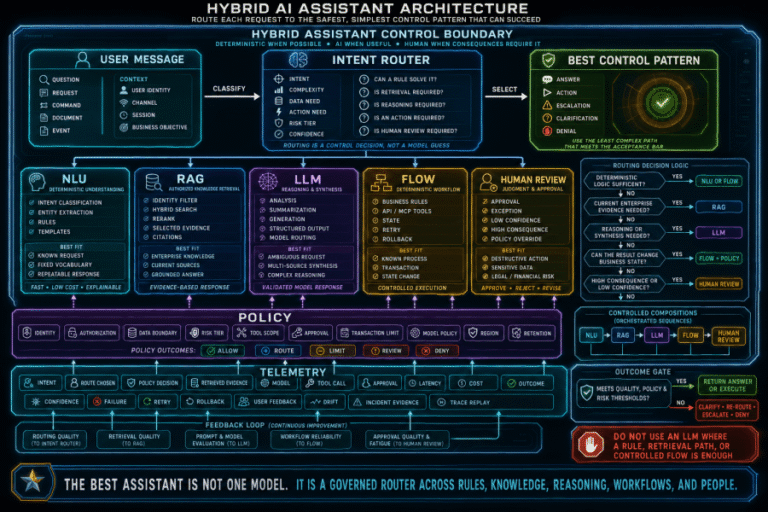
These are related decisions, not alternative names for a single confidence score. A historical incident report may accurately describe a previous action without authorizing that action today. An approved policy may be relevant without supporting the particular conclusion beside its citation.
Define a material-claim coverage measure as the proportion of evaluated material claims supported by admitted evidence. Separately track the proportion of evaluated citation associations judged appropriate. Document the evaluation unit, treatment of claims requiring several passages, and handling of unassessed cases; these custom measures need not match a vendor’s built-in calculation.
Begin with a bounded corpus and a human-reviewed test set. Run new semantic checks in shadow mode to measure disagreements, then introduce blocking behavior for clearly defined answer classes. Shadow evaluation is observation, not protection; retain existing access and rendering controls throughout.
Enterprise AI · Part 1: Data boundaries · Part 2: Retrieval permissions
Introduction
A properly cited answer also remains separate from permission to execute a change. Reading the runbook does not approve the restart.
The following are proposed acceptance cases, not reported test results:
For the support assistant, register which sources may establish policy, which describe operational procedures, and which provide historical or informal context. Have the appropriate owners control those roles through a trusted registry.
The following flow places validation before disclosure. Notice that opening a citation is a subsequent protected operation, not a permanent privilege granted when the answer was generated.
AWS documents S3 presigned URLs as bearer tokens: possession can convey the access granted through the signed request. They support useful distribution patterns, but their expiry is not equivalent to checking the current identity of every person who receives the link.
Report applicability errors, missed decision conditions, and unauthorized metadata disclosures separately. Do not average a disclosure failure away because an answer has excellent relevance or readability.
Separate Citation Existence from Evidence Quality
When current approval status is needed, obtain it through a separately authorized workflow or state that it was not checked. A runbook describing how exceptions work is not evidence that one was granted.
Pair these measures with unnecessary abstentions, validation latency, and cost. A platform that refuses every question has not met its business objective. A platform that answers quickly while dropping the production exception has not met its operational objective either.
Property
Question the control must answer
Provenance
Which source version and passage were supplied to the application?
Claim support
Does the cited evidence justify the specific statement?
Applicability
Does the evidence apply to this environment, system, time, and decision?
Disclosure permission
May this recipient receive the answer and the displayed source information?
Coverage
Are material claims supported, with uncertainty and inference identified?
During an incident, use lineage to identify affected answers and reusable artifacts, prevent further unsafe serving, and preserve required evidence. Recovery must retain current revocations and source withdrawals. Rolling back a model or validator must not reactivate retired information or erase the record of an earlier disclosure.
Use synthetic documents with explicit versions, roles, and permissions. Include supported answers as well as intentionally flawed candidates.
A locator might identify a section or a passage in a versioned document. Do not depend solely on a character offset in content that will be re-extracted differently next week.
Build a Request-Scoped Evidence Manifest
Use them only where those sharing characteristics fit the disclosure policy. For sensitive source viewing requiring recipient-specific authorization, keep access behind the resolver or another mechanism that enforces that requirement.
An authorized excerpt also does not automatically authorize downloading the complete parent document. Evaluate the actual resource and information scope of each operation.
Keep exploring
Managed guardrails also have defined boundaries. As checked on September 10, 2026, AWS states that Knowledge Bases guardrails apply to model input and generated responses, not to references retrieved at runtime. Do not treat enabling that feature as validation of the entire citation-viewing path.
Those checks establish reference integrity. They do not establish semantic support.
Supplied Context and Cited Evidence Are Different Records
Do not let text inside a document declare itself authoritative. A draft containing “this is the current production policy” should not gain policy status merely because the model repeats that sentence.
Source freshness is a relationship to the question. It is not simply a preference for newer documents.
Amazon Bedrock’s RAG evaluation documentation distinguishes correctness, faithfulness, citation precision, and citation coverage. Those are useful dimensions to preserve even when an organization uses a different evaluation platform.
Also distinguish “no relevant evidence was retrieved” from “no restriction exists.” A search result does not establish the completeness of the organization’s policy corpus. When the required evidence is absent, give a bounded answer or abstain from the operational recommendation.
Use source status, effective dates, product or service scope, and environment applicability when selecting and evaluating evidence. These fields need reliable ownership and update mechanisms, not merely a place in the index schema.
Validate the Claim, Including Its Conditions
Business-hours restarts are permitted for nonproduction instances. Production instances require an incident-commander-approved exception.
Evaluate the evaluator against representative human-labeled cases. Measure both unsupported answers it accepts and supported answers it rejects. A second model saying “supported” is an assessment under that model and rubric, not a certificate of truth.
Keep the supplied evidence set separate from the subset the model cites. The latter is not a complete dependency or confidentiality inventory. An answer can contain information from context it does not cite.
Preserve the Condition That Changes the Decision
For this architecture, distinguish the following properties:
The runbook permits business-hours restarts for nonproduction instances. A production restart requires an approved exception. This answer does not establish that an exception exists for this request.
schema_version: “1.0”
policy_id: support-rag-evidence-v1
manifest:
owner: trusted_application
scope: request_and_customer
version_binding: exact_admitted_evidence
unresolved_lineage: withhold
references:
allowed_handles: admitted_manifest_only
unknown_handle: reject_candidate
model_supplied_destinations: reject
claim_checks:
material_claims: require_support
decision_conditions: preserve
applicability_profile: support-runbook-rules-v1
semantic_rubric: support-evidence-review-v1
unresolved_material_claim: review_or_abstain
release:
mode: buffered
authorization_scope: all_governed_context_dependencies
before_delivery: revalidate_disclosure
content_change_after_validation: revalidate
dependency_failure: withhold
max_repair_attempts: 1
final_payload_binding: required
source_view:
before_metadata_delivery: authorize
before_content_delivery: authorize
version: cited_version
unavailable_version: report_unavailable
full_document_access: authorize_separately
rendering:
citation_builder: trusted_application
raw_generated_html: reject
automatic_external_fetches: deny
evidence_record:
storage_profile: restricted-evidence-v1
retention_profile: support-evidence-retention-v1
credentials: exclude
Distinguish direct source statements from derived interpretations. Labeling an inference is useful, but does not excuse missing premises or make the inference safe to act on.
The example uses a buffered release mode for operational answers. Unknown references, unresolved material claims, and failed disclosure checks prevent release. A single repair attempt is an illustrative retry budget, not an industry benchmark.
Across this series, the control model has remained consistent: govern information as it enters and changes form, authorize its use for the actual requester, and validate the evidence relationship before disclosure. None of those decisions should be delegated to the model merely because it can generate a convincing explanation.
A required-validator outage should not become permission to provide an unchecked operational recommendation. An independently authorized source viewer or a qualified human workflow may offer a fallback, provided it does not bypass the failed security boundary.
Evaluate Combined Claims and Missing Evidence Carefully
I would treat that relationship as an application contract, not a formatting feature. The scope here is an indexed enterprise assistant producing answers from approved sources. The manifest, policy, and tests below are proposed implementation patterns, not features guaranteed by every RAG product.
An invented handle should fail validation. Do not map it to the nearest-looking title or attach a plausible source after the fact. Additional evidence requires another authorized retrieval and validation cycle.
Semantic evaluation can help identify unsupported claims, missing conditions, and conflicting evidence. Decide explicitly whether a particular check is a synchronous release gate, an offline evaluation, or a sampled review. An offline quality score does not block a production response unless the application implements that control.
Establish Source Authority and Applicability
An authorized historical viewer can show that a version has been superseded. A requester whose access was revoked should not receive the protected historical content simply because the citation was valid earlier.
Receive new enterprise AI and hybrid platform articles when they are published.
For disclosure checks, retain the conservative context dependencies established in Part 2, including permitted conversation state. Do not broaden access because the generated answer happens to cite only its least restricted source.
Failure should produce a controlled outcome with a diagnosable reason. A revoked dependency requires discarding the affected answer and rebuilding from currently authorized context, not merely removing its citation. Do not keep regenerating until an evaluator eventually accepts an answer, and do not deliver unchecked tokens before a required blocking decision completes.
Test the full interface, including previews, saved conversations, exports, and browser network behavior. A server-side validator passing is insufficient when a separate client path renders unvalidated metadata.
OWASP’s logging guidance identifies credentials, access tokens, sensitive information, and data exceeding the logging system’s classification as material that should not be recorded indiscriminately. Diagnostic convenience does not approve a broader audience for the original documents.
Treat the Evaluator as a Controlled Component
For an operational assistant, I would extend that separation to source authority and current disclosure permission. Neither can be inferred from a model’s confidence in its answer.
A supported response would preserve the distinction:
Static exports and information already read fall outside what later access revocation can erase. Define export permissions separately rather than implying the platform can recall every disclosed copy.
The following YAML extends the admission and retrieval contracts from Parts 1 and 2. It describes controls for a custom application; it is not native Amazon Bedrock configuration or a ready-made enforcement engine.
Keep Citations Inside the Disclosure Boundary
For the proposed operating model, measure reference validity separately from claim support. A working-link rate answers whether references resolve. It does not answer whether their passages justify the claims.
Start with deterministic checks. Every returned handle must exist in the response’s admitted manifest. Its source version and locator must resolve. Any claimed direct quotation must match the designated source representation under a documented normalization rule.
Success means an authorized answer reaches the requester with resolvable references and recorded validation decisions. It does not mean the application has mathematically proved every natural-language claim.
Amazon Bedrock’s Citation API object associates a generated response segment with retrieved-source information. That is a useful interface for attribution. It is not an independent test that the segment is justified.
Preserve the Version Without Preserving the Old Permission Grant
New articles
For each admitted evidence item, retain the authoritative document identifier and revision, an integrity reference, the exact model-visible passage or a protected reference to it, its source locator, and the extraction or transformation version. Associate the item with the request’s customer boundary, policy decisions, and approved use.
When the exact version is unavailable, report that the original evidence cannot be opened. Do not fabricate continuity through a similar current document.
A Presigned Link Is a Different Access Mechanism
In the hypothetical runbook, assume the governing passage states:
The source title, customer name, excerpt, storage path, and preview are themselves information. Authorize their display before sending them to the browser, not only when the user clicks the document.
Use model-based assessment alongside deterministic validation and domain-owner review. OWASP’s prompt-injection guidance cautions that a guardrail model is itself susceptible to injection and should not replace independent security controls.
Render Evidence Without Opening Another Data Path
The application should assess the environment restriction and approval requirement as decision-critical claims. Where approved policy exists in reliable structured form, evaluate those conditions through trusted code rather than relying exclusively on another language model.
Use an application-controlled resolver that accepts an opaque reference, establishes the current recipient, and resolves the permitted source version. Possessing a reference identifier should not bypass those checks.
OWASP’s prompt-injection guidance identifies malicious links, image-based exfiltration, and streaming Markdown as output-channel risks. A response can therefore create a problem through what the renderer does, not just through the text a person reads.
Part 1 addressed how information enters the platform and retains its restrictions. Part 2 addressed which information a request may retrieve and disclose. This final article assumes those controls exist and examines the relationship between an answer, its evidence, and the way that evidence reaches the reader.
Define a Citation Release Contract
Assign source owners responsibility for authority and applicability metadata, application owners responsibility for citation mapping and rendering, and the AI quality team responsibility for evaluation behavior. Give the service owner accountability for the complete release path.
Pin the citation to the evidence version used for the answer. When the source has changed, distinguish the original evidence from the current document. Never silently replace the original with today’s version while presenting it as the evidence originally used.
A citation checker should not become a privileged fetcher for model-supplied destinations. OWASP’s server-side request-forgery guidance supports restricting network destinations and preventing redirects from bypassing validation. Resolve approved source identifiers through constrained connectors rather than fetching arbitrary links to see whether they work.
Bind validation to the final content-bearing payload, its evidence manifest, and the policy decisions used for release. Content-changing redaction, translation, or regeneration requires another assessment. If presentation changes alter citation offsets, recompute the mapping against the final text.
An incident report can explain why an engineer restarted a service during a previous outage. It should not silently override the active restart procedure. Equally, an older procedure may be the right evidence for a historical question about what was permitted at the time.
In this design, the evaluator receives only approved evidence and the candidate answer. It cannot change permissions, approve a production exception, browse arbitrary destinations, or invoke remediation tools. Its processing location and retained data must satisfy Part 1’s boundary rules.
Validate source identity, claim support, applicability, and disclosure permission separately. Reauthorize source viewing, constrain generated markup, and retain protected evidence records. Treat model-based evaluation as an assessment, not an authorization decision or a guarantee of truth.
The procedure, however, permits the restart only in nonproduction environments unless an incident commander approves a production exception. The assistant has removed the condition that determines whether its recommendation applies.
An investigation should establish which evidence versions were submitted, which claims were returned, what checks ran, and what the application released. Separate that protected evidence record from ordinary operational telemetry.
Continue with the path that best matches the architecture or operating challenge in front of you.
When equally applicable authoritative sources conflict, surface a bounded conflict to an authorized reader or route the decision to the designated owner. Do not resolve it solely through similarity rank or the newest modification timestamp.
Test the Failures a Working Reference Can Hide
Start with the runbook case. Give the assistant a valid source containing a decision-critical exception, then test whether that exception survives retrieval, generation, validation, rendering, and later source viewing. The result will tell you more than counting footnotes.
Let the retrieval application create the evidence manifest after Part 2’s authorization checks and before generation. The model may select from the resulting citation handles, but it must not define the underlying document identities, versions, permissions, or destinations.
Test condition
Required behavior
A valid passage is cited but its production exception is omitted
Withhold the recommendation or rebuild it with the condition preserved
A handle from another response is inserted
Reject the handle rather than resolving it globally
An obsolete procedure conflicts with the active procedure
Apply the registered authority rules or surface an unresolved conflict
Access changes before source opening
Deny protected metadata and content under the current decision
Generated markup requests an unapproved external resource
Prevent the outbound load in the deployed rendering path
A required validator is unavailable or times out
Withhold the affected answer without bypassing the gate
For high-consequence operational recommendations, an unresolved material condition should lead to review or abstention. For lower-risk explanations, a clearly bounded partial answer may be appropriate. Neither route should expose protected evidence to a reviewer who lacks the required access.
The enterprise requirement is not that every answer looks sourced. It is that the system can establish what was supplied, what supports the claim, which conditions apply, and why this recipient may receive the result.
Introduce Blocking Controls Through a Measured Rollout
An answer may need several passages to support one conclusion. Record the evidence set for that conclusion and assess whether the combination supports it without discarding restrictions or introducing an unsupported assumption.
OWASP’s authorization guidance requires checks on each request and on the specific resource being accessed. Apply that principle to citation previews, document opening, downloads, and saved-answer views.
Record the model, prompt, parser, retrieval configuration, evaluation rubric, and renderer versions used for the release test. Repeat relevant cases when those dependencies change. A passing finite suite supports a bounded deployment decision, not a guarantee covering every future question.
Retain Evidence Without Creating an Uncontrolled Second Corpus
For this assistant, render references from validated application data. Escape document titles and excerpts as data, sanitize permitted markup, and prevent generated content from automatically loading unapproved remote resources.
An engineer asks whether a production service can be restarted during business hours. The assistant says yes and cites the recovery runbook. The document exists, the reference opens, and the engineer is authorized to read it.