Domains, clusters, edge sites, automation integrations, and external services may require staged changes. Design the lifecycle model before the first major upgrade forces the issue.
A useful operations model therefore links every important signal to four things:
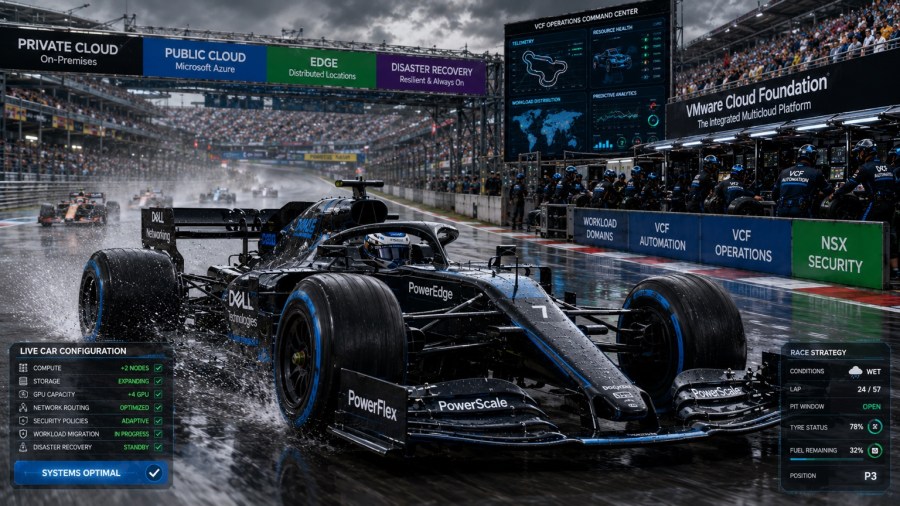
The multicloud lanes in the image also need an important guardrail. Private cloud, Azure, edge, and disaster recovery are not automatically one control plane. They become an integrated service only when the organization defines the interfaces, responsibilities, identity boundaries, network paths, data flows, service levels, and recovery procedures between them.
Scenario: A Wet Race Across Four Operating Zones
Consider a global enterprise running customer-facing applications in its primary private cloud. A new analytics service needs additional GPU capacity. A remote manufacturing site needs local processing because its network connection is unreliable. A development team wants temporary capacity in Azure. The recovery team is preparing for a quarterly failover exercise. At the same time, a security advisory affects part of the infrastructure stack.
It requires defined recovery time and recovery point objectives, protected management dependencies, consistent networking and identity, ordered application recovery, clean-room or isolation decisions where appropriate, evidence collection, and routine exercises.
Telemetry is the difference between driving and guessing.
VCF Operations should be treated as the platform’s decision-support layer. Health, capacity, performance, logs, dependency context, network visibility, and security findings can help teams understand whether the platform is operating within its intended envelope.
A workload contract should continue to make sense when execution crosses a private-cloud, public-cloud, edge, or recovery boundary. Define the interfaces and lifecycle decisions that each environment owns before presenting the estate as a coordinated multicloud service.
Classify the workload and its service requirements.
Select an approved execution zone.
Apply identity, network, security, quota, and data policies.
Provision through an automated workflow.
Validate health, performance, and compliance.
Maintain a tested recovery path.
Feed operational evidence back into capacity and lifecycle planning.
If the only answer is “that is where the hosts happened to fit,” the design is not finished.
Scope and Terminology Guardrails
A weak operating model treats each request as a separate project.
A domain can separate lifecycle timing, scale, hardware characteristics, network design, or organizational ownership. That does not mean every workload needs a dedicated domain. It means the platform should have an intentional answer for why workloads share infrastructure and where separation is required.
They should not be interpreted as one homogeneous pool.
Workload Domains Are More Than Resource Pools
Without those links, telemetry becomes an expensive collection of interesting graphs.
The edge lane optimizes for proximity, local continuity, data reduction, and distributed execution.
Azure Is an Adjacent Operating Boundary
The core platform loop looks like this:
Third, speed requires discipline. Racing teams move quickly because the work is rehearsed, instrumented, governed, and repeatable. Enterprise private cloud teams should aim for the same outcome. Fast delivery should come from engineered workflows and clear guardrails, not from bypassing controls or relying on a small group of experts to perform manual heroics.
Edge Requires Local Resilience and Central Governance
The platform wins when speed, control, resilience, and ownership reinforce one another.
The private cloud lane usually provides the strongest control over hardware selection, data location, network architecture, upgrade timing, and platform customization. It is often the best fit for stable demand, sensitive workloads, latency-sensitive services, or applications that benefit from close integration with existing enterprise systems.
Disaster Recovery Is an Operated Capability
A recovery platform should be measured by demonstrated recovery outcomes, not by the amount of idle infrastructure it contains.
Behind every lap is a coordinated operating model. Engineers interpret telemetry. Strategists evaluate weather and tire degradation. The pit crew prepares a controlled change. The driver executes within the limits of the car and the circuit. Race control sets non-negotiable boundaries. Every decision must account for timing, risk, available capacity, and the consequences of failure.
The image captures that distinction. The car represents the workload platform. The pit wall represents observability and decision support. The garage represents automation and platform engineering. The wet circuit represents changing business conditions. The private cloud, Azure, edge, and disaster recovery lanes represent distinct execution environments that must be joined through deliberate architecture rather than optimistic diagrams.
The Dell Components Are Illustrative
A Formula One team optimizes one car for a specific race series. An enterprise platform supports many workload classes, business owners, risk levels, geographic regions, and lifecycle schedules. There is no single finish line. The platform must operate continuously while teams onboard, change, migrate, recover, and retire services.
The management domain, identity services, DNS, network control, automation, operations, and recovery tooling are not background details. They are dependencies that determine whether operators can act during an incident.
Assumptions Behind the Model
The race is won through a continuous loop, not a one-time deployment.
Replication proves that data moved. Testing proves that a service can recover.
Workload placement is based on documented requirements rather than team preference.
The management domain and workload domains have explicit ownership.
Identity, certificates, DNS, time, and network dependencies are treated as platform services.
Automation workflows are version controlled and tested.
Operations data has defined owners and escalation paths.
Security policy is translated into enforceable network, identity, configuration, and recovery controls.
Lifecycle changes include compatibility review, backup, validation, rollback, and communication.
Azure, edge, and recovery environments retain their own service boundaries.
Platform teams can say no when a workload does not meet a supported service pattern.
Avoid alerting on every technical event. Alert when a condition threatens a service objective, support boundary, capacity threshold, security control, or recovery posture.
Mapping the Race Team to VMware Cloud Foundation
Race Team Element
VCF Interpretation
Operational Question
Race car
Workload domain or application-ready platform zone
Is the infrastructure class fit for this workload?
Power unit
Compute, memory, and accelerator capacity
Can the platform meet performance and growth demand?
Chassis and grip
Storage, network design, and physical infrastructure
Can the workload remain stable under real operating conditions?
Driver controls
Self-service interfaces and approved actions
What can consumers change without operator intervention?
Pit crew
VCF Automation and platform engineering workflows
Which changes can be executed repeatedly and safely?
Pit wall
VCF Operations plus human decision-makers
Which signals require action, and who owns that action?
Track boundaries
NSX, vDefend, identity, and governance controls
Which communication and administrative paths are allowed?
Tire strategy
Placement, capacity, and service-tier policy
Which resource profile fits the current conditions?
Pit stop
Lifecycle, remediation, expansion, or recovery workflow
Can the change be completed within the risk window?
Alternate circuit
Azure, edge, or recovery environment
What must remain consistent, and what must remain separate?
Race rules
Architecture standards, support boundaries, and change control
Which decisions are non-negotiable?
The organization states intent, executes through automation, observes the result, makes a governed decision, and improves the platform. Each cycle should reduce manual effort, remove ambiguity, and increase confidence.
The Car Is the Workload Domain
The race image is a conceptual architecture, not a literal bill of materials. Several boundaries matter.
The metaphor becomes useful when it changes the implementation plan.
It may use a secondary VCF site, a managed cloud service, isolated recovery infrastructure, or a combination of patterns. The design must account for management-plane recovery, network changes, identity dependencies, data integrity, recovery sequencing, and evidence that the restored service is safe to return to production.
Lifecycle management is where integrated platforms prove whether they are genuinely integrated.
Maintain a component and integration register.
No metaphor should be allowed to hide architecture complexity.
The metaphor is therefore a tool for alignment, not a claim that private cloud operations are simple.
The Pit Wall Is VCF Operations
A workload domain is a logical unit of application-ready infrastructure. It creates an important boundary for compute, storage, networking, lifecycle, scale, and administrative responsibility.
Examples may include a general-purpose virtual machine service, a regulated application zone, a Kubernetes platform service, an AI or GPU service, an edge service, and a recovery service. Document what each class includes and where it can run.
Define the health, capacity, performance, log, network, and security signals needed to operate each service. Confirm that alerts reach accountable teams and that the team can diagnose dependencies across the stack.
A platform becomes operationally mature when these functions reinforce each other.
An upgrade affects more than software versions. It may affect firmware, drivers, certificates, APIs, automation workflows, management packs, backups, network behavior, and supportability. The sequence matters. The prechecks matter. The rollback point matters.
A threshold or condition.
An accountable owner.
An approved response.
Evidence that the response worked.
This is the architecture that turns several environments into one service portfolio.
The Pit Crew Is VCF Automation
Centralize standards that protect shared infrastructure and enterprise risk. Delegate low-risk actions that are well bounded, observable, and reversible.
Actual support must be validated against the current VMware compatibility guidance and Dell validated designs. Dell documents validated VCF storage patterns for several platforms, including PowerFlex as supplemental storage. The PowerScale label in the image should therefore be treated as adjacent file or data services unless a specific supported integration is documented for the intended design. Branding in a concept image is not a support statement.
The objective is not the shortest maintenance window at any cost. It is the shortest repeatable maintenance window that preserves supportability and service confidence.
Who can request the service?
Which organization, project, or tenant receives it?
Which workload domain or zone can host it?
Which compute, storage, network, and security profiles apply?
Which quotas and approvals are required?
Which observability and protection services are attached?
Which changes can the consumer perform later?
How is the service retired?
Map what can fail together and what must recover independently.
NSX and vDefend Define the Track Boundaries
VMware Cloud Foundation is not the race car alone. It is the complete engineering system around the car.
The best private cloud teams move quickly for the same reason elite race teams do. They prepare before the event, instrument the system, rehearse the work, respect operating limits, and learn from every cycle.
Edge consistency should reduce operational variation, not erase site-specific constraints.
Include loss of connectivity, expired certificates, unavailable identity services, failed automation, capacity exhaustion, security isolation, and partial site failure. The objective is to discover hidden dependencies before an incident does.
The workload domain gives architects a place to express boundaries.
The edge lane represents distributed sites that may have limited staff, intermittent connectivity, strict latency requirements, or local data-processing needs. Central policy and lifecycle control are valuable, but the edge must remain capable of running through a management-plane interruption.
The metaphor is useful because it shifts the conversation away from individual components and toward coordinated execution. A fast private cloud is not created by buying powerful infrastructure alone. It is created by connecting provisioning, policy, observability, security, capacity, recovery, and human ownership into a repeatable operating loop.
Lifecycle Management Is the Pit Stop Discipline
This is the infrastructure equivalent of a wet race.
The practical design test is simple:
A central team may define policy and lifecycle, while local clusters continue operating through a wide-area network disruption. This places additional importance on zero-touch deployment, fleet inventory, staged updates, local failure handling, secure remote access, and hardware replacement procedures.
Provisioning, approved resizing, network attachment, policy assignment, image delivery, backup enrollment, certificate workflows, patch orchestration, and retirement are common candidates. Keep manual approval where risk requires it, but remove manual execution where repetition creates inconsistency.
A verified source and target baseline.
Hardware and software compatibility review.
Capacity and failure-domain checks.
Current backups for management components.
Change sequencing across management and workload domains.
Validation of automation, monitoring, networking, security, and recovery integrations.
Defined stop conditions and escalation paths.
Post-change evidence that services returned to the expected state.
The PowerEdge, PowerFlex, PowerScale, and networking elements in the image represent the physical and data infrastructure beneath or beside the platform.
Multicloud Lanes Need Contracts, Not Slogans
The racing analogy is useful here because a pit stop is fast only after extensive preparation.
A platform team may own the physical network and external routing. A cloud administrator may define shared transport and organization-level policy. A tenant or application team may manage its own isolated networks and approved security rules. The exact roles vary, but the boundary must be explicit.
Private Cloud Lane
A dashboard cannot decide the acceptable risk of delaying an upgrade, whether a capacity threshold justifies new hardware, or whether a recovery exercise should interrupt a business release. Those are operating-model decisions. The tooling supplies evidence, but accountable people still need to interpret the signal, approve the action, and own the outcome.
The most important point is the feedback loop. Automation without operations creates fast drift. Operations without automation creates a well-observed ticket queue. Security without service design creates friction. Recovery without routine validation creates false confidence.
Azure Lane
Conditions are changing, multiple decisions are active, and the correct answer is not simply “add more nodes.” The platform team must determine where the workload belongs, which data can move, which network and identity policies apply, how capacity will be reserved, what lifecycle baseline is supported, and how the service will be observed and recovered.