TL;DR
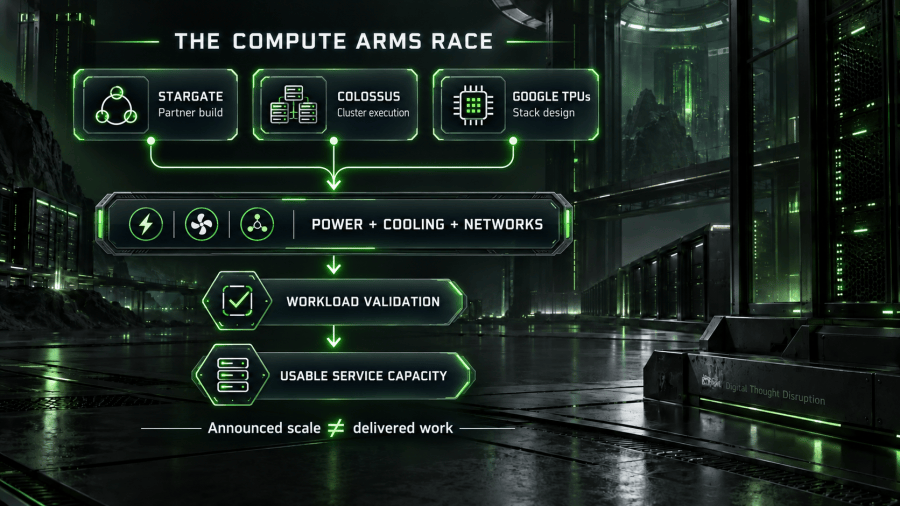
A large fleet is not automatically one large computer.
This is not a reason to avoid specialization. It is a reason to price and validate it honestly. A specialized stack can be the better choice even when it is less portable, provided the gain is demonstrated and the dependency is accepted.
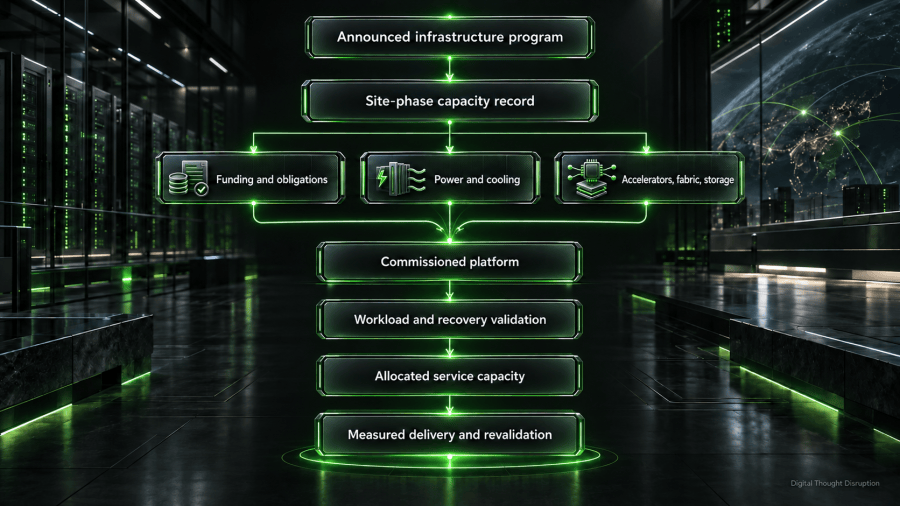
Count capacity when the required workload can use it under agreed operating conditions, not when somebody announces the investment.
Google’s TPU strategy emphasizes the relationship between accelerator design, interconnects, software, and workload execution. The meaningful comparison is not simply a TPU count versus a GPU count.
A later, dated disclosure changes the picture. On May 6, 2026, SpaceXAI described Colossus 1 as containing more than 220,000 NVIDIA GPUs, including H100, H200, and GB200 systems, and announced an agreement giving Anthropic access to the facility.
Apply Hard Gates Before Comparing Price
The strategic significance is broader than the hardware count. Infrastructure developed around one model ecosystem can become capacity for another. Physical ownership, operating responsibility, and the right to consume the system are separate dimensions.
The next article examines the AI alliance map and the dependencies connecting laboratories, clouds, chip suppliers, and infrastructure partners.
Keep Recovery Capacity Separate from Expansion Capacity
Suppose an illustrative facility averages 120 megawatts of total demand and 100 megawatts of IT demand over the same interval. Its energy ratio is 1.20. That does not establish that its accelerators are performing useful work, that a particular model fits, or that the site can support the same demand during maintenance.
NVIDIA’s GB200 NVL72 documentation describes a liquid-cooled rack-scale design connecting 36 Grace CPUs and 72 Blackwell GPUs within a 72-GPU NVLink domain. That specifies a tightly connected scale-up system. It does not imply that every other rack or facility becomes part of the same communication domain.
For planning, use an explicit capacity ledger. Record each site phase or service allocation separately rather than assigning one maturity label to an entire program.
Measure the Conversion from Infrastructure to Service
Once candidates pass, compare equivalent service outcomes over the same period. Include commitment utilization, networking, storage, support, engineering work, and the cost of maintaining the replacement path. Avoid comparing an interruptible allocation with a protected production service as though the price difference were pure efficiency.
For scale, a constant one-gigawatt load running for 24 hours consumes 24 gigawatt-hours. This is unit arithmetic, not an estimate of any named project’s actual consumption.
The following YAML is a proposed requirements record, not a vendor API or deployable configuration. Its numbers are illustrative targets, not results from DTD testing.
Nor are laboratories necessarily confined to one accelerator family. Anthropic’s May 2026 announcement states that it trains and runs Claude across AWS Trainium, Google TPUs, and NVIDIA GPUs. That establishes a heterogeneous strategy at Anthropic, not effortless portability for every enterprise workload.
Power Usage Effectiveness, or PUE, compares total facility energy with IT equipment energy over the same measurement boundary and interval. Google’s data-center efficiency reporting illustrates why the boundary and reporting period must accompany the number.
What the Evidence Does and Does Not Prove
The International Energy Agency’s April 2026 report, Key Questions on Energy and AI, projects global data-center electricity consumption rising from about 485 terawatt-hours in 2025 to about 950 terawatt-hours in 2030. Those figures cover data centers overall, not AI alone, and the 2030 value is a projection. The report also identifies supply-chain and infrastructure bottlenecks that constrain near-term expansion.
That question remains unanswered until somebody connects the announcement to a deployment location, supported model, delivery date, usable allocation, performance envelope, and recovery arrangement. A supplier can have a strong long-term infrastructure strategy and still be the wrong near-term dependency for a particular application.
A training job needs an agreed model-quality target and a credible completion window. Its infrastructure evidence should include simultaneous resource availability, scaling behavior, data delivery, checkpoint overhead, and retained progress after interruption.
An inference service needs a different acceptance envelope: arrival rate, input and output sizes, concurrent requests, latency, quality, and behavior under overload. Independent serving replicas may be distributed across locations; a model partitioned across devices still needs its required communication topology. Do not classify all inference as loosely coupled.
Conclusion
For an enterprise evaluating a Stargate-backed service, ask the service provider to identify the relevant delivery phase and contractual allocation. A model trained successfully at one site is useful operational evidence. It does not establish a particular customer’s inference quota, residency boundary, or recovery capacity.
These measures favor different strengths. Partner-led expansion may improve delivery breadth. Rapid cluster deployment may improve timing. Co-design may improve workload efficiency. The winner for a particular service is the approach that delivers the required combination, not necessarily the largest aggregate number.
The platform team should request an identifiable service allocation, not a share of a supplier’s headline fleet. Acceptance should cover the model and runtime bundle, workload distribution, peak duration, quality tests, maintenance behavior, and the agreed failure scenario.
“Secured” is not a standardized engineering acceptance state. Depending on the announcement, it can describe an agreement, a future allocation, an investment plan, or infrastructure that is already operating.