Dell, VCF, and Azure: A Hybrid Cloud Operating Model
A hybrid operating model should be built in a sequence that produces evidence at each stage.
Scenario: A Distributed Enterprise Cloud
The practical goal is not one pane of glass. It is a closed operational loop in which intent flows down, telemetry flows up, ownership is explicit, and automation is allowed to act only within tested guardrails.
Exit criterion: Arc-connected resources have a declared owner, policy scope, cost model, and permitted action set.
The Infinity Ring Is an Operating Model, Not a Product
NSX can provide powerful overlay networking and distributed security, but it still depends on a stable physical underlay. Dell networking in this model should provide predictable routing, MTU consistency, redundant paths, failure isolation, and enough telemetry to distinguish an overlay problem from a physical transport problem.
PowerEdge systems and GPU-capable platforms provide the execution substrate for traditional virtual machines, Kubernetes services, data platforms, and AI workloads. The architecture decision is not simply how many hosts to purchase. It includes CPU and GPU ratios, memory headroom, NUMA behavior, network bandwidth, rack density, power, cooling, and the failure domain created by the chosen cluster shape.
Exit criterion: Each automated action has a measured success rate, documented rollback, bounded identity, and auditable evidence.
The presence of a product in an architecture image does not prove support for every version, protocol, topology, or feature combination. Validate the exact bill of materials and support matrix before treating the design as deployable.
Define workload-domain patterns, network and security templates, storage options, backup tiers, recovery expectations, lifecycle windows, and capacity reserves. Connect each service class to a business owner and an operating SLO.
Architecture at a Glance
Map administrative roles, workload identities, service accounts, privileged workflows, logging sources, Sentinel connectors, detection rules, and response playbooks. Test the full path from identity event to investigation and containment.
New articles
Compute and Acceleration
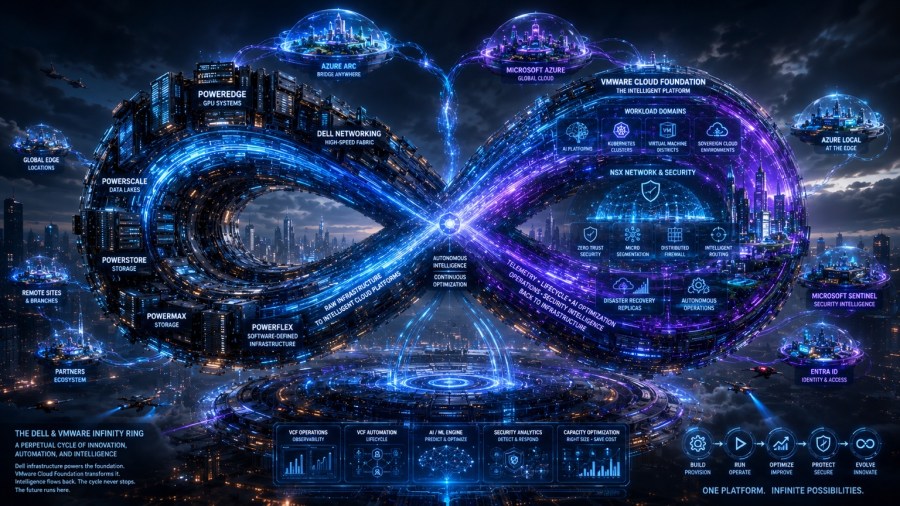
That is a useful architecture metaphor, but only when it is translated into decision rights, supported interfaces, lifecycle boundaries, and measurable operating outcomes.
The image is a portfolio map, not proof that every storage platform, protocol, feature, or topology is interchangeable.
Storage Selected by Service Characteristics
Several patterns can turn the architecture into a collection of expensive consoles.
Inventory physical systems, firmware, network paths, storage connectivity, support status, capacity, and failure domains. Reconcile that inventory with what VCF, vCenter, storage tools, and network tools report.
The infinity ring creates value when it helps teams place workloads deliberately rather than politically. A workload should not land in VCF, Azure, or Azure Local because a team prefers one console. Placement should follow explicit criteria.
Physical Networking as the Dependable Underlay
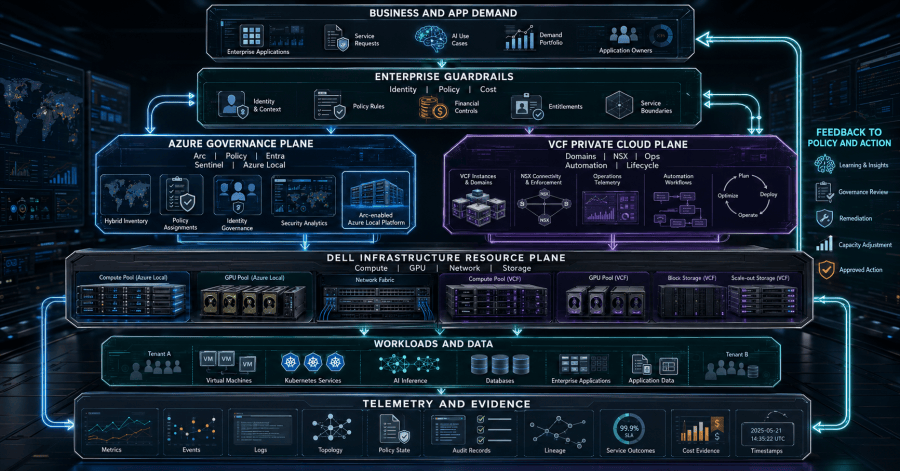
The important detail in the following diagram is the direction of authority. Business and platform intent flow downward. Telemetry and evidence flow upward. Local platforms remain responsible for local execution, even when their resources are projected into a broader cloud governance layer.
The infinity-ring image captures the ambition behind a better model. Dell infrastructure forms one loop. VMware Cloud Foundation and its private cloud services form the other. Azure Arc, Azure Local, Microsoft Sentinel, and Microsoft Entra ID extend governance and security around the perimeter. Telemetry, automation, and intelligence meet at the center.
The Right Loop: VMware Cloud Foundation Is the Private Cloud Service Layer
Collecting more data can increase cost and noise without improving reliability. Every dashboard, metric, log, and alert should support a decision, a runbook, or an evidence requirement.
Workload Domains Create Operational Boundaries
The best underlay is usually boring by design. It converges quickly, changes deliberately, exposes clean operational signals, and gives the NSX layer a reliable foundation.
The model succeeds only when each platform retains clear authority. The enterprise must define where hardware lifecycle ends, where VCF lifecycle begins, where NSX policy is authoritative, which Azure actions are permitted, how identity crosses boundaries, and who responds when telemetry becomes an incident.
The center of the infinity ring is where the image places autonomous intelligence, continuous optimization, telemetry, lifecycle operations, security intelligence, and capacity management. This is also the easiest part to overstate.
NSX Provides Policy Close to the Workload
The practical design rule is to start with workload characteristics, not with a product logo. Define access protocol, latency target, throughput, capacity growth, replication, recovery objectives, data reduction assumptions, isolation, and lifecycle ownership. Then validate the storage model against the exact VMware Cloud Foundation release, supported configuration, and intended workload-domain design.
Exit criterion: The organization has one reconciled source of truth for hardware, topology, ownership, and compatibility.
Operations and Automation Turn Infrastructure into a Service
Sending every event to a SIEM is not the same as creating security visibility. The platform team and security operations team must agree on which signals matter and what action each signal should trigger.
VMware Cloud Foundation is the point where raw infrastructure becomes a managed private cloud platform.
Azure Extends the Ring Without Replacing Local Authority
The first is the resource system. It includes physical compute, accelerators, storage, and networking. Its job is to provide dependable capacity, predictable failure domains, firmware discipline, and hardware-level observability.
Azure Arc Projects Resources into Azure Governance
The Dell, VMware, and Azure infinity ring is a strong mental model because it shows hybrid cloud as a continuous system rather than a one-time deployment. Dell infrastructure supplies dependable capacity. VMware Cloud Foundation turns that capacity into private cloud services. Azure Arc, Azure Local, Microsoft Entra ID, and Microsoft Sentinel can extend governance, distributed execution, identity, and security analytics across the estate.
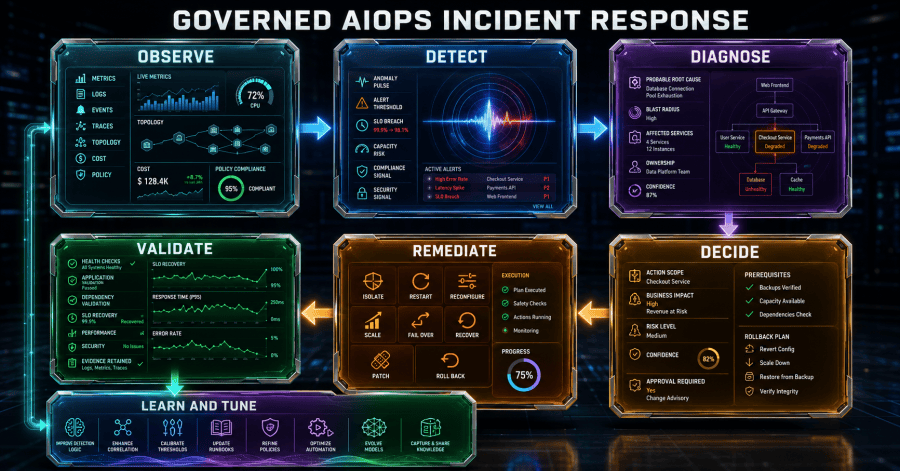
Autonomous operations do not emerge because several dashboards are connected. They require a closed and testable control loop.
Technology integrations matter, but ownership determines whether they survive production.
Azure Local Is a Parallel Distributed-Infrastructure Option
The second is the private cloud service system. VMware Cloud Foundation organizes infrastructure into a platform that can host different workload classes, enforce network and security policy, provide operational visibility, and expose repeatable consumption patterns.
A private cloud cannot automate around a poor capacity model. If the physical design cannot absorb maintenance, failure, and growth at the same time, the cloud layer inherits that constraint.
Hybrid cloud rarely fails because an enterprise lacks technology. It fails because the organization accumulates control planes faster than it defines authority.
Microsoft Entra ID and Microsoft Sentinel Connect Identity and Security Evidence
Exit criterion: A workload request maps to a documented service class rather than a custom infrastructure conversation.
The third is the hybrid governance system. Azure Arc, Azure Policy, Microsoft Entra ID, Microsoft Sentinel, and Azure Local can extend inventory, identity, governance, security analytics, and distributed execution across locations.
Keep exploring
The Center Joint: Telemetry Must Lead to Controlled Action
These metrics make the ring operational. They also reveal where the integration is only visual and where it is producing real enterprise value.
Start with low-risk, high-volume use cases such as tag correction, stale-resource reporting, capacity threshold escalation, certificate-expiry workflow, or evidence collection. Add automated remediation only after the detection logic, approval path, rollback, and validation step are proven.