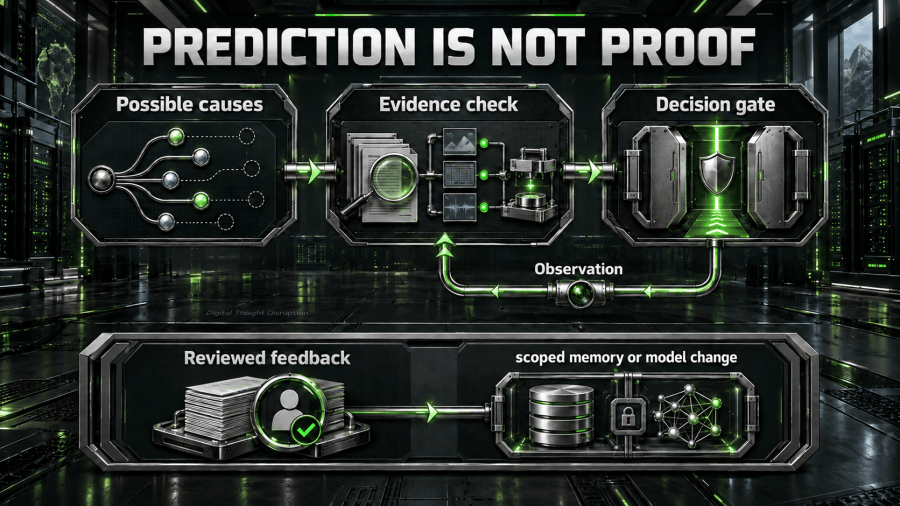
But several different questions are being compressed into one response. Is the activity genuinely unusual for this environment? Are the account and network events independent evidence, or different views of the same event? Has the assistant checked an approved maintenance window? Even with a strong diagnosis, is it authorized to isolate a production dependency?
Introduction
Bayesian inference and predictive processing help unpack the first part of that problem: how expectations should change when observations arrive. Enterprise architecture must handle the rest, including evidence quality, decision consequences, execution authority, and controlled feedback.
The connection to AI is useful precisely because the mechanisms are not interchangeable. Bayesian mathematics, theories of brain function, and next-token prediction describe different things. Treating them as synonyms makes AI sound more understandable while making its operating model less precise.
TL;DR
Receive new enterprise AI and hybrid platform articles when they are published.
Bayesian Inference in AI Starts with Explicit Uncertainty
Bayesian inference updates the probability of a hypothesis in light of evidence:P ( H ∣ E ) = P ( E ∣ H ) P ( H ) P ( E )
Architecture & integration
Day-2 execution
Consider an AI assistant investigating unusual network traffic. It proposes an intrusion, points to an unfamiliar administrative account, and recommends isolating the affected system. The explanation sounds coherent. The recommendation may even be correct.