The Private AI Model Factory: Turning Enterprise Data into Governed AI Services on VMware Cloud Foundation
The factory still needs adjacent model and application telemetry. The operations design should correlate platform signals with experiment, deployment, and model metadata so teams can trace a degraded service to the right layer.
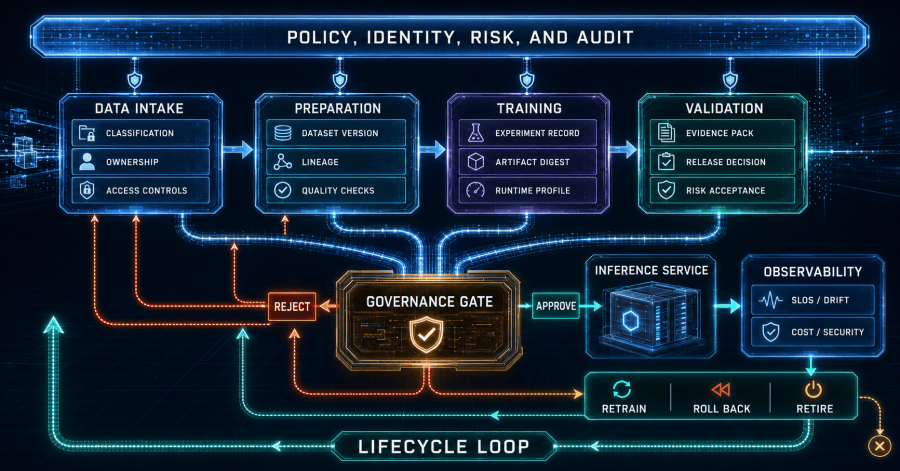
The factory should be designed as a gated lifecycle with feedback loops, not as a one-way conveyor belt. A model can be rejected, returned for rework, rolled back, or retired at any point.
The Factory Is an Operating Model, Not a GPU Cluster
This is where private AI can provide meaningful architectural control, but private placement does not make data use automatically compliant. The organization still needs documented purpose, access boundaries, and accountable data owners.
Once the first path is stable, add workload profiles such as experimentation, batch training, real-time inference, sensitive-data inference, and high-availability services. Introduce quotas, showback or chargeback, capacity forecasts, and service tiers.
Factory concept
Enterprise AI implementation
Raw material
Classified data, documents, events, features, prompts, and approved external content
Production line
Repeatable data, training, evaluation, approval, deployment, and monitoring workflows
Machinery
GPU-enabled compute, Kubernetes, virtual machines, pipelines, registries, and serving runtimes
Quality control
Performance, safety, bias, security, privacy, resilience, and cost evaluations
Product label
Model version, intended use, limitations, ownership, lineage, and approvals
Control tower
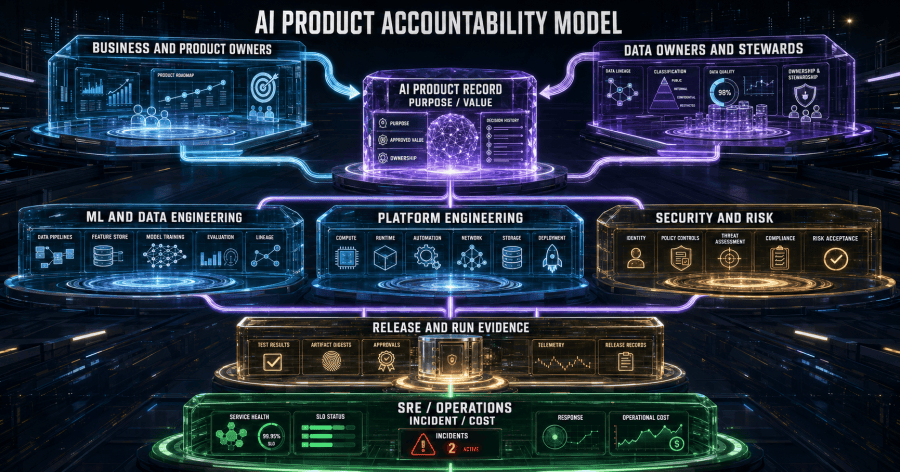
Capacity, service health, model behavior, risk evidence, cost, and incident status
Finished product
A supported AI service with an API, service objective, owner, runbook, and rollback path
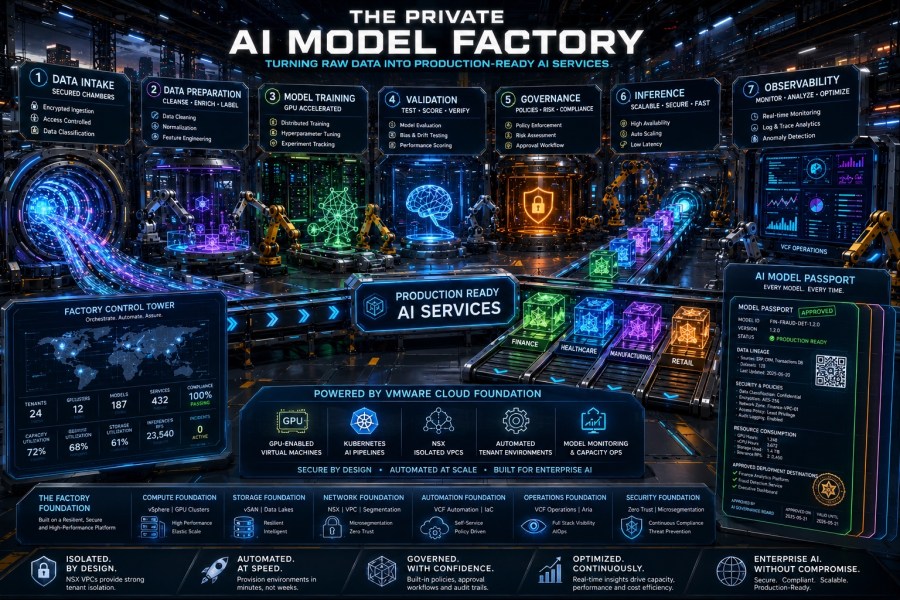
The factory image presents governance as a station between validation and inference. That is useful visually, but the operating model should apply governance throughout the lifecycle.
GPU memory, interconnects, storage paths, and network bandwidth can become bottlenecks before average GPU utilization looks problematic. Capacity planning should use workload profiles and concurrency behavior, not only aggregate consumption.
The End-to-End Model Factory Lifecycle
The compute layer provides virtualized, GPU-enabled workload environments for development, training, fine-tuning, and inference. Different workload classes can be assigned distinct resource policies, clusters, or placement rules based on performance, isolation, support, and availability requirements.
Scale the platform through reusable contracts rather than one-off integrations. Standard interfaces, portable artifacts, declarative policy, and explicit ownership reduce the cost of changing model frameworks or serving runtimes later.
TL;DR
Validation should test more than aggregate accuracy. The evaluation pack should reflect the actual deployment context and the consequences of failure.
A useful catalog item should deliver more than a machine. It should attach the correct network zone, storage policy, identity integration, observability agents, quota, expiration policy, tags, and ownership metadata. The goal is to make the compliant path the fastest path.
Conclusion
Start with supported infrastructure, identity integration, network zones, storage classes, GPU resource policy, logging, backup, and tenant boundaries. Select one or two use cases with real business ownership and manageable risk.
The following YAML is an illustrative pattern, not a product-native VMware schema. It shows the minimum type of metadata a release pipeline could require before promotion.
A factory control tower should measure flow, quality, reliability, risk, and economics. GPU utilization is useful, but it is not sufficient.
External References
Test rollback before the first production incident. For retrieval systems, rollback may include the model, prompt template, embedding model, index version, and application configuration. Reverting only the model may not restore the previous behavior.
Choose your next step
Define what is in scope. A first release may support retrieval-augmented generation and bounded inference but exclude large-scale pretraining, autonomous actions, or regulated decisioning. Explicit exclusions prevent the pilot platform from being judged against every possible AI workload.
AI strategy & delivery
Enterprise AI
Strategy, governance, AI platforms, data, and accelerated infrastructure.
Explore Enterprise AI →
Architecture & integration
Hybrid Platforms
Architectures that connect VCF, Azure, public cloud, Kubernetes, and edge.
Explore Hybrid Platforms →
Training and fine-tuning consume expensive shared resources. The factory needs workload classes, quotas, placement rules, scheduling policy, artifact storage, and experiment tracking. It also needs a clear distinction between exploratory work and controlled release candidates.
Get practical guidance by email
A rack of accelerated servers can run training and inference. It does not automatically create lineage, approval evidence, reproducibility, tenant isolation, service ownership, or rollback discipline. Those capabilities emerge from the operating model built around the infrastructure.