The Infrastructure Origami Engine: A VCF 9.1 Blueprint for Multi-Tenant Private Cloud
Examples include:
A useful VCF blueprint should define both the standard baseline and the tenant-specific parameters at every layer.
The most dangerous interpretation of multi-tenancy is that a different folder, resource pool, network segment, or catalog project automatically creates an isolated environment.
Standardize Hard, Parameterize Carefully
The blueprint should define tenant administrators, service consumers, platform operators, automation identities, emergency access, and review procedures. It should also distinguish between access to the consumption layer and access to the underlying infrastructure.
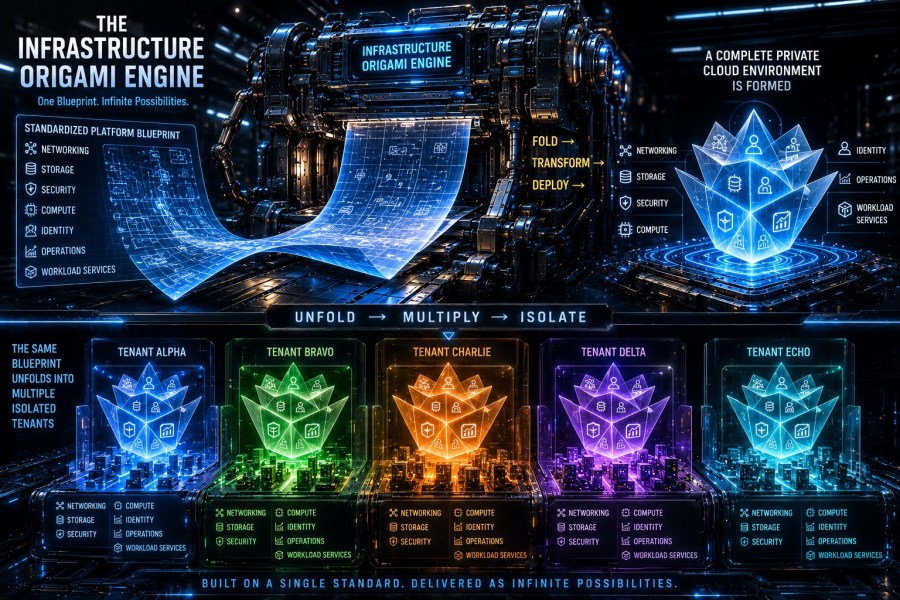
The engine in the image should be interpreted as the complete platform production system.
Too little parameterization forces consumers into unsuitable environments. Too much parameterization turns the service catalog into an infrastructure design questionnaire.
Operations is often the forgotten tenant boundary.
Environment purpose
Workload classification
Expected capacity
Availability requirement
Recovery requirement
Connectivity class
Data sensitivity
Required workload service
Ownership group
Expiration or review date
After deployment, the platform must reconcile the running environment against the intended standard.
Cluster and datastore placement
Address allocation
Object naming
Routing implementation
Baseline security controls
Monitoring agents and integrations
Mandatory tags
Backup integration
Supported software versions
Lifecycle sequencing
The required strength of separation should be selected through architecture criteria, not assumed from the name of an object.
Choosing Between Shared and Dedicated Boundaries
Not every tenant should be implemented at the same layer.
Deployment pattern
Best fit
Isolation characteristics
Primary tradeoff
Shared VCF instance with logical tenant boundaries
Internal teams, development environments, standard enterprise applications
Identity, organization, network, quota, storage, and operational separation on shared infrastructure
Highest efficiency, largest shared-service blast radius
Dedicated cluster or workload domain
Performance-sensitive workloads, separate maintenance cadence, stronger capacity control
Dedicated execution or lifecycle resources while selected management services remain shared
Better separation with additional capacity and lifecycle cost
Dedicated VCF instance
Regulated business unit, major organizational boundary, regional or identity separation
Stronger management, failure, identity, and lifecycle boundary
Additional management footprint and operational complexity
Dedicated fleet or physical platform
Legal separation, sovereign environments, high-assurance service-provider requirements
Maximum control over management services and infrastructure dependencies
Highest cost, lowest consolidation efficiency
The design should provide tenant-scoped views without blinding the platform team to the condition of the shared service.
That is how standardization creates efficiency without requiring every tenant to become identical.
Regulatory or contractual separation
Identity and delegated-administration requirements
Security-policy ownership
Acceptable management-plane blast radius
Performance predictability
Maintenance-window alignment
Recovery time and recovery point objectives
Data residency and encryption-key ownership
Tenant scale and expected growth
Platform team capacity
Cost attribution and economic efficiency
Exit and portability requirements
Isolation is a stack. Each plane addresses a different type of failure or unauthorized interaction.
Operational Implications of the Origami Model
Provider-controlled decisions should usually include:
Blueprint Ownership Becomes a Platform Responsibility
The infrastructure origami engine is a strong model for the modern VCF private cloud because it reframes infrastructure from a collection of manually assembled components into a governed production system.
The infrastructure origami image offers a better model. Start with one carefully engineered blueprint. Fold the required platform capabilities into it. Transform the variable parts through approved parameters. Deploy a complete environment, then repeat the process without abandoning the standard.
Drift Must Be Classified
It does not.
It includes architecture standards, configuration templates, automation workflows, policy controls, naming conventions, validation tests, operational ownership, and lifecycle procedures. A YAML blueprint or catalog item may be part of that system, but the blueprint is larger than any one file.
The shared platform must track committed capacity, actual consumption, growth, headroom, failure scenarios, and maintenance requirements.
Shared Capacity Requires Provider Discipline
A user who can request a service should not automatically receive administrative access to the provider platform. Likewise, a provider administrator should not use broad standing access when a narrower operational role will work.
The word tenant is used broadly to describe an organizational or workload consumer requiring controlled separation. It does not imply that every tenant requires a dedicated VCF instance, workload domain, cluster, NSX project, or physical platform.
Lifecycle Changes Must Preserve the Contract
Tenant quotas cannot compensate for a provider that has no capacity model. The blueprint should perform preflight checks before accepting a deployment that would reduce the platform below its operational reserve.
Expert consumers may need advanced profiles, but those profiles should still be governed products rather than unrestricted access to every infrastructure setting.
Offboarding Must Be Designed at the Beginning
Quotas, reservations, limits, placement policy, admission controls, dedicated clusters, and dedicated workload domains offer different strengths of separation. The appropriate choice depends on noisy-neighbor risk, licensing, performance guarantees, maintenance cadence, and recovery requirements.
Every production blueprint needs an accountable owner, technical maintainers, security reviewers, test evidence, a supported-version matrix, and a review trigger.
Assumptions and Guardrails
The platform team should test blueprint compatibility against new component versions before changing the provider baseline. Existing tenants may need controlled remediation rather than silent mutation.
Security and network capabilities depend on the selected VCF architecture, enabled services, configuration, and entitlements. A visual boundary in an automation portal should never be treated as proof of technical isolation.
Two tenants using different storage policies on the same underlying system may satisfy one requirement and fail another. Regulated environments may require separate keys, backup domains, retention controls, administrators, or physical systems.
Good consumer inputs include:
The most expensive private clouds are often not the largest. They are the ones where every new application team, business unit, development environment, or regulated workload triggers another bespoke design exercise.
Conclusion
The decision should consider more than technical feasibility.
The network team creates a new routing pattern. The virtualization team creates another cluster layout. Security invents another policy structure. Identity groups are assigned manually. Storage policies are interpreted differently. Monitoring arrives after deployment, and nobody agrees whether the resulting environment is a tenant, a project, a workload domain, a namespace, or simply a folder with a different color.
A complete tenant is the deliberate composition of the boundaries required by the workload. That composition may remain entirely logical, or it may include dedicated clusters, workload domains, VCF instances, encryption keys, management services, or physical resources.
Without that contract, automation only accelerates inconsistency.
A successful API response is evidence that an object was created. It is not evidence that the tenant boundary works.