Compute translation should therefore start with service objectives, not source VM counts.
A datastore-backed database inside a VM might translate more effectively to a managed database service. File shares might move to an Azure file service. Static application content might move to object storage. Backup repositories might move to purpose-built backup and archive services.
A VMware design expresses workload intent through objects such as workload domains, vSphere clusters, resource pools, datastores, NSX segments, gateways, distributed firewall rules, identity groups, and operations policies. Azure expresses similar outcomes through a different hierarchy of management groups, subscriptions, resource groups, virtual networks, platform services, Azure Policy, Microsoft Entra, Azure Monitor, and infrastructure as code.
Introduction
A virtual machine can often be copied. An operating model cannot.
The practical approach is to preserve the workload’s intent while redesigning the implementation for the target platform. Some workloads need continuity through Azure VMware Solution. Some should transform into Azure-native infrastructure or platform services. Others should remain on-premises while Azure Arc extends governance and visibility. The translation bureau must classify each workload, map its dependencies, choose the correct destination lane, and validate the resulting operating model before migration begins.
That distinction changes automation and governance design. A migration team should translate folders, tags, custom attributes, permissions, templates, and lifecycle groupings into a combination of:
A useful record should also link to dependency evidence, target diagrams, infrastructure-as-code modules, test results, exceptions, cost estimates, and the final operational handoff.
Migration factories need a repeatable unit of work. A workload translation record should connect source evidence to target decisions and validation.
Why Translation Matters More Than Feature Matching
Translate each policy by asking:
Some VMware policies govern infrastructure placement, storage behavior, or cluster operations. Azure Policy evaluates Azure resource configuration and can audit, deny, modify, or deploy supporting configuration within its supported model. Application behavior, runtime security, and service-level objectives still require other controls.
Workload identities deserve special attention. A service account stored in a VM configuration might become a managed identity, a secret retrieved from a vault, or a federated workload identity. The best target removes long-lived credentials where the application and service support it.
Context: Why does the source object exist?Scope: Which workloads, teams, environments, or sites does it govern?Identity: Who or what is allowed to act?Security: Which trust boundary or control objective is being enforced?Networking: Which traffic paths, services, and dependencies must remain valid?Data: What performance, resilience, retention, and recovery outcomes are required?Operations: Who monitors, patches, backs up, supports, and pays for the workload?Automation: How is the desired state created, approved, changed, and recovered?Migration: Which transition method preserves service while the target operating model matures?
A resource pool may limit or reserve compute, delegate administration, separate tenants, support chargeback, or organize workloads. Azure does not provide one object that combines all those meanings.
Scope and Assumptions
The classification gate should confirm:
Continuity: Preserve the VMware software-defined data center model in Azure through Azure VMware Solution.Transformation: Rehost, replatform, or refactor workloads into Azure-native infrastructure and platform services.Hybrid governance: Keep selected workloads outside Azure while projecting them into Azure management through Azure Arc-enabled services.
Azure VMware Solution provides dedicated VMware private-cloud infrastructure in Azure with familiar vSphere, vCenter, vSAN, and NSX constructs. It can reduce application change and preserve VMware operational knowledge while bringing workloads closer to Azure services.
VMware Cloud Foundation concentrates infrastructure concerns into an integrated private-cloud stack. Compute, storage, networking, security, lifecycle, and operations are intentionally coordinated. Azure separates those concerns into resource providers, management scopes, platform services, policies, identities, connectivity patterns, and operational services. That separation creates flexibility, but it also shifts responsibility to architecture and governance.
Current State and Target State at a Glance
This lane fits when:
Architectural concern
Typical VMware expression
Typical Azure expression
Translation question
Platform boundary
VCF instance, fleet, workload domain
Tenant, management group, subscription, landing zone
Where should ownership, policy, billing, and quota boundaries exist?
Inventory and lifecycle
vCenter, clusters, folders, tags, templates
Azure Resource Manager scopes, resources, tags, images, deployment stacks
Which objects share a lifecycle, owner, and change process?
Compute placement
Cluster, resource pool, DRS rules
Region, availability zone, availability set, VM scale architecture, host options
Which availability, latency, licensing, and placement outcomes matter?
Storage
vSAN or external datastore, storage policy
Managed disks, storage accounts, file services, database services, backup vaults
Should data remain block storage, or move to a managed data service?
Network segmentation
NSX segments, transport zones, groups
Virtual networks, subnets, network groups, route tables, private endpoints
Which boundaries are routing domains, trust zones, or service-access controls?
Edge and routing
Tier-0 and Tier-1 gateways, BGP, NAT, load balancing
Hub-spoke or Virtual WAN, ExpressRoute, VPN, route tables, Azure Firewall, load balancers
How should connectivity, inspection, route ownership, and failover be redesigned?
East-west security
NSX distributed firewall and security groups
NSGs, Azure Firewall, application controls, host controls, private access patterns
Which layer should enforce each control objective?
Identity and access
vCenter identity sources, roles, groups, service accounts
Microsoft Entra identities, Azure RBAC, managed identities, scoped role assignments
How will human and workload identities be governed?
Operations
VMware operations, logging, automation, capacity, compliance
Azure Monitor, Log Analytics, Azure Policy, Defender for Cloud, Cost Management, automation
Which team owns detection, remediation, evidence, and cost accountability?
Migration
HCX, replication, backup restore, application cutover
Azure Migrate, Azure VMware Solution, replication tools, rebuild and data migration
Is the workload being moved, transformed, or temporarily preserved?
The key design question is not which Azure feature resembles DRS or vSphere HA. It is how the application will meet its availability and recovery objectives after the infrastructure behavior changes.
The Translation Engine
Optimization completes the translation by aligning the running workload with the intended Azure operating model.
A rehosted VM usually needs managed disks with appropriate performance, encryption, availability, backup, and recovery settings. The source datastore tier can inform the initial selection, but it should not be copied mechanically. Actual workload telemetry should drive disk type, size, throughput, input/output requirements, caching, and growth assumptions.
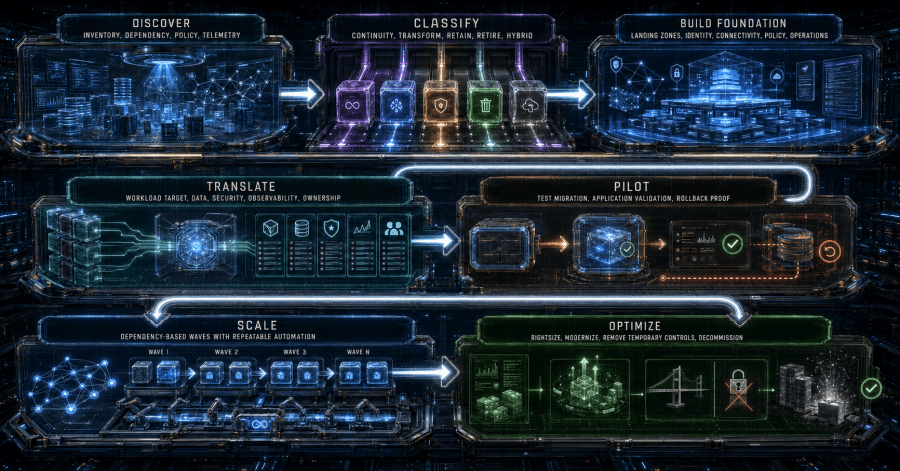
After the pilot, migration waves should use repeatable records, modules, test plans, and acceptance gates. Automation should create target infrastructure, policy assignments, diagnostics, role assignments, and evidence consistently.
Workload Domains Are Not Subscriptions
This is a good example of why object mapping fails. The source object is one thing, but its intent must be distributed across several target controls.
NSX gateway tiers often express north-south connectivity, tenant routing, route redistribution, NAT, service insertion, and isolation. In Azure, those outcomes may be implemented through:
who owns the workload;
whether environments need independent policy or billing;
whether service limits and quotas require separation;
whether regulated workloads need stronger isolation;
whether shared connectivity and management services are centrally operated;
whether the workload will use infrastructure services, platform services, or both.
Exceptions should remain visible. A migration factory becomes dangerous when every special case is silently encoded into scripts without an owner or expiration condition.
vCenter Inventory Is Not the Azure Portal
A VCF workload domain creates an infrastructure and lifecycle boundary. It can separate management from workload resources, isolate capacity, establish platform ownership, and control upgrade behavior. An Azure subscription is primarily a governance, billing, quota, and access boundary beneath a management-group hierarchy. It does not imply a dedicated cluster or storage system.
Migration should progress through decision gates, not just waves of virtual machines.
management groups;
subscriptions;
resource groups;
resource tags;
Azure Policy assignments;
role assignments;
image and artifact repositories;
deployment modules;
workload metadata.
Moving workloads into an ad hoc subscription may produce an early success that becomes a long-term governance problem. Retrofitting identity, policy, network, logging, and cost standards after production migration is slower and riskier than establishing them first.
Resource Pools Are Composite Intent
During transition, VMware and Azure monitoring, security, backup, and automation tools may overlap. Define the authoritative system for each control and the date when transitional tooling will be retired.
Azure Migrate can support discovery, assessment, replication, test migration, and cutover for applicable VMware workloads. It can provide valuable technical evidence and execution capability. It does not decide the landing-zone hierarchy, ownership model, security architecture, data-service strategy, or long-term operating model.
subscription or resource-group ownership;
Azure RBAC;
budgets and cost allocation;
regional or service quotas;
VM sizing and scaling rules;
dedicated hosts or isolation controls;
policy constraints;
deployment pipeline approvals.
The Hybrid Cloud Translation Bureau is a useful mental model because it makes the invisible work visible. VMware Cloud Foundation and Microsoft Azure can support many of the same enterprise outcomes, but they express those outcomes through different platform shapes, control planes, and operating responsibilities.
Translating Compute and Availability
vSAN and external VMware datastores present storage to virtual machines through policies, placement, and cluster-level operations. Azure offers managed disks for virtual machines, but also file services, object storage, managed databases, analytics platforms, backup services, and replication options.
Datastore labels and VM disk sizes do not reveal actual workload behavior. Use measured latency, throughput, I/O patterns, growth, recovery needs, and application support requirements.
Rehost: The application remains on virtual machines with minimal operating-system or application change.Replatform: The application moves to a managed runtime, database, container platform, or service.Refactor: The application is redesigned around cloud-native services and failure handling.Retain: The workload remains on the current platform for dependency, risk, cost, or support reasons.Retire: The workload and its dependencies are removed.Continuity on AVS: The workload retains VMware constructs while operating inside Azure.
Azure landing-zone guidance treats identity, resource organization, networking, security, management, governance, and platform automation as interconnected design areas. That is the right level for the translation bureau. Monitoring alone is not an operating model.
Azure Arc-enabled services can project supported resources outside Azure into the Azure management plane. This can extend inventory, governance, policy, monitoring, security integrations, and operational workflows without claiming that the underlying workload has moved.
Discover the Real Environment
A pilot should test the translation method, not merely demonstrate that a VM can boot. Select a workload that is representative enough to expose networking, identity, data, security, operations, and support issues without creating unacceptable business risk.
An NSX distributed firewall can enforce workload-level east-west policy close to virtual network interfaces. Azure security should be designed as layered enforcement rather than treated as a single replacement product.
Preserve Block Storage When It Is Still the Right Abstraction
Use the following decision framing during intake.
Move Data to a Managed Service When the Application Can Support It
The translation may require:
Foundation readiness should include:
Translate Storage Policy Into Measurable Outcomes
The right answer may combine lanes. An enterprise can use Azure VMware Solution for immediate continuity, Azure-native services for strategic applications, and Azure Arc for workloads that remain local. Consistency should come from governance, identity, automation, observability, and decision criteria, not from forcing every workload into the same runtime.
capacity and growth;
latency and throughput;
transaction or I/O profile;
availability and failure-domain requirements;
recovery point and recovery time objectives;
encryption and key ownership;
retention and deletion requirements;
data residency;
backup and restore testing;
application consistency;
dependency on snapshots, clones, or replication.
The most common risk is translating names instead of intent. A cluster is not automatically an availability set. A resource pool is not automatically a resource group. An NSX distributed firewall is not automatically an NSG. A datastore is not automatically a managed disk tier.
Translating NSX Networking Into Azure Connectivity
A tightly coupled application may need proximity and stable latency. A stateless service may benefit from horizontal scaling across zones. A legacy licensed application may require host-level constraints. A database may be better served by a managed platform service than by reproducing the original VM topology.
NSX Segments Do Not Simply Become Subnets
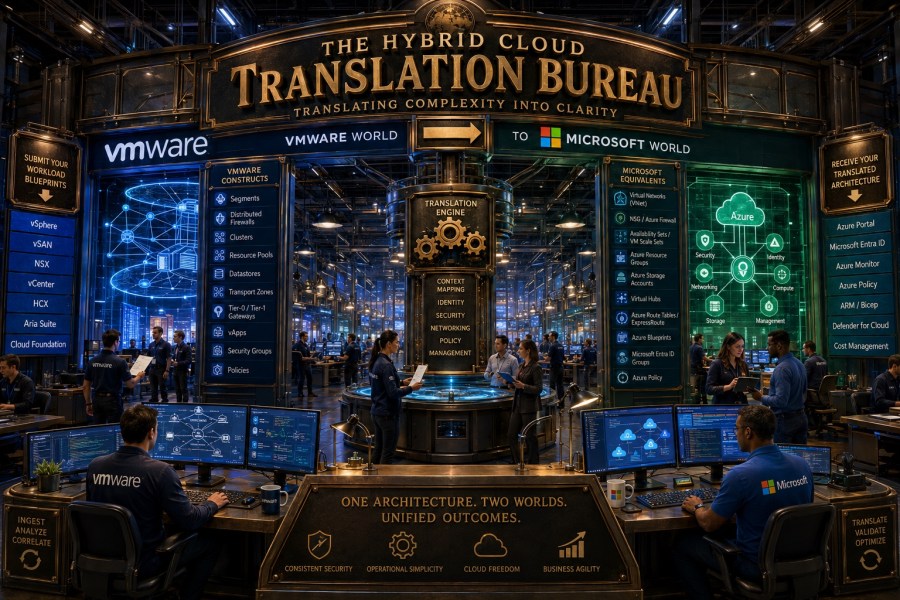
The image behind this article captures a problem that many migration programs underestimate. On the left is a mature VMware world with familiar constructs, operational habits, and platform boundaries. On the right is a Microsoft world built around Azure Resource Manager, Microsoft Entra, virtual networks, policy, monitoring, automation, security services, and cost governance. Between them sits the work that cannot be purchased as a single migration appliance: translation.
The translation record should therefore include:
Is it a routing boundary?
Is it a trust boundary?
Is it an application tier?
Is it only a legacy address allocation?
Does it require east-west inspection?
Does it provide private access to shared services?
Does it depend on stretched Layer 2 adjacency?
Does it carry management traffic that should be separated in the target?
Tools should support the translation process without being mistaken for it.
Tier-0 and Tier-1 Gateways Become a Connectivity Architecture
VMware capacity planning often starts with shared infrastructure that has already been purchased. Azure charges are more directly affected by service selection, scale, retention, data transfer, reservation strategy, and runtime behavior.
hub-spoke networking or Azure Virtual WAN;
ExpressRoute or site-to-site VPN;
route tables and route propagation;
Azure Firewall or network virtual appliances;
load-balancing and application-delivery services;
NAT and outbound connectivity patterns;
private endpoints and private DNS;
separate connectivity subscriptions;
centralized or delegated network ownership.
Treat those objects as simple inventory and the migration will preserve names while losing intent. Treat them as evidence of architectural decisions and the target design becomes much clearer.
Distributed Firewall Policy Becomes Layered Enforcement
Migration automation and target-state automation should be separated conceptually. The first moves or transforms workloads. The second maintains the desired Azure architecture after the migration team has left.
VMware Cloud Foundation and Azure both provide hierarchy, but the hierarchy serves different purposes.
NSGs for network-layer allow and deny rules;
Azure Firewall for centralized inspection, egress control, and policy;
application-layer gateways or firewalls where HTTP-aware controls are required;
private endpoints to remove public service exposure;
host firewalls and endpoint controls;
application authentication and authorization;
platform-service network restrictions;
Azure Policy to audit or deny unsafe configurations;
Defender for Cloud to surface security posture and recommendations.
The target is not a gateway object. It is a routing, inspection, connectivity, and ownership design.
Translating Identity and Access
This table is intentionally not a one-to-one equivalence map. Each row identifies an architectural concern and the target combination likely to carry it.
Platform comparison spreadsheets are useful until they create false confidence. They usually imply that every source capability has one target equivalent. Real enterprise platforms rarely work that way.
vCenter is an authoritative management plane for a vSphere environment. The Azure portal is one interface into Azure. The authoritative Azure management layer is Azure Resource Manager, which receives requests from the portal, command-line tools, APIs, software development kits, and infrastructure-as-code deployments.
human administrators;
platform operators;
application teams;
security and audit roles;
migration automation identities;
workload identities;
emergency access;
third-party support;
read-only operational access.
This turns “gold datastore” into an explicit service requirement that can be evaluated against multiple Azure options.
Resource groups should reflect lifecycle cohesion. They should not be used as a visual imitation of vCenter folders. If resources are deployed, changed, and retired on different schedules, they usually need different lifecycle boundaries even when the source inventory placed them together.
Translating Operations, Policy, and Cost
Incomplete discovery does not become less dangerous because a migration tool reports that a VM is technically movable.
The useful translation record is not “Workload Domain A becomes Subscription A.” It is “Workload Domain A currently expresses these ownership, lifecycle, capacity, and security boundaries; the Azure landing-zone hierarchy must recreate those outcomes.”
Operations Must Be Reassembled as a Control System
The target subnet plan should emerge from those answers, not from a spreadsheet that copies one segment into one subnet.
Azure Monitor for metrics, logs, alerts, and service health;
Log Analytics workspaces and data-collection rules;
Azure Policy for audit, deny, deploy, and remediation patterns;
Defender for Cloud for posture and security recommendations;
Cost Management for budgets, allocation, analysis, and accountability;
backup and disaster-recovery services;
automation runbooks, event-driven workflows, or deployment pipelines;
service-management integration;
dashboards and evidence retention.
Legacy applications often depend on undocumented DNS behavior, fixed addresses, broad east-west access, asymmetric routing, or Layer 2 adjacency. Flow discovery and application testing are essential. The target should remove unnecessary coupling, but the migration plan must first expose it.
which telemetry is collected;
where it is retained;
which alerts are actionable;
who owns each alert;
which conditions trigger automated remediation;
how changes are approved;
how exceptions are tracked;
how cost is attributed;
how recovery is tested;
how platform health and workload health are separated.
Azure Policy Is Not a Complete Replacement for Every VMware Policy
This lane fits when:
Identity translation is often delayed because the virtual machines can be moved before the access model is redesigned. That creates a dangerous gap.
What risk or outcome does it address?
At which lifecycle stage should it act?
Should it prevent, detect, remediate, or report?
Which Azure scope should inherit it?
Who owns exemptions?
What evidence proves it worked?
What happens if the policy blocks a production deployment?
Cloud cost is an architectural signal. Missing tags, shared subscriptions, oversized resources, excessive log retention, and uncontrolled data transfer can hide accountability. Establish cost ownership before production cutover.
Cost Governance Must Move Closer to Provisioning
An Azure landing zone should establish the shared foundation for identity, subscriptions, connectivity, security, management, governance, and automation. Workload teams should receive controlled application landing zones rather than improvise those foundations during each migration wave.
VMware environments commonly combine enterprise directory groups, vCenter roles, local appliance accounts, service accounts, API credentials, certificates, and product-specific privileges. Azure introduces Microsoft Entra identities, Azure RBAC, managed identities, resource scopes, service principals, workload identities, conditional controls, and platform-service permissions.
cost owner;
business application and environment tags;
budget and alert thresholds;
expected utilization;
shutdown or scaling policy;
log-retention cost;
backup and replication cost;
network transfer assumptions;
commitment or reservation strategy;
unit-cost metric where useful.
A vSphere cluster is a compute and failure-domain construct with scheduling, high availability, maintenance, and resource-management behavior. An Azure target distributes those concerns across region selection, availability zones, availability sets, managed service architecture, host choices, scaling design, and application-level resilience.
Choosing the Correct Destination Lane
The following model shows the central idea. Source-platform objects enter the process as evidence. The translation engine extracts intent, selects a destination lane, and produces target architecture plus operational controls.
Azure VMware Solution for Continuity
Infrastructure as code should become the target-state delivery mechanism. Bicep or another approved declarative tool can encode:
The first translation step is to recognize that the platforms organize control differently.
migration speed matters more than immediate platform transformation;
applications depend on VMware behavior or tooling;
refactoring risk is currently unacceptable;
data-center exit timing is fixed;
a staged modernization program will follow;
operational continuity is a primary requirement.
The first translation step is to recognize that the platforms organize control differently.
the application can tolerate change;
cloud elasticity or managed services provide measurable value;
the organization is prepared to redesign deployment and operations;
the workload has a long remaining life;
the team can validate application behavior, resilience, and supportability;
technical debt reduction justifies the transition effort.
The first translation step is to recognize that the platforms organize control differently.
latency, data sovereignty, edge, or hardware constraints require local execution;
a migration will happen later;
the organization wants a common governance plane;
edge or branch environments remain part of the target state;
operational consistency is more valuable than immediate workload relocation.
A successful translation does not ask, “What is the Azure equivalent of this VMware object?” It asks, “What outcome was this object producing, and which Azure combination should produce that outcome now?”
A Practical Workload Translation Record