Private cloud becomes difficult at the moment it stops serving one infrastructure team and starts serving many independent consumers.
Shared platforms can improve utilization, but the management, security, edge, monitoring, backup, and support layers still consume capacity and labor. Strong tenancy often increases control-plane and operational costs before it produces efficiency.
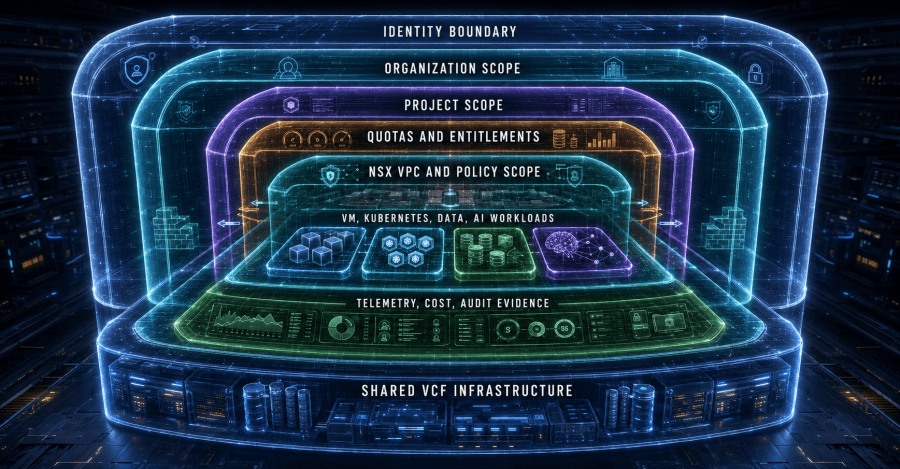
Identity Boundary
Map each tenant type across identity, organization, project, VPC, compute, storage, catalog, operations, cost, compliance, and recovery boundaries.
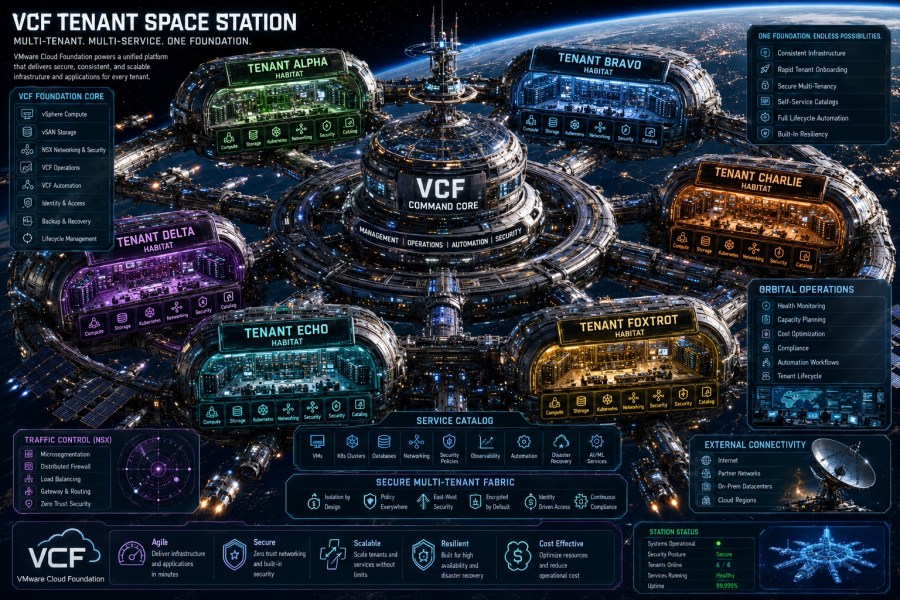
The station image shows internet, partner networks, on-premises data centers, and cloud regions connected to the platform. Every one of those connections changes the threat model and operating model.
Organization and Project Boundary
Shared external connectivity can be efficient, but it creates common failure and security domains. Dedicated connectivity can strengthen isolation, but it increases cost, routing complexity, and lifecycle obligations.
The center of the station is the VCF command core. This is where the metaphor becomes especially useful.
Resource Boundary
The central command core represents the capabilities that benefit from consistency: automation, operations, identity, lifecycle, security policy, capacity, and cost governance. The tenant habitats represent bounded consumption environments built from aligned organization, project, resource, network, service, and operational controls.
Start with a few production-ready services that have clear owners and repeatable validation. A standard VM, a Kubernetes environment, and a controlled network pattern are more valuable than twenty catalog items with unclear support.
NSX Is the Traffic Control Layer
A project is not enough. A resource pool is not enough. A VPC is not enough. A role assignment is not enough.
The architecture should make those tradeoffs explicit before tenants are onboarded.
Tenant VPC and subnet boundaries
East-west microsegmentation between workloads
North-south routing and firewall policy
Provider management-plane separation
Shared service access
Internet and partner egress
Load balancing and published application access
DNS, IP address management, and certificate dependencies
Logging, flow visibility, and security evidence
The service catalog sits at the bottom center of the image because it is the consumer-facing interface to the station.
Provider teams need fleet, instance, domain, cluster, network, service, and tenant-aware views. Tenants need enough visibility to understand the health of their services without exposing another tenant’s data or the provider’s privileged operational context.
Shared Edge or Dedicated Edge
A catalog item without an owner and a lifecycle is not a service. It is an automated support ticket waiting to happen.
That is the right starting point, but a multi-tenant design needs a clear distinction between shared capability and delegated control.
The Service Catalog Is the Interface, Not the Infrastructure
Decide whether the goal is showback, chargeback, budget control, unit economics, or capacity accountability. Define which costs are included, how shared overhead is allocated, how reservations are treated, and how idle resources are reclaimed.
The image’s orbital operations panel includes health monitoring, capacity planning, cost optimization, compliance, automation workflows, and tenant lifecycle. Those are not secondary features. They are what keep multi-tenancy from turning into shared-platform chaos.
A cost dashboard without a decision process is only reporting. A useful FinOps model changes behavior by connecting usage to ownership, quotas, lifecycle policy, and capacity planning.
Service question
Required answer
What is being delivered?
A defined service outcome, not a vague infrastructure object
Who owns it?
A named platform or service team
Who can request it?
An explicit organization, project, role, or approval path
What guardrails apply?
Quotas, policies, placement, network, security, and lifecycle controls
How is success validated?
Deployment checks, health signals, ownership transfer, and evidence
How is it retired?
Lease, reclamation, decommissioning, backup, data handling, and cost closure
A multi-tenant private cloud is not simply a large cluster with several folders. It is a provider-consumer system.
Deploy and integrate the management, automation, operations, identity, network, and lifecycle capabilities before broad self-service begins.
The Command Core Is an Operating Model
The important point is not the science-fiction appearance. It is the separation of responsibilities.
Several anti-patterns appear repeatedly in multi-tenant private cloud programs.
Version service definitions and test upgrades. The catalog is part of the platform’s API to its consumers, so uncontrolled changes create downstream risk.
The provider owns the station itself. That includes platform lifecycle, identity integration, shared infrastructure, network control, service definitions, monitoring, capacity, cost policy, compliance evidence, and incident response. Tenants consume approved services without needing administrative access to the full platform.
Capability
Accountable owner
Operational responsibility
Tenant onboarding
Platform product owner
Identity mapping, organization creation, projects, quotas, catalog entitlements
Network onboarding
Network platform owner
VPC, routing, firewall, shared services, external connectivity
Service publishing
Service owner
Template quality, dependencies, approvals, versioning, validation
Capacity
Infrastructure and FinOps owners
Forecasting, reserve policy, expansion trigger, tenant communication
Security
Security architecture and operations
Control objectives, policy review, evidence, exceptions, incident support
Lifecycle
VCF platform owner
Compatibility, patching, upgrades, certificates, rollback
Tenant support
Service desk and platform operations
Triage, escalation, ownership transfer, service-level reporting
Before approving the design, the architecture team should be able to answer the following questions clearly:
The decision should be documented as an architecture decision, including the requirement, selected pattern, alternatives, tradeoffs, owner, and review trigger.
Health and Observability
The NSX design should make tenant intent visible. A network engineer should be able to identify which tenant owns a VPC, which projects may use it, which services it can reach, where inspection occurs, who owns firewall changes, and how traffic is logged.
A tenant can exist entirely within shared infrastructure. Conversely, a regulated tenant may require dedicated clusters, workload domains, edge capacity, or even a separate VCF instance. The correct boundary depends on risk, lifecycle autonomy, performance isolation, and operating-model requirements.
Capacity and Reserve
Test onboarding, access review, deployment, network policy, incident response, quota exhaustion, backup, restore, offboarding, and evidence collection.
That tension is what the VCF Tenant Space Station image captures well.
Once tenants become accustomed to unlimited or unpriced consumption, introducing quotas and reclamation later becomes an organizational conflict rather than a technical change.
Cost, Showback, and Chargeback
The practical path is to define the tenant contract first, choose the required separation pattern, align every control layer, publish a small set of supportable services, instrument operations and cost, then scale through automation. That is how one foundation can support many tenants without turning the private cloud into an uncontrolled collection of shared resources.
The platform should be run like a product. That means a roadmap, service definitions, published constraints, measurable outcomes, and a feedback loop from tenant experience into platform improvement.
A credible tenant habitat is formed when several boundaries align:
Compliance and Evidence
Giving tenants low-level access to raw platform constructs may feel flexible, but it transfers complexity without transferring the skills or accountability required to manage it.
Quotas, limits, reservations, placement rules, and service entitlements protect the shared foundation. They also create the basis for capacity planning and financial accountability.
External Connectivity Is a Trust Boundary
A shared edge design can reduce cost and simplify operations, but it increases the importance of routing, NAT, firewall, load-balancer, and capacity controls. A dedicated edge design can strengthen separation and lifecycle autonomy, but it consumes more resources and adds operational overhead.
A useful ownership model looks like this:
Which tenant or service owns the connection?
Is the path shared or dedicated?
Where are routing, firewall, inspection, and address translation enforced?
How are overlapping addresses handled?
Which identities or workloads can use the path?
How is availability monitored?
Who approves changes?
What happens when the dependency fails?
What evidence is retained?
VMware Cloud Foundation 9.1 provides the platform constructs needed to build this model, but the quality of the result depends on architecture discipline. Organizations and projects do not replace network isolation. NSX does not replace identity governance. A catalog does not replace service ownership. VCF Operations does not replace capacity and financial decisions. Shared infrastructure does not remove the need for tested failure and recovery boundaries.
The left side of the image lists the VCF foundation core: compute, storage, networking, operations, automation, identity, recovery, and lifecycle management.
Choosing the Right Tenancy Pattern
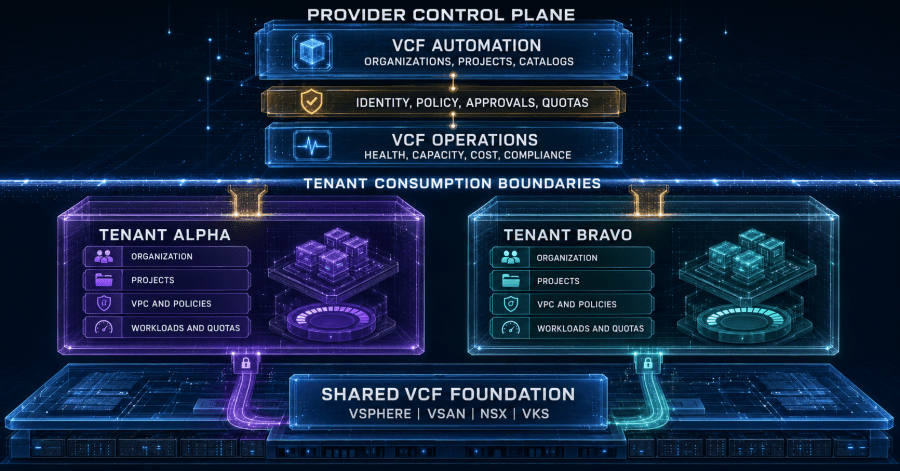
VCF Automation provides the consumption and automation layer. VCF Operations provides health, capacity, cost, compliance, and operational visibility. Identity services govern who can access which scope. NSX and vSphere enforce workload and infrastructure controls. Lifecycle processes keep the platform supportable.
Tenancy pattern
Best fit
Separation level
Operational impact
Key warning
Projects inside one organization
Internal teams with common identity and governance
Logical project, quota, and entitlement separation
Lowest overhead
Weak fit when teams require separate administration or identity
Separate organizations on shared infrastructure
Business units, subsidiaries, partners, or customers
Stronger administrative and consumption separation
Moderate catalog, identity, and reporting overhead
Still requires deliberate network and resource isolation
Separate organizations with dedicated VPC and edge policy
Tenants needing stronger network autonomy
Administrative plus stronger network separation
Higher network and edge complexity
Shared dependencies may still exist below the network layer
Dedicated clusters or workload domains
Regulated, performance-sensitive, or lifecycle-sensitive tenants
Dedicated capacity and stronger failure isolation
Higher cost and lifecycle overhead
A workload domain is not automatically a complete tenant operating model
Separate VCF instance or private cloud boundary
Strict sovereignty, independent lifecycle, or major blast-radius requirements
Highest infrastructure and management separation
Highest cost, staffing, and integration overhead
Centralized fleet services and identity relationships still require careful design
A mature catalog can expose virtual machines, Kubernetes environments, networks, security policies, databases, observability, automation workflows, recovery services, and AI capabilities. The catalog should hide unnecessary implementation detail while preserving the controls needed for production operations.
An Implementation Sequence That Scales
The VCF Tenant Space Station is more than a creative image. It is a useful way to explain the difference between a shared private cloud foundation and a governed multi-tenant operating model.
Define the Tenant Contract
Include service levels, maintenance expectations, data handling, backup responsibilities, recovery objectives, support paths, cost policy, and exit procedures.
External connectivity should answer:
Build the Isolation Matrix
Those capabilities need explicit ownership.
Define human users, groups, service accounts, API clients, privileged roles, access-review cadence, and break-glass procedures. Tenant administrators should not inherit provider-level authority simply because they need to manage their own projects.
Establish the Provider Foundation
Not every tenant needs the same degree of separation. Use the lightest pattern that satisfies risk, performance, lifecycle, and governance requirements.
These assumptions matter because the image presents an idealized result. The architecture work lives in the controls that make that result credible.
Publish a Small Catalog
VCF Operations can support cost and capacity management, including tenant-oriented visibility for organizations and projects. The operating model still has to define the financial rules.
It also assumes that:
Instrument Operations and Cost
Those consumers may be application teams, business units, subsidiaries, development groups, regulated environments, partners, or external customers. They want fast access to virtual machines, Kubernetes clusters, networking, data services, recovery capabilities, and increasingly AI services. The platform team still has to protect capacity, enforce security, maintain lifecycle consistency, preserve auditability, and prevent one tenant from creating problems for everyone else.
Pilot With Different Tenant Types
A strong multi-tenant platform is built in layers. Starting with a large service catalog usually creates more variation than the operating model can support.
The provider team still needs deep infrastructure access. The tenant should usually see a smaller and more stable interface. That separation reduces accidental coupling between application delivery and infrastructure administration.
Scale Through Automation and Governance
The hierarchy should reflect the operating model. Do not create one organization per temporary project if that produces catalog, identity, and reporting sprawl. Do not put unrelated business units into one organization merely because they share the same hardware.
Failure Modes That Break the Station
Use at least one cooperative internal tenant and one tenant with stricter requirements. The second tenant exposes assumptions that the first tenant may never challenge.
Treating a Project as the Entire Tenant Boundary
A credible capacity model subtracts maintenance reserve, failure reserve, growth buffer, operational overhead, storage protection, network headroom, and any disaster-recovery commitments. Tenant quotas should be based on this usable capacity model, not on the total hardware installed.
Publishing Infrastructure Instead of Services
This article uses VMware Cloud Foundation 9.1 as the version baseline and assumes that VCF Automation and VCF Operations are part of the target operating model.
Building the Catalog Before the Operating Model
One of the most common design mistakes is treating a single object as the tenant boundary.
Assuming Shared Means Cheap
The image labels NSX as traffic control, and that is a practical way to think about its role.
Delaying Cost and Capacity Governance
Use organizations for durable administrative and consumption separation. Use projects for narrower scopes such as application teams, product groups, development environments, or workload portfolios.
Do not accept a vague statement such as isolated by NSX. Record the actual enforcement object, owner, validation method, and exception process.
A Practical Design Review Checklist
If the answers exist only in different teams’ heads, the station is not ready for additional habitats.
What exactly is a tenant in this environment?
Which VCF Automation organization and project pattern represents each tenant type?
Which identity provider, groups, roles, API clients, and privileged paths apply?
Which NSX VPC, subnet, routing, firewall, load-balancing, and egress patterns apply?
Which compute, storage, edge, Kubernetes, and accelerator resources are shared or dedicated?
Which catalog services are supported, versioned, monitored, backed up, and recoverable?
Which quotas, leases, approvals, and reclamation policies apply?
How are health, cost, capacity, and compliance scoped to tenants?
Who owns provider incidents, tenant incidents, and shared-service incidents?
How is tenant offboarding performed, including data retention and access revocation?
Which requirements would force a move to dedicated clusters, workload domains, or a separate instance?
Which evidence proves the promised isolation and recovery behavior?
The image includes databases, disaster recovery, and AI services. Those are valid private-cloud service targets, but they should not be presented as universally built-in outcomes. Each one needs its own dependency model, support boundary, security posture, availability target, capacity plan, and operational runbook.
Conclusion
The following diagram translates the image into a practical VCF mental model.
Tenants should not need direct administrative access to vCenter, NSX Manager, storage administration, fleet lifecycle, or the management domain to consume a standard service. The platform team should expose service outcomes, not internal machinery.
The station metaphor is a mental model, not a literal VCF topology diagram. Several terms need to remain precise or the design quickly becomes misleading.
Automate repeatable onboarding and lifecycle tasks only after the design is stable. Keep approvals and exception handling visible. Use version-controlled templates and policy where possible, but retain clear human ownership for risk decisions.
External References