TL;DR
For MCP, that can mean understanding the difference between tools/list, tools/call, resources/read, and a specific tool name. It can also mean using the MCP server’s authorization model, validating token audience correctly, preventing token passthrough, and treating tool annotations or risk labels as policy inputs.
Scope and Assumptions
This is where AI and DevOps meet. Agent capability should be promoted like infrastructure. Gateway policy should be versioned. Tool access should be reviewed through pull requests or change records. Observability should feed the same operational process used for service reliability and security response.
The goal is to provide a practical design model that security, platform, DevOps, and AI engineering teams can use before the environment becomes a web of direct agent-to-tool connections.
| Assumption | Why It Matters |
|---|---|
| Agents will use multiple tools | Single-tool security patterns break down when tool catalogs grow. |
| Some tools are sensitive | Read-only lookup and destructive workflow execution need different policies. |
| Agent identity matters | A generic service account is not enough for investigation or least privilege. |
| User context may matter | Some actions must be authorized based on the user, not only the agent. |
| Gateway capabilities differ by vendor | Do not assume every gateway can parse every protocol attribute equally. |
| Application-level authorization still applies | A gateway should reduce risk, not become the only security layer. |
The core problem is that agent traffic is not just API traffic with a chatbot in front of it. Agent traffic carries intent, delegation, context, and tool selection. Security controls need to inspect and govern those dimensions where the protocol and platform allow it.
MCP, A2A, and Agent Gateways Are Different Security Surfaces
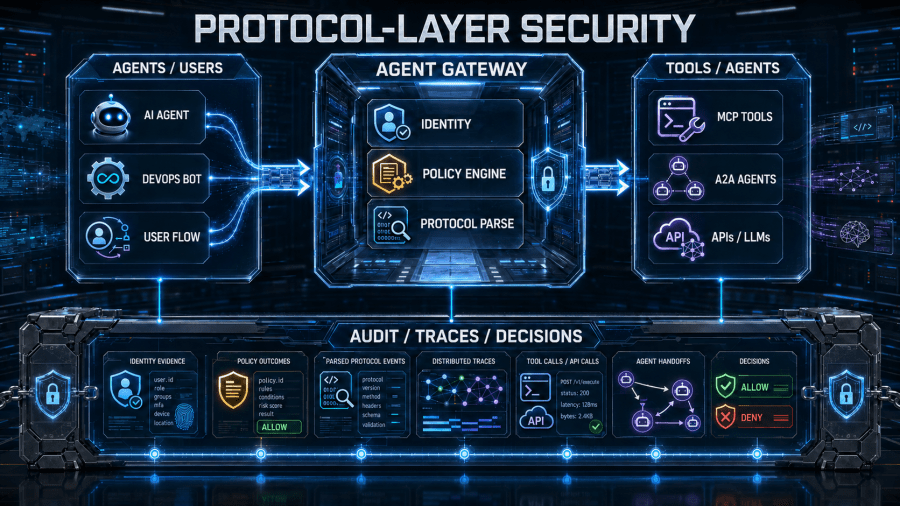
For an agent gateway, protocol-layer security means the gateway is more than a reverse proxy. It becomes a policy enforcement point that can combine identity, route, target, protocol attributes, content inspection, and telemetry.
| Area | MCP | A2A | Agent Gateway |
|---|---|---|---|
| Primary purpose | Connect AI applications and agents to tools, prompts, and resources | Let independent agents communicate and collaborate | Govern, route, authenticate, authorize, and observe agentic traffic |
| Common interaction | Agent invokes a tool or reads a resource | Agent delegates or coordinates with another agent | Agent traffic passes through a central policy enforcement point |
| Capability description | Tool, prompt, and resource definitions | Agent Card and skills | Registry, target, route, policy, identity, and telemetry metadata |
| Security focus | OAuth, token audience, scopes, tool authorization, prompt/tool risks | HTTP-layer authentication, Agent Card security schemes, skill authorization, task delegation | Identity enforcement, protocol-aware policy, egress control, audit, and integration with security services |
| Main failure mode | Overprivileged tools, token passthrough, prompt injection, session misuse | Overtrusted remote agents, weak skill authorization, opaque delegation | Blind passthrough, incomplete policy context, missing ownership, noisy logs without decision evidence |
Google Cloud’s Agent Gateway is positioned as part of the Gemini Enterprise Agent Platform governance layer. Its documentation describes gateway support for HTTP-based traffic, including MCP and A2A, with deeper MCP request parsing for attribute-based authorization policies. The design also ties into agent identity, Agent Registry, authorization policies, Model Armor, logging, tracing, and Service Extensions for delegated authorization.
A2A has a different shape. The remote agent may be an independent system. It may expose a public Agent Card, an authenticated extended Agent Card, and one or more skills. It may support long-running tasks, streaming, state updates, or push notification callbacks.
The Request Flow That Needs to Be Governed
Teams do not need to solve every future agent security problem on day one. They do need a minimum control set before tool adoption spreads across the environment.
This article focuses on enterprise protocol-layer security patterns for MCP, A2A, and agent gateways. It is not a step-by-step guide for a specific product deployment.
Where Google and AWS Are Signaling the Architecture
Decision telemetry also helps DevOps and platform teams improve the system. Denied requests can reveal missing policy, broken registration, overbroad agent design, or a tool that should not be exposed to agents at all.
Use A2A-specific governance when agents delegate tasks, expose skills, share status, or operate across framework, account, project, tenant, or organizational boundaries. Treat remote agents as governed services, not trusted libraries.
Agent -> Gateway -> Registered MCP Server
Agent -> Gateway -> Registered A2A Agent
Agent -> Gateway -> Registered API Target
Agent -> Gateway -> Approved Model Route
Traditional request logs often answer what happened. Agent gateway telemetry needs to answer why it was allowed to happen.
MCP, A2A, and agent gateways often get discussed together because they sit in the agent connectivity path. They solve different problems, and that difference matters for security design.
| Design Area | Google Cloud Agent Gateway Direction | AWS AgentCore Gateway Direction | Practical Takeaway |
|---|---|---|---|
| Agent connectivity | Governed entry and exit point for agent interactions | Single secure entry point for agents, tools, other agents, and models | Put a managed control point in the path instead of direct tool sprawl |
| MCP handling | Supports MCP traffic and documented MCP attribute extraction for policies | Aggregates MCP targets into a unified virtual MCP server | MCP is becoming a first-class gateway concern |
| A2A handling | Supports HTTP-based A2A traffic through gateway routing | Supports A2A-style services through HTTP targets and passthrough | A2A needs identity and route-level governance even when deep inspection varies |
| Policy model | Authorization policies, Service Extensions, IAM-related controls, Model Armor integration | Inbound authorization, credential providers, gateway rules, target routing | Gateway policy needs to combine identity, protocol, route, and content controls |
| Observability | Cloud Logging, Cloud Trace, and agent observability integration | Gateway-level routing and operational controls with AWS-native integration paths | Logs must preserve agent, target, operation, decision, and trace context |
This is the same architectural instinct behind network segmentation, API gateways, service mesh, and privileged access management. The difference is that the policy input now includes agent behavior and protocol context.
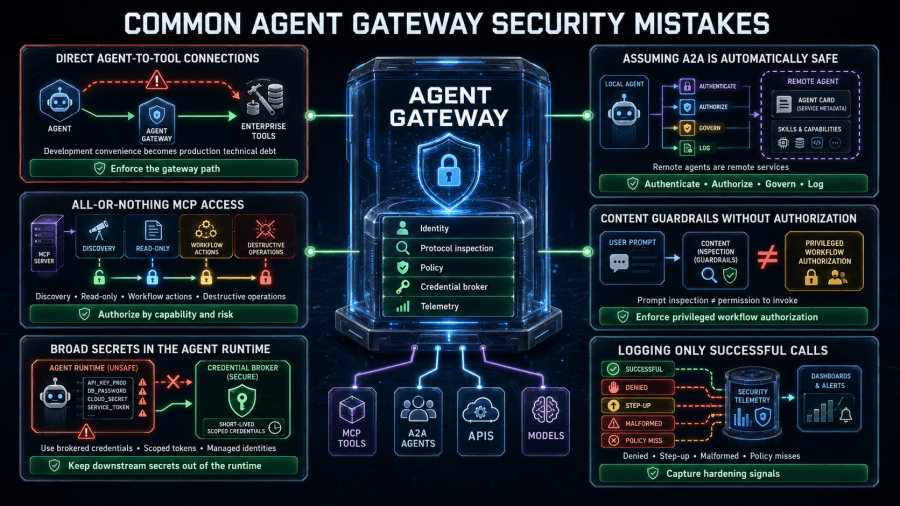
The most important operating principle is simple: adding a tool to an agent is a security-impacting change. It deserves the same level of review as exposing a new API route, granting a new IAM permission, or adding a new automation runbook action.
The most important shift is operational. Adding a tool to an agent is not a small developer convenience. It is a change to the enterprise action surface. Teams that build gateway-level controls now will have a much easier time scaling agentic systems without losing track of who can do what, through which protocol, against which system, and under which policy.
Protocol-layer security is the ability to apply security decisions using protocol-specific context, not just network location or endpoint identity.
That sounds reasonable until the tool surface grows. A single MCP server may expose dozens of tools. Some are harmless read operations. Some can write tickets, update records, approve requests, rotate credentials, query sensitive data, or trigger automation. Treating all tool calls as equivalent turns a useful integration into an overprivileged execution path.
Use an agent gateway when agents call multiple tools, operate across teams, access sensitive data, invoke workflow systems, call peer agents, or need production observability. That should be the default enterprise direction.
| Control | Why It Belongs in the Gateway Path |
|---|---|
| Agent registration | Prevents unknown agents from connecting directly to tools |
| Tool and target inventory | Makes the exposed action surface visible |
| Ingress authentication | Validates the caller before traffic reaches the agent or gateway target |
| Egress authorization | Restricts which tools, agents, APIs, or models an agent can call |
| Credential brokering | Avoids storing broad downstream secrets inside agent code |
| Protocol-aware policy | Allows decisions based on tool, resource, skill, method, route, or risk label |
| Content and prompt inspection | Adds a runtime guardrail for injection, sensitive data, or unsafe output |
| Decision telemetry | Captures the security reason for allow, deny, step-up, or audit-only decisions |
MCP security should start with a simple rule: do not treat tool discovery as authorization.
A Practical Control Model for MCP
AWS positions Amazon Bedrock AgentCore Gateway as a managed secure entry point for agentic traffic. Its documentation describes MCP target aggregation, HTTP passthrough targets for services such as other agents and A2A services, inference targets, inbound authorization options, credential providers, and gateway rules that can route based on caller identity or request path.
You need all three layers to align: protocol contract, gateway enforcement, and backend authorization.
Agent -> MCP Server
Agent -> SaaS API
Agent -> Internal API
Agent -> Another Agent
Agent -> Model Endpoint
A lot of teams start with this pattern:
A Practical Control Model for A2A
A better policy model evaluates:
Decision Guidance for Architects and Platform Teams
The important pattern is that both vendors are moving the enterprise control point away from individual agent code and toward a gateway layer that can centralize connectivity, authorization, routing, credentials, and telemetry.
Gateway Policy Should Be Managed Like Production Infrastructure
For A2A, that can mean requiring authenticated agent discovery, validating the security schemes advertised in an Agent Card, applying authorization per agent or skill, and treating long-running tasks or push notifications as part of the security model. A2A intentionally relies on standard web security mechanisms at the HTTP layer, so the agent server and gateway design must preserve that boundary.
Agent security is not only a security team problem. It changes how platform and DevOps teams manage environments.
The highest-risk shortcut is token passthrough. It is tempting because it makes integration easier. It also breaks the boundary between the MCP client, MCP server, and downstream API. Once tokens are passed around without proper audience validation and exchange, logs become harder to trust, controls are easier to bypass, and downstream systems may accept credentials that were not meant for them.
This is the practical difference between a connected agent and a governed agent.
The Minimum Control Set for Enterprise Agent Gateways
An MCP client may list available tools. That does not mean every listed tool should be callable by every agent. Tool catalogs should be filtered, scoped, and logged. Tool calls should be authorized based on the agent identity, user context where applicable, target MCP server, tool name, tool risk, and requested arguments when feasible.
| Control Area | Minimum Requirement | Why It Matters |
|---|---|---|
| Inventory | Register agents, MCP servers, tools, A2A agents, APIs, and owners | You cannot secure an action surface you cannot name |
| Identity | Assign distinct identities to agents, users, clients, gateways, and backend targets | Shared identities destroy least privilege and audit quality |
| Authorization | Enforce per-agent and per-operation access where supported | Server-level access is too broad for tool catalogs |
| Credential handling | Use credential providers, token exchange, or brokered credentials | Agents should not become secret storage locations |
| Protocol inspection | Extract MCP and A2A attributes where supported by the platform | Policy needs operation context, not only endpoint context |
| Content guardrails | Inspect high-risk prompts, tool inputs, and responses | Prompt injection and data leakage are runtime concerns |
| Telemetry | Log identity, target, protocol, operation, decision, and trace ID | Security investigations need decision-grade evidence |
| Change control | Version policy, review tool additions, and test deny paths | Agent capability changes are production changes |
| Break-glass | Define emergency disablement for agents, tools, targets, and routes | Fast containment matters when an agent path misbehaves |
| Drift detection | Detect direct tool access that bypasses the gateway | Gateway control fails if bypass paths remain open |
Endpoint-level authorization is too coarse for many agent workloads. If an MCP server exposes twenty tools, allowing access to the server is not the same as allowing access to every tool. If an A2A agent exposes multiple skills, allowing communication with the agent is not the same as allowing every delegated action.
Observability Needs to Capture Decisions, Not Just Traffic
A production agent should have a release path that includes:
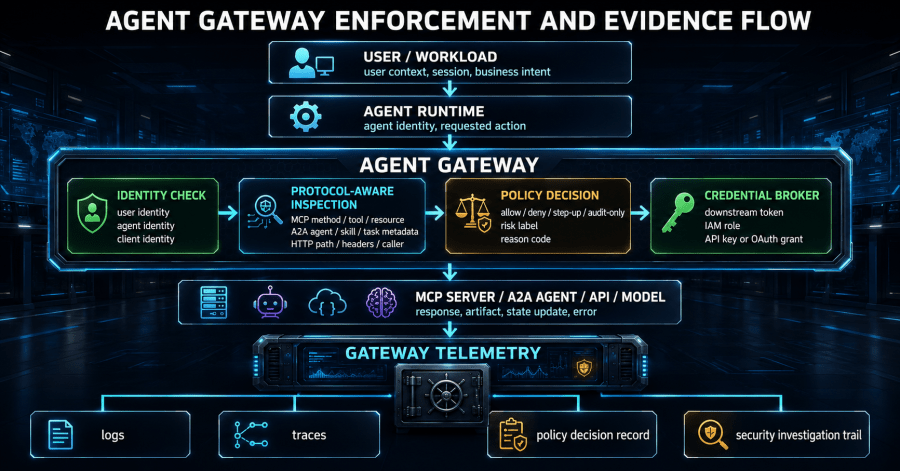
Traditional API security still matters, but it is no longer enough by itself. An API gateway can tell you which endpoint was called. A protocol-aware agent gateway should also help answer which agent called it, which user or workload context was involved, which MCP tool or A2A skill was requested, whether the operation was read-only or destructive, and whether the policy decision was enforced before the request reached the backend system.
| Field | Example |
|---|---|
| Trace ID | Request chain across agent, gateway, tool, and peer agent |
| User identity | Human or workload context that initiated the request |
| Agent identity | The acting agent or runtime |
| Client identity | Application, IDE, workflow, or service invoking the agent |
| Protocol | MCP, A2A, REST, gRPC, inference |
| Target | MCP server, tool, resource, A2A agent, skill, API, model |
| Operation | Tool call, resource read, skill invocation, route, model request |
| Policy decision | Allow, deny, step-up, audit-only |
| Reason code | Matched allowlist, missing scope, unregistered target, destructive operation |
| Credential path | Brokered token, IAM role, OAuth grant, blocked secret path |
| Content decision | Prompt inspection result, sensitive data result, guardrail outcome |
The practical direction is clear. Agents need explicit identities. Tools and peer agents need registration and ownership. Gateway policy needs enough protocol context to distinguish safe requests from risky ones. Credentials need to be brokered rather than scattered across agent runtimes. Logs need to capture decisions, not just traffic.
The common mistake is assuming that A2A makes agents trustworthy because they can describe themselves. Discovery is not trust. An Agent Card is a starting point for policy, not a replacement for identity verification, authorization, and monitoring.
“Should this agent, acting for this user or workload, be allowed to perform this operation against this tool or peer agent, with these inputs, from this runtime, right now?”
A strong identity tells you who is calling. It does not automatically tell you what they are allowed to do.
| Lifecycle Stage | Required Gate |
|---|---|
| Design | Define agent purpose, tool needs, data classification, and ownership |
| Build | Register tool contracts, expected permissions, and protocol targets |
| Test | Validate allowed and denied tool calls in lower environments |
| Release | Promote gateway policy with the agent deployment |
| Operate | Monitor decisions, exceptions, latency, and failed authorization |
| Change | Review every new tool, skill, route, or credential provider |
| Retire | Remove agent identity, tool bindings, policies, and credentials |
The same problem appears in A2A patterns. One agent may ask another agent for a summary, a risk review, a workflow decision, or an action that touches downstream systems. The remote agent may be opaque by design. You may not see its internal prompt, memory, tools, or implementation. That makes the external contract and the policy boundary more important, not less.
That gives security and platform teams a place to enforce the baseline: