VCF on Dell PowerFlex: Storage, Platform, and Lifecycle Boundaries
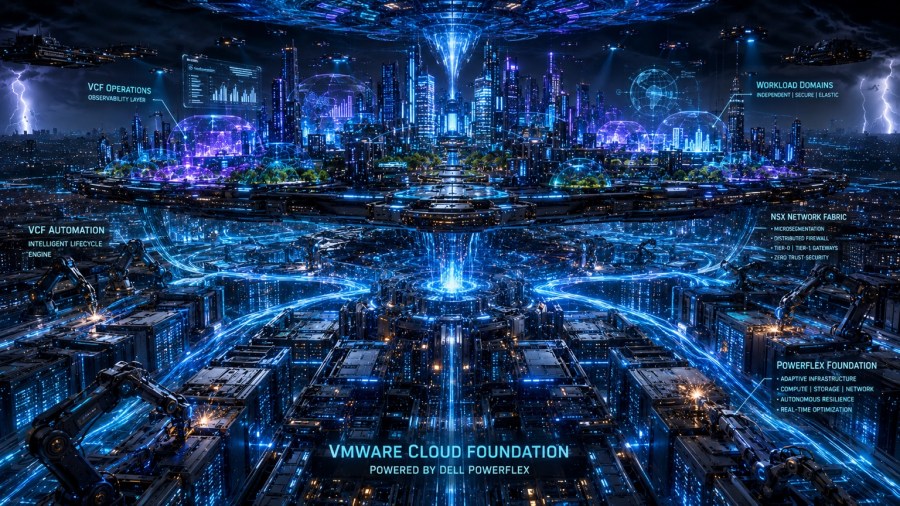
The futuristic city in the image works as a VMware Cloud Foundation on Dell PowerFlex mental model because it makes the layers visible.
VCF Operations Is the Fleet-Level Operational Lens
The best architecture interpretation is coordinated autonomy. Each subsystem can automate within its own authority, but cross-platform changes require policy, validation, and human accountability.
VCF Operations provides the fleet-level view, but the PowerFlex platform still needs authoritative storage telemetry and operational ownership. Alert correlation, time synchronization, event routing, and support evidence should be tested across both environments.
The platform should expose PowerFlex-backed infrastructure as a service with clear performance classes, capacity rules, ownership metadata, and retirement workflows. Otherwise, the environment may be technically sophisticated while remaining operationally manual.
The strongest part of the image is its vertical structure. The platform is not shown as a flat collection of products. It is shown as a set of layers that depend on one another.
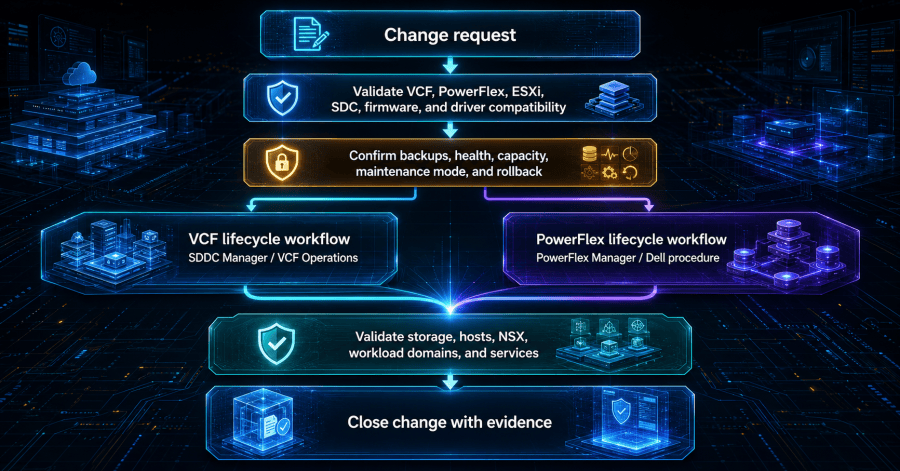
The intended VCF release, PowerFlex release, SDC version, ESXi build, server firmware, network adapters, drivers, and protocol must be validated as one supported system. Version compatibility is part of the architecture, not a deployment checklist added later.
The foundation asks whether the platform has resilient and performant resources. NSX asks how workloads communicate and where policy is enforced. Workload domains ask how infrastructure is grouped, owned, maintained, and consumed. Automation asks how services are requested and governed. Operations asks whether the platform is healthy, compliant, supportable, and economically sustainable.
Is the fleet healthy enough for lifecycle work?
Which workload domain is approaching a capacity or risk threshold?
Are logs and diagnostics available before an incident escalates?
Are security and compliance controls reporting consistently?
Are service costs and consumption patterns visible to owners?
Are platform dependencies, certificates, passwords, and integrations in a known state?
Which team owns the next action?
This is why the design can use PowerFlex as principal storage while still presenting a familiar VMFS consumption model to vSphere and VCF.
The Design Has Two Coordinated Lifecycle Planes
That is not a minor implementation note. It can change server adapter design, switch configuration, deployment sequencing, and the feasibility of an existing network standard.
The physical design must satisfy PowerFlex data-path requirements and VCF deployment constraints without weakening NSX underlay resilience or operational standards. Greenfield and brownfield paths should be evaluated separately because the supported network assumptions can differ.
The design becomes credible only when those layers remain distinct. PowerFlex Manager and VCF do not become one lifecycle system. NSX does not eliminate physical network design. Workload domains are not automatically secure or elastic. Automation does not replace lifecycle governance. The platform succeeds when the boundaries, dependencies, and operational handoffs are designed as carefully as the technology stack.
TL;DR
A strong implementation plan should move from support validation to service operations, not from hardware installation directly to workload migration.
Validate the Service, Not Only the Components
VCF Automation is best understood as the governed consumption and service-delivery layer. It gives platform teams a way to expose infrastructure services through organizations, projects, catalogs, templates, policy, approvals, placement logic, integrations, and Day 2 actions.
Risks and Caveats to Address Early
The image uses the words independent, secure, and elastic. Those are design outcomes, not automatic properties.
Lifecycle Coordination Is Manual at the Boundary
The PowerFlex Storage Data Client is installed in the ESXi kernel. It presents PowerFlex volumes to ESXi as block devices through a logical adapter. Those devices can be formatted with VMFS and exposed as datastores to the management or workload domain under supported configurations.
The Supported Topology Is Not PowerFlex HCI
Observability becomes useful when it changes a decision, not when it creates another dashboard.
Network Constraints Can Affect Greenfield Design
A database platform may need significantly more storage performance without needing a proportional increase in licensed compute. An AI data service may need additional capacity before it needs more ESXi hosts. A consolidation platform may need more compute while the storage pool still has headroom. Disaggregation lets the architecture respond to those patterns without forcing both resource types to scale in lockstep.
Principal and Supplemental Storage Are Different Decisions
A consumer should not need to know every vCenter, datastore, storage pool, network segment, or API call involved in a deployment. The consumer should request a service that has already been shaped by architecture, security, capacity, and governance decisions.
Elastic Infrastructure Does Not Guarantee Elastic Applications
PowerFlex storage traffic, ESXi management, vMotion, NSX tunnel traffic, edge connectivity, backup traffic, replication, and external services all depend on physical network capacity and failure-domain design. MTU, routing, redundancy, congestion, oversubscription, adapter placement, and maintenance procedures remain engineering concerns.
Zero Trust Is an Operating Model
That is a useful mental model, but only after the metaphor is translated into real architecture.
Observability Must Include the Storage Layer
The domain model should therefore be tied to decision criteria, not visual neatness.
Conclusion
The lower layer of the image is labeled as the PowerFlex foundation. That is directionally correct, provided the word foundation is used carefully.
NSX microsegmentation is a strong control, but identity, policy ownership, logging, exception handling, external connectivity, privileged access, and continuous validation determine whether the environment behaves like a zero-trust platform.
A vCenter alarm may identify a host issue. A PowerFlex alert may identify a storage condition. An NSX alarm may identify a transport or gateway problem. An automation failure may identify a service-delivery issue. VCF Operations helps the platform team correlate those signals within the wider VCF operating context.
The practical takeaway is straightforward: do not design the platform as one giant machine. Design it as a set of explicit control boundaries that work together. That is how the private-cloud city becomes operable rather than merely impressive.
External References
The glowing NSX fabric in the image can make the physical network disappear. In production, the underlay remains critical.
Moving from VVF to VCF: Is Your Operating Model Ready?
Prepare the operating model for a VVF-to-VCF transition. Define service ownership, authority, dependencies, recovery, and evidence before expanding automation or self-service.
Read the article →
PowerFlex does not replace the VCF management plane. It does not replace NSX. It does not define workload-domain ownership. It does not automatically provide application-level resilience. It also does not turn the physical network into an abstract concern.
Make your next architecture decision with confidence.
That does not make the environment zero trust by default.