New articles
- Demand: What application teams need, including compute, storage, connectivity, security, availability, and recovery.
- Delivery: How approved services are provisioned consistently through automation.
- Control: How identity, policy, network boundaries, lifecycle state, and configuration standards are enforced.
- Feedback: How telemetry, incidents, capacity, cost, and service performance change future decisions.
Replication status is not recovery evidence. Teams must prove that applications, data, identity, network policy, and management services can be restored in the required order.
The following comparison is deliberately directional. It helps narrow the architecture conversation, but it does not replace compatibility, sizing, or validated-design work.
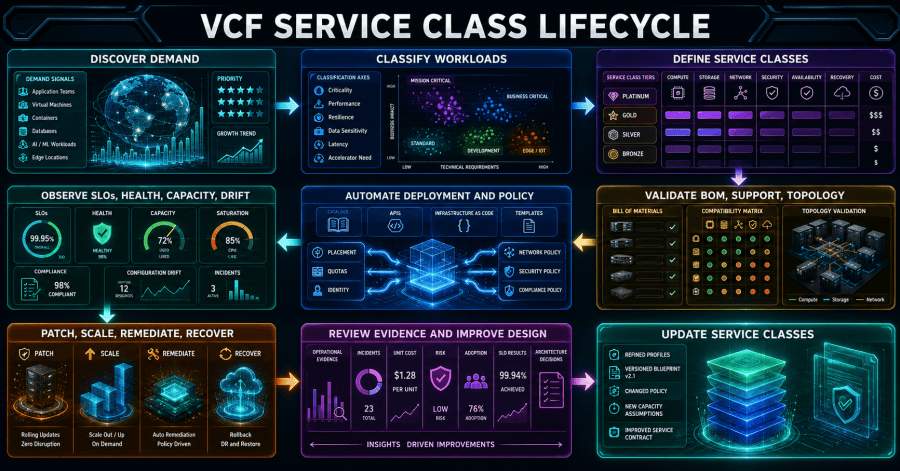
The Adaptive Private Cloud Control Loop
Keep exploring

The diagram below shows what the race-team metaphor looks like as an enterprise architecture. The key point is that telemetry does not end at a dashboard. It must return to policy, automation, capacity, and lifecycle decisions.
A practical responsibility split might look like this:
This is the difference between owning infrastructure and operating a cloud.
| Service class | Workload tendency | Infrastructure posture | Network and security | Operating emphasis |
|---|---|---|---|---|
| Mission critical | Transactional systems and core services | Dedicated failure-domain analysis, validated storage path, reserved headroom | Tight segmentation, explicit east-west policy, controlled administration | Strong SLOs, tested recovery, conservative change |
| Standard enterprise | Broad VM and application estate | Repeatable cluster patterns, shared capacity, standardized data services | Reusable application tiers and policy groups | High automation, predictable patching, cost control |
| Elastic or distributed | Analytics, simulation, edge, burst-oriented services | Scale-out capacity, locality-aware placement, flexible expansion | Site-aware policy, controlled ingress and egress | Capacity telemetry, autonomous remediation, fleet consistency |
This distinction is especially important for AI, analytics, and simulation workloads. The application may run on VCF while its large data set follows a different access, protection, and lifecycle model.
Scope and Terminology Guardrails
The constructor model is useful only when its decisions are explicit. Before selecting a hardware platform, storage family, network topology, or domain pattern, the design team should agree on the criteria that matter.
The architecture review should ask, “Which service objective requires this platform?” rather than, “Which platform do we already own?” Existing investments matter, but they should enter the decision as constraints and capabilities, not as the conclusion.
- VCF is the operating platform, not just the hypervisor layer. Compute virtualization remains essential, but the cloud operating model also depends on automation, operations, networking, security, lifecycle, and governance.
- A workload domain is an operational and lifecycle boundary. It should not be treated as a casual grouping of clusters.
- External storage is not interchangeable. Protocol, principal versus supplemental use, availability design, lifecycle ownership, and current support matrices all matter.
- PowerScale is usually an adjacent unstructured-data service, not a generic substitute for a VCF datastore. Its role should be designed around the application data path and validated integrations.
- The current Dell implementation guides cited for PowerFlex, PowerStore, and PowerMax target VCF 9.0. A VCF 9.1 design must revalidate the current Broadcom bill of materials, compatibility guidance, Dell documentation, and support position before implementation.
- Multicloud does not mean one control plane owns every external cloud. It means governance, identity, connectivity, and service expectations are made consistent where supported, while provider-native responsibilities remain explicit.
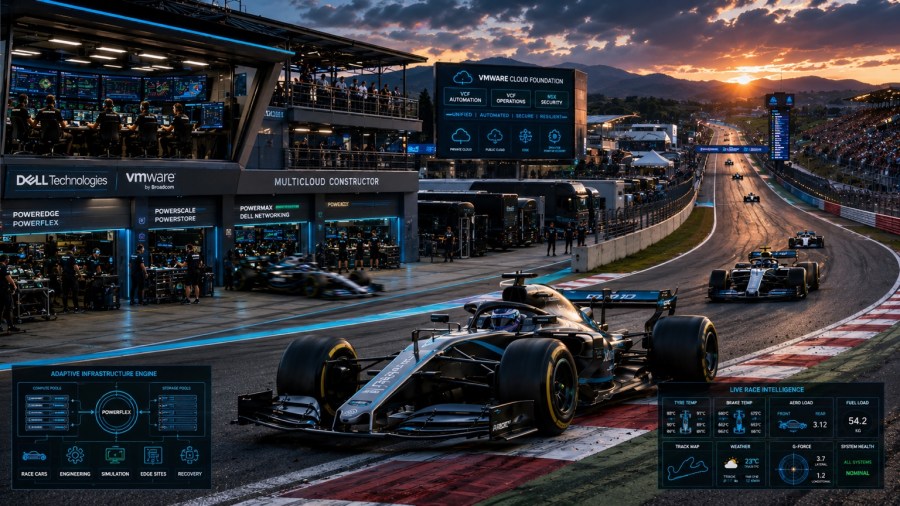
- The image is an operating-model metaphor. It does not imply that every displayed product belongs in every design.
TL;DR
This option introduces specialized SAN, array, and operational responsibilities. It should be selected because workload objectives justify that complexity, not because standardization on a premium platform appears safer.
Workload Service Objectives
This is where the private cloud becomes consumable. Infrastructure teams retain governance, while application teams receive a predictable service without navigating every underlying product.
Failure Domains and Recovery
VxRail represents an integrated Dell infrastructure path for VCF environments. Its value is the combination of standardized hardware, engineered lifecycle integration, and a defined deployment model.
Lifecycle Ownership
The constructor is therefore the platform team plus its operating system of standards, automation, telemetry, and ownership. VMware Cloud Foundation supplies the software control plane. Dell infrastructure supplies multiple implementation choices. The value appears only when those choices are assembled into governed service classes.
Storage and Data-Service Fit
Create version-controlled templates that deploy the service class, not just its virtual machines. Include network policy, tags, ownership, monitoring, protection, quotas, and decommissioning behavior.
Network and Security Boundaries
Decide what can fail together. Host, rack, cluster, fabric, array, site, identity service, management plane, and external dependency failures must be considered separately. Recovery plans should include the control plane itself, not only application data.
Automation and Observability Maturity
A weak design gives each team a virtual machine and asks infrastructure specialists to solve the rest manually. A stronger design publishes service classes that already include placement rules, storage behavior, network policy, protection, observability, and lifecycle ownership.
Translating the Race Team into Architecture
The platform team should avoid two extremes. The first is rebuilding every legacy network construct inside NSX without reconsidering application boundaries. The second is granting unrestricted self-service networking without ownership, quotas, or policy guardrails.
| Image element | Architecture role | Key design question | Failure when ignored |
|---|---|---|---|
| Race car | Application or workload | What service outcome does this workload require? | Every deployment becomes a custom exception |
| Constructor garage | Platform engineering team | Who owns the end-to-end service? | Silos optimize components but not outcomes |
| VCF control wall | Unified private cloud control plane | Where are policy, state, and lifecycle decisions made? | Multiple consoles produce conflicting truth |
| Pit wall telemetry | VCF Operations and service monitoring | Which signals predict SLO risk or capacity exhaustion? | Dashboards grow while action remains manual |
| Race strategy | VCF Automation and placement policy | How is intent translated into repeatable deployment? | Tickets and scripts become the control plane |
| Track barriers | NSX networking and security | Where are trust, routing, and tenant boundaries enforced? | Connectivity expands faster than governance |
| Pit stop | Lifecycle management | How are changes sequenced, validated, and reversed? | Maintenance becomes a high-risk event |
| Recovery crew | Backup, replication, and recovery operations | Can service be restored within tested objectives? | Protection exists on paper but not in practice |
PowerStore can support broad enterprise patterns involving block and file services. Dell’s VCF 9.0 implementation guidance includes principal-storage designs using NFS and Fibre Channel patterns for different domains.
VCF Operations Is the Pit Wall
VMware Cloud Foundation provides the software control plane for automation, operations, networking, security, and lifecycle. Dell infrastructure provides specialized compute, storage, data, and network capabilities. Neither side should be designed independently. The platform succeeds when service objectives determine component choices and when telemetry continuously improves deployment, policy, capacity, change, and recovery.
The platform team stops measuring only host utilization and ticket closure. It begins measuring service delivery time, deployment success, policy compliance, capacity runway, change failure rate, recovery evidence, exception volume, and service-level performance.
Receive new enterprise AI and hybrid platform articles when they are published.
- service health and application impact
- infrastructure health and contention
- capacity runway and demand trends
- configuration and compliance state
- event correlation and change context
- recovery readiness and protection status
- lifecycle state and known compatibility constraints
The service class is the contract. The underlying components support that contract, but they should not be exposed as a random menu of products. Application teams should request an outcome. The platform team should own the engineering required to deliver that outcome safely.
VCF Automation Is the Strategy Engine
Start with measurable requirements: availability, latency, throughput, recovery time, recovery point, change tolerance, data locality, compliance, and expected growth. “High performance” is not a design requirement because it does not establish a threshold or a method of validation.
The platform team should define a small set of service-level indicators that connect infrastructure telemetry to service outcomes. Those indicators then drive alert routing, remediation, capacity changes, and architecture review. The goal is not a larger dashboard. The goal is a faster and more reliable decision.
- approved blueprints and service catalogs
- placement and resource policy
- network and security configuration
- identity and access boundaries
- tagging and ownership metadata
- protection and recovery requirements
- monitoring enrollment
- quota and approval controls
- decommissioning and evidence retention
A portal that submits a ticket is not self-service. The platform must automate an approved service contract and return a validated outcome.
When the concerns are connected, the platform team can operate a repeatable control loop.
NSX Is the Track Control and Safety System
Several guardrails matter:
Define management access, tenant boundaries, east-west controls, north-south services, physical fabric dependencies, routing ownership, and policy deployment. NSX policy should align with application intent and organizational responsibility, not merely mirror legacy VLANs.
The image presents a compelling idea: VMware Cloud Foundation and Dell infrastructure can be understood as a private cloud constructor. Workloads may be the visible race cars, but sustainable performance comes from the engineering system behind them.
vSAN fits environments that prioritize a tightly integrated VCF and hyperconverged operating model. Compute and storage capacity are designed together, and lifecycle alignment can be simpler than a multi-vendor data path.
Dell Infrastructure Is a Portfolio of Specialized Capabilities
The image becomes more useful when every visual element is tied to a platform responsibility.
PowerEdge and the Compute Foundation
PowerFlex is relevant when the design benefits from scale-out block storage and greater independence between compute and storage growth. Dell’s VCF 9.0 guidance includes principal-storage designs for management and workload domains, which makes it a meaningful architectural option where current support validation permits.
The race-team image is memorable, but it can become decorative if it does not change responsibilities, decision criteria, or operational measures. The value of the model is the control loop, not the visual theme.
vSAN and Integrated HCI
Collecting more telemetry without decision ownership creates operational noise. Every important signal needs an action, an owner, and a time expectation.
The server is not an isolated procurement choice. It participates in the VCF bill of materials, lifecycle sequence, capacity model, and support chain.
PowerFlex and Independent Scale
When these concerns are disconnected, the environment may be virtualized but it does not behave like a cloud. Requests still depend on tickets. Every workload becomes a custom build. Security policies drift. Capacity decisions arrive late. Upgrades become major projects because the real dependency graph is unknown.
VCF Operations should be approached the same way. CPU utilization alone is not capacity management. Storage latency alone is not application health. A red alert alone does not explain business impact.
PowerStore and General Enterprise Data Services
Several common behaviors make the architecture look integrated while preserving fragmented operations.
Check the current VCF bill of materials, compatibility guidance, Dell implementation documentation, firmware and driver requirements, network dependencies, and any protocol-specific restrictions. Record unresolved assumptions as design blockers.
PowerMax and High-End Transactional Requirements
A service should not be considered production-ready until it can be requested repeatably, validated automatically, observed against an objective, changed through a controlled process, and recovered through a tested runbook.
Select the service-level indicators that reveal risk early. Establish thresholds, escalation paths, remediation ownership, and capacity review cadence. Remove dashboards that do not support a decision.
PowerScale and Unstructured Data
That metaphor is useful, but only when translated into architecture and operating decisions.
The specific organizational chart can vary. The requirement does not: each service needs a clear accountable owner, and every cross-platform dependency needs an escalation path.
VxRail and the Integrated Dell Path
The tradeoff is coupling. Capacity expansion, failure-domain design, rebuild behavior, and performance isolation must be understood at the cluster level. Integrated does not mean design-free.
Selecting hardware or storage before defining workload objectives turns the design into a justification exercise. Components should be evaluated against explicit service criteria.
Storage Selection Should Follow Service Classes
This article uses VMware Cloud Foundation 9.1 as the private cloud control-plane baseline and Dell infrastructure as the physical and data-service substrate. It is a mental model, not a validated design or support statement for every possible combination.
| Option | Best-fit tendency | Operating advantage | Primary caution |
|---|---|---|---|
| vSAN | Integrated VCF clusters and HCI operations | Strong stack alignment and common lifecycle model | Compute and storage scaling remain closely related |
| PowerFlex | Scale-out block with independent growth | Flexible capacity and architecture patterns | Added topology, networking, and lifecycle ownership |
| PowerStore | General enterprise block and file services | Broad data-service fit and familiar operations | Protocol and feature support must match the VCF version |
| PowerMax | High-end Fibre Channel and critical systems | Mature enterprise data services and resilience patterns | Greater specialization and SAN complexity |
| PowerScale | Unstructured data adjacent to VCF workloads | Scale-out file and data-centric services | Not a default principal datastore choice |
| VxRail | Integrated Dell HCI deployment model | Engineered hardware and lifecycle path | Design remains bounded by current validated configurations |
Identify who owns firmware, drivers, hypervisor versions, VCF components, storage operating systems, network code, certificates, integrations, and upgrade sequencing. A technically compatible design can still be operationally unmanageable when ownership is fragmented.
Day-0 Through Day-2 Is One Feedback System
The first is a revenue-critical transactional system with strict recovery expectations and predictable latency requirements. The second is a large population of general-purpose business applications that need standardized infrastructure and efficient operations. The third is a growing set of data, simulation, analytics, or edge workloads with different scaling and locality requirements.