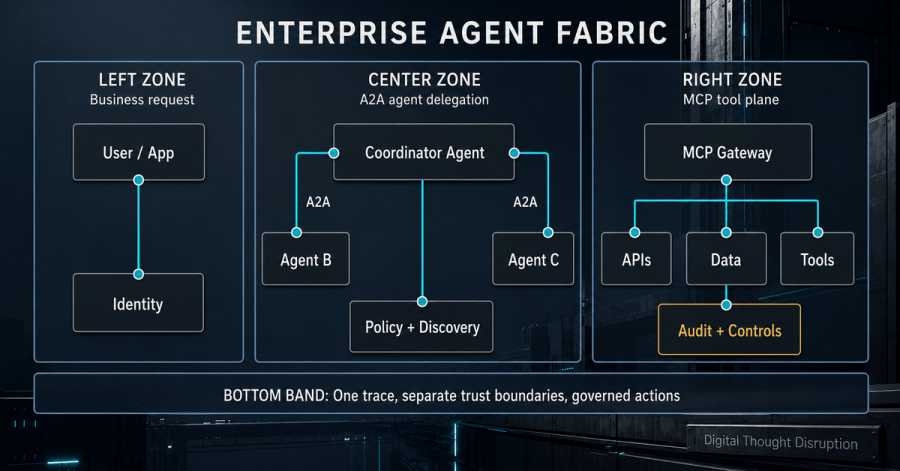
An enterprise deployment will often place gateways in front of both A2A endpoints and MCP servers. The gateway provides a stable control point for identity integration, routing, rate limits, network policy, threat detection, schema validation, and telemetry.
A2A Gateway Responsibilities
- validate the calling workload identity
- verify protocol version and supported binding
- resolve and validate the target Agent Card
- enforce caller-to-skill authorization
- limit delegation depth and fan-out
- constrain task duration and artifact size
- validate push notification destinations
- apply tenant and residency policy
- propagate trace and delegation context
- record task lifecycle evidence
MCP Gateway Responsibilities
- validate the MCP client identity
- enforce MCP server and tool allowlists
- scope tool visibility by identity and purpose
- validate input and output schemas
- block unsafe arguments and destinations
- inject downstream credentials without exposing them to the model
- require approvals for high-impact tools
- apply egress controls and data filters
- record tool call evidence and result metadata
The A2A contract remains focused on what the agent can do, not how it does it.
A Realistic End-to-End Request Flow
A useful separation is:
Each protected service should receive a token intended for that service. A token issued for the A2A server should not be forwarded to an MCP server, and a token accepted by an MCP server should not be passed through unchanged to an underlying API.
Best fit: Large organizations with established domain ownership and different data, regulatory, or release requirements.
Add A2A for Cross-Agent Delegation
The hardest part of combining MCP and A2A is not message formatting. It is preserving trustworthy identity and authorization context across a chain of independent actors.
The user identity answers who initiated the request. The workload identity answers which software component is making the current call. Both matter.
Integrate Identity and Policy Per Hop
Consider an operations assistant asked to investigate a production service degradation and prepare a remediation plan.
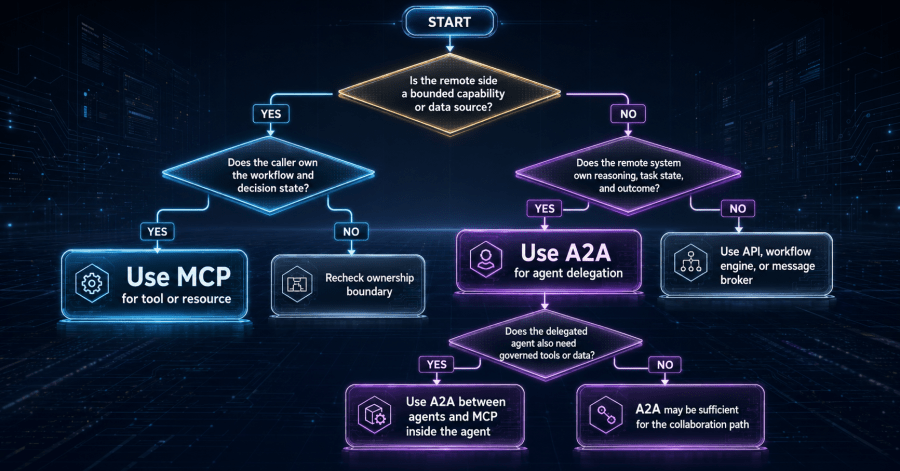
That rule prevents two common design failures. The first is wrapping every API in an agent, which adds latency, non-determinism, and operational overhead without adding useful autonomy. The second is exposing a remote autonomous agent as if it were a synchronous tool, which hides task state, clarification, authorization pauses, cancellation, and failure semantics.
Add End-to-End Observability and Evaluation
The most important design decision is not which protocol to deploy first. It is how the organization distinguishes an agent from a tool.
An API call does not become more enterprise-ready because it is wrapped in an autonomous agent. The extra model call may increase latency, cost, and non-determinism while obscuring a perfectly good schema.
Scale by Domain, Not by Tool Count
The first A2A pilot should demonstrate a real delegation boundary, not two copies of the same agent calling one another.
The external A2A gateway should terminate partner trust, validate Agent Cards, constrain skills, inspect artifacts, and prevent external identities from reaching internal MCP endpoints directly.
Ownership and Operating Model
| Capability | Primary owner | Operational responsibility |
|---|---|---|
| A2A protocol profile | Enterprise architecture or agent platform team | Versions, bindings, card standards, interoperability testing |
| Agent catalog | Agent platform team with domain owners | Registration, signature validation, lifecycle, ownership metadata |
| MCP registry and gateway | Platform engineering or integration team | Server approval, tool policy, routing, egress, compatibility |
| Identity and token service | Identity and security teams | Workload identity, token issuance, audience, revocation, federation |
| Policy decision service | Security governance with domain policy owners | Delegation, skills, tools, data, environment, approvals |
| Agent runtime | Domain product team | Prompts, models, state, tool selection, evaluation, support |
| MCP servers | Owning application or platform team | Tool schemas, downstream integration, validation, least privilege |
| Observability | Platform operations and SRE | Trace continuity, dashboards, alerts, retention, incident evidence |
| Human approvals | Business and operational control owners | Approval criteria, segregation of duties, evidence, escalation |
Use MCP to invoke capabilities. Use A2A to delegate outcomes.
Decision Checklist
A durable enterprise design does not choose one protocol and force it to do both jobs. It uses A2A across agent boundaries and MCP inside each agent’s execution boundary. Identity, discovery, gateways, policy enforcement, approval controls, and observability surround both. The result is a layered architecture where agents can collaborate without exposing their internal tools, and tools remain governed without being misrepresented as autonomous agents.
- Is every interaction classified as agent delegation, tool invocation, or ordinary API integration?
- Can each agent be operated without exposing its private memory or internal tool inventory?
- Are Agent Cards resolved through a trusted discovery path and verified before use?
- Are MCP servers and tools restricted by identity, purpose, tenant, and environment?
- Does every hop use a token intended for the receiving resource?
- Is user context preserved separately from workload identity?
- Can the system pause for authorization or human approval before a high-impact action?
- Are delegation depth, fan-out, duration, and cost bounded?
- Can one trace connect the user request, A2A task, MCP calls, policy decisions, and final artifact?
- Are sensitive prompts, arguments, results, and artifacts minimized and governed?
- Can operators cancel a task, revoke access, isolate an agent, and roll back a tool change?
- Does each agent and MCP server have a named owner, support path, and lifecycle status?
This distinction improves policy decisions and incident investigation. It also prevents every downstream system from receiving the user’s original bearer token.
Conclusion
The same gateway platform may implement both paths, but the policy objects, telemetry fields, and failure handling should remain protocol-aware.
Expose one or two domain agents through A2A. Publish governed Agent Cards, define stable skills, validate task lifecycle behavior, and test clarification, cancellation, timeout, failure, and authorization-required states.
This works for a short demo because the caller sees one callable interface. It fails when the remote system needs clarification, long-running state, streaming progress, cancellation, authorization pauses, or multiple artifacts.
Tradeoffs: The platform team can become a bottleneck, and domain-specific policies may be forced into a generic model.