TL;DR

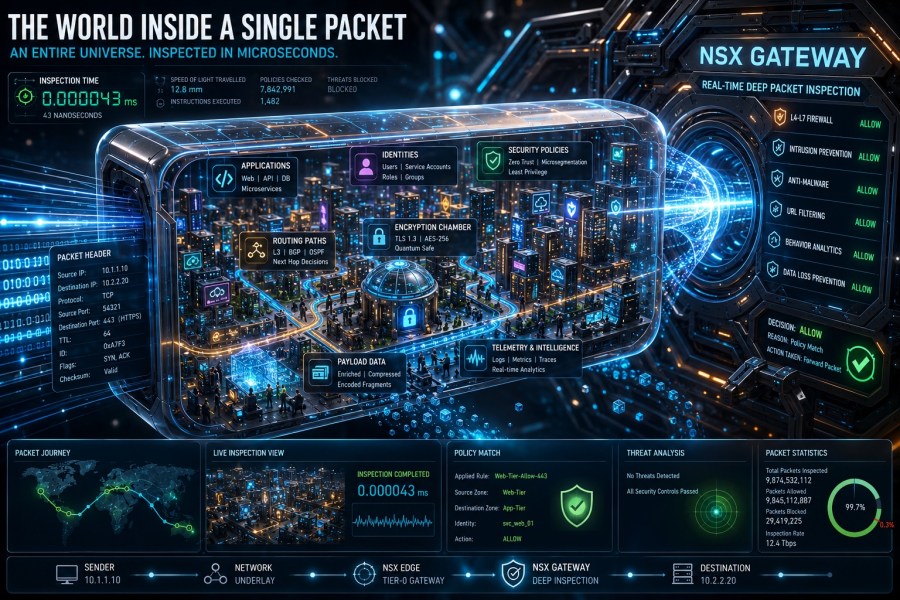
Consider an HTTPS request from a web server to an internal application API.

At its simplest, a packet gives the firewall a set of network facts. For TCP or UDP traffic, these commonly include source and destination addresses, source and destination ports, protocol information, and length. TCP traffic can also expose flags and sequence-related information.

Data-loss prevention and some forms of behavior analytics may involve adjacent products, integrations, or broader security operations. Their presence in the image should not be interpreted as proof that every NSX Gateway configuration performs those functions directly.

  • Certificate-authority ownership and protection
  • Client trust distribution
  • Mutual TLS and certificate-pinning behavior
  • Privacy-sensitive and regulated traffic
  • Applications that break under interception
  • Cryptographic and service-core capacity
  • Logging of bypassed, failed, and inspected sessions
  • Recovery behavior if the inspection service becomes unavailable

Understanding that distinction produces a more useful NSX design model. The packet is small. The decision context is not.

IDS/IPS and Threat Prevention

Broadcom documentation describes distributed and gateway firewall management through the same NSX environment, allowing groups and policy constructs to support coordinated security designs. The stronger architecture typically uses distributed enforcement for local east-west segmentation and gateway enforcement for routed boundaries and selected advanced services.

Bypass should not mean invisible. Retain appropriate metadata and monitoring so excluded traffic remains observable without violating privacy or application requirements.

The current documentation baseline used for the version-sensitive portions of this article includes VMware vDefend Firewall 9.1 documentation and VMware vDefend Advanced Threat Prevention 9.0 documentation. Exact capabilities depend on release, topology, licensing, activated services, Edge design, and available service-core capacity. Broadcom documentation also notes that Layer 7 gateway firewall processing has service-core requirements, making capacity and placement part of the security design rather than an afterthought.

The payload may contain application data, but that data may be encrypted, fragmented, encoded, compressed, or otherwise unsuitable for immediate interpretation. Even when application data is visible, the packet itself usually does not explain the complete business context of the communication.

Malware Prevention and Adjacent Security Services

Start by determining whether the traffic is east-west, north-south, inter-segment, internet-bound, or crossing a controlled application boundary.

The packet arrives through the data path. Policies, groups, context profiles, identities, signatures, and configuration are prepared through management and control-plane functions. Enforcement brings those two worlds together.

The image places routing paths and gateway inspection inside the same decision universe. This reflects an operational reality: route selection, NAT, interface placement, and traffic direction affect which policies and services can be applied.

The firewall decision is therefore an act of correlation. The platform takes a small amount of traffic data and evaluates it against a much larger operational model.

Telemetry Is Part of the Security Decision

The image is best understood as showing the broader security ecosystem that can influence or investigate a flow, not a guaranteed list of processing stages for each packet.

The metaphor becomes misleading, however, when treated as a literal representation of the packet-processing pipeline. A packet does not contain an identity database, a routing table, seven million policies, or a complete threat-analysis engine. Those capabilities exist around the packet.

Test what happens when:

  • Rule and policy identifiers
  • Source and destination groups
  • Application or context-profile results
  • IDS/IPS signature and severity
  • TLS inspection status
  • NAT and routing information
  • Byte and packet counts
  • Session duration
  • Gateway and enforcement-point details
  • Timestamps and correlation identifiers

This layer answers questions such as:

A North-South Packet Journey

Firewall policy answers whether communication is permitted. IDS/IPS examines whether the permitted communication appears malicious.

A practical design selects inspection scope intentionally. Applying every signature to every flow can increase noise, capacity consumption, and investigation workload. The stronger pattern is to align signatures and inspection profiles with workload exposure, protocol use, threat model, and operational response capability.

Layer 7 inspection, TLS decryption, IDS/IPS, malware analysis, and detailed logging consume resources beyond ordinary stateful forwarding.

Inspection Should Produce Evidence

Port-based policy becomes less reliable when many applications use HTTPS, dynamic ports, tunnels, or shared infrastructure. A rule that allows TCP 443 may permit the intended API, but it may also permit unrelated or undesirable applications using the same transport.

Multiple Control Domains Can Influence One Flow

This is also why policy distribution and object hygiene matter. A technically valid firewall rule can still produce poor results when groups are stale, tags are inconsistent, ownership is unclear, or application definitions no longer match actual traffic.

The Final Action Must Be Explicit

The packet still carries an IP address, not a human-readable identity record. The enforcement system associates that address or workload with known context and then applies the appropriate policy.

What the Image Compresses or Gets Wrong

A production TLS-inspection design must consider:

The Packet Does Not Contain the Policy Universe

The most important idea in the image is not that a packet contains an entire digital universe. It is that a meaningful security decision may require an entire digital universe of context.

Not Every Service Runs Against Every Packet

Security and network teams need to know which rule matched, what source and destination objects were resolved, which application was detected, whether inspection occurred, and why the platform allowed or rejected the traffic.

Decisions Are Often Flow-Centric

For critical policies, an operator should be able to answer:

Encrypted Payloads Are Not Automatically Visible

Design against failure-state capacity, not only normal-state utilization. An Edge cluster that performs adequately when every node is healthy may become overloaded after failover.

The Performance Statistics Are Illustrative

Where practical, use stable abstractions such as application tier, environment, workload purpose, ownership, and data classification. Define tagging standards and lifecycle ownership before depending on those tags for security.

A gateway can observe an encrypted session without seeing all protected application data. Payload visibility requires an explicit inspection design or endpoint-level telemetry.

Not Every Displayed Control Is Necessarily Native

The security architecture is defined as much by degraded behavior as by normal behavior.

Design and Operational Implications

Place Enforcement Where Traffic Naturally Flows

That does not mean every packet passes through every threat-prevention engine. Inspection depends on the IDS/IPS policy, selected traffic, signatures, gateway placement, and activated services.


If the team cannot answer these questions during normal operations, it will struggle during an incident.

Treat Advanced Inspection as a Capacity Consumer

The strongest NSX designs do not attempt to run every security service against every packet. They apply the right control at the right location, for the right traffic, with explicit operational ownership and validated failure behavior.

VMware vDefend documentation describes IDS/IPS support at both distributed and gateway enforcement points. Gateway IDS/IPS is intended for traffic traversing the gateway path, including north-south scenarios, and documentation covers deployment on gateway firewall services and supported Tier-0 and Tier-1 designs.

  • Concurrent connections
  • New connections per second
  • Packet and request rates
  • Average and peak throughput
  • Encrypted-traffic percentage
  • Inspection-profile scope
  • Signature volume
  • Logging rate
  • Edge-node failure
  • Traffic redistribution during maintenance

Before enabling advanced gateway inspection in production, confirm the following:

Build Policy from Stable Abstractions

The image places identities inside the packet, but identity normally enters the decision through correlation.

The goal is not to log everything indefinitely. Excessive logging can create cost, storage, privacy, and signal-to-noise problems. The goal is to retain enough evidence to explain important decisions, investigate suspicious activity, and validate that policy behaves as designed.

The image’s “quantum safe” encryption chamber should not be interpreted as a default property of every NSX-protected connection. Cryptographic posture depends on the protocols, certificates, endpoint capabilities, and security design in use.

Design Encrypted-Traffic Exceptions Deliberately

The design question should not be “Which firewall replaces the other?” It should be “Which enforcement point has the best context and natural traffic path for this control?”

One connection can be affected by networking, segmentation, identity, encryption, application recognition, threat prevention, and observability. Those domains need coordinated ownership even when they are operated by different teams.

Make Decisions Explainable

A dynamically populated group is not automatically trustworthy. It needs controlled inputs, validation, monitoring, and an exception process.

  • Which rule matched?
  • Which groups were resolved?
  • What application was detected?
  • Was TLS inspection performed or bypassed?
  • Was IDS/IPS active for the flow?
  • What route and NAT decision applied?
  • Which enforcement point processed the traffic?
  • What evidence was retained?

This distinction matters because security teams frequently build policies around abstractions such as Web-Tier, Production, PCI-Workloads, or Service-Accounts. Those labels are not packet fields. They are control-plane objects associated with the endpoints and then used by the enforcement system.

Validate Failure and Bypass Behavior

This creates an operational dependency that is easy to overlook. Identity-aware policy is only as reliable as the identity resolution, synchronization, grouping, and lifecycle processes supporting it. Stale mappings can become a security problem even when the firewall rule itself is correctly written.

Stateful firewalls maintain connection state. Initial packets establish context and policy treatment, while later packets can be evaluated as part of the existing flow. That is different from independently executing an entire policy universe against every packet.

  • An Edge node fails
  • A service core is unavailable
  • Identity context becomes stale
  • A workload loses its expected tag
  • TLS inspection cannot validate a certificate
  • Signature updates fail
  • Log destinations are unavailable
  • Traffic exceeds planned inspection capacity
  • An application changes protocol behavior

A firewall action without supporting evidence is difficult to operate.

Practical NSX Gateway Inspection Checklist

The visual communicates several important architecture ideas.

  • The traffic direction and natural enforcement point are understood.
  • Packet facts are clearly separated from identity, group, and application context.
  • Layer 3, Layer 4, Layer 7, TLS, and IDS/IPS requirements are independently defined.
  • Edge and service-core capacity include maintenance and failure scenarios.
  • Encrypted-traffic inspection and bypass rules have named owners.
  • Logging captures enough evidence to explain critical decisions.
  • Allow, block, failover, bypass, overload, and recovery paths have been tested.
  • Product version, licensing, topology, and feature assumptions have been validated against current documentation.

Conclusion

Security testing should cover more than a successful allow and a successful block.

Good policy placement reduces unnecessary traffic movement and avoids creating inspection bottlenecks.

A more accurate model separates packet facts from platform context.

Encryption changes what the gateway can see.

External References

Similar Posts