TL;DR
The actual implementation must define an authoritative schema, enforce the gates, resolve the referenced evidence, and bind the signed-off candidate to the artifact deployed. Replace the illustrative candidate names and review roles with the enterprise’s real inventory, service objectives, and change responsibilities.
The discovery environment and the production control plane should be separate systems with different permissions, owners, and approval rules.
An improvement measured against a moving target is difficult to defend.
Continue reading
Introduction
Changing the evaluator is sometimes legitimate. When a defect is found, however, the team must record the change and rerun affected candidates rather than silently preserving old results under new rules.
A machine-discovered scheduling policy may become unsuitable when job sizes change, new tenants arrive, accelerator types are replaced, or service deadlines tighten. A network configuration may lose its advantage after a routing upgrade, hardware refresh, new traffic pattern, or changed failure-domain arrangement.
Network fabric changes are harder to isolate. A shared routing or physical topology change may affect services outside the intended pilot. A conventional canary is inappropriate if the underlying control plane or failure domain is not truly separable. Use hardware laboratories, dedicated test fabrics, maintenance staging, and approved fallback methods when necessary.
For an AI-discovered scheduling heuristic, a bounded rollout might route a subset of noncritical batch jobs through the new scheduler while comparable jobs remain on the approved baseline. Measure useful completion, deadline misses, resource contention, cost, and policy adherence. Stop if protected workloads regress or the comparison becomes unreliable.
The best outcome is neither unrestricted machine autonomy nor a requirement that every AI-generated answer resemble conventional engineering practice. It is an operating model where machines expand the space of possible solutions and evidence determines which solutions deserve adoption.
This vocabulary helps decision-makers avoid confusing a promising experiment with an accepted production architecture.
Innovation does not require deployment. Keeping a promising but unqualified candidate in the research portfolio is sometimes the most responsible technical decision.
Define the acceptance conditions before selecting a winning candidate. Preserve the evaluator’s version, test inputs, scoring logic, and configuration. The candidate generator should not be able to edit production acceptance conditions or read a reserved holdout suite during search.
The central argument of this four-part series has been that artificial intelligence should be evaluated for more than its ability to imitate how humans think and work.
A correctness claim may establish that an algorithm satisfies a mathematical specification or that a network graph preserves particular paths. A performance claim may show that an implementation improves a measured outcome under stated workloads. A production-readiness claim must address the service’s security, resilience, integration, cost, support, and recovery obligations.
The discovery team wants to move forward.
The evaluation evidence supports a specific artifact, environment, workload profile, and decision period. It does not permanently certify the design.
An organization should also be prepared to withdraw a discovery. That may mean reverting to the former algorithm, restoring approved infrastructure configuration, placing the new capability into read-only mode, or retiring an unsupported implementation.
The architecture looks unfamiliar, but the results are promising.
The distinctions are especially important when the generated result is unfamiliar. A human-designed approach may carry years of informal operational experience, known workarounds, and troubleshooting knowledge. A machine-discovered design does not automatically inherit that history.
They want to know what happens when physical link errors increase, when the traffic profile changes, when routing reconverges during maintenance, or when a switch behaves differently from the simulation model.
The central question is:
Discovery, Correctness, and Production Readiness Are Different Claims
At the end of the process, use clear decision states instead of one ambiguous label such as “validated.”
Set a review trigger for material changes rather than relying only on an annual assessment. Preserve the earlier evidence for audit and incident analysis, but distinguish historical acceptance from current operating suitability.
Google’s Site Reliability Engineering Workbook describes canarying as a partial, time-limited deployment evaluated against a control. That pattern is useful for many algorithmic or software changes, but it must be adapted to the failure domains of the proposed artifact.
| Claim | Evidence that can support it | What the evidence does not establish |
|---|---|---|
| Structural or mathematical validity | Proof, exact checker, independent graph or constraint analysis | Real-world throughput or operational safety |
| Measured improvement | Controlled baseline comparison, reproducible workloads, uncertainty analysis | Superiority under every future workload |
| Robustness | Holdout cases, failure injection, sensitivity testing | Exhaustive coverage of all possible failures |
| Operational acceptability | Hardware or system pilot, security review, runbooks, recovery tests | Permanent authorization regardless of future changes |
| Production trust | Approved change, bounded rollout, monitored outcomes, accountable owner | A guarantee that the design cannot fail |
The decision is straightforward: the candidate is eligible for further evaluation, but is not approved for production.
This article focuses on promotion of machine-discovered engineering artifacts, such as a frozen algorithm or a versioned network configuration. It is deliberately narrower than assurance for a continuously acting AI agent. If the production system will continue generating and autonomously applying changes, that live decision-maker also requires separate identity, authorization, action verification, and incident controls. A successful artifact-promotion review does not authorize an autonomous agent.
The Evidence Boundary Between Discovery and Production
That makes evaluator quality a first-order engineering control.
The following YAML is a vendor-neutral, conceptual contract for a proposed network-discovery candidate. It is not an implemented custom resource, executable deployment configuration, or proof that any test has passed.
A production proposal needs a compact, reviewable evidence dossier. It should contain the actual candidate and its supporting records, not a polished narrative produced by the same model that proposed the candidate.
Where results are variable, compare distributions rather than one headline score. Define the minimum useful improvement and the maximum acceptable regression before the holdout run. Report variation and uncertainty instead of converting a favorable sample into guaranteed performance.
Zero observed failures in a finite test set is not proof that failures are impossible.
Human review must be substantive. Approvers need to see the relevant constraints, failed tests, open assumptions, and the operational consequences of the proposed design. An approval button that hides the evidence is weak governance.
These boundaries matter more than the number of models or optimization techniques used by the search engine.
The proposed fabric configuration passes its graph-level connectivity checks, respects the modeled switch-port limits, and survives the defined failure scenarios. A network simulator suggests that the design may also reduce congestion under a representative workload.
Give Discovery and Deployment Different Owners
Run promising candidates through an independently controlled evaluation path. For exact algorithms, this may mean a second implementation of the mathematical checker. For scheduling policies, it may mean replaying held-out traces with a separately maintained simulator. For a network configuration, it may mean verifying configuration semantics and forwarding behavior with an independent analysis tool, then testing the relevant hardware.
AI-assisted discovery introduces a risk of concentrated authority. The same team can unintentionally define the benchmark, tune the candidate against it, declare the winner, and push the result into production.
| Responsibility | Accountable role | Required boundary |
|---|---|---|
| Candidate generation | Discovery or optimization team | Can propose, cannot approve its own evidence |
| Evaluator and reproducibility | Independent test or engineering owner | Controls acceptance checks and holdout evidence |
| Service and architecture fit | Service owner and domain architect | Decides whether the result meets the real requirement |
| Security and compliance | Security or risk authority | Can block prohibited design states |
| Production authorization | Delegated change authority | Approves the exact artifact, scope, and recovery plan |
| Day-2 operation | Platform or operations team | Owns monitoring, response, lifecycle, and withdrawal |
This is a normal lifecycle responsibility, not an admission that discovery was a mistake.
A successful laboratory test does not eliminate deployment risk. The next step is to restrict exposure while gathering real operating evidence.
Reusing the same faulty evaluator in two pipelines does not provide meaningful independence. Review the assumptions and critical dependencies, not just whether the program executed twice.
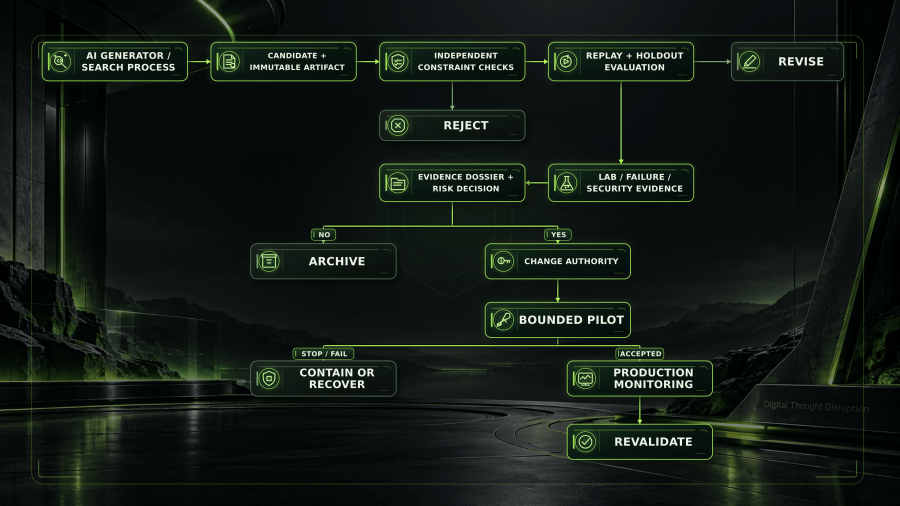
The following architecture shows the boundary. Notice that no direct path exists from the generator to production change authority.
The discovery team may have identified a real improvement. Operations may also be correct that the experiment has not established production readiness.
Importantly, the generator should not hold production credentials. It should emit versioned proposals into an isolated review pipeline. The approved delivery mechanism then applies only the specific artifact and scope authorized by the change decision.
A realistic promotion review would therefore begin with this decision table:
The network operations team is less certain.
- What exact artifact and infrastructure scope will change?
- Which acceptance conditions were independently demonstrated?
- Which live signals will reveal harm or unexpected behavior?
- Who can stop the rollout, and what condition forces a stop?
- What is the tested restoration path if a simple rollback is impossible?
NIST SP 800-218, Secure Software Development Framework (SSDF) Version 1.1, provides a relevant secure-development foundation. It does not replace domain-specific correctness, performance, or operational acceptance testing.
Continue the AI discovery series or explore the Enterprise AI hub.
Engineering Trust Expires When the Conditions Change
But the freedom to propose unconventional solutions must be matched by discipline in verification. A discovery engine needs independent evaluators. Engineers need reproducible evidence. Production owners need explicit controls, recovery paths, and authority boundaries. Decision-makers need to know precisely what has been demonstrated, what remains uncertain, and which changes would invalidate the approval.
The classification should follow evidence. It should not be determined by which organization proposed the candidate or how impressive the generated explanation appears.
Imagine the network architecture experiment from Part 3 produces an unexpected candidate.
| Monitoring signal | Why the original decision may need review |
|---|---|
| Service-level objective regression | The result is no longer producing acceptable service outcomes |
| Changed workload distribution | The original comparison may no longer represent production demand |
| Configuration or dependency drift | The deployed artifact or its operating assumptions have changed |
| New failure behavior | Previously unmodeled dependencies or correlated faults have emerged |
| Security or policy changes | An accepted design may now violate a mandatory requirement |
| Rising operating cost | The improvement may no longer justify support and infrastructure expense |
| Missing telemetry or failed recovery test | The organization can no longer demonstrate control over the service |
This final article addresses the transition from a technically interesting result to an accountable engineering decision.
A search engine learns what earns a high score, whether or not the score represents the organization’s actual objective.
This final installment defines how architects, engineering teams, AI platform owners, security leaders, and operations teams should evaluate machine-discovered solutions before adopting them. It includes an evidence architecture, an approval model, a machine-readable promotion contract, practical deployment gates, and the conditions under which a previously accepted discovery should be withdrawn.
When the Right Decision Is Not to Deploy
It therefore needs an explicit mechanism for building evidence where operational experience is missing. That does not mean holding machine-generated work to an impossible standard. It means judging every consequential design, regardless of origin, against the same requirements while making uncertainty visible.
The final question is whether your organization has built an engineering process capable of recognizing a genuinely better solution, even when nobody on the team would have thought to propose it.
The focus is on candidate algorithms, infrastructure configurations, scheduling policies, and other machine-discovered technical artifacts that may affect enterprise systems. It is not a claim that every result requires an identical review process, or that existing safety and change-management frameworks must be replaced.
AI discovery promotion flow from candidate artifact and independent checks through replay, evidence dossier, change authority, bounded pilot, monitoring, and revalidation.
And the business owner asks the question that ultimately matters: what evidence justifies accepting the additional risk?
A Practical Production Decision Model
Reject or defer promotion when the evaluator cannot independently verify critical claims, holdout results are unstable, the candidate depends on unsupported hardware or software, or the operational benefit disappears once full cost is included.
| Decision state | Meaning | Permitted next action |
|---|---|---|
| Research result | Candidate exists; limited checks may pass | Continue experimentation |
| Independently verified candidate | Defined validity and performance claims reproduced | Complete operational qualification |
| Pilot authorized | Owners accept bounded exposure and recovery plan | Execute the approved pilot only |
| Production accepted | Service-specific release gates and monitoring are satisfied | Operate within the approved scope |
| Suspended or withdrawn | A critical assumption, control, or service outcome no longer holds | Contain, recover, revert, or retire |
A rollback document is not equivalent to a tested rollback capability.
The most important field is missing_evidence: block_promotion. Unknown results should remain unknown, not quietly become passes.
Conclusion
apiVersion: example.dtd/v1
kind: DiscoveryPromotionContract
metadata:
name: zone-aware-fabric-candidate
spec:
artifact:
immutable_digest: required
source_revision: required
approved_baseline: current-fabric
authority:
candidate_generator: propose_only
evaluator_owner: independent_engineering
production_changes: approved_pipeline_only
verification_gates:
– structural_constraints
– independent_routing_analysis
– security_policy_validation
– holdout_traffic_comparison
– failure_and_recovery_testing
– hardware_compatibility_review
– operational_cost_review
acceptance:
hard_constraints: all_pass
performance_baseline: approved_current_design
thresholds_source: approved_service_objectives
missing_evidence: block_promotion
deployment:
initial_scope: isolated_noncritical_pilot
approval_mode: explicit_human_authorization
rollback_or_recovery_plan: required
stop_conditions:
– security_policy_violation
– routing_or_connectivity_regression
– service_objective_breach
– loss_of_required_observability
required_approvals:
– network_service_owner
– security_owner
– operations_owner
– change_authority
Nobody is necessarily wrong.
This is not hostility toward unfamiliar designs. It is the same distinction an architect should apply to any architecture that has not yet demonstrated the required service properties.
How do we create enough confidence to adopt an unfamiliar solution without requiring that solution to resemble something a human expert would have invented?
A production-ready discovery process needs a documented evidence chain: the problem and constraints, candidate provenance, trustworthy evaluation, independent reproduction, operational testing, risk acceptance, bounded deployment authority, and continuous monitoring. Each stage answers a different question. Skipping one can turn an interesting research result into an unmanaged production risk.
A repeatable decision process becomes easier to govern when the promotion criteria are stored as structured records rather than assembled from emails and presentation slides.
The National Institute of Standards and Technology’s AI Risk Management Framework (AI RMF) 1.0 organizes risk management around Govern, Map, Measure, and Manage. Its guidance supports continuous, context-sensitive risk decisions rather than one-time assurances. That is a useful governance reference for discovery systems, although this dossier and release process are proposed DTD engineering patterns, not NIST-prescribed certification steps.