TL;DR
A production assistant should not be a single technique. It should be a routing architecture that uses the right control pattern for the user’s intent, risk level, data source, and required action.
Risk-Based Assistant Design
Start with read-only answers and deterministic workflows. Add RAG once the knowledge base has clear ownership and retrieval tests. Add LLM summarization where synthesis adds value. Add tool calls only when policy, audit, approval, and rollback are designed. Keep human handoff visible throughout the lifecycle.
This matters because assistant failures are rarely isolated to prompts. They often reveal missing content, poor routing, unclear ownership, or workflow gaps.
Detailed Side-by-Side Comparison
| Pattern | Best For | Strengths | Risks |
|---|---|---|---|
| Deterministic flow | Known tasks with fixed steps | Predictable, auditable, easier to test | Brittle if user intent varies |
| NLU | Intent classification and routing | Fast, controlled, useful for known domains | Requires training data and maintenance |
| RAG | Answers from enterprise knowledge | Grounded, citeable, better for changing docs | Depends on source quality and retrieval design |
| LLM | Summarization, reasoning, flexible language | Handles ambiguity and synthesis | Hallucination, cost, latency, prompt sensitivity |
| Human handoff | Exceptions and high-risk cases | Preserves trust and safety | Requires process design and staffing |
However, the LLM should be surrounded by constraints:
Where Deterministic Flows Fit
The trap is overbuilding hundreds of intents for every possible phrase. In modern architectures, NLU should often be a routing component, not the entire assistant strategy.
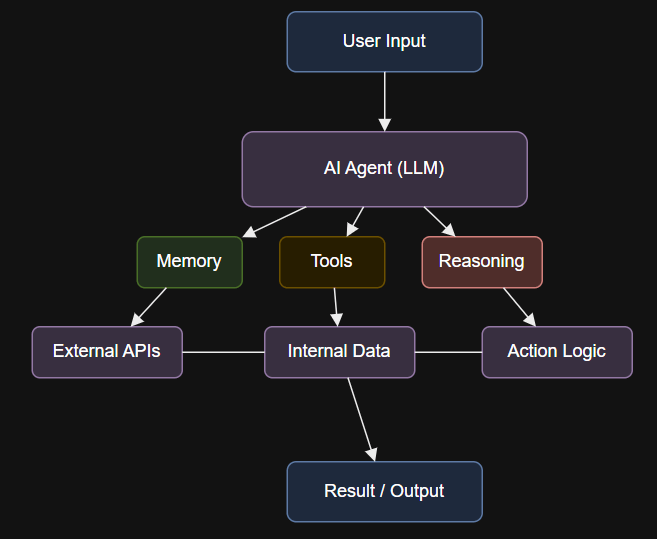
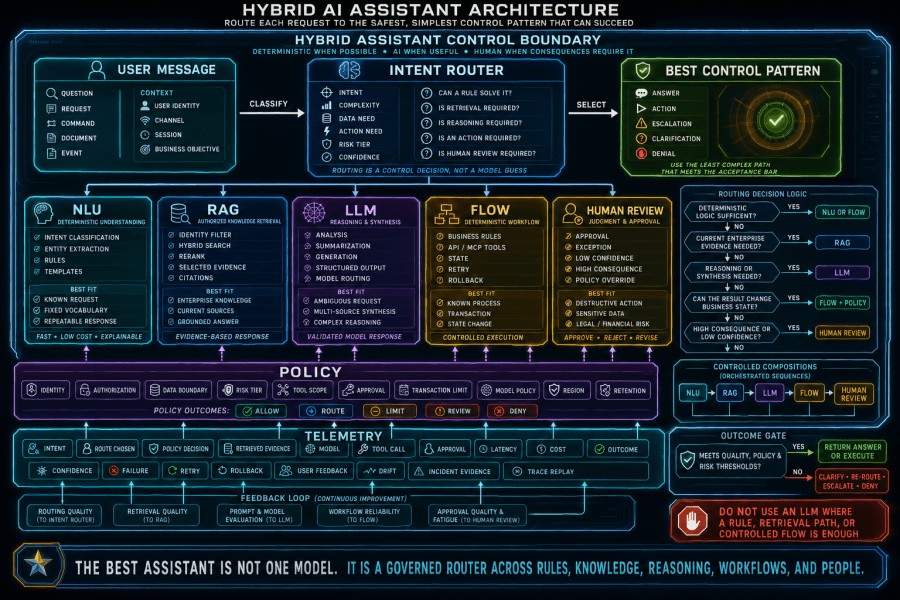
The practical architecture is a controlled assistant router that chooses deterministic flows, NLU, RAG, LLM reasoning, or human handoff based on intent and risk.
- password reset guidance
- appointment scheduling
- ticket creation
- entitlement request intake
- change request submission
- status lookup
RAG fits when the user needs an answer from enterprise knowledge:
Risk and Control Model
Low risk -> FAQ answer, status lookup, summarization
Medium risk -> RAG with citations, workflow draft, team routing
High risk -> deterministic workflow, approval, audit trail
Critical risk -> human review, change process, rollback plan
Autonomy should decrease as impact and irreversibility increase.
The practical design question is not which pattern is superior. It is which pattern should own each class of interaction.
The assistant should escalate when confidence drops, not loop indefinitely.
It works best when intents are stable and domain boundaries are known. For example, an IT support assistant might use NLU to distinguish between access requests, device issues, network problems, and application incidents.
Where RAG Fits
A good assistant uses the LLM where language intelligence adds value, not where strict workflow control is required.
- runbooks
- product documentation
- architecture standards
- policy libraries
- ticket history
- knowledge base articles
That turns handoff from abandonment into continuity.
Enterprise assistants should be hybrid by design. LLMs are powerful, but they are not a replacement for routing, workflow control, retrieval architecture, or human escalation.
Where LLMs Fit
The real design opportunity is to let natural language help the user enter the workflow, while the workflow itself remains constrained and testable.
The diagram below shows the assistant as a router, not a monolithic model. The important point is that routing happens before the system decides which AI or workflow pattern should respond.
- system instructions
- tool boundaries
- retrieval rules
- safety policies
- confidence thresholds
- logging and evaluation
Use this routing logic as a starting point:
Human Handoff as a Design Control
That is how a chatbot becomes an enterprise assistant rather than a conversational demo.
Examples include:
Decision Guidance
The assumption is that the assistant must operate in an environment where identity, policy, auditability, and operational ownership matter.
| User Need | Recommended Primary Pattern |
|---|---|
| Complete a known transaction | Deterministic flow |
| Route a request to the right queue | NLU or classifier |
| Ask about policy, runbooks, or documentation | RAG |
| Summarize multiple retrieved sources | RAG plus LLM |
| Perform an irreversible or privileged action | Deterministic flow plus approval |
| User is angry, stuck, or low confidence | Human handoff |
A handoff should include context. The human should not receive an empty ticket that says the assistant could not help. The handoff should include the user request, detected intent, retrieved sources, confidence signal, attempted path, and recommended next step.
Governance and Observability
Human handoff is not a failure. It is a control for ambiguity, high risk, low confidence, user frustration, policy exceptions, or irreversible actions.
- detected intent
- selected path
- confidence score
- retrieved sources
- tool calls
- handoff events
- user feedback
- failure reason
A practical rollout should move from controlled assistance toward more capable behavior only after the organization can observe and govern the system.
This article assumes the assistant will support employees, customers, or internal operators across a mix of questions, tasks, and escalations. It is not limited to one vendor platform.
Practical Implementation Path
Deterministic flows are still the right choice for workflows where the organization needs consistency, auditability, and constrained execution.
Every route should produce telemetry:
The comparison focuses on architectural fit:
- classify and route user intent
- answer from approved sources
- draft structured workflow inputs
- hand off with context
- call low-risk tools
- support supervised actions
- execute constrained automation only when governance is mature
Conclusion
The assistant should mature in stages:
LLMs are useful when language flexibility, synthesis, or summarization matters. They can convert messy user input into structured data, summarize retrieved evidence, explain tradeoffs, or ask clarifying questions.
A mature assistant architecture should make those gaps visible. If the assistant repeatedly routes users to human support for the same missing runbook, that is not only an AI issue. It is a knowledge-management issue. If the assistant repeatedly misroutes entitlement requests, that is not only a model issue. It is an intent-design and ownership issue.
Some interactions need deterministic workflows. Some need NLU classification. Some need RAG over trusted content. Some need an LLM to summarize, reason, or translate user intent into a structured request. Some need a human handoff before anything irreversible happens.