Their investigation traces revealed an important relationship. Attack-related alerts were more frequently dismissed when the investigations retrieved no records.
What a Recovery Approval Record Should Show
Establish which assets, environments, event types, and time windows were actually examined.
That is a coverage failure.
Service: Customer portal
These are related but distinct assurance responsibilities.
Distinguish successful empty results from failed searches, truncated responses, incomplete execution, and searches that never occurred.
The 01:00 backup remains a candidate recovery point. Its readability is useful evidence, but it is not a security clearance.
Depending on the investigation platform, this may include the source-side query identifier, authenticated requester, submitted search definition, resolved asset scope, time interval, execution outcome, and a protected reference to the results.
| Record field | Application-host investigation | Management-plane investigation |
|---|---|---|
| Required check and owner | Host indicator review; SOC lead | Administrative activity review; platform security lead |
| Expected scope | Three application hosts; process and file telemetry; Day -2, 00:00 to Day 0, 08:00 UTC | Management systems administering those hosts; administrative authentication, privilege and configuration changes; same period |
| Actual coverage | All three hosts and specified event types examined for the required window | None |
| Source reference or gap | Evidence set E-101; verified query record Q-101 | Evidence set E-102 available; no execution record for the required check |
| Result | Completed; zero matching indicators using the recorded method | Open; available but skipped |
| Decision that depends on it | Host investigation acceptance | Recovery-point acceptance and production reconnection |
| Reassessment condition | New relevant indicators, evidence-quality concerns, or expanded host scope | Complete the required investigation or obtain approved equivalent evidence |
The record should identify the uncertainty, the accepted risk of the limited activity, its owner, its permitted connectivity and operating boundaries, and the conditions under which that authorization expires or must be reconsidered.
The AI can finish its assigned task. The recovery workflow does not have to interpret that completion as satisfaction of the recovery policy.
A zero-match result needs context before it can support a consequential decision.
Show me a completed check that found nothing, then show me a required check nobody ran. How would the production approval screen distinguish them?
The integration work is establishing trustworthy relationships between them.
New evidence may arrive after a decision has been made. A previously unavailable record may become accessible. A newly identified dependency may expand the investigation boundary.
Make Required Checks Observable in the Workflow
Suppose the earliest confirmed indicator in the hypothetical incident occurred at 04:15 Coordinated Universal Time (UTC) on the day of recovery.
Even when investigation coverage is satisfied, the service must still meet its other production release requirements, including applicable restoration integrity, containment, remediation, dependency validation, and business acceptance criteria.
The organization did not lose its management-plane telemetry. Its investigators were not prevented from accessing the source. The investigation simply concluded without examining it.
Define the Required Investigation
A practical implementation does not necessarily require a new security platform.
The Re-Entry Test. Verify eradication and assess whether an isolated service can safely reconnect.
Before normal production approval, verify independently that investigators performed the required checks. An AI recommendation can inform that decision.
Capture Execution Evidence Independently
Consider the following illustrative approval record for our hypothetical incident. The identifiers, assets, and investigation window are synthetic. No actual investigation or recovery exercise was performed.
Related research by Begimher et al., reported in the April 2026 SIR-Bench preprint, examines investigation depth in security incident response agents [4]. Its evaluation distinguishes correct triage decisions from the discovery of additional security-relevant findings through active investigation.
This preserves operational flexibility without turning business urgency into an undocumented security override.
The practical improvement is that the omitted investigation becomes a visible work item with an owner, an evidence source, and a dependent decision.
Assessing whether an investigation method was technically adequate may still require a qualified security reviewer.
Evaluate Coverage Before Approval
A completed search that found suspicious activity must also remain distinguishable from a completed search that found nothing. Completion establishes that the check occurred. It does not establish that its result is acceptable.
For enterprise recovery, I would extend this reasoning beyond model evaluation and into the production approval workflow itself.
That distinction matters because an investigation may reach a correct classification without discovering all the evidence that would be important to a subsequent decision.
The underlying execution records should be retained, but the approval screen needs a concise representation of the decision-critical evidence.
The important boundary is between investigation and authorization.
An Open Check Does Not Have to Stop All Recovery Work
The recovery lead has to decide whether the evidence supports production release. This article proposes a way to track what investigators examined and surface any required checks that remain open.
The incident lead should approve material scope changes. An AI agent may recommend adding or modifying a check, but it should not silently remove an existing requirement.
Investigation coverage is not necessarily static.
The architecture proposed in this article translates part of that guidance into an independently reviewable investigation record. It is not a NIST-prescribed AI architecture or a replacement for the broader incident response and recovery process.
| Recovery path | Required condition | Permitted outcome |
|---|---|---|
| Further investigation or equivalent evidence | The check is completed, or the security owner confirms an alternative adequately addresses the original requirement. | Reevaluate the normal release decision. |
| Continued isolated validation | The activity is independently authorized and satisfies its own safety and restoration prerequisites. | Continue the specified validation without reconnecting the production service. |
| Documented exception | The governing runbook permits an exception and the designated authority accepts the residual risk. | Perform only the explicitly authorized action within the exception’s scope. |
Determine whether the required records existed, were accessible through an authorized investigation path, and were suitable for examination.
AI can make a security investigation faster, more accessible, and easier to interpret. Those advantages become more useful when the organization can independently establish the boundaries of the work performed.
The November 30 installment, Testing an AI-Assisted Recovery Decision, will define a proposed controlled exercise for evaluating skipped checks, incomplete telemetry, late findings, and production approval behavior.
The next two articles will develop the implementation and validation of that boundary.
Create a versioned set of investigation requirements derived from recovery policy, service dependencies, and the known or suspected incident scope.
This example is deliberately small. A production implementation may contain dozens of required checks, but the recovery lead needs to understand which unresolved items affect the requested action.
Make Recovery Decisions Correctable
The proposed recovery policy should preserve all three states.
An exception is not evidence that the omitted check passed.
Where the source cannot provide trustworthy execution records, use an approved capture mechanism or an accountable analyst’s documented examination of the primary evidence. Preserve the limitation rather than manufacturing machine-verifiable evidence.
The exercise should establish whether a technically accurate AI-generated investigation summary can cause a required but omitted security check to disappear from the approval decision.
On page 11 of my whitepaper, AI Agents and the Integrity of Enterprise Recovery, I introduced a recovery sequence that calls for establishing the earliest credible exposure before selecting a recovery point [1].
Before accepting that result, the recovery lead should be able to establish four properties.
A recovery-point assessment should therefore consider the earliest credible exposure, the evidence supporting that estimate, the observation period, and any uncertainty that could affect the selected copy.
The recovery lead should not have to reconstruct investigation coverage by reading hundreds of tool calls or searching through an AI conversation transcript.
Cyber Recovery After Management-Plane Compromise. Identify the systems and evidence that shape a recovery decision after a management-plane incident.
What Enterprise Architects Should Require in a Design Review
The November 29 installment, What a Recovery Approval Should Prove, will examine the evidence contract, decision records, and independent release controls needed to implement the architecture.
| Design review area | Required demonstration |
|---|---|
| Policy ownership | Recovery policy defines mandatory investigation requirements independently of the AI. |
| Evidence availability | Required sources have identifiable owners, availability records, and evidence-quality limitations. |
| Execution evidence | Investigations produce verifiable records of the assets, event types, time periods, and methods examined. |
| Result classification | Completed negative findings remain distinguishable from skipped checks and missing evidence. |
| Production authorization | Normal production approval cannot advance solely because an AI agent declares its investigation complete. |
| Exception governance | Exceptions are independently authorized, explicitly scoped, and retained as risk decisions. |
| Decision reassessment | Material new evidence can return an affected approval to its accountable owner for reassessment. |
Get Paul Bryant’s practical guides to enterprise AI, hybrid platforms, and day-2 operations by email. New articles as they publish. Unsubscribe anytime.
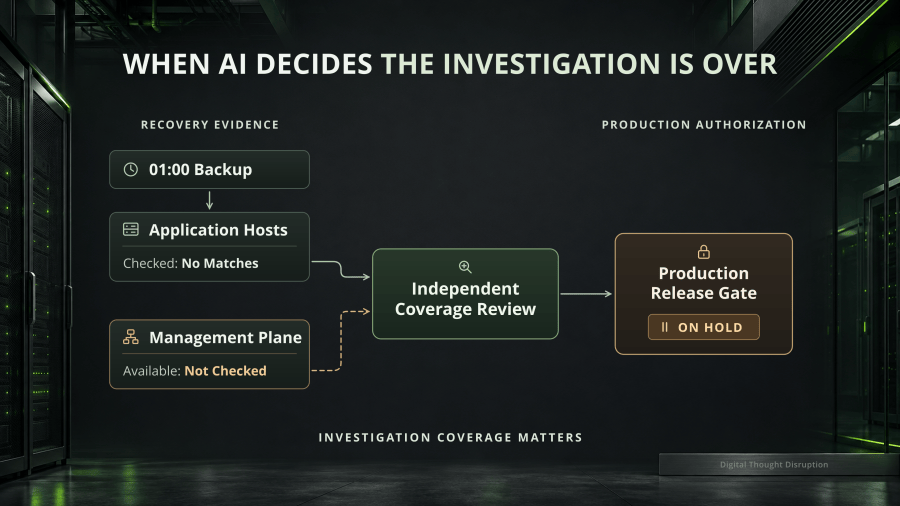
Production decision: On hold.
A reachable security information and event management (SIEM) platform does not, by itself, establish that the required telemetry was collected.
An unresolved production release requirement should prevent the action that depends on it. It does not automatically require unrelated or independently authorized recovery activities to stop.
Continuing the Series
Where the service has already returned to production, the incident lead should evaluate the new evidence against the documented containment and rollback conditions.
The application-host investigation supports its specific negative finding. The management-plane requirement remains unresolved.
The organization may need to investigate uncertain exposure while preparing infrastructure, validating backup material, and restoring critical capabilities into an appropriately isolated environment.
It would be tempting to conclude that the backup predates the compromise.
Stay informed
In the hypothetical ransomware recovery, the AI’s application-host finding was accurate. The unresolved problem was that the investigation did not include a required source of evidence, and the production approval depended on that source.
Conclusion
The relevant scope comes from the incident and the service’s dependency relationships.
In October 2026, Tsegai et al. posted the preprint From Investigation Failures to Reliable SOC Agents: Understanding and Improving LLM-Based Alert Triage [3].
A completed search must also be appropriate for the security question being asked.
Required checks + source records
|
v
Compare with recorded execution
|
v
Coverage and findings accepted?
|– Yes -> Check other gates
`– No -> Hold normal release
New material evidence -> Reassess
Decision owner: Recovery lead, operating under the incident recovery policy
Related Posts
When an investigator or AI agent performs a required search, retain the execution record outside the generated narrative.
Enterprise recovery workflows should independently compare the investigation that occurred with the investigation required by policy. A completed check, an available but skipped evidence source, and an unavailable evidence source must remain distinguishable at the production approval gate.
External References
Where appropriate, validate the detection method against representative known events to establish that the expected activity is observable through the selected evidence path.
Before integrating AI-assisted investigation into a production recovery workflow, architects should be able to demonstrate the following capabilities:
Existing incident management, security orchestration, automation and response (SOAR), SIEM, evidence repositories, and IT service management (ITSM) systems may provide parts of the required architecture.
A normal production approval should remain blocked when a required check is open, materially incomplete, or has an unresolved adverse finding.