With 18 required completions and a ceiling of 12, successful coordination alone cannot produce a capacity pass. An additional path must be supported by evidence, or the remaining shortfall must stay visible.
For architects and continuity leaders, the important question is not whether the alternate ordering process works. It is whether the complete fallback service can carry the combined workload before the deadlines expire.
ASPR TRACIE’s Partnering with the Healthcare Supply Chain During Disasters describes healthcare coalitions as coordination and information-sharing points connecting suppliers, healthcare facilities, public health, and emergency management. It also identifies joint training and exercises as useful parts of that role. [4]
For the hospital scenario, include the people needed to enter orders manually, verify stock, call dispatchers, resolve duplicate requests, receive unfamiliar shipments, and reconcile records when normal systems return.
Keep the need identifier distinct from the order identifier. One need may be submitted through two channels during an outage, or fulfilled through several partial shipments. Two messages do not necessarily represent two needs, and two order numbers do not necessarily represent two independent deliveries.
TL;DR
The hospitals require 18 completions. Even under perfect execution, at least six needs require another path to finish on time.
The FDA’s Drug Shortages Report to Congress, Calendar Year 2024 illustrates why that distinction matters. Following Hurricane Helene’s impact on Baxter’s North Cove facility, recovery included manufacturing-line requalification, monitoring, and testing. Newly manufactured products required testing before distribution and release. This was a physical disruption, not the fictional cyber incident described here, but it demonstrates why restarting production and making supplies available for use are different milestones. [2]
In This Article
Three Continuity Plans Can Share One Capacity Limit
Each option introduces tradeoffs. Holding stock requires space, stewardship, and replenishment. Reserving capacity can introduce cost and continuing contractual obligations. A more independent source may require longer transport or additional acceptance work. Select the combination against the required service outcome rather than maximizing supplier count.
Where local processing is the constraint, address receiving hours, trained staff, storage, and release procedures. Buying additional upstream capacity will not solve a receiving bottleneck by itself.
[4] HHS ASPR TRACIE, “Partnering with the Healthcare Supply Chain During Disasters,” Aug. 2024. [Online]. Available: https://asprtracie.hhs.gov/documents/aspr-tracie-partnering-with-the-healthcare-supply-chain-during-disasters.pdf. Accessed: Nov. 20, 2026.
Where supply is the constraint, examine the upstream source behind each distributor. Two supplier names should not be counted as independent alternatives without checking whether they rely on the same stock, warehouse, manufacturer, or delivery pool. Ask the provider to substantiate the independence relevant to the scenario.
The hospital supply lead does not need another acknowledgement. She needs a defensible answer about whether the supplies will be usable before the deadline, what remains uncommitted, and when she must act to preserve another option.
Count Supplies That Are Usable Before the Deadline
A workaround also consumes people.
Those assumptions place the planned escalation threshold at 09:30 , two and a half hours before the usable-by deadline.
Record the information available at the time. An escalation that looks obvious afterward may have depended on a confirmation that had not yet arrived.
Get Paul Bryant’s practical guides to enterprise AI, hybrid platforms, and day-2 operations by email. New articles as they publish. Unsubscribe anytime.
Where records disagree, preserve the disagreement and assign someone to resolve it. Do not let the latest message silently overwrite a stronger but earlier confirmation.
For enterprise architects, apply the same questions to shared recovery sites, restore bandwidth, specialist response teams, and other resources used by several continuity plans. Build the service dependency map around the resources required to complete the work, then test how those resources behave when several consumers activate together.
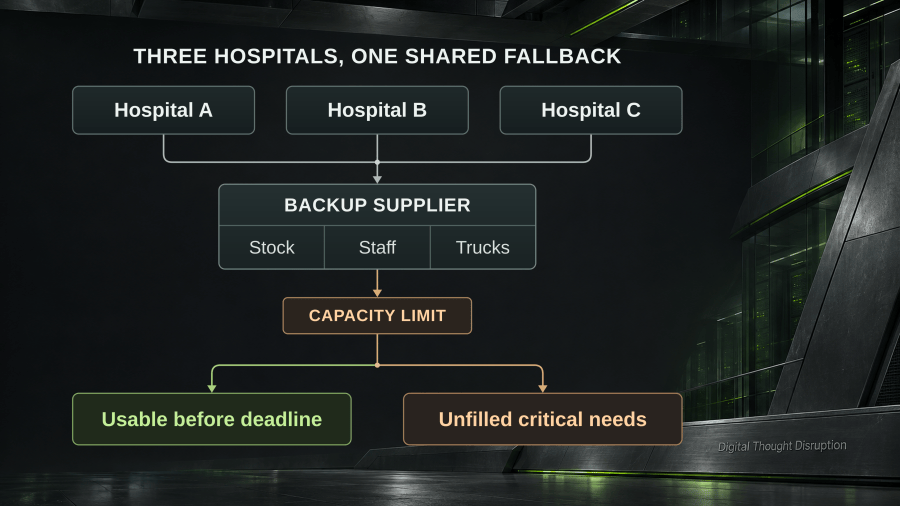
The diagram shows the combined constraint. The three hospitals do not each have access to 12 deliveries; they share the same maximum.
Bring the supplier, dispatch function, facility supply leads, receiving teams, and relevant coordination partners into the same scenario. Where possible, include participants who can explain actual constraints and commitments rather than only describe the documented procedure.
This is not a guarantee that an alternate route will succeed. It is a planning threshold that should be recalculated when the lead time, receiving workload, or available route changes. Unknown lead times should remain visible as uncertainty rather than being treated as zero.
Separate the Order from the Commitment
How much essential work can this fallback complete by the deadline when everyone else is using it too?
Each has a continuity plan. Each tested its alternate ordering procedure. All three depend on the same pool of inventory, staff, and delivery vehicles. The constraint becomes visible only when the plans are activated together.
State
What it establishes
Evidence and responsible party
Need recorded
A facility requires a defined quantity by a defined deadline
Facility-owned need record, with an owner and approved priority
Order acknowledged
The supplier received the request
Supplier acknowledgement tied to the facility’s request
Stock allocated
Identified inventory has been assigned to the need
Supplier allocation record, including quantity and conditions
Transport committed
Delivery capacity has been assigned for the required route and window
Authorized dispatch confirmation
Received and usable
The receiving site has accepted the quantity and completed applicable checks
Receiving confirmation and local release evidence
The appropriate response is not automatically another supplier contract. First establish where the constraint sits and whether an additional arrangement would introduce genuinely independent capacity.
The fallback workload therefore has two parts: completing essential work during the disruption and restoring trustworthy records afterward. Budget for both.
That changes the unit of analysis. Reviewing one hospital’s agreement cannot establish whether the shared provider can meet several hospitals’ needs at once.
A team can manage a shortage correctly while demonstrating that the fallback design is inadequate.
The proposed exercise is a practical way to test the capacity claim. It is not a report of a completed test or a prescribed regulatory exercise.
Start the Escalation Clock Before the Delivery Deadline
Submit one need through both the alternate ordering channel and a coordination call. The team should identify the duplicate representation without deleting the legitimate requirement or counting two commitments as two completed needs.
Figure 1. Illustrative shared-capacity constraint. Eighteen unique needs and a maximum of twelve usable completions leave a minimum shortfall of six in the same four-hour window. Also test the transition back to normal operation. A request submitted by phone should not be issued again automatically when the ordering system returns. Reconciliation must preserve the underlying need, identify what has already been committed or delivered, and resolve any duplicate reservation with the relevant provider.
90 minutes from an approved alternate-route decision to arrival.
30 minutes for receiving and local release.
15 minutes to obtain the required decision.
15 minutes of planning allowance.
In its March 15, 2024 bulletin responding to the Change Healthcare cybersecurity incident, the Centers for Medicare & Medicaid Services recognized that pharmacists could face manual and additional time-consuming procedures. That is evidence of a recovery workload that a purely technical restoration plan can miss. [3]
Give the exercise two distinct findings. The first concerns control: did the team maintain accurate commitments, identify conflicts, preserve needs, and escalate in time? The second concerns capacity: did the available routes actually meet the defined demand?
Use that coordination function to establish a common view of demand, constraints, commitments, and unresolved needs. Define separately who can allocate stock, commit transport, approve priority changes, and confirm receipt.
Where delivery capacity is the constraint, discuss specific transport commitments, activation conditions, competing obligations, and what happens when the promised route becomes unavailable. Do not treat an inventory reservation as a transport reservation.
Budget for the Work the Fallback Creates
Before adding another supplier’s name to a continuity plan, ask:
Treat this as shared fallback capacity risk : several recovery plans depend on resources that cannot satisfy their combined demand under the same disruption.
Review the assumptions when suppliers, routes, facilities, staffing, or critical demand change. Capacity established for one operating arrangement should not quietly become a permanent property of the fallback.
Then introduce a material change: a previously available delivery slot is withdrawn, a receiving team becomes unavailable, or a supplier update arrives after it is no longer current. Require participants to show which affected commitments they reconsidered and who made the resulting decisions.
Define success as supplies received and usable before the service deadline. Separate acknowledgements from resource commitments, account for existing backlog and manual work, and establish escalation triggers early enough for another option to remain viable. A shared fallback should be counted as recovery capacity only to the extent that its end-to-end commitments can be supported under the disruption being planned for.
Queue age is useful, but it should not replace deadline analysis. A newly received request can be more urgent than an older one.
Exercise the Shared Commitments Together
The exercise should leave participants with a clearer account of both the resources and the decision rights available to them.
For the hospital exercise, stop the clock at the agreed receiving and release boundary, not when a truck leaves the warehouse.
Establish the Needs Independently of the Working Queue
Give three fictional hospitals six comparable deliveries each in the same four-hour window. Assume the shared fallback can support at most 12 completed deliveries in that period, including receipt and the local checks needed to make the supplies usable.
Existing commitments reduce the capacity available to the exercise. If three of the 12 slots are already committed to earlier orders from other customers and cannot be reassigned, only nine remain for the hospitals’ 18 needs. Their minimum shortfall becomes nine.
Hospital supply chain resilience depends on what a fallback can complete under simultaneous demand, not simply whether an alternate supplier answers the phone. Several hospitals can have individually credible continuity plans while relying on the same inventory, dispatch team, delivery vehicles, and receiving capacity. Those plans need to be evaluated together.
Introduce Conflicts That Require Decisions
For any proposed AI assistance, keep the initial role bounded: extract request details, suggest possible duplicates, and flag missing evidence for review. Do not allow a generated summary to create an inventory reservation, infer clinical priority, or declare receipt. Those transitions need evidence from the responsible party.
A practical coordination record should connect the facility, item and quantity, deadline, priority owner, supplier references, allocated quantity, transport commitment, received quantity, and remaining unmet quantity. Retain the source and verification time of each material status.
[3] Centers for Medicare & Medicaid Services, “Change Healthcare Cybersecurity Incident: CMS Response and State Flexibilities,” CMCS Informational Bulletin, Mar. 15, 2024. [Online]. Available: https://www.medicaid.gov/federal-policy-guidance/downloads/cib031524.pdf. Accessed: Nov. 20, 2026.
Score Coordination and Capacity Separately
Stay informed
This is a shared view of several authorities, not a replacement for them. Procurement can establish what was requested. The supplier can establish what stock it allocated. Dispatch can establish what transport it committed. The receiving facility can establish what arrived and became usable.
For an illustrative need that must be usable by 12:00 , assume:
Work backward from the time the supplies must be usable. Include the time needed to make the decision, activate the alternate route, transport the shipment, receive it, and complete local checks. Add an uncertainty allowance appropriate to the scenario.
Measure usable quantities completed by the deadline at each site, especially for critical needs. Also record unmet quantities, unresolved ownership, the oldest outstanding critical need, and how much time remained when escalation occurred.
Coordinate Across Organizations Without Inventing Authority
[1] HHS ASPR TRACIE, “Health Care Coalition Supply Chain Integrity Self Assessment,” Sep. 2026. [Online]. Available: https://asprtracie.hhs.gov/documents/hcc-supply-chain-integrity-self-assessment.pdf. Accessed: Nov. 20, 2026.
Prepare a controlled list of the fictional needs, deadlines, priorities, and receiving conditions before the exercise begins. Keep that list separate from the queue participants will build during the exercise.
Do not assign the same available staff time independently to each activity. If the receiving team is also maintaining the emergency order log, the exercise needs to account for both duties. A plan that restores ordering by consuming the staff needed to receive deliveries has moved the bottleneck rather than removed it.
The control list provides a denominator for assessing results. Otherwise, a request omitted from the working queue can disappear from the score as well.
A known shortfall should trigger action when it becomes known. The calculated threshold is not permission to wait until 09:30.
Change the Fallback Design When the Gap Is Real
Start with the 18 unique needs and a fixed capacity ceiling. State whether existing backlog consumes that ceiling and which commitments may be reassigned. Do not allow capacity to increase merely because the discussion becomes uncomfortable.
Continue reading
Use a state model such as the following, adapting the evidence and authority to the organizations involved.
The distribution of completions also matters. Delivering six shipments each to two hospitals and none to the third produces the same regional total as delivering four to each. Those outcomes are not operationally equivalent, and neither arithmetic pattern establishes an appropriate allocation policy.
Start with one critical supply category and bring the relevant facilities and provider into the same constrained exercise. Make competing demand, existing backlog, manual work, and receiving requirements visible. Preserve the distinction between a well-managed shortage and a fallback that actually meets its service requirement.
A useful shared view should preserve what each participant can actually establish. Do not compress several different states into a single “confirmed” field.
A delivery deadline is too late to serve as the escalation trigger.
Conclusion
Define the completion boundary before collecting these numbers. A supplier’s dispatch capacity is not automatically the receiving hospital’s usable supply capacity.
A fallback can remain operational throughout an incident and still fail the continuity requirement. Its ordering service may be available. Its warehouse may be open. Every available vehicle may be working. The failure is that more deadline-bound work has been promised than the system can complete.
Specify who records each commitment and how changes are communicated to everyone relying on it. Share the minimum operational information needed for coordination rather than making patient-level information the default content of a regional supply record.
The distinction matters when several organizations see the same apparent spare capacity. A shared display does not reserve a truck. A coordination call does not necessarily authorize redistribution of inventory.
External References
The September 2026 Health Care Coalition Supply Chain Integrity Self Assessment from the U.S. Department of Health and Human Services’ ASPR TRACIE program identifies this planning problem directly. Activity 3.10 asks members to share established emergency distributor agreements so the region can identify situations where multiple organizations have selected the same resource solution and vendor capacity may be insufficient for all of them. [1]