Google Cloud’s documented spend-cap budgets are another useful example. They apply to a single eligible service within a single project, using gross estimated costs. Enforcement is not instantaneous, and in-flight requests can complete and accrue charges. Persistent resources can continue generating charges outside that pause. Google currently limits these budgets to monthly periods beginning on the first day of the month. [5]
Spend Caps Still Have Residual Exposure
The broader lesson is to distinguish invalidating existing authority from preventing replacement authority. During an incident, investigate both.
AWS documents a delay between resource consumption, billing, and AWS Budgets notifications. It also supports budget actions that can apply policies or act on specified resources. The distinction is therefore not “alerts versus automation.” It is whether the mechanism observes consumption after it occurs or evaluates the next request before accepting more work. AWS states that budget information is updated up to three times a day, with updates typically 8 to 12 hours apart. That cadence is not a request-time spending boundary. [2], [3]
The documentation also identifies important boundaries. Concurrent requests can temporarily exceed a limit because final token consumption is not known until responses arrive. Token usage is tracked independently at each gateway, including regional gateways, rather than aggregated across the entire API Management instance. [4]
Preserve Essential Work Through a Separate, Trusted Path
A gateway policy only governs requests that pass through it. The design must also address direct provider access, alternate credentials, and the administrative permissions that can create new routes.
The design implication is important: assess both existing model access and the authority to create more of it. An identity that can enable services, issue credentials, or change consumption controls can expand the spending boundary beyond the application originally approved.
The first useful question is not simply, “Which account received the charge?”
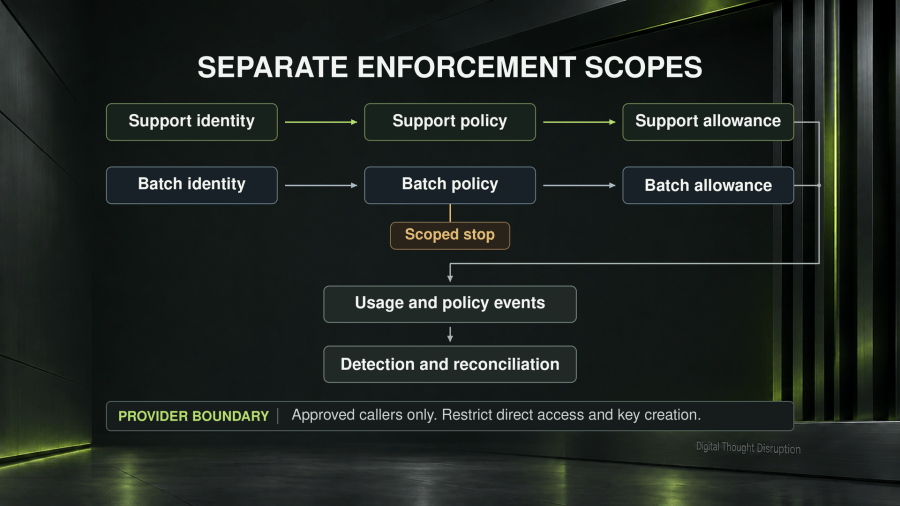
Run two distinct workloads. One represents approved support activity. The other develops an unusual consumption pattern. Give them separate identities and known ownership so the exercise can establish whether responders can identify the responsible workload, apply the intended restriction, and explain its scope.
Introduction
Credential containment needs particular care. AWS documents a role-session revocation mechanism that denies permissions to sessions issued before a specified point. That mechanism does not, by itself, prevent an authorized principal from assuming the role again afterward. [6]
The question I would put to the person approving that service is:
External References
The moment an operator submits a restriction is not necessarily the moment consumption ends.
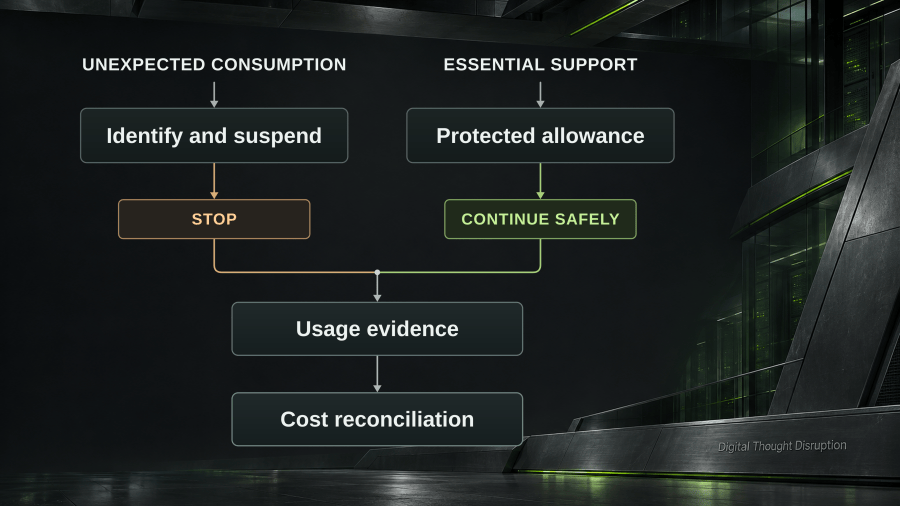
Return to the support-team scenario. Suppose the investigation identifies unexpected consumption under a batch-processing identity.
Report the financial and operational outcomes separately. OWASP’s LLM10:2025 Unbounded Consumption identifies both economic loss and service degradation. An incident with modest charges can still disrupt critical work, while a large bill does not prove that legitimate service was interrupted. [7]
For support, define the minimum service outcome that must survive. It might be a bounded volume of ticket summaries, an approved lower-cost function, or a manual support workflow with access to the required knowledge. The service owner should decide what constitutes acceptable degraded operation.
Use the narrowest restriction that actually contains the abuse, not the narrowest restriction that avoids an outage. When compromise reaches a shared provider credential or administrative identity, broader suspension may be necessary.
For each run, retain the first observable anomaly, detection time, restriction-request time, effective-enforcement time, and the last accepted unauthorized request. Record consumption before enforcement and any remaining consumption afterward. Preserve uncertainty where telemetry is incomplete.
Keep the emergency restriction path outside the authority of the workload under investigation. An application should not be able to remove its own suspension by changing a route, minting another credential, or redeploying an older configuration.