The application receives a text result through one shared function, while the provider-specific request construction remains isolated.
TL;DR
Muse Glimmer is released under Apache 2.0. Muse Spark Open uses the Muse Model License. Llama models are governed by applicable Llama Community License terms.
Model Context Protocol provides a common way for AI applications to discover and invoke capabilities supplied by MCP servers.
That does not mean a model should be allowed to execute any requested operation.
Open weights and unrestricted open-source licensing are not interchangeable claims.
Introduction
This provides procurement and integration alternatives, but distribution through a cloud provider does not mean the model weights are delivered for independent hosting.
Self-hosting therefore requires significant capacity planning. A smaller active-parameter count does not eliminate the memory required to load the model’s full weights.
Even when the JSON schema is unchanged, models can interpret tool descriptions, instructions, ambiguous requirements, and missing evidence differently.
External authorization should remain authoritative.
Meta’s documented BF16 reference weights occupy approximately 1.65 TB. The NVFP4 checkpoint is approximately 537 GB, with additional memory required for runtime overhead and key-value caches.
Google’s Gemma family, for example, is separate from the proprietary Gemini models discussed here.
The following rates are publicly documented examples for standard, direct API usage as of October 19, 2026. They are expressed in US dollars per one million uncached input tokens and one million output tokens.
OpenAI’s Responses API supports remote MCP connections. The developer documentation also describes Secure MCP Tunnel for reaching supported local or private MCP services.
The Muse Spark Open example illustrates the scale difference.
The original design exposes an uncomfortable dependency: the application has absorbed the provider’s API semantics, conversation state, tool-call format, SDK behavior, and error handling.
That request must be treated as untrusted input.
It supports Python, TypeScript, Go, and Java.
These differences affect network reachability, credentials, tool approval, and operational ownership.
Compare Developer Platforms, Not Chat Applications
The managed Agents API provides a different execution model.
A Claude tool call identifies the requested operation and its structured arguments. If the tool is client-executed, the application runs it and returns a tool-result block. Anthropic also offers server-executed tools for supported operations.
| Ecosystem | Primary model API | Agent development and execution | Model deployment |
|---|---|---|---|
| OpenAI GPT | Responses API | Agents SDK and managed Agents API | Vendor-managed model inference; application and sandbox hosting options |
| Anthropic Claude | Messages API | Claude Agent SDK and Claude Managed Agents | Anthropic API and supported cloud-provider distribution |
| Google Gemini | GenerateContent and Interactions APIs | Agent Development Kit, Antigravity, managed Agent Runtime | Google-hosted Gemini inference with several application-runtime choices |
| xAI Grok | Responses API and supported compatible interfaces | Native SDK, built-in tools, custom agent loops; Grok Bot as a separate product | xAI-managed inference and supported cloud distribution |
| Meta | Meta Model API, with Responses, Chat Completions, and Messages interfaces | Muse Code, supported agent frameworks, custom tool loops | Hosted Muse models; downloadable Llama, Muse Glimmer, and Muse Spark Open models |
Hosted inference shifts responsibilities. It does not remove them.
The Current Model Baseline
Two models with similar token prices may have very different cost per accepted outcome.
| Provider | Representative model identifier | Evaluation role |
|---|---|---|
| OpenAI | gpt-6.1-sol |
Complex professional tasks with a balance of cost and capability |
| Anthropic | claude-sonnet-5-5 |
General software engineering and agent workloads |
gemini-3.8-flash |
High-throughput, multimodal, and agent-oriented development | |
| xAI | grok-4.7 |
Coding, reasoning, and tool-connected applications |
| Meta | muse-spark-1.3 |
Hosted multimodal and agent development |
A client-executed function requires more application code, but it allows the organization to keep policy enforcement and business-system credentials within its own environment.
This concerns whether another model will produce acceptable outputs under the same instructions and data conditions.
Model Cost =
(Input Tokens / 1,000,000) x Input Rate
+ (Output Tokens / 1,000,000) x Output Rate
The most useful economic metric is:
OpenAI: Responses API, Agents SDK, and Managed Agents API
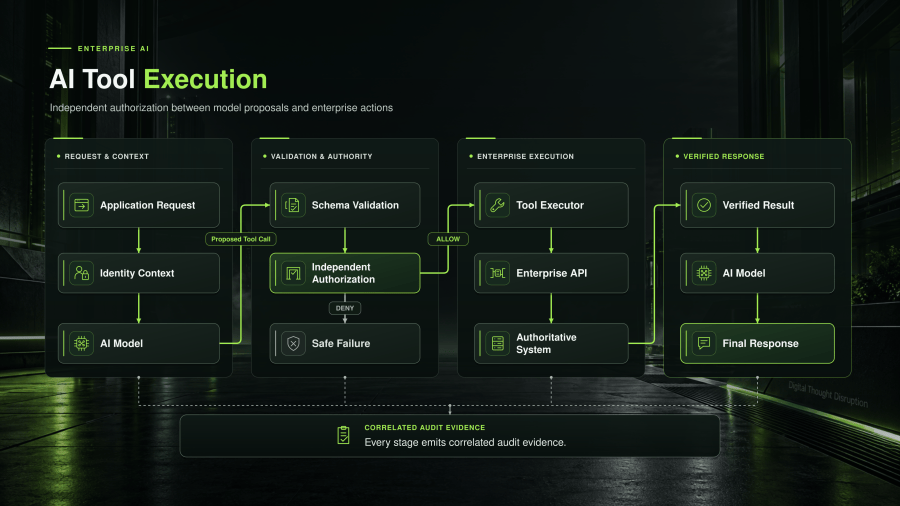
The application should validate the JSON schema, authenticate the effective requester, check the requested operation against policy, and determine whether approval is required.
Responses API
However, Google’s Interactions API overview, updated October 15, 2026, still states that Gemini 3 does not support remote MCP and that availability is forthcoming.
A practical default is to retain sufficient metadata to diagnose and audit the transaction, with controlled access to detailed content only when justified.
Meta’s Contributor mode offers lower prices in exchange for permission to use customer content to improve models. It should not be treated as a cost optimization for restricted enterprise data unless that use is explicitly approved.
It supports structured model outputs, function calling, and model-compatible hosted tools. Those tools can include search, file retrieval, code execution, and MCP integrations.
The most important separation is between model selection and business-system authority.
Agents SDK
For a production deployment, choose the documented and tested path rather than relying on an assumed equivalence between the model API and ADK.
An application making one model request is easier to cost than an agent that performs repeated reasoning, searches several services, retries failed operations, and generates a large final artifact.
Model compatibility becomes an infrastructure concern. Drivers, accelerator memory, runtime versions, quantization, tokenization, and attention implementations can affect whether a model operates correctly and efficiently.
xAI supports remote MCP tools through its native SDK and supported Responses interfaces.
A model provider may return an error while an agent is halfway through preparing a change request. An MCP server may be reachable but fail authorization. A retrieval index may return stale information. A model upgrade may change structured output behavior without generating an infrastructure alert.
Managed Agents API
The tradeoff is that the application must implement its own orchestration, durable business state, authorization, retries, and operational recovery when the workflow becomes more complex.
This is the ability to change an endpoint, model identifier, or client configuration without rewriting the entire request workflow.
The example deliberately holds token volume constant. Real providers may tokenize the same material differently, generate different output lengths, perform internal reasoning, or require a different number of calls to complete the task.
OpenAI and the compatible xAI and Meta interfaces use a Responses-style request.
Anthropic: Messages API and Claude Agent Execution
The organization should set thresholds according to the business service.
Every approved production route should therefore record the provider, model identifier, endpoint, tool configuration, prompt version, output schema, and evaluation baseline.
Muse Spark Open is distributed under the Muse Model License, not the Apache 2.0 license used by Muse Glimmer.
The platform distinguishes client-executed functions from server-executed tools.
A cross-vendor architecture should be introduced incrementally. Building a comprehensive multi-agent platform before validating one workflow creates unnecessary engineering risk.
Claude Agent SDK
The service supports agent definitions, tools, connected MCP servers, and session-specific credentials. Anthropic’s documentation separates reusable agent configuration from secrets provided to particular sessions.
An infrastructure operations assistant might use a research agent to retrieve evidence and a separate drafting agent to prepare a change request.
Those omissions are intentional.
Building with GPT, Claude, Gemini, Grok, and Meta models is increasingly an architecture and operating-model decision rather than a simple API comparison.
This fifth article focuses on the engineering consequences.
Claude Managed Agents
Portability should be evaluated at four distinct layers.
Google uses the GenAI client and a GenerateContent call.
It supports the broader capabilities associated with agent execution, including file operations, shell-based work, tool permissions, hooks, and supported MCP integrations.
Muse Code provides a terminal-oriented coding agent.
Deployment Through Other Cloud Providers
It accepts a provider name and a text request, sends one inference call, and returns the text output. It does not expose tools, execute business operations, maintain agent memory, or perform automatic fallback.
These are product-specific capabilities, not identical implementations of every MCP specification feature.
An enterprise that expects to support more than one model provider should adopt a small set of explicit design rules.
Google: Gemini APIs, ADK, and Enterprise Agent Runtime
Vendor-specific optimizations can remain inside clearly defined adapters.
GenerateContent and Interactions APIs
The adapter exposes a stable application function while using provider-specific client behavior internally.
The distinction between text output and tool-use blocks is important when building applications.
Assume a hypothetical application makes 1,000 requests, each consuming 2,000 input tokens and producing 500 output tokens.
The SDK can coordinate those model interactions, but the application must still authorize operations against the ticketing or infrastructure system.
Agent Development Kit
ADK provides the agent orchestration capability. It does not remove the need to design data permissions, secrets management, application state, or incident handling.
This is a separate agent execution product, not merely another name for Meta Model API.
Muse Code supports MCP server configuration, including local process transport and remote HTTP connections.
Behavioral portability requires regression testing.
Gemini Enterprise Agent Runtime
The relevant comparison is the programmatic surface through which an application accesses a model, controls tools, manages state, and executes workflows.
The correct choice depends on the sensitivity and provenance requirements of the workload.
Architecture decision: Meta offers one of the clearest choices between hosted frontier model access and downloadable model deployment within this five-vendor comparison. However, Muse Model API, Muse Code, Muse Spark Open, Muse Glimmer, and Llama have different technical and legal boundaries.
This provides an option for organizations that want greater control over model-serving infrastructure.
Anthropic’s Messages API MCP connector supports remote servers using supported HTTP transports.
However, it must also engineer accelerator capacity, storage, serving runtimes, networking, scheduling, monitoring, scaling, security, and recovery.
Meta’s Llama family includes downloadable model weights that can be deployed through compatible inference runtimes.
For concrete examples, the following are documented model identifiers available in the respective developer ecosystems at the October 19, 2026 baseline.
On October 15, 2026, Meta released Muse Spark Open.
The difference is not merely performance.
Built-In Tools
The introduction of a more powerful model is not sufficient evidence to expand that authority.
Building applications with GPT, Claude, Gemini, Grok, and Meta models involves substantially more than choosing an inference API. All five ecosystems support programmatic access to language models and structured tool use, but they differ in agent runtimes, SDK conventions, MCP integration, execution environments, model hosting, observability, and commercial arrangements.
The practical requirement is to verify the actual model identifier, endpoint, SDK version, and MCP operation before accepting the integration.
A multi-provider application should not expose every provider-specific capability directly to business workflows.
Values are rounded to cents. These are calculated examples, not observed invoices or performance measurements.
SDK and Compatible Interfaces
A research assistant can tolerate longer completion times than a customer-facing voice agent. An agent creating infrastructure change requests may require stronger audit and authorization guarantees than a summarization service.
OpenAI offers several mature paths from direct inference to managed agent execution. Anthropic combines a structured Messages API with powerful agent tooling and managed services. Google provides a deeply integrated cloud agent platform and flexible deployment patterns for application runtimes. xAI supports compatible model access and distinctive search and tool capabilities. Meta now spans hosted Muse interfaces, agent development, and downloadable models with very different hardware and licensing profiles.
The architecture below is a proposed reference design, not a deployment diagram for one particular vendor.
The assistant must retrieve monitoring information, read support tickets, consult approved runbooks, produce a technical explanation, and draft a remediation plan. Eventually, it may be allowed to create change requests or perform tightly controlled operational actions.
Grok Bot Is a Separate Execution Surface
A production MCP implementation needs five controls.
The objective is to compare official developer interfaces, model execution, MCP support, agent orchestration, hosted and self-hosted deployment, portability, cost, and Day-2 operations. It also provides a practical reference architecture and a vendor-neutral implementation pattern.
The initial prototype uses one vendor’s API and works well.
Fallback should never become a way to bypass a control that would block the original request.
Only after identity, authorization, audit, state recovery, and approval mechanisms have been demonstrated should the enterprise consider granting any production-change authority.
“””Read-only smoke test, not a production agent.”””
import os
from openai import OpenAI
from anthropic import Anthropic
from google import genai
MODELS = {
“openai”: “gpt-6.1-sol”,
“anthropic”: “claude-sonnet-5-5”,
“google”: “gemini-3.8-flash”,
“xai”: “grok-4.7”,
“meta”: “muse-spark-1.3”,
}
def generate_text(provider: str, prompt: str) -> str:
“””One text response; no tools or agent state.”””
if provider not in MODELS:
raise ValueError(f”Unsupported provider: {provider}”)
model = MODELS[provider]
if provider == “openai”:
response = OpenAI().responses.create(
model=model,
input=prompt,
)
text = response.output_text
elif provider == “anthropic”:
response = Anthropic().messages.create(
model=model,
max_tokens=700,
messages=[
{“role”: “user”, “content”: prompt}
],
)
text = “”.join(
b.text
for b in response.content
if b.type == “text”
)
elif provider == “google”:
response = genai.Client().models.generate_content(
model=model,
contents=prompt,
)
text = response.text
else:
prefix = (
“XAI” if provider == “xai”
else “META_MODEL”
)
client = OpenAI(
api_key=os.environ[f”{prefix}_API_KEY”],
base_url=os.environ[f”{prefix}_BASE_URL”],
)
response = client.responses.create(
model=model,
input=prompt,
)
text = response.output_text
if not text:
raise RuntimeError(
“No text response; inspect provider result”
)
return text
if __name__ == “__main__”:
target = os.getenv(“AI_PROVIDER”, “openai”)
print(generate_text(
target,
“Explain two risks in a VM change plan.”
))
Architecture decision: Claude is a strong candidate when a workload needs structured tool use, code-oriented execution, or a managed agent service. Choose the API or agent runtime according to the required execution and credential boundaries, not simply the model family.
These statements cannot be treated as a universal guarantee of support for every Gemini 3-series model.
Second, the MCP server must authorize the requested capability, rather than trusting the model’s assertion that it may perform the operation.
This separation becomes especially important when the application changes model providers. The model can be replaced without changing the enterprise’s authorization policy or the implementation of the business operation.
The developer-platform decision should follow the workload and the organization’s operating requirements.
Muse Code
Google’s Gemini API supports model inference, multimodal inputs, structured results, and function calling.
It also states that some parameters supported in OpenAI-style integrations, including require_approval, are not currently supported by xAI’s compatible interface.
Meta’s downloadable model families use different licenses.
Anthropic documents availability of current Claude models through its own API and supported services from Amazon Web Services, Google Cloud, and Microsoft.
Llama
This is the ability to move a workflow between orchestration environments without losing state, approval logic, scheduled work, tool permissions, and recovery behavior.
This is substantially more difficult than changing a model API.
A more complete model is:
Muse Glimmer
Neither is automatically preferable. The workload’s data, latency, support, and security requirements determine the appropriate pattern.
OpenAI provides the Responses API, Agents SDK, and managed Agents API. Anthropic offers the Claude Messages API, direct tool use, MCP connectivity, and Claude Managed Agents. Google combines the Gemini APIs with its Agent Development Kit (ADK) and managed Agent Runtime. xAI supports Grok through native and OpenAI-compatible APIs, including built-in tools and remote MCP integration. Meta now provides the hosted Meta Model API and Muse Code alongside downloadable Llama models, Muse Glimmer, and the newly released Muse Spark Open.
It is most relevant when the organization controls model weights or uses a provider that supports the same model through several cloud environments.
Muse Spark Open
A successful smoke test demonstrates that all configured interfaces are reachable and can return text.
Total AI Workflow Cost =
Model Input and Output
+ Cache Writes and Storage
+ Search and Tool Invocations
+ Agent Runtime and Sandbox
+ Network and Data Processing
+ Retry and Failed-Run Cost
+ Human Review and Remediation
+ Allocated Platform Operations
Google’s managed Agent Runtime provides deployment infrastructure for agents.
These distinctions affect commercial rights, redistribution, derivatives, attribution, and other obligations.
OpenAI manages the underlying agent harness and persistent session infrastructure, with options for hosted or customer-managed execution environments.
For Gemini 3.8 Flash, Google documents a scheduled increase to .50 per million input tokens and .50 per million output tokens starting January 1, 2027.
Meta Model API supports structured function calling, but the examined documentation does not establish an identical hosted remote MCP feature across all its model interfaces.
Do not spend months trying to make every feature portable.
The five ecosystems are not equally portable at the model-deployment layer.
Third, tool arguments must be validated against the operation’s schema and business rules.
The architecture team wants a second model provider for resilience. Security wants all tool calls evaluated independently. Finance wants lower-cost models for routine classification. Platform engineering wants deployment choices across managed cloud services and private infrastructure. The development team wants to reuse its application logic without rewriting the entire agent.
How a Tool-Using Transaction Should Work
The team should execute the same harmless prompt through each approved model and capture the model identifier, response, latency, usage metadata, and any errors.