Choosing VVF 9.x or VCF 9.x from vSphere 8: The Customer Decision Workshop
I would capture the recommendation, assumptions, verified evidence, risks, unresolved conditions, and the events that would cause the decision to be revisited.
The workshop should produce a decision record, not simply a presentation containing a preferred product.
The critical point is that an inventory alone does not explain the organization’s desired future.
I would ask the customer to describe the next three to five years through concrete requirements.
Consider a hypothetical regional enterprise operating three vCenter environments, conventional VLAN networking, external Fibre Channel storage, centralized backup, and a small infrastructure team.
Nor would I assume VVF is less expensive simply because it has a narrower product scope.
The Operating Model Must Be Approved Alongside the Technology
The decision model must consider the architecture that can actually be delivered, not the cheapest theoretical deployment of either product.
Get Paul Bryant’s practical guides to enterprise AI, hybrid platforms, and day-2 operations by email. New articles as they publish. Unsubscribe anytime.
Operational responsibility
VVF-oriented ownership
VCF-oriented ownership
Compute and clusters
Virtualization team
Platform infrastructure team
Network services
Network team and infrastructure team
NSX platform owner with network team
Security policy
Security and network teams
Security policy owner with NSX enforcement ownership
Provisioning
Infrastructure automation team
Cloud platform product and automation teams
Lifecycle management
vSphere operations and associated component owners
VCF fleet, instance, and domain lifecycle owners
Application consumption
Application owner through infrastructure request workflows
Application or tenant owner through governed platform services
Recovery
Backup, DR, and application owners
Coordinated platform recovery and application recovery owners
Costs
Infrastructure and finance
Platform service owner, business consumers, and finance
I would open the workshop with one question:
If fleet operations are expected to reduce administration effort, I want to understand the existing lifecycle work, the new management requirements, and what measurable work will disappear.
The question that exposes organizational readiness
A third may select VVF as the immediate target and retain a future option to adopt VCF when its service-delivery requirements become mature enough.
Broadcom KB 437250 confirms that VMware 9.x licensing uses subscription-based license files managed through VCF Operations and the VCF Business Services console rather than traditional upgraded 25-character keys.
Declaring a decision final before the critical evidence exists. A conditional recommendation is legitimate. An unverified compatibility assumption presented as a completed assessment is not.
The table describes architectural approaches, not a complete entitlement matrix. Some VCF advanced security, load balancing, recovery, and data services require separately licensed capabilities. The specific feature guide footnotes and commercial agreement govern the final bill of materials.
Continue reading
Turn the Workshop into an Approved Architecture Decision
The scope is existing vSphere 8 environments considering VVF 9.x or VCF 9.x. The current 9.1.1 feature documentation provides the product baseline as of October 26, 2026. Exact source-to-target compatibility, entitlement, and partner support remain environment-specific decisions.
For a customer currently running vSphere 8, I would complete this decision before approving the detailed migration execution plan. The platform choice should direct the transition strategy, not be an accidental consequence of whichever upgrade workflow appeared easiest.
A useful sensitivity exercise is to adjust the weights to reflect a credible change in business priorities.
An affirmative answer should be supported by a preliminary design and capacity model.
If the business requires those capabilities to be preserved within an integrated VMware platform, a VVF-only option cannot become acceptable simply because it scores well on price or implementation familiarity.
Scoring future capabilities without funding or ownership. An ambition to introduce private cloud self-service should not receive the same evidence confidence as an approved implementation requirement.
This can be a legitimate phased strategy when the customer needs to exit vSphere 8 support but has not yet established a funded private cloud transformation.
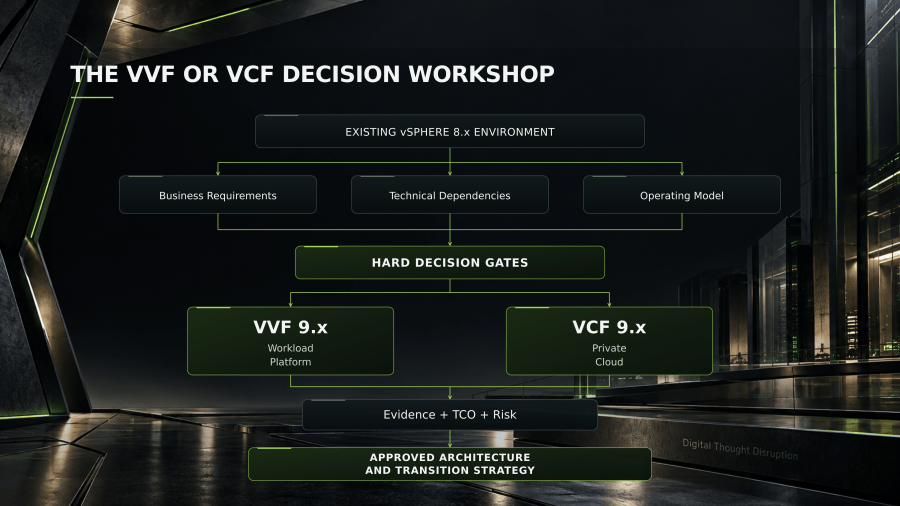
How I Would Run the Customer Workshop
The VVF-versus-VCF decision is best treated as an enterprise architecture selection with operational, commercial, and lifecycle consequences.
Existing NSX usage is not enough to declare the entire estate ready for VCF. Network boundaries, current builds, management topology, backup, recovery, and supported workflows must all be validated.
Session
Principal activity
Required outcome
Requirements and hard gates
Review current state, business outcomes, mandatory controls, and operational ownership
Approved requirements and disqualifying constraints
Candidate architecture evaluation
Assess VVF and VCF designs, deployment models, management footprint, TCO, and transition risks
Comparable candidates and documented evidence gaps
Decision and execution handoff
Review scoring, sensitivities, recommendation, exceptions, and approval conditions
Architecture decision record and funded next steps
Reversibility should therefore be a visible evaluation criterion.
If the existing estate is already compatible with VVF 9.x, an in-place upgrade may have a different cost and risk profile from a new VCF deployment that also introduces NSX, additional management services, and redesigned operations.
What the customer should leave with
The customer has production NSX networks, security policies, several infrastructure domains, distributed application teams, and an approved modernization program.
If VCF Automation is included in the business case, I want a defined service catalog, service owners, provisioning workflows, and a realistic implementation plan.
The next practical action is to authorize a source-to-target compatibility assessment using the selected architecture, complete current build inventory, supported hardware and storage information, and approved recovery constraints.
That is not an economic benefit. It is duplicated capability.
Transition cost can materially alter the answer.
For example, the documented VCF Management Services deployment requires an initial minimum allocation of 12 management-network IP addresses, with additional capacity available for expansion and future lifecycle requirements. The documentation also identifies internal service-network ranges that must be checked for overlap.
What I Would Not Allow Into the Final Recommendation
I would not introduce a generic vendor scorecard with dozens of equally important criteria. I would use a relatively small set of decision dimensions with explicit weights and evidence requirements.
Likewise, owning NSX licenses does not automatically prove that every NSX capability is deployed, critical, or must be preserved.
That is something the architecture team can evaluate.
It disqualifies an implementation that depends on reusing those servers.
Application teams must be able to request an approved three-tier development environment, including compute, storage, networking, and security policy, without creating separate infrastructure tickets. The service must have defined quotas, an accountable owner, and a controlled retirement process.
A vague statement such as “we need cloud-like automation” is not ready to influence a purchase.
It may have no business requirement to become an internal cloud service provider.
What must this infrastructure environment be capable of delivering over the next three to five years, and what responsibilities is the organization prepared to own?
The architecture team must establish how these services will be addressed, protected, monitored, updated, backed up, and recovered.
Conclusion
That is the problem the decision workshop needs to solve.
Consider a different hypothetical enterprise with several datacenters, significant NSX networking dependencies, multiple application teams, inconsistent provisioning practices, and a funded objective to deliver private cloud services.
Stay informed
Even then, I would want to prove that the organization can actually adopt the capabilities creating the value.
A decision and commercial assessment. This records the recommended direction, hard-gate results, weighted evaluation, cost assumptions, risks, and circumstances that could change the decision.
Takeaway: Select the operating model the customer can justify, implement, maintain, and recover. Then choose the supported technical path to reach it.
That creates potential future costs involving migrations, licensing, management redesign, recovery reconfiguration, and coexistence.
A meaningful comparison needs a common time horizon and equivalent service requirements.
External References
This is where the current Broadcom feature comparison becomes useful.
vSphere 8 to VMware 9.x: Building the Exact Build Compatibility and Transition Plan
Build the vSphere 8 to VMware 9 transition plan from exact builds, hardware and partner compatibility, supported workflows, recovery, and pilot evidence.
Read the article →
Choosing VCF because it is the larger product. Broader capabilities are valuable only when the customer has an actual requirement and can operate them.
Make your next architecture decision with confidence.
The October 2027 support deadline has prompted a modernization discussion.