The question most procurement teams ask first is whether customer information will be used to train future AI models.
TL;DR
AI Assistant Decision Series | Part 4 of 6 | Product and source baseline: October 19, 2026.
Before comparing security features, identify the exact service and agreement.
An AI-generated document saved in Drive follows the lifecycle of a Drive document. A Gemini conversation and a Gemini Enterprise audit event are separate records.
Google documents that Gemini’s access to Workspace information is constrained by the effective user’s permissions and applicable administrator and content-owner restrictions.
Introduction
For AI systems, that is insufficient.
However, the available sources do not establish an equivalent enterprise-wide compliance API and SIEM-export contract across Meta AI, Muse, and Meta Business Agent.
The security team wants to know whether conversations are used for model training. That is an appropriate question, but it is only one part of the problem.
That question should remain a contractual requirement, but it needs precise wording.
The enterprise should test whether those controls remain effective when an agent receives misleading content, retries a failed task, changes its plan, or invokes a tool indirectly.
A platform may enforce approvals through application permissions, cloud-browser controls, managed-agent policies, connector services, or a separate authorization component.
Continue reading
- Which source systems can the assistant access, and under whose identity?
- Can the agent send information to an external service or modify an authoritative record?
- What is retained in chat history, agent memory, browser sessions, connector caches, logs, and backups?
- Which approvals are enforced by policy, and which depend on the model deciding to ask?
- Can the organization reconstruct an action or revoke the authority that enabled it?
- What legal and contractual commitments apply to the specific product being used?
xAI’s consumer policies describe how eligible Grok interactions may be used for model training and how users can manage those choices.
OpenAI’s enterprise privacy documentation states that business data is not used for model training by default. Its consumer documentation describes controls for disabling model improvement, including Temporary Chat behavior.
Similarly, a product that fails one pilot may be qualified later if the vendor releases the necessary control, the enterprise changes its architecture, or the business reduces the workflow’s privileges.
The described components include a credential service, privileged connector workers, and Sentinel, which authorizes connector actions and network egress.
The First Security Decision Is Which Product You Are Authorizing
However, Google distinguishes qualifying Workspace core-service access from situations where Gemini operates as an additional Google service under consumer-oriented terms.
Connected applications introduce one of the largest changes in AI security risk.
Meta’s Muse architecture separates the agent runtime from more sensitive credential-handling and authorization services.
Get Paul Bryant’s practical guides to enterprise AI, hybrid platforms, and day-2 operations by email. New articles as they publish. Unsubscribe anytime.
For a regulated workload, evidence of an appropriate certification or compliance program must be checked against the actual service, region, features, and contractual scope. A vendor-wide certification badge does not establish that every connected product or customer deployment is covered.
| Ecosystem | Distinct product boundaries | Primary security question |
|---|---|---|
| ChatGPT / OpenAI | Personal ChatGPT, Business, Enterprise, Work, Codex, API | Which workspace, connected application, and execution permissions apply? |
| Claude / Anthropic | Consumer Claude, Team, Enterprise, Claude Code, API | Which commercial retention, model, connector, and session controls apply? |
| Gemini / Google | Personal Gemini, Workspace, Gemini Enterprise, developer API | Which organizational data policies and source permissions survive retrieval? |
| Grok / xAI | X-integrated Grok, Grok.com, API, Grok Bot | Which entity processes the data, and which privacy and agent terms govern it? |
| Meta AI / Muse | Meta AI, Muse, Business Agent, enterprise offerings, model APIs, Llama | Which data-use policy and agent security architecture applies to the specific offering? |
Anthropic documents access to organization activity, chats, files, projects, and supported Claude execution sessions through its Compliance API.
Its purpose is to make the selection and implementation requirements testable.
OpenAI’s documentation distinguishes saved conversations, Temporary Chats, uploaded or created files, projects, and the cloud-browser environment.
Model Training and Enterprise Data Use
Chat history, uploaded files, projects, connected-application interactions, compliance records, and agent execution environments may each have different lifecycles.
Part 1 of this series examined the five AI ecosystems. Part 2 compared their features. Part 3 identified their strongest starting candidates for real-world use cases.
Every vendor describes some form of logging, monitoring, or usage visibility. The important question is what those records actually capture.
Claude Enterprise supports organizational identity controls, including SSO and SCIM, while individual connectors can introduce their own permission requirements.
Gemini Enterprise integrates with Google Cloud logging and observability services.
Training-Use Comparison
| Ecosystem | Consumer or personal use | Documented commercial position |
|---|---|---|
| OpenAI | Eligible personal content may support model improvement; user controls and Temporary Chat restrictions apply | Business, Enterprise, Edu, and API content excluded from model training by default, subject to explicit agreements or permissions |
| Anthropic | Consumer training depends on choices and specified safety-review exceptions | Commercial Claude and API inputs and outputs are not used for model training by default, with documented feedback and opt-in exceptions |
| Gemini Apps may operate under consumer privacy terms, including eligible human review and improvement uses | Qualifying Google Workspace core-service use has enterprise data protections; content is not used for model training outside the customer’s domain without permission | |
| xAI | Grok.com and X expose training-related controls under their respective policies | xAI states that business and API data are not used for model training without permission; Grok Bot requires separate Cursor data-setting review |
| Meta | Meta AI interactions can be used for AI improvement; Muse describes sanitizing agent trajectories for training, with an opt-out | Product-specific enterprise data-use obligations require validation; a universal no-training commitment across Meta AI, Muse, Business Agent, and new enterprise services is not established here |
The organization must approve the actual combination being deployed.
OpenAI: Commercial Exclusion Is the Default, but Product Settings Still Matter
These are shortlist recommendations based on documented architecture and control availability, not independently established comparative security rankings.
Meta’s September 2026 Muse security publication describes a dedicated user virtual machine that stores files, memory, credentials, and durable application state.
Meta states that Muse stores working files, credentials, and durable state within a dedicated cloud virtual machine. It also explains that sanitized inference trajectories can be used to improve models by default, with an opt-out setting for users who do not want that training use.
Uncontrolled secondary use: Training opt-outs, feedback mechanisms, personalization settings, and product-improvement exceptions can differ across products and contractual arrangements.
Anthropic: Commercial Protection Has Explicit Exceptions
These policies can permit an action automatically, require explicit approval, or invoke automatic evaluation. The defaults are not universally deny-by-default across all tool types.
An enterprise selecting a particular region must determine which parts of the service actually operate within that boundary.
Claude Enterprise supports configurable retention for supported chats and projects. Anthropic documents a minimum retention period of 30 days for that feature. Configure chat and project retention separately: project retention takes precedence for chats inside projects and defaults to indefinite retention, even when standalone chats have a custom period. Relevant activity resets the applicable retention clock.
However, those options should not be applied indiscriminately to content stored in Gmail, Drive, Docs, Sheets, or other Workspace services.
Google: Workspace Entitlement Changes the Privacy Boundary
An enterprise AI system needs both, but a third identity is increasingly important: the agent or automation performing work on behalf of the user.
When enabled, documented action recording uses its own storage and retention behavior. Exporting corresponding telemetry requires additional configuration.
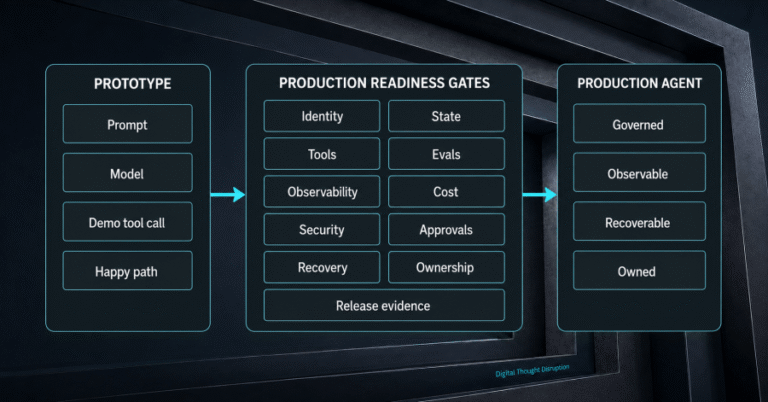
The next question for a platform leader is therefore concrete: If this assistant retrieves the wrong record, attempts an unauthorized action, or must be shut down during an incident, can the organization prove what happened and regain control?
The documentation describes integration with security information and event management (SIEM), data loss prevention (DLP), and electronic discovery systems.
xAI: Consumer Grok, Business APIs, and Grok Bot Must Be Separated
If that answer cannot be demonstrated, the AI system is not yet ready for the proposed level of authority.
An administrator may configure a platform carefully and still be exposed if the contract allows broad secondary data use, indefinite retention exceptions, opaque subprocessors, or changes to the underlying service without sufficient notice.
A workflow may involve a person, an application, an AI agent, a connector, and an underlying source system. If those identities collapse into a single broad service credential, the organization can lose the ability to enforce or reconstruct user-specific permissions.
The default API endpoint does not guarantee a specific processing region. A US regional API endpoint is documented, but only selected models and operations fall within its guarantee. Other features, including specified files and server-side tools, are outside that scope.
Meta: Muse’s Detailed Architecture Does Not Replace Contract Review
A workload may have separate processing locations for model inference, storage, search indexing, browser execution, tool calls, logs, backups, security inspection, and technical support.
For these five ecosystems, contract review should answer specific technical questions.
Successful validation would demonstrate that the pilot can retrieve permitted evidence, create a draft, deny prohibited changes, and retain the necessary audit records.
Consequently, the removal of a chat should not be treated as proof that every connected session, file, or external service artifact has been removed.
apiVersion: dtd.ai-governance/v1
kind: AgentSecurityContract
metadata:
name: infrastructure-incident-assistant
environment: pilot
classification: internal
ownership:
business: infrastructure-operations
technical: ai-platform
security: security-governance
identity:
requireEnterpriseSSO: true
requireEffectiveUserContext: true
allowSharedCredentials: false
requireAgentAttribution: true
dataPolicy:
modelTraining:
permitted: false
requireContractualEvidence: true
allowedSources:
– approved-ticketing
– approved-runbook-repository
permittedClassification:
– internal
dataResidency:
status: pending-approval
requireSourceAuthorization: true
tools:
allowed:
– ticket-read
– document-search
– change-draft-create
blocked:
– ticket-delete
– permission-modify
– production-shell
– firewall-change
– change-submit
execution:
defaultDecision: deny
requireIndependentAuthorization: true
humanApprovalForExternalWrites: true
revalidateAfterRetries: true
stopOnPolicyFailure: true
audit:
record:
– effective-user
– workflow-id
– model-identifier
– source-identifiers
– policy-decision
– tool-name
– action-result
– approval-reference
promptBodyLogging: disabled
requireCorrelationId: true
exportValidation: pending
retention:
scheduleApproved: false
deletionTestPassed: false
revokeSessionsOnDecommission: true
release:
productionApproval: false
requireSecuritySignoff: true
requireRecoveryExercise: true
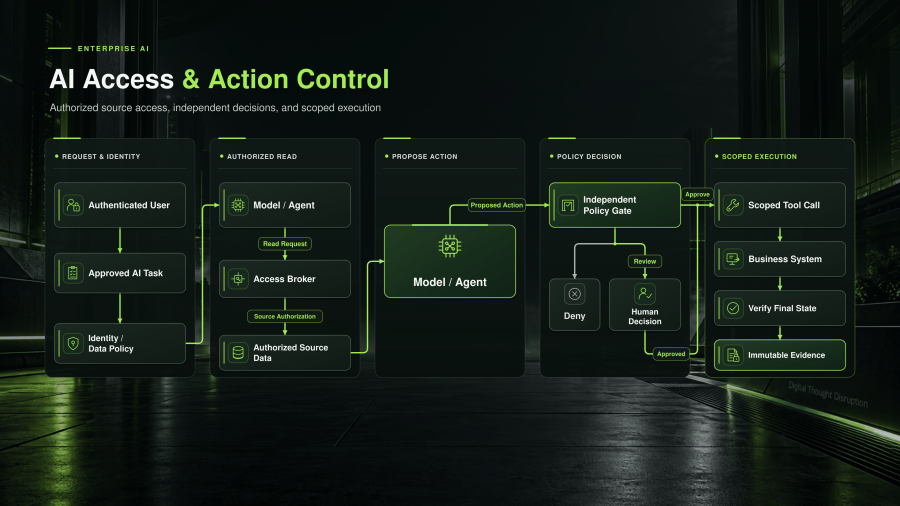
Model instructions alone should not authorize those operations.
The current implementation uses technical isolation and operational controls, but Meta acknowledges that it does not cryptographically prevent Meta from accessing data when necessary to support, secure, or operate the service.
Retention planning should identify the system of record for every artifact.
Documented Retention Boundaries
| Platform or service | Documented behavior | Enterprise qualification |
|---|---|---|
| ChatGPT Enterprise | Workspace retention controls; OpenAI documentation describes a 90-day minimum for configurable conversation retention | Confirm applicability to chats, projects, Library files, Work artifacts, compliance records, and browser state |
| OpenAI API | Standard retention and eligible reduced-retention arrangements depend on endpoint and feature | Verify endpoint eligibility, abuse-monitoring retention, application state, and exceptions |
| Claude Enterprise | Configurable chat and project retention with a documented 30-day minimum | Confirm exclusions for cloud-executed features, retained sessions, and compliance records |
| Anthropic API | Standard request retention is generally 30 days, with documented exceptions and eligible zero-retention arrangements | Check the selected model, Files API, stateful features, and Covered Models policy |
| Gemini in Workspace | Administrators can configure Gemini conversation-history retention, including 3-, 18-, and 36-month options | Distinguish conversation history from Workspace content, logs, backups, and other Gemini services |
| xAI API | Standard API inputs and outputs are retained for 30 days for specified purposes; eligible zero data retention is configurable | Confirm zero-retention status and identify API features disabled by the setting |
| Grok Bot | Persistent cloud environment; enterprise action recording has its own retention and configuration | Confirm Cursor terms, shared-computer state, browser sessions, routine data, and action logs |
| Meta Muse | Dedicated virtual machine stores durable application data and credentials; backup and model-training flows are separately described | Obtain product-specific retention, deletion, backup, export, and contractual evidence |
These are valuable implementation details.
OpenAI: Conversation History, Library Files, and Browser State Are Different Assets
The security team should approve the product, configuration, data class, and use case together, rather than approving a vendor name without qualification.
This fourth article examines the controls required to operate those capabilities responsibly.
OpenAI provides role-based access control for supported managed workspaces, alongside application-specific permissions and workspace administration.
Grok Bot introduces another boundary. Its documentation states that it uses Cursor authentication and account data settings, and that its cloud-based execution requires persistent storage.
The security requirement is not simply whether the organization has enabled a retention setting. It is whether that setting covers the data generated by the selected workflow.
Anthropic: Custom Retention Does Not Cover Every Execution Surface
Consider a fictional enterprise deploying an assistant to investigate infrastructure incidents.
Each user receives a dedicated cloud computer, while multiple Bots belonging to that user share its environment.
The example deliberately leaves residency, audit export, retention, and production approval unresolved.
The National Institute of Standards and Technology (NIST) Generative AI Profile provides a broader risk-management framework for these assessments. Vendor-specific controls should be mapped into a consistent organizational process rather than accepted as incomparable marketing claims.
It does not eliminate the need to test access boundaries.
Google: Chat History Is Not the Entire Workspace Data Lifecycle
That creates a practical validation opportunity: the application can record whether the intended retention configuration was applied to a specific request.
Its commercial privacy documentation excludes training on business inputs and outputs by default, but describes exceptions when a customer explicitly provides feedback, reports issues, or authorizes data sharing.
For example, an agent may ask a user for confirmation in natural language. That is different from a tool execution system that refuses to proceed without a valid, scoped approval record.
A successful test should prove that a user cannot retrieve a restricted document through an AI assistant even when a more privileged administrator or indexing component can access the document.
A better starting point is to preserve identity, authorization decisions, source references, tool names, action results, and correlation identifiers. Capture full content only when a defined control requirement justifies it.
xAI: Zero Data Retention Has Functional Consequences
Anthropic makes a similar distinction between consumer and commercial offerings.
Grok Bot is different. It requires persistent cloud storage and does not support the same legacy privacy mode available in other Cursor experiences.
An organization that enables Grok Bot but never configures Action Recording may have administrative evidence without the detailed execution records needed for an investigation.
The original security approval covered a question-answering assistant. The system now participates in business operations.
An enterprise should therefore verify the organizational unit, user license, service status, and feature entitlement instead of relying solely on the fact that an employee signed in with a company email address.
The documentation provides a response-header mechanism to confirm whether API ZDR is active.
Meta Muse: Isolated Storage Is Not Equivalent to Provider-Inaccessible Storage
According to the documentation, a Bot does not have a separately privileged identity capable of exceeding the permissions granted through the signed-in user and configured tools.
The five vendor names conceal multiple commercial and technical arrangements.
That is substantially different from claiming that everything associated with Grok is processed in the United States.
A vendor feature should be considered qualified only when the enterprise can demonstrate its required behavior.
xAI documents an optional Zero Data Retention (ZDR) configuration for eligible API customers.
Identity and Authorization: The Assistant Must Never Become a Shared Superuser
That model-specific exception makes contract and model inventory important. A security assessment cannot assume one organization’s privacy agreement produces identical behavior across every model family.
The distinction is especially explicit in Grok Bot’s documentation.
A service may offer strong security documentation while an adjacent consumer product operates under materially different privacy expectations. A developer API may provide reduced data retention while a stateful agent requires persistent files, sessions, and credentials.
This is a concrete defense-in-depth architecture and deserves serious consideration in an agent security evaluation.
Identity and Access Comparison
| Platform | Documented control direction | Critical qualification |
|---|---|---|
| OpenAI | Enterprise authentication, configurable feature access, role-based controls, app permissions | Verify effective user and connector authority, not only workspace membership |
| Anthropic | Enterprise identity provisioning, SSO, SCIM, connector controls, tool permissions | Distinguish user-level access from application or cloud-agent credentials |
| Workspace identity and content permissions, Gemini Enterprise IAM, source-level access control | Validate source ACL enforcement and user-delegated actions | |
| Grok Bot | Cursor-based user identity, team permissions, enterprise policy and network controls | Bots belonging to one user share a computer and are not independent isolation boundaries |
| Meta Muse | User-granted connector permissions, credential isolation, independent Sentinel authorization | Validate delegation scope and distinguish personal consent from enterprise policy enforcement |
OpenAI: Workspace Roles and Connected Application Permissions
Enterprise decision: Require the executed service terms, data-processing addendum, subprocessor list, training-use restrictions, and product-specific retention schedule before classifying sensitive workloads as approved.
Stay informed
None of these capabilities removes the organization’s responsibility for source permissions, agent authorization, incident response, audit retention, and decommissioning.
Therefore, an xAI API data-retention commitment should not automatically be applied to Grok Bot execution data.
The correct treatment is to mark those requirements as needing verification rather than assume that a consumer agent’s internal action records satisfy enterprise audit obligations.
Anthropic: User Permissions and Tool Policies Are Separate Layers
Therefore, creating two Bots does not establish two independent trust zones.
However, its retention documentation excludes certain cloud-executed features from the same settings.
Its API security documentation provides a different baseline: API inputs and outputs are not used for training without explicit permission. Business and enterprise terms may provide additional commitments.
A log showing that an employee authenticated successfully does not prove what an agent accessed afterward. A record showing that a tool returned success does not prove that the intended business change occurred. A conversational transcript may capture the agent’s explanation while missing the actual command, API request, or downstream system mutation.
A vendor may meet every requirement for a public-information research assistant while remaining unsuitable for an agent with privileged infrastructure access. That does not make the vendor universally insecure. It means the security boundary or contract does not meet the requirements of that workload.
Google: Document Permissions Must Survive Retrieval
This architecture is a recommended control pattern, not a claim that all five vendors implement precisely this sequence.
Persistent credentials: Long-running agents create durable access paths. Revoking the user’s immediate chat session may not remove every background routine, browser session, or connected credential.
Grok Bot’s security FAQ identifies two further authorization limits. Blocking a plugin does not block the same service in the browser; closing that access path requires Enterprise Network Controls. The Enterprise model allowlist is not guaranteed to be enforced, and there is no customer-facing model picker. If approved models or subprocessors are mandatory requirements, obtain product-specific commitments and verify the available enforcement before authorizing the workflow.
The process should preserve explicit exceptions.
These retention statements cannot be converted into a single vendor ranking. The shortest documented duration does not necessarily cover every data store used by an application.
Grok Bot: Different Bots Can Share the Same User Computer
Google documents audit records for administrative operations, usage activity, and execution traces. For certain audit events, sensitive prompt and response fields are omitted or redacted unless the relevant content-logging setting is enabled.
When ChatGPT executes an approved action through an external application, the source application’s audit record may still be necessary to prove the result.
This makes native identity integration a meaningful advantage, especially for organizations already maintaining detailed permissions in Google Workspace.
An important operational distinction is that training exclusion does not mean every business interaction is immediately deleted.
Google documents administrator controls for Gemini conversation history in qualifying Workspace environments.
Enterprise audit logs cover administrative, security, authentication, and Bot control-plane events. Action Recording is a separate enterprise capability, disabled by default.
The documented options include 3, 18, or 36 months when history is enabled. When history is disabled, certain conversations may still be held temporarily for service operation and feedback processing.
Meta Muse: Credential Isolation and Action Authorization Are Explicitly Designed
A security-sensitive workflow requiring separation of credentials or workloads must use a stronger isolation mechanism than simply assigning different Bot names.
If an employee has broad privileges in a connected application, the assistant may be able to exercise approved portions of those privileges. The AI workspace does not automatically correct excessive permissions in the source system.
The assistant can now access additional document repositories, search customer records, open support requests, prepare change tickets, and execute selected actions through connected applications. A persistent agent has been configured to run scheduled tasks. Several administrators have enabled integrations, and individual employees have connected additional services.
Anthropic also documents special retention requirements for designated Covered Models. These requirements may affect customers that otherwise expect zero data retention.
However, different Bots associated with the same user can encounter the same durable computer state, including files, browser sessions, and credentials.
Connectors and Agents: Where Read Access Becomes Write Authority
This provides a meaningful basis for centralized oversight. However, retention settings, zero-retention arrangements, and local execution can change which records are accessible.
Model training, inference processing, safety review, product analytics, personalization, and operational retention are different data uses.
Under the applicable Workspace terms, Gemini content is not used for model training outside the organization’s domain without permission. Google also describes the inheritance of relevant Workspace security protections and access restrictions.
The Enterprise AI Execution Boundary
Data residency requirements are often reduced to a single location field.