Administrators cannot establish new sessions through the normal identity path. Management interfaces are unavailable or incomplete. Infrastructure changes cannot be performed safely. Log ingestion may have stopped. Backup or recovery services may be inaccessible, and the team cannot establish whether a restored component is ready to resume its intended role.
TL;DR
The central takeaway: High availability can preserve service execution. Recovery readiness must demonstrate that an organization can regain the capabilities required to operate the platform.
Get Paul Bryant’s practical guides to enterprise AI, hybrid platforms, and day-2 operations by email. New articles as they publish. Unsubscribe anytime.
It also examines dependency cycles where one component must be available to recover another, but the second component is needed to restore the first.
What does recovery mean under those conditions?
Introduction
The paper distinguishes three documented architectural recovery models:
The intended audience includes VMware Cloud Foundation architects, private cloud platform owners, infrastructure operations leaders, and enterprise recovery planners.
This first edition focuses on the availability and operational recoverability of the VCF management plane.
Define which administrator must regain access, which management endpoint is required, which action demonstrates restored control, and what time objective the service owner has established.
Designing and Validating Management-Plane Recovery in VMware Cloud Foundation 9.1.x
Beyond High Availability
Beyond High Availability was written to provide a practical framework for performing that work in VMware Cloud Foundation 9.1.x.
Consider a VMware Cloud Foundation environment experiencing a serious management-plane failure.
But the infrastructure team has a different problem.
The resulting operational decision is intentionally narrow: ready for the named scenario, ready with restrictions, or not ready for the named scenario.
Why I Wrote Beyond High Availability
These are assessment categories proposed in the paper, not vendor-defined service-level commitments.
What the Whitepaper Covers
It is not a vendor-certified recovery design, a universal startup sequence, or a collection of laboratory benchmark results.
Seven Capabilities That Define Useful Recovery
That distinction deserves explicit architecture decisions, documented dependencies, applicable recovery procedures, controlled exercises, and defensible acceptance evidence.
| Capability | What recovery must demonstrate |
|---|---|
| C1: Workload availability | A representative application transaction completes successfully |
| C2: Administrative access | An authorized operator establishes a fresh session and exercises the intended role |
| C3: Infrastructure management | An approved, reversible change completes and its effect is verified |
| C4: Self-service provisioning | A governed request creates the intended resource and completes cleanup |
| C5: Operational visibility | A fresh event becomes visible through the required investigation or alerting path |
| C6: Security and trust | Required permissions and trust relationships function, while prohibited actions remain denied |
| C7: Continued protection | New protection evidence is created and retrievable, with its recovery point identified |
For teams working with VMware Cloud Foundation 9.1.x, I recommend beginning with one critical management capability rather than immediately attempting to validate every possible disaster scenario.
NEW PUBLICATION | FIRST EDITION
For example, consider recovery of infrastructure management after a specified management-service failure.
Only when those prerequisites are established should the team authorize the laboratory exercise.
Map the Dependencies That Recovery Actually Requires
Beyond High Availability examines management-plane recovery as a specific architecture and operational assurance problem within VMware Cloud Foundation 9.1.x.
Which management capability must your organization recover first, and what evidence would convince you that it can actually be recovered under the failure conditions that matter?
The central question is whether an authorized recovery path exists from the resources and information that survive the named failure. The supporting architecture discussions on VCF workload-domain boundaries and VCF fleet operations explain how lifecycle, ownership, and shared services affect those dependencies.
The distinction matters because capabilities can recover at different times.
One successful recovery milestone does not automatically satisfy the others.
Compare the Documented VCF Recovery Models
The resulting evidence should show what succeeded, what failed, which dependencies were assumed to survive, which safeguards were restored, and what remains unresolved.
| Recovery model | Primary boundary |
|---|---|
| Component Backup and Restore | Recovery of selected management components |
| VCF Instance Backup and Restore | Reconstruction of a failed VCF instance from backup under the documented topology and infrastructure-identity requirements. |
| VCF Fleet Disaster Recovery | Recovery of designated fleet functions into another qualified VCF instance within the same fleet under the documented disaster-recovery design. |
The framework begins with seven observable capabilities. Each requires a functional demonstration rather than reliance on an appliance status or completed task alone.
38 pages | Version 1.0 | October 20, 2026
The framework and hypothetical planning examples are proposed assessment guidance. They are not represented as customer results or executed tests.
An organization’s readiness assessment should identify the exact environment, failure boundary, required capabilities, and operating conditions. A successful component recovery test cannot be silently promoted into proof of complete management-domain or site recovery.
From Recovery Procedures to Evidence-Based Readiness
Its VCF 9.1.1 reference baseline also does not mean every 9.1.x source and target combination is supported. Environment-specific recovery procedures must be qualified against the installed products and actual deployment history.
- Vendor documentation: Does an authoritative procedure apply to the selected recovery scenario, including its release scope and restrictions?
- Release and topology qualification: Do the actual component builds, deployment history, recovery destination, and environmental prerequisites satisfy that procedure?
- Observed behavior: Has the required capability been demonstrated through a controlled exercise with recorded results?
- Organizational acceptance: Has the responsible authority accepted the measured outcome, limitations, and operating conditions?
The scenario assumes that the original Management Services cluster has become unavailable and that Log Management must be recovered onto a qualified new or rebuilt cluster.
The whitepaper does not establish cyber-clean recovery, forensic preservation, regulatory compliance, or application-data recovery. Those outcomes require separate requirements, procedures, and evidence.
Paul Bryant | Digital Thought Disruption
Recovery evidence record
The paper examines how those differences affect management services, VCF Operations, VCF Automation, vCenter Server, NSX, and relevant external dependencies.
Laboratory planning and observation worksheets
Broadcom KB 436904 documents a Log Management reconciliation scenario involving a new or rebuilt Management Services cluster. Where Network File System (NFS) storage was configured in the previous cluster, the guidance requires that path to be accessible from the new cluster before proceeding.
Release and recovery qualification record
Then map the dependencies of that exact action, qualify the relevant documented recovery path, and identify what infrastructure, identities, credentials, and recovery artifacts must survive the failure.
Bounded recovery test library
If you own a VCF environment, I encourage you to begin with one recovery question:
The paper follows the lifecycle of a management-plane recovery assessment, from defining the necessary capabilities to making an operational readiness decision.
Stay informed
How I Recommend Using the Paper
The whitepaper examines how normal operating dependencies can differ from recovery dependencies.
However, the recovery path involves more than deploying replacement infrastructure.
The paper also includes a public source register and detailed component and fleet recovery qualification notes.
A structured record for capturing the service, failure boundary, documented method, exact baseline, required dependencies, observations, acceptance decision, and outstanding work.
Read Beyond High Availability on Zenodo for the architecture discussion, evidence framework, worked planning assessment, recovery qualification material, and reusable worksheets.
The example also separates several outcomes that might otherwise be reported together: new event ingestion, historical log availability, delivery of events generated during the failure, archive access, authorization, and renewed protection.
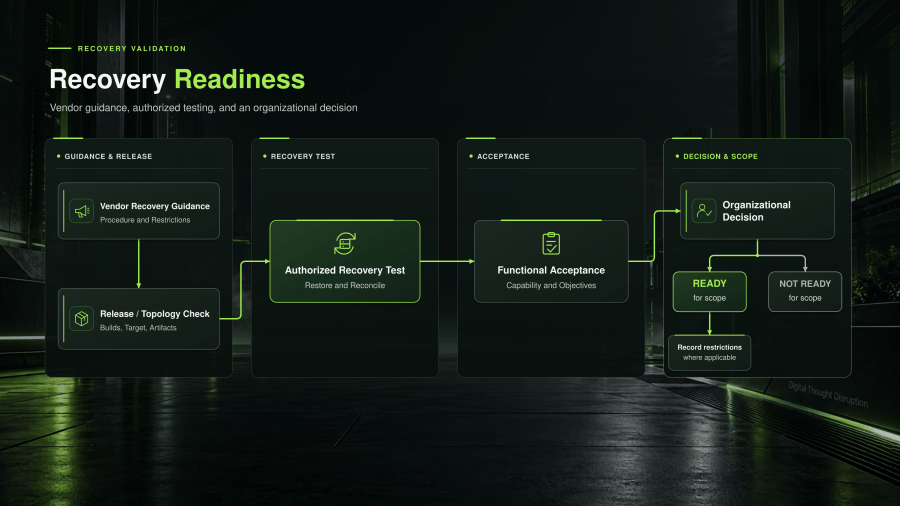
Vendor guidance and release qualification lead to an authorized recovery exercise, functional acceptance, and a scoped organizational readiness decision.
Scope and Important Limitations
Animation: Workloads can remain available while management capabilities require recovery and verification before return to service.
Templates for defining authorized failure injection, prerequisites, stop conditions, recovery milestones, timing, functional validation, and final disposition.
An administrator may regain emergency access while normal identity integration remains unavailable. A management interface may respond before infrastructure changes are safe. Logging services may restart without demonstrating that new events are being ingested.
A method for documenting source and target versions, topology restrictions, vendor applicability, dependency requirements, and qualification gaps.
Read Beyond High Availability on Zenodo for the complete framework, planning example, qualification records, and reusable worksheets.
Read the Complete Whitepaper
Reference release: VCF 9.1.1
The following diagram illustrates the assessment logic. A successful restore task is an intermediate result, while readiness requires the complete evidence chain.
The organization has preserved some workload availability, but it has lost essential operating capabilities.
These models have different state requirements, supported mechanisms, destination conditions, and operational consequences. The documented architecture and procedures are linked under External References.
The whitepaper includes a worked planning example focused on VMware Cloud Foundation Log Management.
I am releasing a new technical whitepaper, Beyond High Availability: Designing and Validating Management-Plane Recovery in VMware Cloud Foundation 9.1.x. The paper examines an operationally important problem: a private cloud can continue running applications while losing the management capabilities required to administer infrastructure, investigate incidents, recover services, and maintain protection.
Continue reading
These resources are intended to reduce the amount of interpretation left to the person performing a recovery assessment. They do not replace release-specific product procedures, environment validation, or organizational authorization.
Conclusion
The required outcome is straightforward: an investigator must be able to search for a newly generated event through the recovered logging service.
That process gives the platform owner a more useful deliverable than a generic disaster recovery test summary. It establishes whether a specific operating capability can be recovered under stated conditions.
Business-critical virtual machines remain powered on. Existing applications continue processing transactions. From the perspective of an application health dashboard, production may appear relatively stable.
These questions motivated my new whitepaper.
Importantly, an architectural model is not automatically an executable procedure for every installed VCF 9.1.x build.
That conclusion is deliberate.