TL;DR
from itertools import combinations
LEAVES = (“l1”, “l2”, “l3”, “l4”)
SPINE_ZONES = {“s1”: “A”, “s2”: “B”, “s3”: “A”, “s4”: “B”}
def structural_rejections(topology):
problems = []
if set(topology) != set(LEAVES):
problems.append(“unexpected leaf inventory”)
for leaf in LEAVES:
uplinks = topology.get(leaf, ())
if len(uplinks) != 3 or len(set(uplinks)) != 3:
problems.append(f”{leaf}: exactly three distinct uplinks required”)
if set(uplinks) – set(SPINE_ZONES):
problems.append(f”{leaf}: unknown spine”)
elif len({SPINE_ZONES[s] for s in uplinks}) < 2:
problems.append(f”{leaf}: both power zones required”)
for spine in SPINE_ZONES:
if sum(spine in topology.get(leaf, ()) for leaf in LEAVES) > 4:
problems.append(f”{spine}: port budget exceeded”)
for left, right in combinations(LEAVES, 2):
shared = set(topology.get(left, ())) & set(topology.get(right, ()))
if len(shared) < 2:
problems.append(f”{left}/{right}: insufficient shared spines”)
return problems
def zone_failure_rejections(topology):
problems = []
for failed_zone in (“A”, “B”):
for left, right in combinations(LEAVES, 2):
shared = set(topology[left]) & set(topology[right])
surviving = {s for s in shared if SPINE_ZONES[s] != failed_zone}
if not surviving:
problems.append(
f”{left}/{right}: no shared spine after zone {failed_zone} fails”
)
return problems
baseline = {leaf: (“s1”, “s2”, “s3”) for leaf in LEAVES}
balanced = {
“l1”: (“s1”, “s2”, “s3”),
“l2”: (“s1”, “s2”, “s4”),
“l3”: (“s1”, “s3”, “s4”),
“l4”: (“s2”, “s3”, “s4”),
}
zone_aware = {
“l1”: (“s1”, “s2”, “s3”),
“l2”: (“s1”, “s2”, “s3”),
“l3”: (“s1”, “s2”, “s4”),
“l4”: (“s1”, “s2”, “s4”),
}
for name, topology in (
(“baseline”, baseline),
(“balanced”, balanced),
(“zone-aware”, zone_aware),
):
structure = structural_rejections(topology)
zones = zone_failure_rejections(topology) if not structure else [“not evaluated”]
print(
f”{name}: structure={‘PASS’ if not structure else ‘FAIL’}, ”
f”power-zones={‘PASS’ if not zones else ‘FAIL’}”
)
A network topology is more than a diagram showing which devices connect.
A network architect is asked to redesign a datacenter fabric that supports virtualization, storage traffic, Kubernetes applications, and an expanding collection of AI workloads.
An AI system that proposes a new topology must respect the underlying requirements. Novelty alone cannot justify removing useful path diversity.
Introduction
There is no single network evaluator that proves every relevant property. The validation stack should become progressively more expensive and more realistic.
None of these calculations proves a real-world performance improvement. They show that even a small topology search can produce different validity outcomes depending on which failure domains the evaluator understands.
baseline: structure=PASS, power-zones=PASS
balanced: structure=PASS, power-zones=FAIL
zone-aware: structure=PASS, power-zones=PASS
Perhaps changing a small number of physical connections would improve traffic distribution. Perhaps an alternative allocation of links would reduce the impact of a particular failure. Perhaps the existing topology is already the best practical option, but an unconventional design could expose a useful relationship between traffic patterns and network capacity.
Assume four leaf switches and four already installed, powered, and licensed spine switches. Each leaf has three approved uplinks, for a total of twelve leaf-to-spine connections. Each spine has four available leaf-facing ports. No leaf-to-leaf or spine-to-spine links are permitted in this simplified two-stage fabric. All candidate links use the same approved port speed and compatible physical media.
Do not let one optimization metric hide the full cost of change. A topology requiring recabling or new operational procedures has a transition cost even when the switch inventory is unchanged. Consider optics, structured cabling, maintenance windows, redundancy during cutover, routing-policy complexity, monitoring, training, and rollback.
Most enterprise network architectures begin with established design patterns. Engineers choose proven topologies, routing protocols, redundancy models, and traffic-engineering methods because those approaches have understandable failure behavior and operational history. That discipline is necessary, but it also limits how many alternative designs an engineering team can realistically investigate.
These documents help explain why physical connectivity, next-hop selection, and effective bandwidth utilization must be evaluated separately.
Graph theory can establish whether two devices remain connected after a link or node failure.
Those are appropriate engineering activities.
A conventional leaf-spine fabric provides predictable structure. In a fully connected two-tier design, each leaf has uplinks to every spine, allowing traffic to use multiple paths through the fabric.
Before using this code against a real inventory, replace the illustrative devices and zone map with approved data. Add hard gates for allowed port pairings, physical cabling, line-card failure domains, route and policy dependencies, and service-specific reachability. A production discovery harness also needs strict input validation and safeguards against malformed or excessive candidate submissions.
Part 3 applies those ideas to a concrete networking problem.
The search should stop when further evaluation cost exceeds the plausible value of the remaining candidates, when the improvement is no longer reproducible, or when no qualified candidate offers a meaningful advantage over conventional engineering alternatives.
The proposed experiment uses an intentionally small, constrained network. The objective is to compare different assignments of the same physical uplink budget, rather than give the AI unlimited freedom to buy devices or invent forwarding capabilities.
Separate search scenarios from holdout scenarios. The generator may receive scores from an approved development evaluator, but it should not repeatedly tune against the final acceptance suite. Otherwise, strong scores may reflect benchmark overfitting rather than robust network behavior.
Why Network Architecture Is a Difficult Discovery Problem
The challenge is to use that structure to expand exploration without weakening engineering discipline.
A candidate still needs a supported device configuration model. A passing graph test cannot substitute for route-policy analysis. Likewise, static reachability analysis is not a throughput benchmark.
All three are useful when the evidence is retained. None requires pretending that AI has invented a universally superior network fabric.
Established Patterns Exist for Good Reasons
The business wants more usable capacity without a disproportionate increase in infrastructure spending.
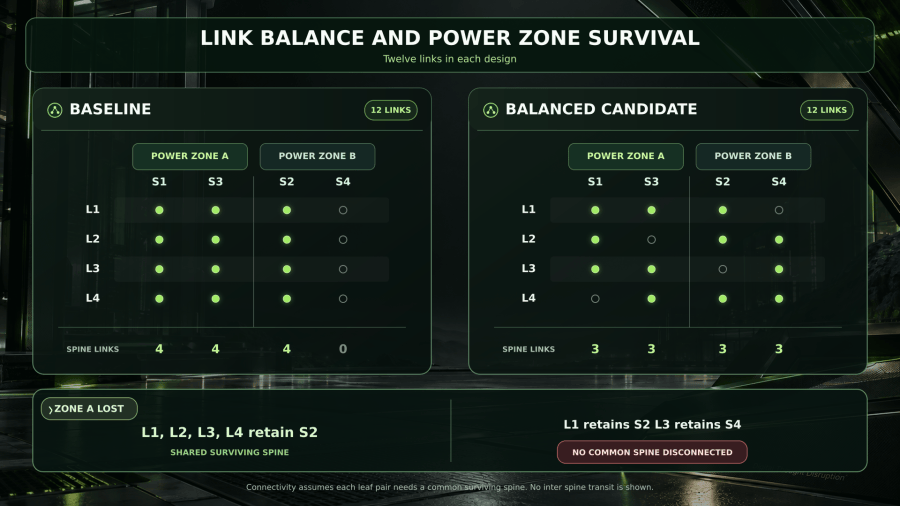
The twelve-link example shows why that process must be layered. A balanced-looking candidate can satisfy local redundancy rules and still break connectivity when a shared failure domain disappears. A different candidate can survive that failure while creating a new concentration of critical paths. Structural validity, performance, resilience, and operational acceptability are separate decisions.
This is also where a mathematically elegant topology may become unappealing. It might require awkward recabling, consume unusual port combinations, complicate maintenance, or create a failure pattern that the operations team cannot readily diagnose.
The existing infrastructure is functional. Redundant switching is in place, Border Gateway Protocol (BGP) provides routing in the fabric, and Equal-Cost Multipath (ECMP) distributes eligible traffic across available paths. Monitoring shows that the environment is generally healthy, although some links experience congestion while others remain underutilized.
Comparison of two twelve-link leaf-spine fabrics: the balanced candidate loses a common surviving spine after a modeled power-zone failure.
A Valid Topology Is Not Necessarily a Good Topology
A network simulator such as ns-3 can provide a repeatable environment for testing modeled packet-level behavior. Its suitability depends on the specific protocol and queue models configured and whether they capture the mechanisms that matter for the workload.
A candidate may disconnect a workload during a spine failure, oversubscribe an uplink, exceed a switch’s port capacity, violate a segmentation requirement, or depend on forwarding behavior the installed hardware does not support.
This makes networking an especially useful domain for testing the discovery-engine concept.
Do not assume the simulator’s ECMP or congestion model matches the hardware. That claim requires its own validation.
A comparison should distinguish the best normal-operation result from the most defensible operating result. An extra percentage point on a simulated throughput score is not enough to justify a design with materially weaker fault tolerance or an unmanageable change path.
A topology may look excellent in simulation while failing under real congestion, route reconvergence, or optical faults.
- Can the network forward traffic between required endpoints?
- Can it preserve that connectivity through the defined failures?
- Does routing converge to the intended paths?
- Are security boundaries enforced along those paths?
- Can the topology handle representative traffic without unacceptable degradation?
- Can engineers deploy, monitor, troubleshoot, and recover the design using supported mechanisms?
The following is the proposed experiment’s evidence plan, not a report of completed test results.
Bound the Search: A Twelve-Link Fabric Experiment
A search algorithm concerned with distributing links evenly might suggest spreading all twelve links across four spines, three links per spine. On a simple port-utilization score, that arrangement looks attractive. It also passes basic tests requiring three unique uplinks per leaf, connections in both power zones, and two common spines between each pair of leaves.
This is exactly the kind of subtle failure a discovery engine must catch before performance scoring.
Continue the AI discovery series or explore the Enterprise AI hub.
| Fixed assumption | Why it is fixed |
|---|---|
| Four leaves, four spines, twelve uplinks | Preserves the hardware and cabling budget across candidates |
| Three distinct spine neighbors per leaf | Prevents a candidate from reallocating all capacity away from one leaf |
| Four leaf-facing ports maximum per spine | Prevents impossible physical assignments |
| Spines S1 and S3 in power zone A; S2 and S4 in zone B | Allows correlated power-zone failures to be tested |
| Approved BGP underlay and supported ECMP behavior | Keeps the experiment inside an implementable protocol model |
| Existing security segmentation and allowed paths | Prevents an optimization from silently weakening isolation |
| No production write access | Separates experimentation from change authority |
AI-assisted network architecture discovery is a reasonable engineering research direction precisely because networking exposes the difference between plausible proposals and verifiable results. Graph structure can be tested, routing and policy can be analyzed, traffic can be simulated, and selected candidates can be challenged on physical hardware.
The comparison should use identical traffic inputs and equivalent resources for the baseline and qualified candidates. Test steady-state load, bursts, asymmetric traffic, and failures. If the objective involves distributed AI, include traffic patterns representative of the relevant collectives or service communications rather than relying on a generic uniform-flow generator.
The Counterexample: Better Balance Can Make Resilience Worse
A technically valid candidate is not automatically novel, and a novel candidate is not automatically useful.
There are three legitimate outcomes. The machine-search approach may discover a reproducible improvement worth advancing to a controlled hardware pilot. It may uncover a tradeoff or failure mode that improves the team’s understanding without changing the architecture. Or it may demonstrate that the existing design or a conventional optimizer remains the stronger option.
Only the strongest candidates should consume laboratory hardware time. On the intended devices and software baseline, verify supported cabling and optics, route convergence, link and switch failures, congestion behavior, security enforcement, and recovery after the test.