TL;DR
Suppose a generated routing strategy reduces measured congestion but introduces difficult configuration dependencies, unclear troubleshooting paths, or behavior that existing operations teams cannot reliably maintain.
Imagine an enterprise network architecture team preparing for a major infrastructure redesign.
The candidate generator should not have authority to modify the evaluator or weaken its acceptance criteria.
Most of our language around artificial intelligence is borrowed from human cognition.
Introduction
The next article will examine how to engineer the discovery environment itself, including candidate generators, evaluators, simulation boundaries, search memory, and validation controls.
The central takeaway: The next frontier of useful AI may depend less on teaching machines to reproduce human reasoning and more on engineering environments where machines can discover solutions humans can independently verify.
Researchers applied this method to the cap set problem, an established problem in combinatorics, discovering new constructions that improved previously known results.
The design space must be large enough to permit useful alternatives but constrained enough that candidate architectures can be evaluated meaningfully.
Throughput alone would be an incomplete objective.
Ask a model to invent a radically different networking architecture and it might produce an appealing description involving adaptive routing, distributed policy, or unusual topology arrangements.
A candidate may look unusual without being new.
Traditional benchmarks remain useful for assessing the capabilities of individual models.
It is a conceptual and decision-oriented article, not a claim that today’s general-purpose language models can autonomously invent production-ready infrastructure.
Suppose the organization operates a datacenter network supporting virtualization, storage services, Kubernetes applications, and distributed AI inference workloads.
Suppose a networking experiment rewards lower latency but does not measure packet loss or workload completion.
It may also violate routing constraints, overlook failure domains, depend on unsupported hardware, or assume physical properties that do not exist.
This is where search history, candidate diversity, reproducible experiments, and iteration become important.
There are practical reasons for this approach.
A general-purpose language model can propose unconventional ideas.
Why Human Intelligence Became the Default AI Benchmark
Successful exploration should build on previous evidence rather than generate unrelated answers indefinitely.
An experienced network architect does not evaluate every mathematically possible network topology. Instead, they recognize patterns, eliminate obviously unsuitable options, apply engineering principles, and focus on architectures likely to succeed.
A stronger evaluator must connect performance metrics to actual service outcomes.
What if a machine-assisted discovery system could evaluate thousands of additional network configurations, including combinations no engineer would initially consider reasonable?
A machine-assisted discovery experiment could explore a broader but still controlled set of alternatives.
Evaluation should consider several dimensions.
Human Intelligence Has a Particular Architecture
Much of artificial intelligence is evaluated against human performance. We ask whether a model can pass examinations, write convincing explanations, produce expert-level code, solve mathematical problems, or reason through familiar engineering tasks. These evaluations are useful, but they may overlook a different opportunity: using AI to explore valid solutions that human experts would be unlikely to propose.
AlphaTensor and FunSearch show that machine-driven exploration can produce discoveries in appropriately structured and verifiable domains. Their results are narrow enough to remain scientifically meaningful and important enough to challenge the assumption that established human approaches always define the strongest available solution.
These measures should not automatically be collapsed into a single score.
Continue the AI discovery series or explore the Enterprise AI hub.
FunSearch generated heuristics that outperformed established first-fit and best-fit approaches on the evaluated benchmark distributions.
Otherwise, a large performance improvement can conceal a disqualifying weakness.
A model may assume uniform traffic, accurate device behavior, predictable failures, or instantaneous policy convergence.
A discovery environment needs several cooperating capabilities.
Discovery is rarely one attempt.
These requirements should be encoded as testable constraints before candidates receive performance scores.
The infrastructure team wants to reduce congestion and improve failure tolerance without replacing the entire network.
This article examines that question through documented AI research, the limitations of human-centered benchmarking, and the architectural conditions required to turn unconventional machine-generated ideas into verifiable engineering discoveries.
The Difference Between Imitation and Discovery
There is a broader architectural possibility.
| Evaluation approach | Question being asked | Evidence of success |
|---|---|---|
| Human-performance benchmarking | Can AI perform a task at the level of a capable human? | Accuracy, task completion, benchmark score |
| AI-assisted engineering | Can AI help engineers complete familiar work more efficiently? | Reduced effort, improved quality, faster delivery |
| Machine-assisted discovery | Can AI identify valid improvements beyond the established solution set? | Novel candidate, independent validation, measurable improvement |
That conservatism serves a purpose. Production systems cannot be managed through novelty alone.
Security boundaries, service objectives, interoperability, recovery, and accountability may be mandatory.
They are still bounded by available computation, memory, context, algorithms, training data, and the quality of their objectives. A language model does not possess infinite working memory or unrestricted reasoning capability simply because it runs on silicon.
Experience helps us compensate.
What AlphaTensor and FunSearch Actually Demonstrated
That possibility deserves serious attention, especially when organizations are investing heavily in AI systems whose primary objective is still to perform recognizable human tasks.
Some solutions are unacceptable regardless of their apparent performance.
That improvement is meaningful, but its scope matters.
The important possibility is that a search system might identify a useful, nonobvious relationship between topology, routing behavior, workload characteristics, and cost.
The answer may be creative.
AlphaTensor: Searching Beyond Established Algorithms
What AlphaTensor demonstrated was that a machine-search system could discover a mathematically valid algorithm improving on a long-established reference point.
The decision should be driven by the structure of the search space and the available evaluator.
We have limited working memory, finite attention, restricted sensory access, and comparatively little time to examine every possible alternative.
Enterprise technology decisions are often constrained by established patterns because those patterns are familiar, supportable, and efficient to reason about.
The existence of an automated evaluator does not guarantee meaningful discovery.
It does not require the AI to explain a solution the way a human expert would have discovered it. It requires the solution to satisfy the relevant rules and produce an improvement that survives verification.
The most practical entry point is a bounded optimization problem, not a production-wide autonomous architecture engine.
Independent testing would determine whether the simulated improvements transfer to actual operating conditions.
Three experienced architects develop three credible proposals.
Google DeepMind’s AlphaTensor approached the discovery problem as a reinforcement-learning search over tensor decompositions.
The problem begins when we confuse performance on human-designed tasks with the full range of useful machine capabilities.
For enterprise technology leaders, the next step is not to hand architectural authority to a language model.
FunSearch: Using Language Models to Generate Verifiable Ideas
A technically superior design can be economically unsuitable because of licensing, optics, cable complexity, operational skills, or lifecycle requirements.
A new network topology cannot be considered superior if it violates mandatory security boundaries or cannot survive a required failure condition.
The purpose of the discovery environment is to find better candidates and produce evidence, not to grant an AI system unlimited authority to redesign production infrastructure.
This is a specification problem, not evidence of an intelligent architectural breakthrough.
But human performance should not become the outer boundary of what we are willing to investigate.
Those outcomes should influence whether the program continues.
Machine systems operate under a different collection of constraints.
Otherwise, the search can optimize the measurement mechanism rather than solve the intended problem.
Arithmetic domain, additions, memory access, hardware characteristics, implementation overhead, and numerical behavior can affect practical performance.
The Shared Discovery Pattern
Hard constraints should remain disqualifying conditions, and performance improvements should be reported alongside uncertainty and validation limitations.
Stay informed
| Property | AlphaTensor | FunSearch |
|---|---|---|
| Primary method | Deep reinforcement learning | LLM-guided evolutionary program search |
| Search target | Matrix multiplication algorithms | Programs and heuristics |
| Evaluation | Mathematical correctness and efficiency | Executable evaluation against defined problems |
| Demonstrated contribution | Improved multiplication constructions | New mathematical constructions and stronger tested heuristics |
| Important boundary | Specialized mathematical domain | Problems with suitable executable evaluators |
One of the reported discoveries involved multiplying 4 × 4 matrices over the binary field.
Candidate topologies would first pass graph-level connectivity and redundancy checks. They could then be evaluated through network simulation or emulation using realistic routing and traffic behavior.
The metric improves while the service gets worse.
The Discovery Engine Is More Important Than the Model Alone
We have spent decades trying to build computers that perform tasks associated with human intelligence.
Research systems such as Google DeepMind’s AlphaTensor and FunSearch demonstrate that machine-driven search can discover improvements over established approaches in narrow, formally defined domains. The important distinction is that these systems do more than generate plausible answers. They combine candidate generation with mathematical structure, executable evaluation, and mechanisms for retaining and improving promising results.
Novelty should be demonstrated through an appropriate comparison, not inferred from the fact that a model generated the candidate.
An AI-generated program may exploit evaluator weaknesses, rely on hidden assumptions, or behave differently on unseen cases.
The evaluator is the most important trust boundary.
The achievement is more specific: a language-model-guided search process found executable strategies that outperformed established reference approaches under defined evaluation conditions.
The most important implication of AlphaTensor and FunSearch is not that computers have become universally better thinkers than humans.
Candidate Generation
All three have value.
A useful initial experiment should have a measurable objective, established baseline, repeatable evaluator, and limited risk.
Human tasks provide recognizable reference points. If an AI system can correctly interpret a technical incident, explain a complex architecture, or produce working code, we can compare its performance against existing expectations.
Continue reading
Hard Constraints
Neither result demonstrates that arbitrary scientific or enterprise architecture problems can be solved through unrestricted AI search.
Machine-assisted discovery becomes valuable when it can challenge those implementation choices while preserving the requirements that matter.
Yet a few might expose useful architectural relationships that conventional design reviews would never discover.
The search system might be permitted to vary physical link placement within approved hardware limits, traffic-engineering policies, ECMP behavior, or selected routing configurations.
Independent Evaluation
It gives expertise a different role in the discovery process.
The resulting discoveries return to human and independent technical verification before they become engineering decisions.
Humans define the problem, establish constraints, determine acceptable risk, construct or approve evaluators, and decide what is worth operating.
The existing network has grown through years of acquisitions, platform migrations, security requirements, and incremental capacity expansions. The team must improve resilience, reduce congestion, accommodate new AI workloads, and preserve predictable failure behavior.
A promising design would need testing against normal demand, congestion, node failure, link failure, maintenance conditions, and changes in traffic distribution.
Search Memory and Feedback
An unfamiliar design can be technically superior under test and still be a poor enterprise choice.
Discovery systems require additional measures.
The more interesting engineering question may be different:
It should not be free to assume a switch has unlimited ports, invent an unsupported protocol feature, or bypass security segmentation.
The Architecture of a Verifiable Discovery System
The following conceptual architecture separates creative search from authoritative validation.
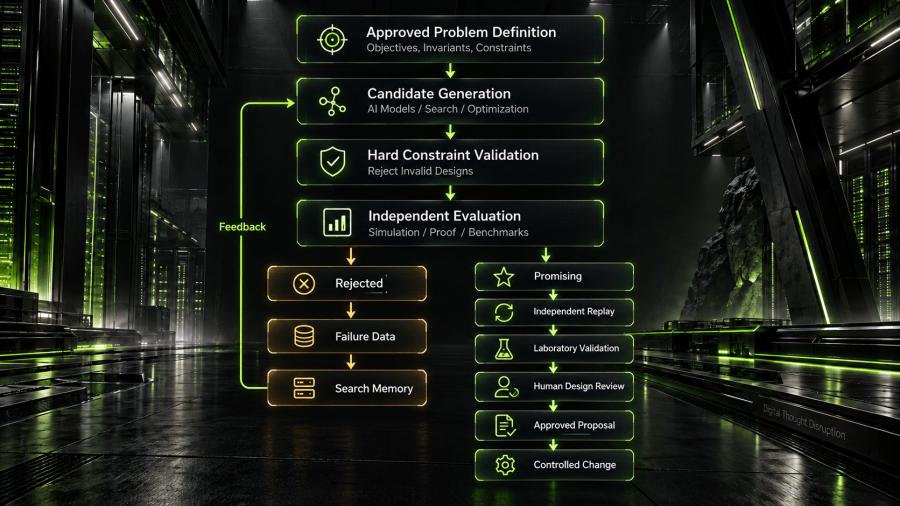
Discovery system flowchart from approved problem definition and candidate generation through hard constraints, independent evaluation, search memory, replay, human review, and controlled change.
Using an LLM is optional. Some optimization problems may be better served by established mathematical solvers.
That is efficient reasoning.
The Search Can Rediscover Known Results
That does not establish universal superiority across all workloads, and it is not evidence of deployment into a production datacenter.
Consider three questions:
It also preserves the boundary between exploring a design and deploying it.
The Evaluator Can Be Manipulated
Depending on the problem, that mechanism could involve reinforcement learning, evolutionary algorithms, constraint-guided search, conventional optimization, LLM-generated programs, or a combination of methods.
For engineering systems, the evaluator may need simulation, emulation, static analysis, hardware measurement, and scenario testing.
The contract is useful because it makes the discovery problem explicit.
We describe models as reasoning, learning, understanding, remembering, planning, and solving problems. We measure their performance using examinations, coding challenges, mathematical competitions, professional assessments, and expert evaluations.
The Result May Be Too Complex to Operate
Its architecture combined a pretrained large language model (LLM), an evolutionary search process, and an automated evaluator.
That work has produced valuable capabilities, including systems that explain, summarize, write code, analyze information, and assist engineers with increasingly complex work.
That is the architectural lesson.
They originate inside the design space that the engineers already understand.
How Enterprises Should Begin Exploring Machine Discovery
Machine-search systems explore candidate spaces, identify relationships, and propose improvements at a scale or through representations that would be impractical for human teams to examine manually.
FunSearch
Published in Nature in 2022. Used reinforcement learning to search for efficient matrix multiplication algorithms, producing mathematically valid improvements for specific matrix sizes and arithmetic settings.
A practical experiment could begin with a graph representation of the existing network and representative, anonymized traffic traces.
- Select a bounded problem. Choose something difficult to optimize manually but possible to evaluate repeatedly. Avoid problems where success is mostly subjective or critical requirements cannot be tested.
- Build the evaluator before selecting the AI model. Define valid outputs, prohibited states, representative workloads, performance metrics, and rejection conditions.
- Establish credible baselines. Include the current design, an established alternative, and a conventional optimization method where appropriate. AI-generated solutions must earn their place against real competitors.
- Explore in an isolated environment. Record candidates, model and evaluator versions, random seeds where applicable, costs, failures, and reproducibility evidence. Do not expose production credentials or change authority.
- Independently validate promising candidates. Use held-out workloads, different environmental assumptions, expert review, and laboratory testing when physical infrastructure is involved.
- Promote only accepted engineering results. Maintain architecture approval, change management, rollback planning, monitoring, and operational ownership.
The evaluation process must compare discoveries against established algorithms, published research, known implementations, and relevant design alternatives.
Human expertise makes enormous solution spaces manageable by filtering them through accumulated knowledge. Usually, this is an advantage. But it can also mean that unconventional approaches are dismissed before anyone examines whether they could work.
A particular topology, scheduling heuristic, algorithmic approach, or placement strategy may be an implementation choice.
A Better Measurement Model for AI Discovery
The language model generated candidate programs. The evaluator executed and scored them. The search process retained promising candidates and used them to guide further generation.
Repeated runs, holdout tests, independent implementations, and expert review reduce the chance of mistaking an evaluation artifact for a discovery.
| Measure | Why it matters |
|---|---|
| Valid candidate rate | Shows how effectively the system searches within hard constraints |
| Improvement over baseline | Establishes whether the result solves the problem better than available alternatives |
| Novelty evidence | Distinguishes discovery from reproduction or rediscovery |
| Independent reproducibility | Shows whether the claimed result survives outside the original evaluation |
| Robustness | Tests whether improvements persist across workload and environmental variation |
| Verification cost | Reveals whether evaluating candidates is economically practical |
| Operational acceptability | Determines whether the discovery is supportable and governable |
It needed a suitable representation of the problem, a search process, and conditions under which a successful result could be verified.
Get Paul Bryant’s practical guides to enterprise AI, hybrid platforms, and day-2 operations by email. New articles as they publish. Unsubscribe anytime.
A conventional architecture review might compare several established spine-leaf configurations, changes to equal-cost multipath (ECMP) routing, additional uplink capacity, or revised workload placement.
For decades, mathematicians and computer scientists have developed increasingly efficient multiplication algorithms.
The Larger Opportunity: Stop Assuming the Best Solution Must Look Familiar
It is also selective reasoning.
Generated code should execute within a restricted, resource-bounded environment.
The following YAML illustrates a conceptual contract for an AI-assisted network discovery experiment.
Both demonstrate that discovery becomes possible when candidate generation is coupled to a sufficiently reliable method for distinguishing useful results from invalid ones.
Matrix multiplication is foundational to scientific computing, artificial intelligence, graphics, and numerous numerical workloads.
This suggests a new division of engineering responsibility.
That creates a new operational risk.
Each proposal is technically defensible. Each reflects years of engineering experience, established design patterns, operational constraints, and lessons learned from previous deployments.
Some candidates would violate fundamental constraints. Others would be mathematically possible but operationally impossible. Many would perform worse than existing designs.
For example, single_link_failure_tolerance requires a precise definition of which services must remain reachable, how quickly traffic must reconverge, and what degradation is acceptable.
Explainability does not always require reproducing the generator’s internal reasoning. It does require documenting the resulting design, its assumptions, invariants, failure behavior, and enough diagnostic information for engineers to operate it safely.
The operating question to carry forward is simple:
Bin packing asks how items should be placed into containers of fixed capacity. In the online version, decisions are made as items arrive, without knowledge of the complete future sequence.
The strongest candidates would progress to a laboratory configuration using the relevant hardware and software.
For some mathematical problems, a candidate can be checked using a proof or exact verification procedure.
It is not a schema for an existing commercial product, and it does not implement the evaluator.
Conclusion
Nevertheless, a properly engineered machine-search system can examine candidate spaces differently from a human design team.
The previously known two-level construction based on Strassen’s algorithm used 49 scalar multiplications. AlphaTensor found a construction requiring 47.
Start with the equipment and capabilities that the organization can actually deploy.
A configuration that improves average throughput could make distributed training traffic more sensitive to incast congestion, increase tail latency for critical applications, or create a more complicated failure-recovery sequence.
Instead of asking a model to reproduce an existing algorithm, researchers formulated a game whose successful outcomes corresponded to mathematically valid multiplication procedures.
Human intelligence is remarkable, but it evolved under constraints that shaped how we approach problems.
Similarly, minimize_total_operating_cost needs a cost model that includes lifecycle and engineering effort, not simply the number of switches.
The AI was part of a search process whose results could be checked independently of the model’s explanation.
The organization can then decide whether the discovery method produces enough value to justify broader use.
Which constraints in your current architecture are genuine technical requirements, and which are familiar design choices that a controlled discovery system could safely challenge?