VCF Fleet Operations: Shared Services and Local Control
TL;DR
A well-designed fleet gives operators a shared picture, consistent controls, and repeatable workflows without pretending that every site, domain, cluster, and workload has the same risk or the same operating conditions. That is how VCF fleet management scales from a collection of infrastructure environments into a private cloud operating model.
Align instances to real operational boundaries. Sites, regions, infrastructure types, legal entities, and recovery models are stronger design inputs than arbitrary size alone.
Failure domains
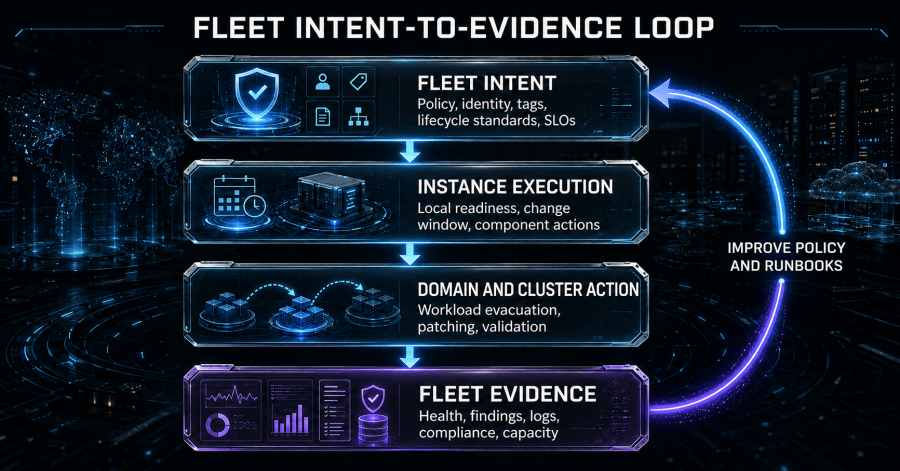
The metaphor becomes dangerous when the blue links are interpreted as a requirement for every workload to communicate through a central point. Fleet coordination is not a reason to centralize application traffic, flatten network boundaries, or merge independent failure domains.
A fleet is not one oversized vCenter, one management domain, or one workload failure boundary. Designs that blur those layers create weak incident triage, oversized maintenance events, and confusing ownership.
Change windows
A management domain or VI workload domain is an important lifecycle, isolation, and blast-radius boundary inside an instance. Domains should be designed around workload classes, change windows, infrastructure requirements, and operational ownership rather than created only because capacity exists.
VCF Operations provides the shared operational picture that the squadron metaphor depends on. Health, diagnostics, metrics, logs, capacity, security findings, and network context can be correlated across the estate rather than reviewed as isolated product consoles.
Local capacity and workload behavior
Centralized visibility does not remove local responsibility. Instance owners still need to understand which services consume each certificate, what restart behavior is required, how renewal is validated, and how to recover when automation fails halfway through a workflow.
A VCF instance is a discrete software-defined data center footprint with its own management domain and optional workload domains. It is the level at which local infrastructure dependencies, instance lifecycle, and many failure scenarios become real.
The Coordinated Autonomy Model
Password expiration and certificate lifecycle problems are predictable, but they remain common causes of failed upgrades, broken integrations, and emergency maintenance. Central visibility helps the platform team identify risk before it becomes an outage.
The blue links in the image should be interpreted as API-driven coordination, not manual console access.
VCF fleet management is better understood as a coordination layer. It gives platform teams a consistent way to govern and observe multiple VCF instances, while each instance retains the local management structures required to operate its own infrastructure and workload domains.
Conclusion
Make lifecycle readiness measurable. Use common prechecks for health, capacity, backup, compatibility, workload mobility, and application validation, then allow instance-specific scheduling.
The fleet view should not replace instance-level engineering. Capacity risk usually becomes actionable at the cluster, domain, and site level, where hardware constraints, failure tolerance, workload demand, and procurement lead times differ.
The fleet owner should define the minimum readiness gates. Instance owners should decide when their environment is ready to pass through those gates.
The fleet may identify a capacity trend, but the response depends on local workload behavior. An AI cluster constrained by GPU placement, a database domain constrained by latency, and a general-purpose virtualization cluster constrained by memory are not interchangeable.
External References
Define the fleet service level. Document availability targets, recovery objectives, backup scope, break-glass access, and degraded-mode expectations for fleet-level components.
Management-Plane Failure: What Still Works When vCenter, Azure, Identity, or the WAN Is Unavailable
Map what continues, what stops, and what can recover when management services fail. Separate workload execution from new operations and recovery across vCenter, Azure, identity, and WAN dependencies.
Read the article →
Each VCF instance must remain a real operational unit with its own management dependencies, workload domains, capacity decisions, change windows, and recovery procedures. At the same time, the enterprise gains leverage when identity, lifecycle standards, certificates, passwords, tags, licensing, observability, diagnostics, and automation are coordinated across the fleet.
Make your next architecture decision with confidence.
The VCF hierarchy needs to remain clear because fleet, instance, domain, cluster, and private cloud are not interchangeable terms.