VCF on Dell: Platform Layers and Operational Boundaries
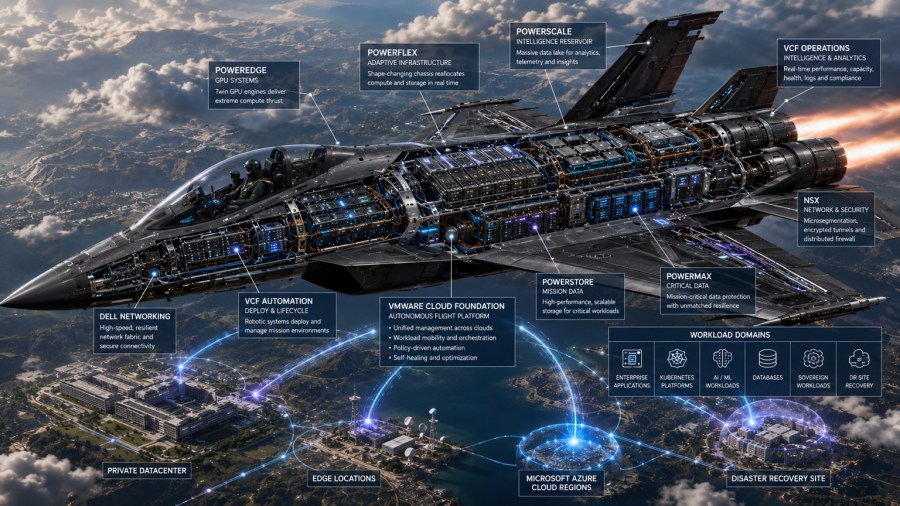
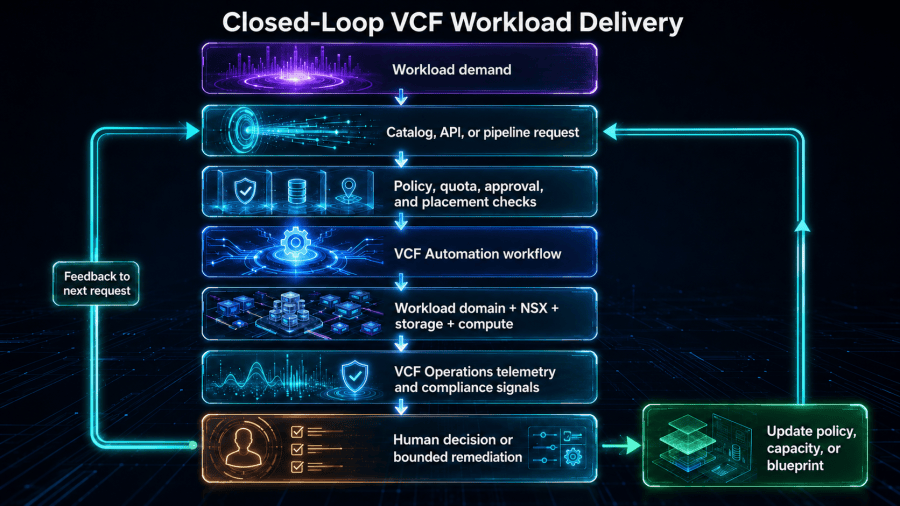
The rear of the aircraft is labeled with VCF Automation and VCF Operations. Together they suggest a closed-loop platform, where demand becomes controlled deployment, telemetry becomes decision support, and approved corrective action feeds back into the system.
The private datacenter usually hosts the primary VCF management and workload infrastructure, core identity dependencies, physical network services, storage systems, backup integrations, and enterprise operational tooling. It is often the most controlled environment, but it can also carry the most accumulated technical debt and organizational dependencies.
Without these controls, the system is not autonomous. It is merely automated in places.
Disaster Recovery Site
Connect operations data to actionable decisions. Capacity alerts should lead to a forecast and expansion process. Compliance findings should identify the violated standard and accountable owner. Performance symptoms should correlate across compute, network, storage, and application layers. Remediation should begin with low-risk, reversible actions before expanding into more autonomous behavior.
The practical takeaway is that an autonomous private cloud is not a single appliance and it is not hands-off infrastructure. It is a governed system of validated components, policy boundaries, telemetry, automation, and human decision points. The architecture succeeds when those layers are designed as one operating model rather than purchased as disconnected products.
The Closed-Loop Operating Model
The aircraft image works because it presents hybrid private cloud as a coordinated system rather than a rack diagram. PowerEdge supplies compute and accelerator capacity. Dell PowerSwitch carries the physical fabric. PowerFlex, PowerStore, PowerMax, and PowerScale address different data missions. NSX controls virtual network and security behavior. VCF Automation turns approved intent into repeatable delivery, while VCF Operations supplies the telemetry and feedback needed to operate the platform deliberately.
TL;DR
This article uses the image as a mental model rather than a literal reference design. The goal is to map each visual element to its architectural role, expose the assumptions behind the model, and show what must be designed for the platform to behave like a coordinated flight system instead of a collection of expensive parts.
AI Bottlenecks Extend Beyond GPUs
For Azure connectivity, define the landing-zone and hybrid network relationship explicitly. For edge sites, define disconnected or degraded operation. For recovery, define how routing, security, and name resolution change during testing or failover.
Mobility Is Not Recovery
Establish the management foundation first, then create workload domains aligned to the mission profiles. Avoid creating domains solely to mirror organizational charts or to consume available hosts. Each domain should have a written purpose, service level, ownership model, storage pattern, network policy, capacity threshold, and lifecycle plan.
Hybrid Cloud Is Not One Security Boundary
The lower half of the image shows a private datacenter, edge locations, Microsoft Azure regions, and a disaster recovery site connected by luminous paths. That is a strong representation of hybrid operations, but the lines should be understood as governed relationships rather than assumed uniformity.
Conclusion
For example, an AI domain may need GPU-equipped PowerEdge hosts, high-throughput east-west networking, access to large PowerScale data sets, separate quotas, and specialized observability. A database domain may prioritize predictable latency, PowerMax or PowerStore data services, tightly controlled change windows, and recovery validation. A sovereign workload domain may require stricter identity, logging, data-location, and administrative controls.
These differences are why workload domains should be designed from service requirements backward. If every workload is placed into the same generic domain because the cluster has spare capacity, the platform eventually inherits incompatible maintenance windows, noisy-neighbor conflicts, unclear ownership, and policy exceptions that undermine standardization.
The architectural mistake is to size only for aggregate CPU and memory. A real design must account for host failure, maintenance evacuation, fault-domain placement, accelerator availability, network interface capacity, storage paths, and lifecycle compatibility. A cluster that looks large on a bill of materials can still be operationally fragile when it lacks maintenance headroom or when a small set of specialized hosts becomes a bottleneck.
External References
The Azure side needs its own landing-zone design, identity integration, routing, DNS, security policy, subscription structure, management groups, logging, resource governance, and application ownership. The private cloud side needs corresponding egress controls, route management, service exposure, certificate trust, telemetry correlation, and data movement policies.
VMware Cloud Foundation on Dell Infrastructure: Where Azure Arc Fits in the Hybrid Cloud Operating Model
Clarify the responsibilities of Dell infrastructure, VCF, NSX, and Azure Arc in a hybrid operating model. Define supported integration paths, ownership, lifecycle boundaries, and readiness criteria.
Read the article →
A workload domain should represent a meaningful combination of:
Make your next architecture decision with confidence.
PowerEdge systems provide the resources that make every workload possible. In an AI-oriented design, that may include dense GPU configurations, high-memory nodes, or specialized host profiles. In a general private cloud design, it may mean balanced compute clusters with predictable expansion units.