The likely failure mode is false abstraction. A clean profile does not guarantee that every underlying product supports every field directly. The platform team must document which controls are enforced automatically, which are monitored, which require approval, and which remain manual.
The infrastructure problem is not simply how to provide more GPUs. It is how to support different AI risk profiles without creating a separate platform, operating model, and support structure for every use case.
Introduction
An AI universe should be understood as a bounded consumption and governance domain, not as a literal VCF construct. Depending on scale and isolation requirements, one universe may map to a combination of VCF Automation organizations and projects, vSphere namespaces, VKS clusters or Kubernetes namespaces, resource pools, storage policies, NSX network boundaries, accelerator pools, model services, and observability scopes.
Enterprise AI rarely arrives as one application with one owner and one infrastructure profile. It arrives as a portfolio.
The platform should know which data sources a domain may access, where data may be stored, how long it may be retained, and whether prompts, embeddings, outputs, and logs contain sensitive information. Data classification must follow the workload through retrieval, inference, observability, backup, and recovery.
NSX policy is one control layer. Administrative roles, management-plane access, shared services, logs, backup systems, registries, secrets, and automation credentials can still cross boundaries.
VCF Automation can expose approved catalog items and policy-controlled provisioning paths. VCF 9.1 also advances an API-first operating model across the platform, which matters because AI environments must be repeatable, testable, and versioned.
The Image Is a Mental Model, Not a Product Topology
Success is not a compelling demonstration. Success is a repeatable service that survives operational review.
The domains in the image share infrastructure building blocks, but they should not receive identical service definitions.
This stage should also record capacity assumptions and support boundaries. Do not promise “limitless innovation” when the physical design has finite GPUs, network bandwidth, storage throughput, power, cooling, and operator attention.
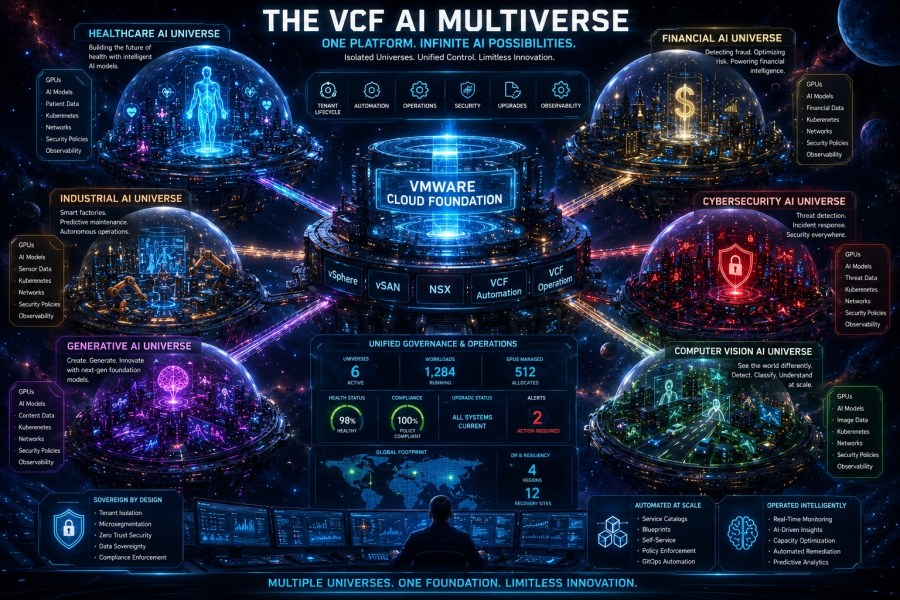
That is what the image gets right. The “VCF AI multiverse” is a metaphor for domain-specific AI environments connected to one governed private-cloud foundation. The six universes and the dashboard figures shown in the artwork are illustrative. They are not VMware Cloud Foundation product objects, published scale limits, or benchmark results.
One Foundation, Many AI Operating Domains
CPU inference, small models, preprocessing, data pipelines, orchestration, and control services may run efficiently without dedicated accelerators. Service classes should match workload evidence rather than assume GPU consumption.
It shows that multiple use cases can share a foundation without sharing the same data and policy profile. It places automation, operations, security, upgrades, and observability at the center rather than treating them as later additions. It recognizes that GPUs, models, Kubernetes, networks, security policies, and data must be managed together. It also frames sovereignty, self-service, and intelligent operations as cross-domain capabilities.
The practical goal is not to build six isolated technology stacks. It is to create repeatable AI operating domains on a common private-cloud control plane, then vary the guardrails according to workload risk, data sensitivity, latency, model lifecycle, and sovereignty requirements.
What VMware Cloud Foundation Contributes
First, the domains do not own independent copies of every infrastructure capability. They consume shared platform services through controlled interfaces. Second, governance exists above the platform and inside each domain. VCF can enforce infrastructure and operational controls, but the enterprise must still define acceptable models, data use, human oversight, retention, and business accountability.
Compute and Accelerator Placement
A complete GPU operating model should also answer:
Multiple AI universes become manageable when they are not treated as separate technology programs. They become governed consumers of one private-cloud platform, with isolation applied where risk requires it and standardization applied everywhere else.
Storage and Data Locality
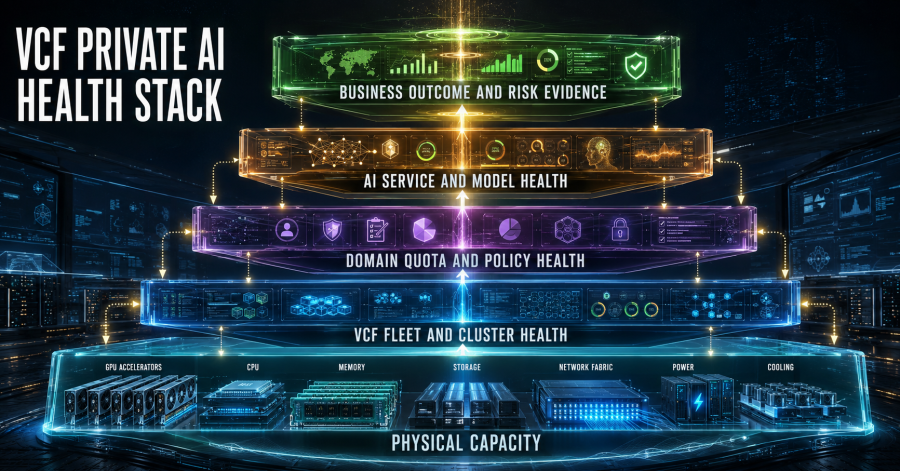
For an inference service, useful signals include request latency, time to first token, throughput, cache behavior, model load time, error rate, queue depth, GPU utilization, memory pressure, and cost per useful transaction. For retrieval-augmented generation, operators also need retrieval quality, source freshness, rejected requests, policy denials, and data-access evidence. For agents, tool calls, approval events, action outcomes, and rollback activity become part of the audit trail.
Model locality and data locality are operational concerns. Moving a model closer to sensitive data may reduce exposure and latency, but it also changes backup, patching, capacity, and recovery requirements.
Network and Security Boundaries
New universes should inherit the shared service model and override only justified differences. If every domain requires a separate automation path, monitoring stack, identity model, or upgrade process, the platform has not created reuse. It has merely hidden duplication behind a portal.
They do not solve portfolio-level accelerator governance by themselves.
Kubernetes and Private AI Consumption
The exact mapping should follow risk and operations, not the visual layout.
vSAN and approved external data services provide persistent capacity for virtual machines, Kubernetes workloads, model artifacts, vector data, container images, logs, and temporary processing. AI domains should use explicit storage policies for availability, encryption, performance, retention, and placement.
Automation and Lifecycle
VMware vSphere Kubernetes Service provides a Kubernetes runtime within the VCF operating model. VMware Private AI Foundation with NVIDIA and VCF Private AI Services add supported patterns for AI workstations, GPU-capable Kubernetes clusters, inference services, model and data workflows, and self-service catalog delivery.
Review capacity, policy exceptions, model versions, unsupported dependencies, idle resources, recovery evidence, and business value across the full AI portfolio. Fleet governance should identify domains that can share more, domains that need stronger isolation, and services that should be retired.
Operations and Observability
The platform should make the safe path the fastest path. That requires pre-approved patterns, not manual governance attached after deployment.
Receive new enterprise AI and hybrid platform articles when they are published.
Each AI Universe Needs a Different Contract
The important design question is not whether a GPU is present. It is who may consume it, how placement is controlled, what level of sharing is acceptable, and what happens when demand exceeds supply.
AI domain
Typical data profile
Workload shape
Primary control emphasis
Operational evidence
Healthcare AI
Clinical, patient, imaging, research
RAG, decision support, image analysis
Privacy, residency, access review, explainability
Data access logs, model version, human review, latency
Financial AI
Transactions, market, customer, risk
Fraud scoring, forecasting, document analysis
Low latency, lineage, segregation of duties, audit
Decision trace, drift, false positives, policy exceptions
Industrial AI
Sensor, video, maintenance, operational technology
Edge inference, predictive maintenance, control support
Availability, safety, local operation, change control
Edge health, inference delay, failure mode, rollback status
Cybersecurity AI
Logs, flows, endpoint and identity telemetry
Streaming detection, correlation, investigation
Privileged access, evidence integrity, rapid containment
Detection quality, response time, action history, analyst approval
Generative AI
Documents, prompts, knowledge bases, code
Interactive inference, RAG, agents
Data leakage, prompt and tool governance, cost control
Token rate, retrieval quality, tool calls, policy denials
Computer vision AI
Images, video, metadata
High-throughput ingest and inference
Privacy, bandwidth, retention, model accuracy
Frame rate, queue depth, accuracy, storage growth
Provisioning is only the first lifecycle event. The same automation model should cover change, expiration, scale, patching, model promotion, decommissioning, and evidence collection.
Identity Boundary
Kubernetes resource quotas can constrain aggregate consumption within a namespace, and supported GPU resources can be scheduled through device plugins. Those controls are valuable for preventing accidental overconsumption and for separating team capacity.
Data Boundary
Sovereignty depends on data residency, administrative access, encryption ownership, supply chain, support processes, telemetry destinations, legal control, and operational evidence. Running on premises may support sovereignty goals, but it does not complete them.
Network Boundary
Every domain needs named owners for platform health, application behavior, model quality, security response, cost, and business outcomes. Alerts should route according to ownership. Exceptions should expire. Recovery procedures should identify which team restores infrastructure, which team validates the model, and which business owner authorizes a return to service.
Model and Artifact Boundary
Default-deny connectivity is a stronger starting point than broad reachability. Each domain should declare approved ingress, egress, east-west dependencies, DNS behavior, proxy paths, model repositories, data gateways, and administrative access.
Accelerator Boundary
The multiverse model succeeds when these signals can be viewed at several scopes:
Operations Boundary
Continue with the path that best matches the architecture or operating challenge in front of you.
Unified Control Should Not Become Centralized Friction
The weakest reason is organizational preference alone. Separate teams do not automatically require separate platforms.
This is where the platform can move from infrastructure tickets to governed consumption. Instead of asking an administrator to hand-build each environment, a user requests an approved service class whose compute, network, storage, model, and policy dependencies are already encoded.
Choose a use case with real value and manageable risk. A document-assistance workload over approved internal content is often easier to govern than an autonomous production decision system. The pilot should exercise identity, data access, provisioning, model deployment, observability, cost allocation, patching, and decommissioning.
The platform team owns supported service classes, shared infrastructure, lifecycle, automation, and foundational observability.
Security and governance teams define control objectives, evidence requirements, exception paths, and high-risk approval gates.
Data owners approve data use, residency, retention, and access.
AI engineering teams own model behavior, evaluation, deployment configuration, and service reliability.
Business owners remain accountable for the decision or process the AI system supports.
VMware Cloud Foundation provides the substrate that makes the multiverse model operational rather than decorative. The platform contribution is not one feature. It is the integration of several control surfaces that would otherwise be assembled and operated independently.
A Practical AI Universe Profile
Network isolation is necessary, but it is not sufficient. Identity, data authorization, model provenance, secrets, service accounts, and administrative roles must align with the same boundary.
VCF Operations provides the shared operational view for infrastructure health, capacity, placement, compliance, and performance. VCF 9.1 Private AI capabilities also expand model and GPU observability, including service-level measures such as cache utilization, request throughput, time to first token, and end-to-end latency.