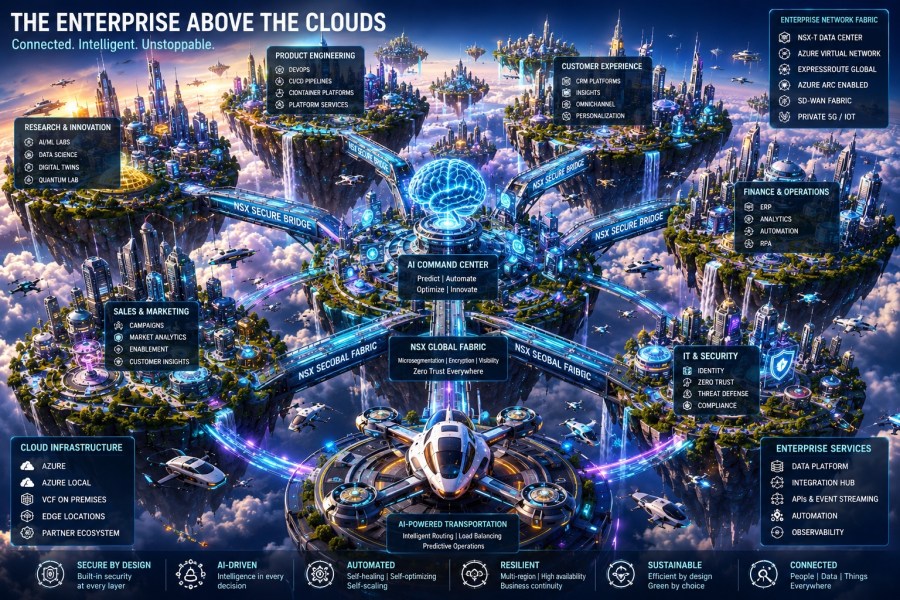
The Enterprise Above the Clouds: Designing an AI-Driven Hybrid Operating Model Across NSX, Azure, and VCF
That makes NSX a strong local nervous system for VCF. It can sense flows, enforce segmentation, connect workload networks, and expose policy through automation interfaces.
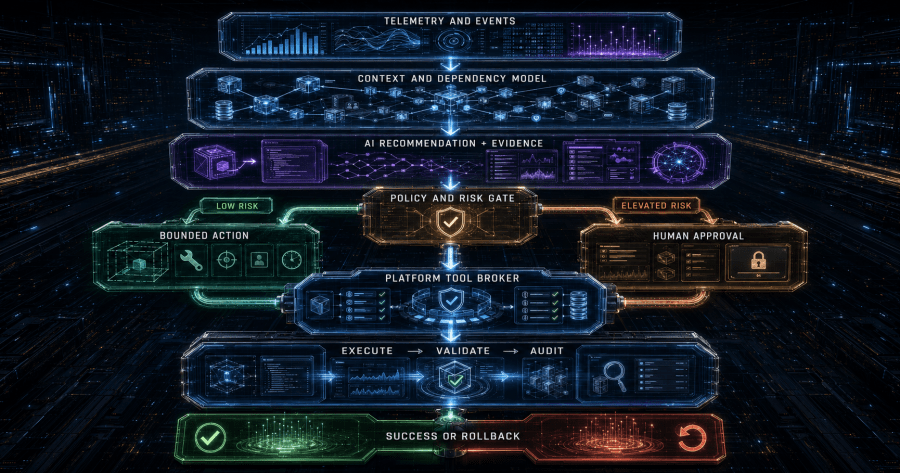
Invoke an approved tool through a broker, validate the result, compare the outcome with the original intent, and record evidence. Failed validation should stop the workflow and trigger rollback or escalation.
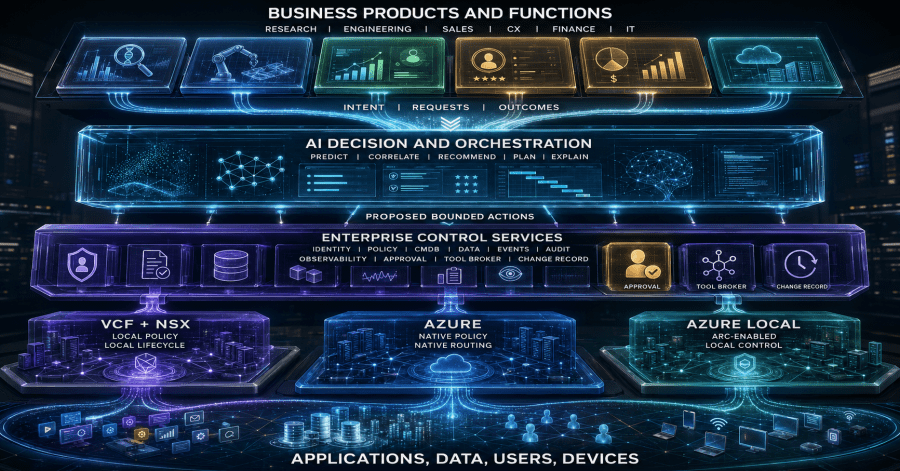
A mature hybrid architecture distinguishes between enterprise standards and local authority.
The image also gets several important ideas right:
The fifth risk is telemetry and data exposure. Central intelligence requires data from many environments. Architects must decide what telemetry leaves each domain, what sensitive fields are removed, where data is retained, and which models may consume it.
First, enterprise fabric means a coordinated operating model. It does not mean one stretched overlay, one routing domain, one firewall policy database, or one management product.
What Azure, Azure Local, and Hybrid Connectivity Should Own
NSX should not be presented as the native control plane for Azure virtual networks, Azure Local, branch SD-WAN, private 5G, SaaS applications, or every edge platform. Those environments have their own routing, security, lifecycle, and support models. Stretching the metaphor too far creates a design where one team is accountable for systems it cannot fully control.
The model in this article depends on four guardrails.
TL;DR
This article treats the image as an architecture mental model rather than a literal topology. The goal is to separate the useful strategic idea from the implementation shortcuts that would create fragility in production.
The AI Command Center Must Be a Governed Decision System
The most useful way to translate the image is to separate business intent, AI-assisted decisions, enterprise control services, platform-native enforcement, and workload execution.
Its authority should still have a boundary.
Observe
The third risk is over-broad transit. Global routing can simplify connectivity while silently increasing lateral movement paths and failure impact. Route design, segmentation, service insertion, and application authorization must be evaluated together.
Contextualize
Enterprises do not struggle because they have too few clouds. They struggle because every platform introduces another identity boundary, policy engine, network model, observability stack, lifecycle process, and operating team.
Recommend
NSX is most valuable when it is authoritative where it has technical depth, not when it is forced to impersonate a universal fabric.
Authorize
Evaluate the proposed action against policy. Low-risk, reversible actions may be automated. High-impact changes should require named approval, explicit scope, and time-bounded authority.