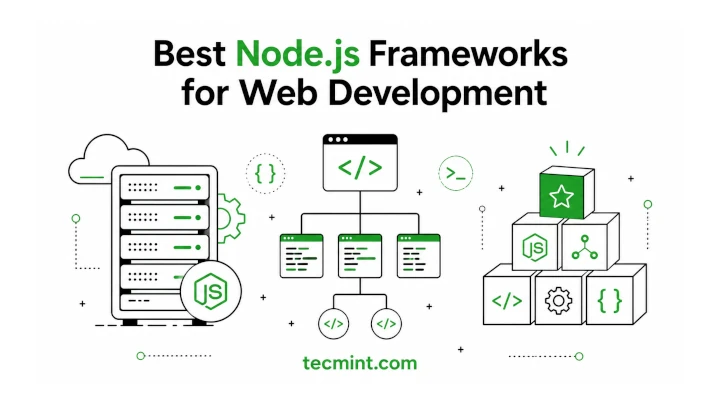
A web application framework provides a set of libraries, tools, and helpers that make it easier to build web applications without writing everything from scratch. When choosing a framework, the most important things to consider are its architecture, ease of customization, extensibility, built-in security features, and how well it integrates with the rest of your technology stack.
We first published this roundup in 2023, but the Node.js framework ecosystem has changed a lot since then. Some frameworks from the original list are no longer actively maintained, while others have become popular choices for modern applications.
So we reviewed each project by checking its development activity, recent releases, and GitHub status, and updated the list accordingly.
This list isn’t ranked in any particular order. Instead, the frameworks are grouped naturally, starting with general-purpose frameworks and then moving on to more specialized ones.
1. Express.js
Express is still the most popular Node.js web framework and is often the first choice for beginners. It’s a lightweight and flexible framework that gives you the essentials for building web applications without forcing you to follow a specific architecture.
It includes features such as routing, middleware support, HTTP utility methods for tasks like redirects and caching, and a simple layer on top of Node.js’s built-in HTTP module. Express also supports many template engines for building dynamic web pages and provides an application generator that helps you quickly create a new project.
Another reason for its popularity is its large ecosystem. Many other frameworks, including NestJS and FeathersJS, are built on top of Express, making it one of the most widely supported frameworks in the Node.js community.
The main drawback is performance. Although Express 5 introduced built-in support for asynchronous error handling, it is still slower than some newer frameworks designed for high-performance applications. It also doesn’t provide native TypeScript support out of the box.
If you’re new to Node.js, want a simple framework with excellent documentation, or need access to a large collection of middleware and plugins, Express remains an excellent choice.
2. Fastify
Fastify is a modern Node.js web framework designed for building fast and efficient web applications. It’s known for its high performance and is often chosen by developers who need faster request handling than Express can provide.
One of Fastify’s biggest strengths is its built-in support for request validation and response serialization using JSON Schema. This helps validate incoming data, improve performance, and reduce the amount of code you need to write.
Fastify also includes a powerful plugin system that makes it easy to organize applications and add new features. It has excellent TypeScript support and works well with popular type providers such as TypeBox and Zod. If you’re migrating from Express, the @fastify/express compatibility plugin lets you continue using many existing Express middleware packages.
The main limitation is that Fastify is designed specifically for Node.js. If you need to run the same application on platforms like Cloudflare Workers or Deno, Hono is a better choice.
If you’re building a high-performance REST API or microservice and want built-in validation, strong TypeScript support, and excellent scalability, Fastify is one of the best Node.js frameworks available today.
3. Socket.io
Socket.io is a popular Node.js library for building real-time applications that require instant, two-way communication between the server and connected clients. It’s widely used for features such as live chat, notifications, online gaming, collaborative editing, and real-time dashboards.
It provides reliable event-based communication and includes useful features like automatic reconnection, disconnection detection, support for binary data, multiplexing, and rooms for grouping connected clients. It also works consistently across different browsers, platforms, and devices.
Socket.io integrates easily with web frameworks like Express and Fastify, making it simple to add real-time functionality to an existing application without major changes.
If your application needs live updates or instant communication between users and the server, Socket.io remains one of the most trusted and widely used solutions in the Node.js ecosystem.
4. Meteor.js
Meteor.js is a full-stack JavaScript framework that lets you build web, mobile, and desktop applications using a single codebase. It includes many tools you need to develop an application, such as a build system, package management, and a reactive data layer that automatically keeps the client and server synchronized.
One of Meteor’s biggest advantages is that it simplifies full-stack development. Changes made on the server are automatically reflected on connected clients, making it a good choice for applications that require real-time data updates.
Meteor has continued to evolve over the years. With the release of Meteor 3.0, it replaced the older Fibers-based concurrency model with native async/await, improving compatibility with modern versions of Node.js. It also introduced MongoDB change streams as the default mechanism for handling reactive data updates.
If you’re looking for a framework that provides an all-in-one development experience and makes it easy to build real-time applications, Meteor is still a solid choice.
5. Koa.js
Koa.js is a lightweight Node.js web framework created by the same team behind Express. It is designed to be smaller, more modern, and more expressive by using JavaScript’s async and await syntax instead of traditional callback functions. This makes asynchronous code easier to read and simplifies error handling.
Unlike frameworks that include many built-in features, Koa provides only the core functionality you need to build web applications. You can add additional features through middleware, giving you greater flexibility and control over your application’s architecture.
Koa is also known for its good performance and efficient request handling. Even though it has remained minimal over the years, it continues to perform well in many benchmarks and is a popular choice for developers who prefer a clean and lightweight framework.
If you like the simplicity of Express but want a more modern approach to handling asynchronous operations, Koa is an excellent option.
6. Sails.js
Sails.js is an MVC (Model-View-Controller) framework built on top of Express. It is designed for developing data-driven web applications and REST APIs, with an architecture similar to Ruby on Rails but tailored for the Node.js ecosystem.
One of its key features is the ability to automatically generate RESTful APIs from your data models, helping you build applications more quickly. Sails.js also includes built-in WebSocket support, making it easy to add real-time features such as live chat, notifications, and dashboards with minimal configuration.
The framework works well with modern frontend libraries and frameworks, including React, Angular, Vue, as well as native mobile applications, making it suitable for a wide range of projects.
Sails.js continues to be actively maintained and remains a good choice for developers who need a structured framework with built-in support for APIs and real-time communication.
7. MEAN
MEAN is a full-stack JavaScript technology stack made up of MongoDB, Express.js, Angular, and Node.js. Unlike the other entries in this list, MEAN is not a single framework but a combination of technologies that work together to build complete web applications.
In a MEAN application, MongoDB is used as the database, Express.js handles the backend and APIs, Angular powers the frontend user interface, and Node.js provides the runtime environment for the server.
One of the biggest advantages of the MEAN stack is that JavaScript is used throughout the entire application, from the database layer to the browser. This allows developers to work with a single programming language across both the frontend and backend.
If your team already has experience with Angular and wants a complete JavaScript-based solution for building modern web applications, the MEAN stack is still a practical and reliable choice.
8. Nest.js
Nest.js is a modern Node.js framework designed for building scalable and maintainable server-side applications. It is built with TypeScript by default and follows a structured architecture that makes it easier to organize large projects.
By default, Nest.js uses Express as its underlying HTTP framework, but you can also switch to Fastify for better performance when needed. It provides built-in features such as dependency injection, modules, controllers, and services, helping developers write clean and reusable code.
Nest.js also offers official support for technologies like GraphQL, WebSockets, microservices, authentication, and database integration through a wide range of first-party modules.
If you’re building a large application or working in a team that values a well-organized codebase, Nest.js is one of the best frameworks available. It is especially easy to learn for developers with experience in Angular, TypeScript, or other strongly typed programming languages.
9. LoopBack
LoopBack is a Node.js framework designed for building REST APIs quickly. It helps developers create API servers with minimal code and includes tools for defining data models, generating endpoints, and connecting to a variety of data sources.
One of LoopBack’s biggest strengths is its support for multiple databases and services. It can connect to relational databases, MongoDB, and external REST or SOAP services, making it a good choice for enterprise applications that need to integrate with existing systems.
LoopBack also provides built-in support for features such as authentication, authorization, model relationships, and reusable components for adding capabilities like third-party login and cloud storage.
The current version, LoopBack 4, is written in TypeScript and is actively maintained under the OpenJS Foundation. Earlier versions, LoopBack 2 and LoopBack 3, have reached end of life, so new projects should always use LoopBack 4.
10. KeystoneJS
KeystoneJS is an open-source, headless content management framework built with Node.js, GraphQL, and React. It is designed for developers who need a flexible backend for managing content while allowing complete freedom to build the frontend with any framework.
One of KeystoneJS’s main strengths is its ability to automatically generate a GraphQL API and a powerful admin interface from a simple schema. This lets you manage content without having to build custom CRUD (Create, Read, Update, Delete) pages from scratch.
KeystoneJS also includes features such as session management, dynamic routing, access control, and a customizable admin dashboard. It is particularly well suited for content-driven websites, blogs, e-commerce platforms, and other applications that require a flexible content management system.
11. Feathers.js
Feathers.js is a lightweight Node.js framework for building REST APIs and real-time applications. It is built on top of Express and makes it easy to create scalable backend services with minimal setup.
One of its standout features is support for both REST and real-time communication through the same service interface. This makes it ideal for applications such as chat platforms, notifications, collaborative tools, and live dashboards.
Feathers.js works well with any frontend framework, including React, Angular, Vue, and React Native. It also provides a flexible authentication and authorization system that can be extended with different strategies to meet your application’s requirements.
If you want to build APIs with real-time capabilities while keeping your codebase simple and lightweight, Feathers.js is an excellent choice.
12. Hapi.js
Hapi.js is a powerful Node.js framework for building web applications and APIs. It follows a configuration-based approach, allowing developers to define routes, validation rules, authentication, and other features through configuration instead of writing a lot of custom code.
The framework includes built-in support for request validation, caching, authentication, and security, making it a good choice for applications that require a reliable and well-structured backend.
One of Hapi.js’s distinguishing features is that its core has no external runtime dependencies, which helps reduce supply-chain risks and makes it easier to maintain. The project continues to be actively maintained by the community with regular releases.
13. Strapi
Strapi is an open-source, headless content management system (CMS) built with Node.js. It enables developers to create and manage content through an easy-to-use admin panel while exposing that content through REST or GraphQL APIs.
The admin interface is fully customizable, and Strapi includes a plugin system that makes it easy to extend its functionality. It works with any frontend framework, including React, Angular, Vue, Next.js, and mobile applications.
Strapi also includes built-in security features and a collection of useful plugins, allowing you to start building content-driven applications without extensive setup.
14. AdonisJS
AdonisJS is a full-featured MVC framework for Node.js that helps developers build web applications using a clean and organized architecture. It is written in TypeScript and includes many built-in features, reducing the need for third-party packages.
The framework provides an ORM for working with databases, a validation system, authentication, routing, session management, and other tools commonly required in modern web applications. Its strong TypeScript integration helps improve code quality and maintainability.
AdonisJS is also known for its excellent documentation, making it easier for beginners and experienced developers alike to learn the framework and build production-ready applications.
15. Total.js
Total.js is a comprehensive Node.js framework for building web applications, REST APIs, and real-time services. It includes many built-in features, allowing developers to create complete applications with fewer external dependencies.
The framework supports popular databases such as MongoDB, MySQL, PostgreSQL, and several others. It also includes an embedded NoSQL database, email (SMTP) support, image processing tools, and many other utilities that are useful in web development.
Total.js is known for its good performance and active development. If you’re looking for a feature-rich framework that includes most of the tools needed to build and maintain modern web applications, Total.js is a solid option.
16. FoalTS
FoalTS is a TypeScript-first framework for building scalable Node.js applications. It provides a structured development environment with many built-in features, so you can spend less time configuring tools and more time writing application code.
The framework includes a command-line interface (CLI), testing tools, authentication, ORM integration, and deployment support, making it a complete solution for developing modern web applications.
FoalTS is actively maintained and supports recent versions of Node.js. If you’re looking for a lightweight alternative to Nest.js that still offers a structured architecture and strong TypeScript support, FoalTS is worth considering.
17. Hono
Hono is a lightweight, high-performance web framework that has quickly become popular among Node.js developers. It is built on standard Web APIs, allowing the same application code to run on multiple JavaScript runtimes, including Node.js, Bun, Deno, Cloudflare Workers, Vercel Edge, and AWS Lambda.
With zero dependencies and a very small footprint, Hono is designed for speed and efficiency. It provides an Express-like routing system, making it easy to learn, along with built-in middleware for features such as CORS, JWT authentication, and request validation. It also offers excellent TypeScript support for building type-safe applications.
One limitation is that Hono cannot directly use Express middleware, so some integrations may require additional work. However, if you’re starting a new project that may eventually run on edge platforms or multiple JavaScript runtimes, Hono is an excellent choice.
Conclusion
These are some of the best Node.js frameworks available today, each designed to solve different development needs. Some frameworks, like Express and Fastify, are ideal for building web APIs, while others, such as Nest.js and AdonisJS, provide a more structured approach for large applications.
If you’re building content-driven websites, frameworks like Strapi and KeystoneJS are excellent options, while Socket.io and Feathers.js are well suited for real-time applications.
The best framework ultimately depends on your project’s requirements, your team’s experience, and the features you need. Try a few of them to see which one best fits your development style and application goals.
If we missed your favorite Node.js framework, let us know in the comments below.