One of the most useful lessons from the current 2026 VMware release cycle is that a newer major version number does not automatically establish a supported upgrade path.
Reserve August for proof, not unfinished architecture
Some changes may support a documented reversal. Other changes require restoring components, rebuilding the management layer, recovering a service into another environment, or proceeding through an approved forward-repair path.
Broadcom KB 448135 also documents back-in-time restrictions affecting certain NSX, vCenter, and ESXi source builds when attempting older 9.1.0.x targets.
- Supported target configurations and accurate component inventories.
- Application functionality and business-owner acceptance.
- Working backup, restoration, and disaster recovery processes.
- Network, security, identity, monitoring, and automation integration.
- Documented lifecycle processes and Day-2 operational ownership.
- Approved handling of any remaining exceptions.
That changes the organization’s ability to manage vulnerabilities, resolve defects, maintain vendor-supported configurations, and demonstrate acceptable lifecycle risk.
Patch-Level Compatibility Can Change the Entire Plan
Broadcom documents brownfield pathways for bringing eligible existing vSphere infrastructure under VCF management.
It assumes an enterprise currently operating vSphere 8.x, possibly with vSAN, NSX, HCX, Aria, backup, replication, and disaster recovery integrations. The current VMware 9.1.1 release family provides a reference point for evaluating target capabilities, but selecting an exact implementation release requires environment-specific validation.
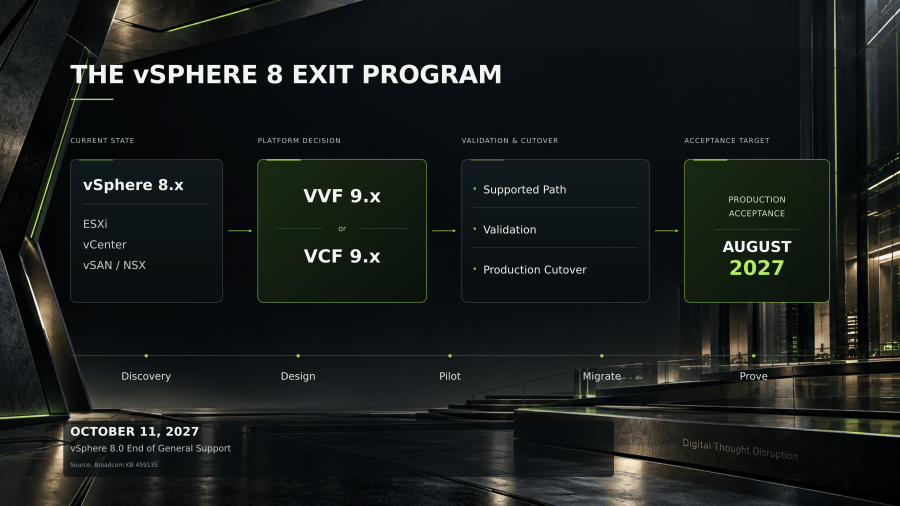
With less than a year remaining before the October 11, 2027 deadline, procurement lead times, application dependencies, maintenance restrictions, recovery testing, and the need to operate two environments simultaneously can quickly consume the available schedule.
| Example transition | Documented result |
|---|---|
| vCenter Server 8.0 U3k to VVF 9.1.0 | Direct upgrade not supported |
| vCenter Server 8.0 U3k to VVF 9.1.1 | Direct upgrade supported |
| VCF source builds affected by back-in-time restrictions | Must use an explicitly supported target BOM and workflow |
A failed host remediation, vCenter upgrade, VCF lifecycle operation, or application cutover can require very different recovery responses.
The pilot should establish the expected outage or cutover duration, required operator activities, failure handling, and evidence needed to approve larger production waves.
“Can we just upgrade to version 9 before October 2027?”
Waiting until March 2027 to begin meaningful platform selection would compress the remaining engineering and commercial schedule unnecessarily.
The lifecycle management model also changes
For others, VCF may justify its additional commitments through capabilities the customer would otherwise need to license, integrate, maintain, or develop separately.
The real question is not whether the team can install ESX 9.x before the deadline. It is whether the organization can establish a supportable target platform, migrate or upgrade the necessary components, validate its critical services, and transfer the resulting environment into normal operations.
I would establish August 2027 as the initial target for completing production transition and acceptance, leaving September for stabilization, remediation, and explicitly approved exceptions. The execution plan should cover the entire environment, including management services, network and storage dependencies, recovery, hardware, subscriptions, automation, and partner integrations.
This classification matters because a cluster that is otherwise suitable for an in-place upgrade may become a greenfield migration candidate when its physical infrastructure cannot support the approved target.
Licensing belongs in the technical critical path
VVF is a reasonable starting point when the organization primarily needs to modernize its VMware infrastructure while preserving a familiar vCenter- and cluster-oriented operating model.
Takeaway: October 11, 2027, should be treated as the support boundary, not the planned date for finishing the migration.
This article establishes the program-level approach I would use to guide that transition.
In Part 2, we will turn that architectural choice into a practical customer workshop, using the existing vSphere 8 estate, required future capabilities, financial constraints, and transition risks to determine which VMware 9.x operating model the organization should adopt.
Use Evidence-Based Gates to Control the Program
Three-to-Five-Year Platform Cost =
Software Subscriptions and Add-ons
+ Hardware and Infrastructure Refresh
+ Storage and Network Changes
+ Migration and Implementation Labor
+ Training and Operating Model Changes
+ Backup, Recovery, and Security Services
+ Ongoing Administration and Support
+ Capacity Growth and Risk Allowance
– Avoided or Retired Costs
For existing VCF environments, that transition must respect the supported SDDC Manager workflow and source version requirements.
| Gate | Required proof | Decision owner |
|---|---|---|
| Discovery complete | Inventory, dependencies, lifecycle exposure, and known blockers | Platform architect |
| Target architecture approved | VVF/VCF decision, economics, topology, constraints, and procurement readiness | Architecture and business sponsor |
| Pilot accepted | Supported build path, representative workload tests, recovery evidence | Technical leads and application owners |
| Production wave authorized | Passing prechecks, capacity, execution sequence, stop conditions, recovery readiness | Change authority |
| Program accepted | Application, security, backup, DR, lifecycle, documentation, and operations acceptance | Service and platform owners |
There are several paths, and the correct one depends on what the organization intends to operate afterward.
That establishes an engineering conversation rather than a licensing debate.
Preserve the distinction between rollback and recovery
The team’s future method for updating firmware, drivers, host images, and platform components needs to be validated before production acceptance.
By August 2027, the major engineering work should ideally be complete.
The guidance distinguishes the following source and target combinations:
The critical difference from a conventional upgrade plan is that these workstreams are interdependent.
This asymmetry creates a real architectural commitment. Selecting VCF can change the cost and difficulty of a later decision to return to a simpler deployment model.
Make Production Acceptance More Demanding Than a Successful Upgrade
Any claimed operational savings should be supported by actual cost assumptions, measurable workload demand, and a credible adoption plan.
Hardware compatibility should shape the migration method. The migration method should not be used to excuse unsupported hardware.
| Acceptance area | Evidence of completion |
|---|---|
| Platform support | Deployed releases and combinations are supported, or approved exceptions have confirmed support arrangements |
| Hardware support | Certified hardware and validated firmware, driver, and storage combinations |
| Application functionality | Business-approved functional and dependency test results |
| Data protection | Successful backup and representative restore testing |
| Disaster recovery | Documented recovery test results against required RPO and RTO |
| Security | Identity, certificates, access, network controls, and required security integrations validated |
| Operational monitoring | Logs, alerts, dashboards, and incident escalation procedures operating |
| Lifecycle management | Supported upgrade and patch procedures with assigned owners |
| Commercial readiness | Valid entitlements, subscriptions, and forecast operating costs |
| Handoff | As-built architecture, runbooks, exceptions, and service-owner acceptance |
The danger is treating those fundamentally different situations as one upgrade project.
I would keep the program documented through five connected artifacts rather than one oversized spreadsheet or implementation document.
The Financial Decision Needs a Three-to-Five-Year View
The commercial team should confirm actual entitlements, purchase terms, available quantities, included capacities, add-ons, and partner arrangements. Generalized claims about universal minimum purchases or renewal penalties should not enter the business case without supporting commercial evidence.
I would work backward from October 11, 2027, and establish a proposed production acceptance target of August 31, 2027.
An application tier, database, identity dependency, middleware service, and associated network policy may need coordinated planning even when they sit on different clusters.
Unfunded exceptions. Retained legacy systems, unsupported partner components, and applications that cannot meet the schedule require explicit ownership, risk decisions, and applicable support arrangements.
Broadcom KB 443586 explicitly warns that hardware supported under ESXi 8 is not automatically supported under ESXi 9.
This separation prevents a common failure: choosing an in-place upgrade because it appears easier, then discovering that the environment’s future requirements call for a fundamentally different platform.
I would aim to complete the production transition and operational acceptance by August 2027, using the remaining time before the deadline to resolve exceptions rather than making the deadline itself the final change window. The critical measure is how much of the environment can be demonstrated to be supported, secure, recoverable, and operationally owned.
I would require the compatibility record to include:
Those requirements might include NSX-backed virtual networking, integrated infrastructure lifecycle management, shared fleet services, workload domains, broader cloud operations, automation, or governed self-service consumption.
How I Would Frame the Customer Conversation
The most important decision is whether the organization should modernize its current virtualization environment using VMware vSphere Foundation (VVF) 9.x or establish a broader private cloud operating model with VMware Cloud Foundation 9.x. That decision needs to happen before the team commits to a particular upgrade or migration procedure.
The first decision is whether you want to modernize the virtualization environment you already operate, or use this lifecycle event to move toward a broader private cloud architecture.
Insufficient spare capacity. Host remediation and workload evacuation require operational headroom. A cluster may be healthy during normal operation yet lack the capacity needed for safe maintenance.
The program should identify these intersections before they become change-window surprises.
Each gate should have an accountable decision owner, a defined evidence standard, a list of unresolved issues, and a clear result: approve, approve with documented conditions where permitted, or hold.
An important part of choosing VVF or VCF is determining what each platform actually costs to operate over its expected lifecycle.
Broadcom KB 456708 documents the corresponding End of Service dates for several related product release families.
This is another reason an upgrade runbook cannot consist of a list of software installers.
Likewise, any potentially available extended support or technical guidance arrangement must be evaluated separately. It is not appropriate to treat an assumed extension as a substitute for an approved migration plan.
The five deliverables I would produce
Upgrading the hosts alone does not establish that this environment has transitioned successfully.
| Deliverable | Purpose |
|---|---|
| VVF versus VCF decision assessment | Requirements, hard constraints, platform selection, operating-model tradeoffs, and cost |
| Current-state compatibility workbook | Exact builds, hardware, storage, network, licensing, integrations, blockers |
| Target architecture HLD/LLD | Management architecture, compute, network, storage, security, recovery, and operations |
| Upgrade and migration execution plan | Component sequences, waves, maintenance windows, stop conditions, validation, and recovery |
| Production readiness and handoff plan | Acceptance evidence, tested recovery, lifecycle ownership, as-built state, and exceptions |
Version drift. New patches, security advisories, and component releases can alter previously valid upgrade paths. Compatibility needs to be rechecked immediately before execution.
VCF deserves consideration when the organization’s requirements extend beyond the traditional virtualization administration model.
What Can Still Derail the Schedule?
The first decision should establish whether the customer needs a modern virtualization platform or a more integrated private cloud architecture.
For a particularly large estate, August completion may not be realistic. The schedule must therefore be tested against actual workload scope, project resources, procurement lead times, and available change windows.
These are different workflows with different prerequisites and ownership consequences.
Broadcom KB 441960 states that VCF 9 cannot be converted in place into VVF 9. A fresh redeployment is required.
This is not a feature-parity table. Exact component capabilities, included entitlements, deployment requirements, and add-ons must be checked against the selected release and commercial agreement.
It also gives the customer something concrete to approve.
Hardware procurement. Supported software is of little use if the necessary infrastructure cannot be acquired, installed, and commissioned on schedule.
This does not mean creating one enormous implementation runbook. Each component needs its own supported procedure. The program exists to coordinate the dependencies, decisions, funding, sequencing, and acceptance criteria across those procedures.
The next action is to establish the VVF-versus-VCF decision and fund a source-to-target compatibility assessment before approving the detailed migration schedule.
The recovery plan should identify which states can safely be restored, what dependencies must be recovered together, and what conditions make a return to the source unsafe.
Conclusion
Continue reading
The important discipline is to expose these risks early enough to change the architecture, funding, scope, or execution schedule while there is still room to act.
A new VVF environment can be appropriate when the organization is replacing hardware, consolidating multiple environments, changing storage, or correcting significant architectural problems.
The migration program therefore needs to track platform supportability as a system-level outcome.
A new VCF environment may be preferable when the customer wants a substantially redesigned private cloud.
Broadcom KB 454369 documents a specific example involving vSphere 8.0 Update 3k.