At 09:00 Coordinated Universal Time (UTC), the recovery lead approved enabling customer-facing production traffic against environment revision ENV-17 and network policy revision NET-17.
Where the target platform supports appropriate conditional operations, the executor should bind the approved action to an expected resource version or equivalent state precondition. A mismatch should prevent the operation from committing.
A simplified representation of the decision logic is:
09:00 UTC Release approved
Policy NET-17
|
09:08 UTC NET-17 changes to NET-18
|
09:10 UTC Executor requests release
|
v
Hold release. Reassess NET-18.
schema_version: “1.0”
record_type: recovery_release_decision
incident_id: INC-001
decision_id: RD-001
decision_revision: 1
service: customer-portal
recovery_intent:
recovery_point:
backup_id: BK-0100
captured_at: “Day 0, 01:00 UTC”
action: enable-production-ingress
target: customer-portal-prod
scope: customer-facing-web-traffic
automated_downstream_writes: remain-disabled
governing_policy:
policy_id: CYBER-RECOVERY
policy_version: “3.2”
requirements_ref: REQ-001-v1
investigation:
assessment_ref: IA-001-v2
required_checks:
– check_id: HOST-01
owner: soc-lead
source_ref: E-101
execution_ref: Q-101
coverage: complete
finding: no-match
disposition: accepted
– check_id: MP-01
owner: platform-security-lead
source_ref: E-102
execution_ref: Q-102
coverage: complete
finding: no-match
disposition: accepted
open_required_checks: []
recovery_validation:
exposure_assessment_ref: EA-001
restoration_integrity_ref: RV-001
remediation_assessment_ref: RM-001
dependency_validation_ref: DV-001
application_acceptance_ref: AV-001
reviewed_state:
environment_revision: ENV-17
network_policy_revision: NET-17
evidence_manifest_ref: EM-001-v2
approval:
authority_record_ref: AUTH-001
decision_owner: recovery-lead
security_assessment_ref: SA-001
decision: approved
approved_at: “Day 0, 09:00 UTC”
expires_at: “Day 0, 09:30 UTC”
exceptions: []
execution_conditions:
require_current_authorization: true
require_validated_environment_state: true
require_current_evidence_assessment: true
require_pre_cutover_review: true
on_material_change: return-for-review
on_verification_unavailable: hold
Record execution and independent outcome verification separately. If the executor loses the response, preserve the action identifier and check authoritative target records before retrying or proceeding with dependent work.
Make the Recovery Evidence Contract Machine-Readable
Checking the target state immediately before execution improves the design, but it does not eliminate every concurrency problem.
The exception record should make the decision explicit.
Existing human emergency access may still be necessary, but it should remain a separately governed and audited capability.
A recovery approval should establish more than whether someone accepted an investigation report.
The following YAML example illustrates how a recovery decision could reference its governing policy, investigation assessment, recovery validation, authorized action, and reviewed environment state.
A recovery approval system becomes difficult to trust when it compresses several distinct properties into one status field.
For an isolated validation exercise, the proposed hard acceptance criterion would be zero unauthorized protected-action commits across the defined test cases.
What Makes This Contract Useful
The evidence contract should preserve that flexibility without misrepresenting the unresolved requirement.
Do not begin by selecting another dashboard. Begin by identifying where production connectivity, access permissions, or another protected recovery action actually changes.
During a prolonged recovery, the time between them may contain new investigation findings, infrastructure changes, identity changes, policy revisions, and evolving incident conditions.
A longer validity period must not override a material change in the reviewed environment.
Similarly, an application owner may accept functional test results without having the authority to waive an unresolved security investigation requirement.
Put the Release Gate Outside the AI
For the management-plane investigation introduced in Part 1, the initial record would look like this:
The architecture proposed here extends that foundation into a practical implementation model for AI-assisted recovery. It introduces a structured evidence contract, an independently evaluated approval record, and an enforcement point immediately before production execution.
The next time your organization reviews its cyber recovery architecture, ask the team to demonstrate something specific:
Together, these recommendations provide a foundation for connecting investigation activities to recovery decisions.
The contract is a representation of the decision. Its authority comes from the independently verified records behind it.
The World Wide Web Consortium (W3C) provenance data model provides a useful conceptual foundation here. PROV-DM describes the relationships between entities, activities, responsible agents, and the derivation of information [2].
Before accepting an AI-assisted recovery approval architecture, I would ask the engineering team to demonstrate the following:
The production release mechanism should then independently verify that those conditions remain applicable when execution occurs.
These responsibilities can be combined in smaller organizations, provided the necessary authority and independent verification boundaries remain intact.
Evaluate the Approval Again at Execution
[1] A. Nelson, S. Rekhi, M. Souppaya, and K. Scarfone, NIST SP 800-61 Rev. 3: Incident Response Recommendations and Considerations for Cybersecurity Risk Management, Cybersecurity Framework 2.0 Community Profile, pp. 29, 34, Apr. 2025.
The recovery gate should establish current decision validity from a trusted source before accepting restored approvals.
[2] L. Moreau and P. Missier, Eds., W3C PROV-DM: The PROV Data Model, W3C Recommendation, Apr. 2013.
| Release condition | Required behavior |
|---|---|
| Governing policy is current or still applicable | Evaluate the complete authoritative requirement set. |
| Required investigation coverage is accepted | Verify supporting records and required dispositions. |
| Restoration and remediation requirements are satisfied | Validate referenced evidence and accountable acceptance. |
| Approval remains authorized | Check authenticity, scope, expiration, and revocation status. |
| Target state remains applicable | Compare relevant current environment conditions with those reviewed. |
| Requested action matches approved intent | Reject unapproved targets, parameters, or expanded scope. |
| Decision-critical verification is unavailable | Hold normal production release and escalate. |
The schema is conceptual and vendor-neutral. It is not executable configuration for an existing recovery product. All identifiers and approval records are synthetic.
These states should be retained through versioned transitions.
The correct next action is to determine the impact of the change, repeat affected validation where necessary, and obtain an updated approval that references the revised environment.
The next step is to make that distinction enforceable throughout the recovery workflow.
A Worked Example: When an Approved Recovery Becomes Invalid
This reduces unnecessary exposure while preserving the evidence needed for accountable review.
The architecture must establish whether that historical approval still authorizes execution at 09:10.
Required check: MP-01
Owner: Platform security lead
Source availability: Available
Investigation coverage: Complete
Finding: No relevant activity identified
Disposition: Accepted within examined scope
Evidence:
Source set E-102
Execution record Q-102
Security assessment SA-102
The next article will develop the controlled tabletop exercise, test conditions, evidence capture requirements, and measurement methodology.
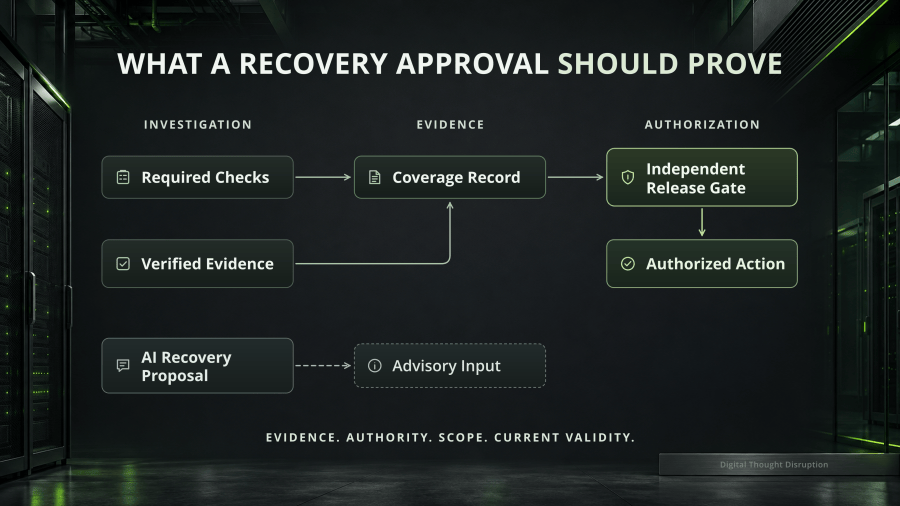
It should establish which requirements governed the decision, what investigators examined, which findings and limitations were accepted, what recovery validation demonstrated, and precisely which action an authorized decision-maker permitted.
My white paper AI Agents and the Integrity of Enterprise Recovery describes this boundary. Historical information can inform an AI proposal. Independently verify current authority before a protected action occurs. [3]
| Decision property | Approved state | Current state |
|---|---|---|
| Recovery decision | RD-001 | RD-001 |
| Approved recovery point | BK-0100 | BK-0100 |
| Investigation assessment | IA-001-v2 | IA-001-v2 |
| Environment revision | ENV-17 | ENV-17 |
| Network policy revision | NET-17 | NET-18 |
| Approval validity period | 09:00 to 09:30 UTC | 09:10 UTC |
| Requested action | Enable production ingress | Enable production ingress |
| Release decision | Previously approved | Reassessment required |
If a material finding emerges after execution, the original approval remains part of the incident history. The workflow should associate the new evidence with the affected decision and route it to the incident authority for containment, rollback, continued operation, or other authorized action.
Another process could modify a relevant configuration after the release gate evaluates it but before the recovery executor commits the action.
Return to the customer portal.
Existing security information and event management (SIEM), security orchestration, automation and response (SOAR), IT service management (ITSM), backup, and infrastructure automation platforms may already provide parts of this capability.
An AI-generated investigation summary is a derived artifact. It may accurately represent the results of multiple investigations, but it is not the original observation.
The example introduces several operationally important relationships.
A citation in an AI-generated report is useful only if the referenced artifact actually supports the claim being made.
Close the Gap Between Verification and Execution
The architecture should therefore evaluate the approval again immediately before the protected action occurs.
For this hypothetical continuation, assume the required management-plane investigation was completed, the recovery point was accepted with its documented uncertainty, applicable remediation and validation requirements were satisfied, and the recovery lead authorized the scoped production action.
I would introduce a recovery evidence contract as the structured agreement between incident investigation, recovery validation, approval, and execution.
The answers should be demonstrated using representative workflows and evidence records, rather than inferred from product capabilities or architecture diagrams.
A prohibited waiver cannot become permitted merely because it is represented in a structured record.
At 09:08 UTC, a material network configuration change produced revision NET-18.
A cyber recovery approval should establish what was investigated, which evidence supported the decision, what action was authorized, who authorized it, and whether the authorization remains applicable when that action executes.
Enterprise architects should implement a versioned recovery evidence contract that connects investigation requirements, independently verifiable execution records, recovery-point assessments, environment state, and accountable approval decisions. Production release mechanisms should independently evaluate that contract before executing a protected recovery action.
Recovery evidence should be retained under access controls appropriate to the sensitivity of incident material.
Consider an isolated recovery where the lead approves a return to production. A network policy changes before the release runs. The executor now has to decide whether the approval still covers the requested action.
An Exception Is a Different Decision
This separation prevents an important implementation mistake.
The AI may require relevant incident evidence to perform its investigation. It does not necessarily require unrestricted access to the complete forensic evidence repository.
record_type: recovery_exception
exception_id: EX-001
incident_id: INC-001
related_check: MP-01
check_disposition: open
evidence_gap: management-plane-audit-unavailable
accepted_risk:
description: >
Administrative activity within the required
investigation period remains insufficiently verified.
authorized_action:
action: continue-isolated-validation
target: customer-portal-recovery
production_connectivity: prohibited
automated_downstream_writes: prohibited
authority:
approver_role: designated-incident-authority
approval_ref: AUTH-EX-001
conditions:
expires_at: “Day 0, 12:00 UTC”
review_on_new_evidence: true
normal_production_release: prohibited
This is not a failure of the AI’s reasoning. The AI could accurately report that the approval was recorded at 09:00.
A record may have been revoked, expired, superseded, or consumed after the restored copy was captured.
The organization should be able to move backward through this chain.
That is where the independent control needs to operate.
The release gate should withhold normal execution.
The exact implementation could involve an existing recovery orchestrator, workflow engine, change-control integration, or dedicated authorization service. The product selection is secondary to establishing the enforcement boundary.
Make Evidence and Approval Survive the Incident
The contract defines what the organization must establish before a particular recovery action becomes eligible for authorization.
This article proposes a recovery evidence contract and a release gate that checks both the scope of approval and the current state before execution.
Organizations do not need to build a comprehensive recovery control plane before obtaining value from this pattern.
Protect the Evidence Repository
These outcomes should remain independently visible.
[3] Paul Bryant, AI Agents and the Integrity of Enterprise Recovery. Digital Thought Disruption, November 2026, p. 11.
The recovery executor should have narrowly scoped permissions, and the AI investigator should not possess alternative credentials that allow it to bypass the gate.
Establish Trusted Approval Identities
When AI Decides the Investigation Is Over established why completed negative findings, skipped investigations, and unavailable evidence must remain distinguishable at the production approval boundary.
A recovery approval authorizes a specific action under defined conditions. The release gate verifies those conditions again at execution.
Without explicit ownership, an approval system can collect substantial amounts of evidence while still leaving nobody accountable for resolving a missing check or assessing a changed condition.
Recover Current Decision State
Useful implementation controls may include protected storage, immutable artifact versions, independently retained integrity information, restricted modification privileges, and auditable access.
These decisions may share evidence, but they do not necessarily share authority.
If a recovery lead accepts a security finding, they should be able to identify the investigation activity that produced it, the evidence examined, the limitations of that evidence, and the decision that relied on it.
The architecture needs an enforcement point between an approved recovery proposal and the system that performs the protected action.
Keep Sensitive Evidence Outside the AI Context Where Possible
How to Verify AI Agents Are Ready to Resume Writes. Test whether an agent has current authority to take consequential actions after recovery.
AI can make each of those activities more accessible and efficient, but it should not become the sole authority connecting them.
The approval had not expired. However, one of its conditions was no longer satisfied.
Define the Lifecycle of a Recovery Decision
The available mechanisms will differ between infrastructure platforms, network controllers, cloud services, and recovery products.
When AI Decides the Investigation Is Over established the difference between a completed negative finding and an investigation requirement that remains open.
| State | Meaning |
|---|---|
| Proposed | A recovery action has been requested but is not authorized. |
| Evidence open | One or more required assessments remain unresolved. |
| Eligible for approval | Required normal-path evidence and dispositions satisfy policy. |
| Approved | An authorized decision-maker has approved a defined action. |
| Reassessment required | Material evidence, policy, scope, or environment conditions have changed. |
| Expired or revoked | The approval can no longer authorize execution. |
| Execution authorized | The release gate has verified current conditions for the action. |
| Executed | The requested operation has been performed; outcome verification remains necessary. |
| Outcome unknown | The executor lacks authoritative confirmation. Hold dependent actions and reconcile target state before retrying. |
| Outcome verified | The resulting state has been independently reconciled with approved intent. |
Do not claim atomic recovery execution when the underlying platforms cannot provide it.
Similarly, the presence of an approved value is not proof that an authorized person made the decision. The approval must be verified against the authoritative approval service or another approved evidence mechanism.
The exact preservation mechanism should follow organizational evidence-handling requirements, including any applicable legal or regulatory obligations.
This article extends that architectural principle into a recovery evidence contract, a versioned approval decision, and independent release enforcement.
Assign Ownership Before the Recovery Exercise
The approval service, evidence repository, identity provider, policy store, and workflow orchestrator all require their own recovery and trust assessments.
Consider a variation of the original scenario in which management-plane evidence becomes unavailable and the incident lead authorizes limited isolated validation while the security team obtains equivalent evidence.
| Role | Primary responsibility |
|---|---|
| Incident lead | Establish incident scope, recovery priorities, and escalation requirements. |
| Security investigation owner | Assess investigation coverage, detection methods, findings, and limitations. |
| Evidence custodian | Preserve evidence provenance, integrity, retention, and authorized access. |
| Platform owner | Establish restoration integrity, infrastructure readiness, and relevant environment state. |
| Application owner | Accept application functionality, consistency, and service dependencies. |
| Recovery policy owner | Define required evidence, hard gates, decision authorities, and exception rules. |
| Recovery lead | Authorize recovery actions within delegated authority. |
| Recovery automation owner | Implement independent verification and execution controls. |
The National Institute of Standards and Technology (NIST) Special Publication 800-61 Revision 3 provides several relevant recommendations through its Cybersecurity Framework (CSF) 2.0 Community Profile [1].
The production release workflow should consume that structured assessment rather than attempting to infer acceptance from a narrative summary.
Introduce the Architecture Without Replacing the Entire Recovery Platform
Restoring an approval database from backup can introduce a separate correctness problem.
The contract must preserve both provenance and evidence-quality assessments.
| Implementation phase | Deliverable | Exit criterion |
|---|---|---|
| Define | Required investigation and recovery checks for the selected transition. | Every mandatory check has an owner and acceptance criteria. |
| Instrument | Independently captured source, execution, and validation records. | Reviewers can distinguish performed work from skipped or unavailable investigations. |
| Assemble | Versioned recovery evidence and approval records. | The decision can be traced to the exact evidence and action reviewed. |
| Enforce | Independent release gate integrated with the recovery executor. | Normal execution cannot proceed without applicable evidence and authorization. |
| Operate | Reassessment, exception handling, monitoring, and outcome reconciliation. | Material changes reach accountable decision owners and dependent actions are controlled. |
Part 1 established that an open investigation check does not necessarily require all recovery activity to stop.
Get Paul Bryant’s practical guides to enterprise AI, hybrid platforms, and day-2 operations by email. New articles as they publish. Unsubscribe anytime.
Where the governing recovery policy permits an exceptional production release, that decision should follow an explicitly authorized exception path. It should identify the remaining uncertainty, approved production scope, compensating controls, accountable risk owner, and reassessment requirements.
The release gate should be controlled by the organization’s recovery policy and authorization mechanisms, not by the investigation agent.
Measure the Control, Not Just the Speed of Investigation
An evidence contract is not particularly useful if the organization cannot establish the integrity of the system that supplies it.
It also requires a pre-cutover review to account for material evidence or conditions arising after the original investigation window.
| Proposed measure | What it evaluates |
|---|---|
| Required-check traceability | Whether mandatory investigation requirements have verifiable execution records or explicit unresolved dispositions. |
| Incorrect normal releases | Whether a normal production action commits despite an unsatisfied mandatory condition. |
| Stale approval rejection | Whether expired, revoked, or materially invalidated approvals are rejected. |
| Reassessment routing | Whether material evidence changes reach the owner of the affected decision. |
| Execution reconciliation | Whether protected actions have independently established destination outcomes. |
| Legitimate release completion | Whether valid recovery actions can proceed without unnecessary obstruction. |
| Approval processing latency | How much time evidence verification and authorization add to recovery. |
A common weakness in recovery workflows is the use of a single approval to represent several different operational decisions.
The practical value is that each dimension answers a different question.
The release gate must not trust the open_required_checks field simply because it appears in a well-formed document. It must establish that the field accurately reflects the authoritative requirements and accepted investigation records.
If the normal identity infrastructure is itself affected, the organization needs an independently governed emergency authorization procedure.
Practical Questions for an Architecture Design Review
The organization should preserve the original approval instead of editing its reviewed configuration reference to make it appear applicable.
- Can the release gate obtain the complete required-check set independently of the AI-generated investigation report?
- Can the recovery lead trace an accepted finding to the actual source and investigation execution record?
- Can the approval system distinguish accepted investigation coverage from an accepted risk exception?
- Can the executor establish that the action and current target state remain within approved conditions?
- What happens when the approval service, evidence repository, or identity provider is unavailable?
- Can any alternative automation or administrative route bypass the release control?
- Can late evidence invalidate the applicability of a previous decision without erasing its history?
- Can the organization independently establish what actually changed after the authorized action?
A decision that requires reassessment does not become valid simply because an investigator updates its summary. It must return through the applicable review and authorization process.
Continuing the Series
A useful contract contains seven evidence dimensions.
Cyber recovery introduces a dependency that is easy to overlook: the recovery control systems themselves may have been affected by the incident.
The illustrated 30-minute approval validity period is an example, not a universal recommendation. Organizations should select validity periods according to the action’s risk, incident conditions, and expected recovery workflow duration.
The exception authorizes a limited activity under specified conditions. It does not mark the management-plane investigation as completed.
Conclusion
Applied to cyber recovery, a source record, an executed query, a resulting finding, and a recovery recommendation represent different artifacts connected through identifiable activities.
Where current authorization cannot be verified, normal release should remain on hold. Recovery teams can then use the approved continuity or emergency decision process rather than assuming that historical authority remains valid.
Source observation (E-102)
|
v
Executed check (Q-102)
|
v
Finding + assessment (SA-102)
|
v
Approval record (RD-001)
|
v
Target result and receipt
That would establish the observed result for those test conditions. It would not establish that unauthorized execution is impossible across every enterprise environment or failure scenario.
AI recovery proposal (advisory)
|
v
Independent release gate
– Verified checks and findings
– Currently authorized action
– Matching target conditions
|
+——-+——-+
v v
Hold for review Authorize action
The recovery point is explicitly identified. The action is limited to enabling customer-facing production ingress. Automated downstream writes remain disabled. The decision is associated with a specific policy version, investigation assessment, and target environment revision.
The approval architecture should preserve that chain.
Related Posts
Authorize action for state S
|
v
Target checks S at commit
|– Mismatch -> Hold for review
`– Match -> Commit
|
v
Verify outcome
The engineering challenge is connecting those capabilities into an enforceable evidence and authorization chain.
External References
The evidence contract provides the structure. The approval system provides accountable authority. The release gate provides enforcement. The destination system and its independently observed outcome provide evidence of what actually happened.
The November 30 installment, Testing an AI-Assisted Recovery Decision, will develop a proposed controlled validation exercise covering investigation omissions, evidence availability, inappropriate release recommendations, changed operating conditions, and decision reassessment.
The most important design distinction is that exception authorization and evidence satisfaction remain separate properties.