This is particularly important for AI-enabled workflows. A model may summarize a support ticket, a reporting database, and an operational dashboard without recognizing that all three originated from the same event.
A useful evidence architecture distinguishes the path that creates a claim from the path that verifies its consequence.
“The payment processor has confirmed successful refund processing.”
The architecture should preserve both records and their relationship.
Independence Depends on What Was Observed
Enterprise reporting systems routinely derive information from common operational records. This is often desirable. Shared data reduces unnecessary duplication, supports consistency, and helps different teams work from compatible definitions.
The following YAML illustrates a proposed application-level verification contract. It is not a native configuration for a payment processor or AI framework.
In reality, neither agent observed the payment-processing outcome.
OWASP’s execution-evidence guidance distinguishes what can be independently rechecked from supplier assertions and missing information. [2]
A valid signature may demonstrate that a particular signer asserted a record. It does not, by itself, establish that the reported action happened or that the record includes every relevant event.
A focused exercise can expose whether the system distinguishes shared assertions from independent observations.
The response should depend on the decision’s consequence.
Make Every Status Describe an Actual Event
The broader lesson is that the meaning of a status must remain attached to the system and process that produced it.
A recorder that receives only an agent’s self-reported results cannot independently prove the agent executed its claimed actions.
The test data and processing service should be synthetic or isolated from live payment operations.
Evidence freshness must account for event time, observation time, transaction identity, and source authority.
Workflow state
What has happened
What has not necessarily happened
Approved
Retailer authorized the refund
Processor received or completed it
Submitted
Refund request was sent
Processor completed it
Pending
Processor reports an unresolved transaction
Refund processing succeeded
Processor succeeded
Processor confirms its defined successful outcome
Customer’s bank has necessarily displayed the credit
Customer received funds
Customer-facing credit is established through suitable evidence
That every related accounting or customer-service obligation is closed
A passing synthetic exercise demonstrates that behavior under its tested conditions. It does not establish that every payment-provider integration, outage, or production transaction will behave identically.
A support database and a finance warehouse may live in different cloud environments, use separate credentials, and refresh on different schedules. If both derive their refund status from the same order event, they remain dependent for that claim.
The more polished the reporting, the harder that dependency can be to see.
An unknown state should trigger reconciliation, not an automatic repeat of the payment action.
Completion Must Be Bound to a Specific Claim
Stripe’s published refund documentation provides a concrete example. Its Refund object can report states including pending, requires_action, succeeded, failed, and canceled. [3]
Cryptographic signatures, audit logs, and provenance records can strengthen evidence handling. They are useful for identifying producers, detecting modifications, and preserving a record of what a system reported.
The AI assistant can help interpret results and explain them clearly. It should not decide whether an approval record is sufficient to establish payment completion.
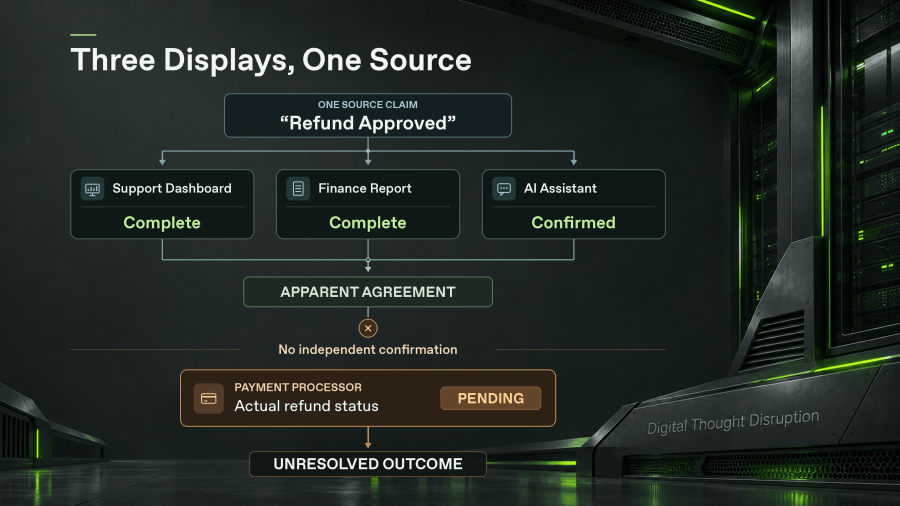
Except the refund is still pending with the payment processor.
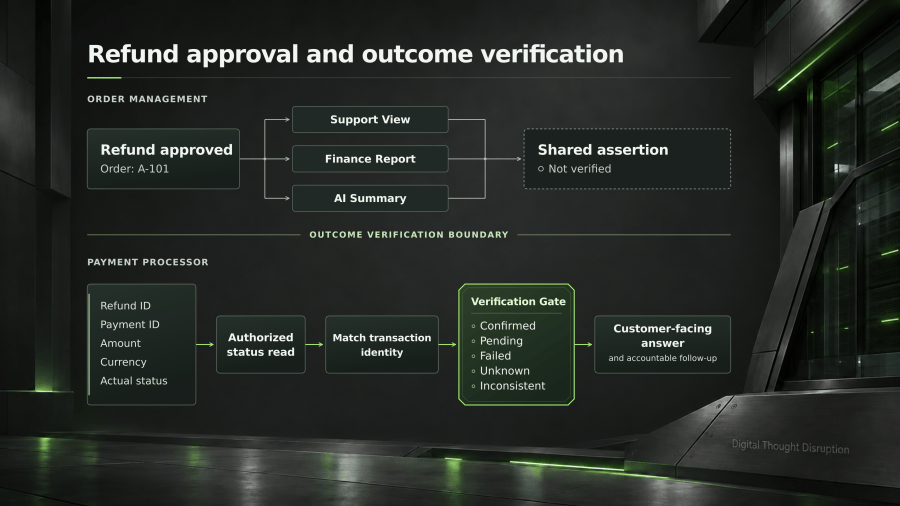
In the refund example, the approval belongs to the retailer’s order-management workflow. The transaction outcome belongs to the payment-processing workflow. They are connected, but they are not the same event.
[5] OWASP, “LLM09:2025 Misinformation,” OWASP Gen AI Security Project. [Online]. Available: https://genai.owasp.org/llmrisk/llm092025-misinformation/. Accessed: Nov. 20, 2026.
They cannot establish every property of the underlying event.
A production evaluation should examine what happens when the answer is wrong in a consequential way.
For the retailer, consider three possible statements.
Build an Evidence Contract for Consequential Claims
Otherwise, the evidence contract is documentation rather than an operational control.
The problem begins when the origin and meaning of that information disappear during transformation.
The relevant question is not how many dashboards agree. It is which system observed the outcome and what that observation can legitimately establish.
These are different outcomes.
That requires evaluating the observation and the authority behind the claim.
For this scenario, useful measures include:
Keep the Verification Decision Outside the Language Model
The practical takeaway: Before allowing AI, automation, or operational reporting to declare consequential work complete, identify which system observed the required outcome, preserve the evidence behind that observation, and define what happens when evidence is missing or contradictory.
These rules apply beyond refunds.
{
“order_id”: “A-101”,
“refund_approved”: true,
“processor_status”: “pending”,
“verification”: “unresolved”,
“permitted_claim”: “refund_approved”,
“follow_up_required”: true
}
The contract intentionally separates processor confirmation from customer receipt. It permits a statement about processor success but does not authorize the application to claim that the customer has received the funds.
[4] Stripe, “Refund and cancel payments,” Stripe Documentation. [Online]. Available: https://docs.stripe.com/refunds. Accessed: Nov. 20, 2026.
What matters is that the evidence check exists and cannot be bypassed simply because a dashboard, report, or AI assistant produces a convincing answer.
Three dashboards can all be wrong together because agreement is not the same thing as independent verification.
[3] Stripe, “The Refund object,” Stripe API Reference. [Online]. Available: https://docs.stripe.com/api/refunds/object. Accessed: Nov. 20, 2026.
AI Agents Can Amplify Evidence Errors Across Workflows
Enterprise systems need to distinguish source agreement, evidence independence, and outcome verification . Data lineage helps establish where a claim originated. Source authority determines what a system is qualified to report. Independent observation provides a separate basis for checking the specific outcome.
A representative may still explain that a refund was approved when processor verification is unavailable. The application should not declare processing complete, close the unresolved financial obligation, or initiate a duplicate refund without appropriate checks.
Stripe also distinguishes refunds submitted to card issuers from when the customer sees the credit, which depends on the payment network and issuing bank. [4]
The application should resolve the relevant transaction, obtain authorized evidence, evaluate the evidence contract, and return a bounded result to the assistant.
The representative opens the finance report. That also shows the refund as complete.
For an automated assistant, this means the workflow may continue in a restricted communication mode while the verification or reconciliation path is unavailable.
A Signed Record Is Still an Assertion
If a verification source is unavailable, the representative can explain what is known, identify what remains unverified, and assign the next action.
The final system has a different observation point. It can report the payment processor’s transaction state, which is directly relevant to whether the refund has progressed beyond internal approval.
None of those methods necessarily establishes the refund outcome.
The objective is not simply to get the assistant to produce the preferred words.
Three systems agree. The representative has every reason to believe the answer is reliable.
Identify the producer of the execution record and the authority controlling it.
Bind the record to the specific transaction, task, or execution being evaluated.
Determine whether a separate observer witnessed the claimed effect.
Preserve gaps and unresolved outcomes rather than converting them into successful completion.
Apply stricter verification before allowing an assertion to trigger another consequential action.
The organization has three consistent presentations of one incorrect conclusion.
Reconciliation Must Preserve Disagreement
The practical response is to preserve source lineage, define what each status means, separate approvals from completed effects, and establish verification at the boundaries where consequences can actually be observed.
That principle applies equally to dashboards, business applications, and automated reporting.
For the unavailable-processor case, the application should not report that the refund failed. It should report that the outcome could not be verified.
An AI assistant retrieves information from both systems and produces a reassuring answer: the refund has been verified, and the customer should expect the money shortly.
When these records disagree, the workflow should identify the conflicting claim and route it to the responsible owner.
Consistency tells us that information agrees across representations. Independence concerns whether the supporting observations can be generated or altered without relying on the same underlying assertion.
An employee may complete the approval task. An application may complete an API request. A processor may complete its refund operation. A bank may subsequently make the credit visible to the customer.
Test the System When Evidence Disagrees
OWASP’s LLM09:2025 Misinformation guidance addresses the wider danger of credible but unsupported AI outputs. Its recommended mitigations include cross-verification, automated validation, human oversight, and communication of uncertainty. [5]
Independent verification creates dependencies of its own.
For enterprise architects, this is an evidence-architecture decision. For platform engineers, it becomes a validation and reconciliation contract. For operations leaders, it determines who owns unresolved work and when a case is genuinely complete.
Second, verify the outcome at the boundary that can observe it. Approval, submission, processing, and customer receipt are different claims with different evidence requirements.
Test
Shared reporting
Processor observation
Expected response
Order A-101
Complete
Pending
State that refund was approved, report pending processing, retain follow-up
Order B-202
Complete
Succeeded
Confirm processor success, without claiming customer receipt
A-101, degraded mode
Complete
Unavailable
Report verification unavailable, retain open follow-up
B-202, mismatched evidence
Complete
Success for a different refund ID
Reject confirmation and investigate the mismatch
The third agent may see two consistent inputs and conclude that the refund has been independently verified.
Define the Pass Criteria Before Running the Exercise
For a refund, it should identify the claim being evaluated, the system qualified to establish that claim, the transaction identifiers required for matching, the acceptable status, the freshness requirements, and the action required when verification fails.
An evidence contract specifies what must be observed before the application may make a particular statement.
Actual payment-provider status models vary, so these are conceptual workflow distinctions rather than a universal payment API schema.
The application recognizes that support and finance share the same underlying order record.
The processor status is matched against the correct refund identity, original payment, amount, and currency.
An approval does not automatically satisfy the processor-completion requirement.
Missing or contradictory evidence prevents unsupported completion claims.
Every unresolved transaction retains an accountable follow-up.
The customer-facing response accurately reflects the verified state.
Applied to enterprise reporting, provenance helps explain how an original record became a dashboard entry, a financial report, or an AI-generated response.
The problem becomes more consequential when AI agents exchange tasks, execution results, and summaries.
A deployment pipeline can report success while an application remains unhealthy. A backup console can report completion while the restore path remains untested. An AI agent can report that a task finished while the destination system still contains the original state.
Suppose the order system reports complete and the processor reports pending.
Measure False Confirmation, Not Just Answer Accuracy
This does not mean every transaction needs a separate verification microservice. A properly designed reconciliation workflow may already perform the required function.
The business service owner should remain accountable for the end-to-end outcome.
Measure
What it reveals
Unsupported completion rate
How often the system declares processing complete without required evidence
Verification coverage
Share of eligible cases that receive the required status check
Transaction match failures
Cases where evidence belongs to a different transaction
Unresolved case follow-up rate
Whether uncertainty results in assigned work
Reconciliation age
How long conflicting records remain unresolved
Customer correction rate
How often a reported status later requires correction
Start with two fictional orders. Both have an internal approval record. Both appear complete in support and finance reporting.
The first four systems may all function as designed according to their local rules. Their agreement does not establish the payment outcome.
Stay informed
Design for Missing Evidence Without Stopping the Business
Support, finance, payment operations, and the AI platform team each own different parts of this workflow.
When an agent receives contradictory records, its response should preserve the contradiction until an appropriate source resolves it.
A timeout after submitting a refund can leave the outcome unknown. Repeating the request without reconciling the original attempt risks duplicate financial activity.
The problem is not necessarily inaccurate source data. The original approval record may be entirely correct. The failure occurs when downstream systems assign that record more meaning than it supports, and agreement among those systems is subsequently mistaken for verification.
Define denominators and measurement windows before using these metrics. A low false-confirmation count means little if most transactions bypass verification or if incorrect answers are rarely detected.
Conversely, a payment processor may provide an authenticated API and an event notification describing the same transaction. Those are two delivery paths, but they remain observations from the same processing authority.
Keep the Customer Response Available
Consider the word complete .
The design requirement is narrower: consequential claims must remain tied to evidence that is appropriate for the conclusion being reported.
A weak reconciliation workflow selects the latest record, averages an inferred confidence score, or gives priority to whichever system has the most recent update timestamp.
Three dashboards reporting the same result do not necessarily provide three independent confirmations. If each dashboard derives its information from the same underlying record, all three can repeat the same error. The problem becomes more serious when an AI assistant summarizes those displays and presents their agreement as verified evidence.
Prevent Verification from Creating New Payment Risks
Configure a simulated payment processor to return different results.
claim_contract:
name: refund_processor_completion
version: 1
claim:
type: refund_processed
scope: individual_transaction
required_evidence:
authority: payment_processor
acquisition: authenticated_status_read
match_fields:
– refund_id
– original_payment_id
– amount_minor_units
– currency
accepted_outcome:
normalized_status: succeeded
freshness:
require_current_observation: true
record_observed_at: true
decisions:
succeeded: processor_confirmed
pending: unresolved
requires_action: unresolved
failed: escalate
canceled: escalate
unavailable: insufficient_evidence
identifier_mismatch: investigate
controls:
preserve_source_reference: true
retain_observation_time: true
prevent_summary_override: true
require_follow_up_for_unresolved: true
customer_receipt_claim: separate_verification
ownership:
workflow: customer_service
evidence_source: payments_operations
reconciliation: finance_operations
The important property is that the language model does not get to convert unresolved into confirmed because two other systems reported completion.
Modern enterprise architectures make it easy to distribute, transform, aggregate, and summarize information. AI makes those transformations even more accessible. But adding another report, model, or agent does not automatically add another observation of reality.
Give the Evidence Conflict an Owner
The customer is still waiting.
Then exercise the workflow with contradictory and unavailable evidence.
That distinction matters. Failure to observe an outcome is not proof that the outcome did not occur.
This leads to three practical rules.
The Operational Decision Is Whether the Evidence Supports the Claim
OWASP’s Verifying Third-Party Agent Execution Evidence Cheat Sheet makes this distinction explicit. Evidence independence depends on who controls the records and what the observer can actually see. [2]