For a VVF environment, this can include vCenter Server, VCF Operations, licensing services, and any deployed VCF Management Services.
An operator should not discover during a management outage that the recovery instructions reference a fleet interface unavailable in the customer’s deployment.
An important operational failure mode is losing monitoring coverage while the infrastructure itself continues functioning.
Establish three different status fields
The platform team should be able to demonstrate:
Continue reading
Status field
Example values
Meaning
Transition execution
Not started, in progress, completed, failed
Whether the technical work executed
Service acceptance
Not tested, accepted, conditional, rejected
Whether the resulting service meets the agreed criteria
Legacy disposition
Retain, pending retirement, retired, exception
What remains of the source environment
Conditionally accepted: Production services meet the agreed mandatory safety and service requirements, but specifically bounded, approved actions remain under accountable operational ownership. Any unsupported exposure remains explicitly identified.
Importing eligible vSphere 8 infrastructure into an existing VCF fleet changes its management relationship. It does not, by itself, upgrade the underlying vCenter, ESXi, or vSAN components to version 9.
Control the Final Production Waves Without Weakening the Gates
I would require application acceptance to cover the full service path, including dependencies that may sit outside the VMware environment.
Recovery is one of the most important reasons not to close a VMware transition based on installation success.
The third assessment determines whether the enterprise can recover its required services after a larger infrastructure failure.
It should not be treated as a cleanup ticket automatically assigned to the infrastructure administrator after the project closes.
Validate readiness before each wave
What about the NSX infrastructure that was not part of the last ESX upgrade wave? Are any workload domains still running version 8 components? Has the recovery site been updated, or does it depend on software reaching end of support in October?
VCF environments with the appropriate deployed services and entitlements expose broader fleet management capabilities through VCF Operations.
Readiness area
Required evidence
Configuration
Current builds and deployed components match the approved target plan
Lifecycle
Supported upgrade or migration workflow and required prechecks
Capacity
Sufficient compute, memory, storage, and maintenance headroom
Network
Required routing, VLANs, NSX policies, DNS, MTU, and connectivity
Protection
Valid source and target recovery arrangements for the planned transition
Application dependencies
Approved move group, test ownership, and planned service interruption
Recovery decision
Documented stop conditions and supported recovery or reversal methods
Change authority
Approved window, accountable lead, communication plan, and decision deadlines
During that period, the responsible teams should review application incidents, performance against baseline, backup results, monitoring coverage, storage health, and any unexpected dependencies.
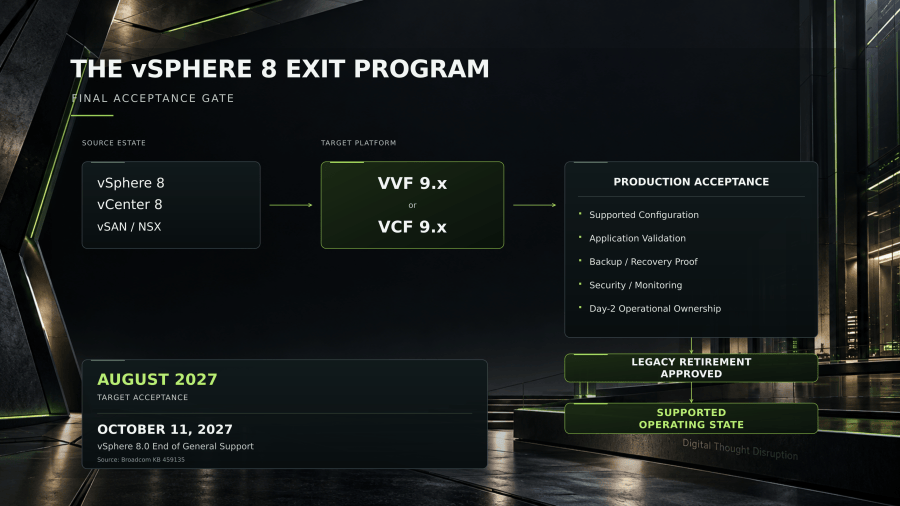
For this series, the recommended timeline has been to target production completion and acceptance by August 31, 2027.
Handle in-place upgrades and workload migrations differently
Those checks are useful, but they do not demonstrate that the service is ready.
The infrastructure team provides the technical evidence. Application owners validate service behavior. Recovery teams demonstrate their protection capabilities. Security reviews the applicable controls. Platform operations accepts the target state.
Both require the same fundamental evidence: validated application functionality, compatible platform components, operational security controls, demonstrated recoverability, and named Day-2 ownership.
That condition must be corrected, the affected state recovered, or an authorized owner must approve a specifically defined exception where policy and service risk permit one.
It is August 2027.
A smaller enterprise might have one team performing several of these functions. A larger organization may distribute them across infrastructure, networking, security, storage, cloud platform, and application teams.
For a VCF environment, the recovery architecture can additionally involve SDDC Manager, NSX Managers, VCF fleet lifecycle services, VCF Automation, identity integration, and other deployed management components.
vSAN maintenance deserves its own stop condition
The final decision belongs to the organization that owns the business services and residual risk.
Broadcom KB 318731 documents file-based and image-based backup options for vCenter Server through version 9.0 and recommends the vCenter Server Appliance Management Interface for appliance backup and restore. For a vCenter 9.1 target, confirm the supported backup and restoration procedure in the documentation for the selected release.
Broadcom KB 443851 also explains that successful scheduled backups for certain VCF Management Services components may not appear in the standard lifecycle task view. Administrators should verify restore points and backup artifacts through the documented restore interface, APIs, or backup destination.
That distinction is the final engineering problem in a VMware modernization program.
Program closure confirms that all in-scope transitions have been accepted, remaining exceptions have been resolved or formally transferred, the target operating model is functioning, and legacy resources can be retired.
An organization may formally accept the business risk of operating a component that remains unsupported.
Prove the Production Service Works After Cutover
Consider a hypothetical financial application that has been migrated into a VCF 9.x workload domain.
The team is preparing to close the migration program.
This final article addresses what happens after those plans reach production.
These are operational details, but they directly influence whether the platform can be recovered after the upgrade program closes.
The final stage of the vSphere 8 exit program should use two separate approval decisions: acceptance of each production migration or upgrade wave, followed by acceptance of the complete target operating environment. These decisions require different evidence. A successful change window proves that an approved activity finished. Program closure must establish that the enterprise can run, protect, maintain, and recover its services after the migration team leaves.
A completed migration task provides execution evidence. It does not establish that the application behaves correctly under production conditions.
Use an acceptance matrix tied to service behavior
Validation domain
Example test
Acceptance evidence
Application
Execute representative business transactions
Application-owner test record
Identity
Authenticate users and required service identities
Authentication and authorization results
Network
Validate required application flows and segmentation
Connectivity and policy test results
Database
Perform approved read/write and integrity checks
Database or application validation
Storage
Validate access, policy compliance, and required performance
Storage and application telemetry
Automation
Exercise required provisioning or integration workflows
Workflow results and errors
Monitoring
Confirm fresh metrics, logs, alerts, and ownership
Observability validation
Backup
Complete supported backup and restore testing
Recovery evidence
Disaster recovery
Validate an approved failure scenario
Recorded recovery objectives and results
This is not intended to create unnecessary administrative activity.
It creates an unresolved acceptance condition.
Establish an observation period
I would not report an imported vSphere 8 workload domain as fully transitioned merely because it appears inside VCF management.
These services do not share one universal backup or restore mechanism.
I would classify remaining exposure as:
The result can be a platform that appears stable but is no longer producing complete operational telemetry.
October 11, 2027, is the support boundary. It should not become the date when the organization begins asking whether its new platform is recoverable.
The same applies to any source system whose backup or recovery arrangements have not been demonstrated.
That creates a specific acceptance requirement.
For affected vSAN 7.x and 8.x environments, Broadcom recommends the appropriate evacuation precheck and describes the availability implications of the available maintenance modes.
This model allows the organization to acknowledge real progress without misrepresenting unfinished work.
For a VVF deployment with VCF Management Services under VVF entitlement, file-based backup and restore of management-services components uses the Fleet LCM API.
Application and workload recovery
The final program decision should have three possible outcomes.
A supported hypervisor does not prove application compatibility. A working backup job does not prove recoverability. A functioning monitoring dashboard does not prove that every adapter is collecting current information.
The exact acceptance criteria should come from the application’s production requirements and pre-change behavior.
Broadcom KB 410997 documents a failure scenario where virtual machines become inaccessible during rolling ESXi host reboots when multiple hosts enter maintenance mode without data migration.
I would establish two formal decision boundaries.
Only then should infrastructure resources be decommissioned through the organization’s approved disposal, retention, and change process.
Management-plane recovery
If extended support is being considered, the coverage must be confirmed through the customer’s actual contract.
Finally, who owns patching, capacity management, incident response, certificate rotation, and recovery testing after the migration project closes?
The closure report should list the actual installed versions, not just the name of the management platform.
None of these dimensions should be inferred from another.
The source cannot be retired simply because the migration task succeeded.
That date creates an operational buffer before the October 11, 2027 general-support deadline.
Conditional acceptance must not be used to bypass a non-negotiable security, recovery, or support requirement.
Site and disaster recovery
The precise organization may differ.
The management recovery plan must account for the selected architecture, supported component methods, configuration dependencies, encryption material, and recovery sequence.
An approved unsupported risk should remain visible in the ongoing risk register rather than being treated as a fully remediated item.
For infrastructure-only changes, such as a management-plane upgrade, acceptance should additionally be based on the platform functions and connected services affected by that change.
Not every enterprise will complete every migration before August 2027.
VVF and VCF Have Different Management Recovery Boundaries
Accepted and closed: The in-scope transition is complete, the required operating controls have passed, residual matters meet the agreed closure criteria, and legacy disposition is documented.
Legacy application dependencies, hardware procurement, vendor certification, specialized devices, and constrained maintenance windows can leave legitimate unresolved work.
I would organize the final months around specific outcomes.
I would therefore establish a risk-based stabilization period for each significant migration wave.
The difference is important.
An enterprise VMware migration is not complete when the upgrade workflow reports success, the hosts run ESX 9.x, or the last planned virtual machine has moved. The environment must also demonstrate that its production applications function correctly, the deployed platform is supported, backup and recovery are operational, monitoring and security integrations remain effective, and the organization has accepted responsibility for ongoing operations.
I would require the following for every component expected to remain outside the approved support baseline.
The test should establish whether the recovery environment can provide the network connectivity, identity, management services, application dependencies, and operational capacity required.
VCF 9.1 scheduled and manual backups are not equivalent
Next, the team should verify that all relevant applications and data have been accepted on the destination and that retained historical information is handled according to policy.
Early waves tend to contain straightforward workloads. The difficult applications remain because they have constrained maintenance windows, old operating systems, specialized hardware, unusual storage dependencies, or recovery requirements that demand more preparation.
Broadcom KB 459138 documents an especially important VCF 9.1.x recovery behavior.
Routine checks should be automated where the platform supports reliable collection. Human attention should focus on exceptions, changes, and decisions.
Large environments may require a different schedule. If discovery shows that the support boundary cannot be met, I would require an early, funded remediation and exception decision rather than assuming that October can absorb unfinished migration work.
The final question I would put to the customer is this: If the migration team disappeared tomorrow and a critical platform or application failed, could the operations organization recover the service, explain the supported configuration, and demonstrate who owns every consequential decision?
Broadcom KB 452364 specifically identifies the API-only procedure for file-based backup and restoration of VCF Management Services components in VVF 9.1.x.
NSX backup retention needs an operating control
A successful restore should establish more than whether the virtual machine powers on.
The following YAML is a conceptual acceptance record for a hypothetical business service. It is not VMware API syntax, does not execute an operation, and does not represent an actual test result.
The objective is to prevent the newly modernized environment from immediately accumulating the same unsupported combinations and operational uncertainty that complicated the vSphere 8 transition.
A backup product reporting successful jobs does not automatically establish that its restored workloads will function on the new architecture.
I would verify that the appropriate scheduled backups are configured, that the required component data is included, and that the restoration procedure has been reviewed and tested to the extent required by the service’s recovery objectives.
The Day-2 operating model should include a repeatable process for reviewing:
Define the minimum recovery acceptance evidence
Recovery area
Required result
vCenter Server
Supported backup exists; approved restore procedure and validation are documented
VVF management services
Correct component-specific recovery interface and workflow identified
VCF management services
Scheduled backup coverage and necessary restore points verified
NSX
Backup destination, recovery material, retention, and restoration requirements validated
Workload backup
Destination-aware protection and representative restoration tested
Disaster recovery
Recovery dependencies and applicable RTO/RPO results demonstrated
Recovery access
Required identities, credentials, encryption keys, DNS, and network paths available
Documentation
Runbooks and recovery records accessible during the defined failure scenario
The objective is to prove that administrators can regain a functioning management environment, not simply recover a collection of virtual appliances.
For VVF, I would confirm that the deployed management configuration provides the expected functionality and that the team knows which tasks remain component-specific.
Verify That Observability Survived the Upgrade
There are product-specific exceptions. Broadcom KB 428674 describes an independent lifecycle for VMware vSphere Foundation for VDI, which should not automatically be assigned the same deadline as ordinary vSphere 8 deployments.
I would use a limited scorecard rather than a large collection of disconnected infrastructure statistics.
I would establish a recurring operating schedule at handoff.
A current example in VCF Operations 9.1.1
For VCF, I would also examine the lifecycle and fleet management signals used by the operations team.
The artifact should reference actual test reports, change records, support matrices, recovery evidence, and approval identities in the customer’s authoritative systems.
Do not assume that because a host has successfully rebooted, the cluster is ready for the next host to enter maintenance mode.
For VCF, platform lifecycle changes must follow the applicable VCF orchestration model. For VVF, the team must follow the supported workflow for its deployment and management components.
Those conditions should be discovered and prioritized as early as possible.
Every production change should begin with a current baseline, not simply a reference to the original compatibility assessment.
The infrastructure team has spent months moving an enterprise from vSphere 8 to its approved VMware 9.x architecture. Management components have been upgraded, hosts have been remediated, applications have moved through production waves, and the project dashboard reports 100% completion.
What monitoring acceptance should prove
A successful replication status does not establish that the application can meet its recovery objectives after a site failure.
Current host, cluster, datastore, and management-component telemetry.
Active collection from required management packs and external integrations.
Alert delivery to the correct monitoring or incident-management system.
Actionable ownership for critical alerts.
Relevant logs and events available for troubleshooting.
Retention and access policies appropriate for the operating environment.
Evidence that a deliberately generated, safe test alert reaches the correct operational owner.
The validation should also examine whether users can complete authorized transactions, background processing operates correctly, external integrations function, security policy permits only intended access, and the service can be monitored and recovered.
Similarly, recovery evidence coverage should not count a successful backup job as a successful recovery test.
Both require validation, but their recovery boundaries differ.
Move From Project Execution to Day-2 Ownership
This distinction belongs in the production handoff.
The real objective is a supported and operationally accepted VMware environment that can continue delivering business services after the project team has finished its work.
Likewise, assigning an operational owner on an organization chart does not demonstrate that the team has the access, training, runbooks, and support relationships needed to maintain the platform.
The responsibility model
Capability
Accountable owner
Required handoff evidence
Platform availability
Infrastructure or platform service owner
Service objectives, escalation, support procedures
Software lifecycle
Platform engineering
Supported BOM, patch cadence, upgrade procedures
Hardware lifecycle
Infrastructure operations
OEM support, firmware baseline, replacement process
Network connectivity
Network operations
Topology, routing, NSX configuration, dependency records
Security controls
Security control owner
Access, certificates, segmentation, logging, exceptions
Backup and recovery
Recovery service owner
Protection policies, restore procedures, test evidence
Application functionality
Application service owner
Accepted testing, dependencies, support contacts
Monitoring and incidents
Operations or site reliability team
Alert coverage, incident procedures, on-call ownership
Capacity and cost
Platform and financial owners
Utilization baseline, forecast, entitlement records
Change governance
Change authority
Approved runbooks, release controls, validation criteria
A workload migration into a new VVF or VCF environment adds data synchronization, network switching, application cutover, authority over production writes, and source retirement.
By the last quarter of execution, the team may also be under schedule pressure.
The observation period should have a defined duration and exit criteria. A fixed number of quiet days is not sufficient if the important application functions have not actually executed.
Define the operating cadence
For a workload migration, returning to the source may be relatively straightforward before the destination begins accepting production transactions.
Executive reporting should distinguish delivery progress from accepted results.
Frequency
Operational review
Daily or continuous
Platform health, critical alerts, backup failures, storage conditions, security events
Weekly
Capacity trends, failed jobs, open incidents, backup destination capacity, unresolved configuration drift
Monthly
Patch and advisory review, component compatibility, certificate and subscription forecasts, configuration compliance
Quarterly
Recovery exercises, operating-model review, entitlement reconciliation, capacity and support-risk assessment
Event-driven
Major releases, security advisories, hardware changes, new integrations, support or licensing changes
It should confirm data integrity, application behavior, authentication, network dependencies, and whether the restored service is suitable to return to production.
However, an exception must not become an invisible extension of the project.
Maintain a supported release baseline
A manually triggered successful backup should not be treated as proof of equivalent management-services recovery coverage.
Broadcom KB 383528 also recommends using a dedicated external backup target for NSX rather than storing its backup files on the SDDC Manager appliance, which introduces a shared failure dependency.
Broadcom KB 456708 states that the identified release families cease receiving technical support and new patches after their documented End of Service dates.
New Broadcom security advisories and maintenance releases.
Current product interoperability and hardware compatibility.
Management component dependencies.
Host image and firmware compliance.
Backup and recovery integration support.
Management-pack compatibility.
Change prechecks, recovery procedures, and post-change evidence.
Takeaway: A VMware upgrade becomes an accepted production platform only when its services are validated, its recovery is demonstrated, its operating responsibilities are assigned, and its remaining legacy exposure is explicitly accounted for.
Do Not Retire the Source Until the Destination Is Fully Accepted
An enterprise may have excellent backup and disaster recovery processes before migration. The new environment can still introduce changes that invalidate parts of that protection model.
The monitoring dashboard may still load. Historical graphs may still be visible. Some adapters may remain healthy while others stop collecting information.
A real recovery test should produce recorded outcomes, including failures and limitations.
The retirement sequence
Are all critical applications protected by backup policies that actually support the new environment? Has a representative restoration succeeded? Are the new monitoring integrations collecting current information? Have the application owners formally accepted the target platform?
For migrated applications, I would establish acceptance at the business-service boundary.
Either model can be valid when responsibilities, escalation boundaries, and evidence are clear.
Legacy component
Required retirement decision
vSphere 8 hosts
Confirm no remaining workload, management, recovery, or approved retention dependency
Old vCenter
Confirm no required host, plugin, automation, backup, or recovery integration remains
NSX 4.x
Confirm network connectivity, routing, and security policy have transitioned or been retired
Old recovery systems
Confirm new recovery chain is accepted and retained copies are handled correctly
Storage and datastores
Confirm data integrity, retention requirements, and approved disposition
Backup repositories
Preserve required recovery points and regulatory records before cleanup
DNS and IPAM
Remove or update records after application and recovery validation
Automation and monitoring
Retire obsolete endpoints, credentials, adapters, and scripts
Subscriptions and contracts
Reconcile entitlements and supported services before cancellation
Physical hardware
Apply approved data sanitization, asset disposal, and inventory controls
The first article in this series established the October 2027 lifecycle deadline and proposed an integrated transition program. Part 2 described how to select VVF or VCF through an evidence-based customer architecture workshop. Part 3 translated that selection into an exact-build compatibility and supported transition plan.
This is an important distinction for environments that used the VCF import workflow.
An imported VCF domain can still contain vSphere 8
The objective is not to apply one identical application test to every system. It is to align each test with the service or control that the change could affect.
The final report should state that difference clearly.
Then the operations manager asks several questions.
Technical execution can be completed while the service remains unaccepted.
Broadcom documents pre-upgrade checks for affected adapters and provides the required management-pack upgrade process.
Handle Unsupported Components Through Explicit Exceptions
A successful target migration does not automatically mean every source component can be safely removed.
The end of the vSphere 8 transition should not be treated as an administrative milestone triggered by the last successful upgrade task.
For example, an overnight batch job might fail even though daytime transactions work correctly. A weekly reporting process might rely on a retired service endpoint. A backup job might encounter an issue only when it performs its first complete protection cycle.
Monitoring should be tested as an operational workflow, not simply inspected as a dashboard.
The exception record
An automated workflow could prevent final closure while required fields remain incomplete.
Exception field
Required information
Affected scope
Exact product, build, hosts, clusters, service, and integration
Lifecycle status
Applicable support boundary and verified entitlement
Business impact
Services, data, and dependencies affected
Technical reason
Specific blocker preventing transition
Risk
Security, availability, recovery, compliance, and support implications
Compensating controls
Approved interim controls and their limitations
Support arrangement
Confirmed vendor or third-party coverage where applicable
Remediation plan
Funded action, accountable owner, and target completion
Approval
Authorized business, technical, and risk decision-makers
Review trigger
Expiration, new release, vendor update, incident, or control failure
A general assumption that older VMware software will remain eligible for full technical support or new security patches is not an acceptable exception strategy.
The final migration waves often carry disproportionate risk.
The acceptance framework should remain consistent while the technical tests reflect the actual change.
Affected integrations include management packs for technologies such as Microsoft SQL Server, ServiceNow, SNMP, HCX, Kubernetes, and Protection and Recovery.