Moving from VVF to VCF: Is Your Operating Model Ready?
TL;DR
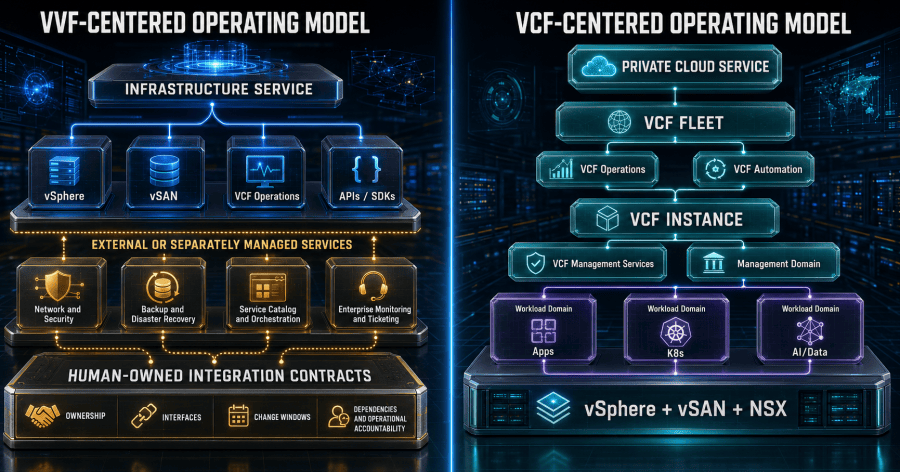
The contract should identify a service owner accountable for the complete result. Component specialists retain their engineering responsibilities. The service owner coordinates their obligations and resolves gaps between them; the title does not grant unrestricted authority over their systems.
Consider an illustrative service that creates a VM, attaches approved storage and network policy, registers DNS, and enrolls the environment in monitoring. The consumer is an application team; the platform team owns delivery; network, security, and application owners supply the policies and acceptance checks. These are proposed responsibilities for the example, not a claim that VCF automatically implements this workflow.
Service responsibility
Decision to make
Evidence the owner should retain
Request and approval
Who may request the service, which inputs are required, and which exceptions need approval?
Request identity, approved inputs, policy version, and approval record.
Delivery and isolation
Which placement, storage, network, and access policies apply?
Resulting resources, policy assignments, and checks of permitted and prohibited access.
Health and recovery
Which service checks establish readiness, and who takes over after partial completion?
Observed application state, failure details, recovery actions, and escalation.
Lifecycle and retirement
Who authorizes maintenance, validates dependencies, and removes unused resources?
Change record, validation results, inventory reconciliation, and retirement evidence.
VCF supports pathways for importing existing vSphere infrastructure, but import does not erase configuration drift, unsupported design choices, old lifecycle practices, naming inconsistency, or undocumented dependencies.