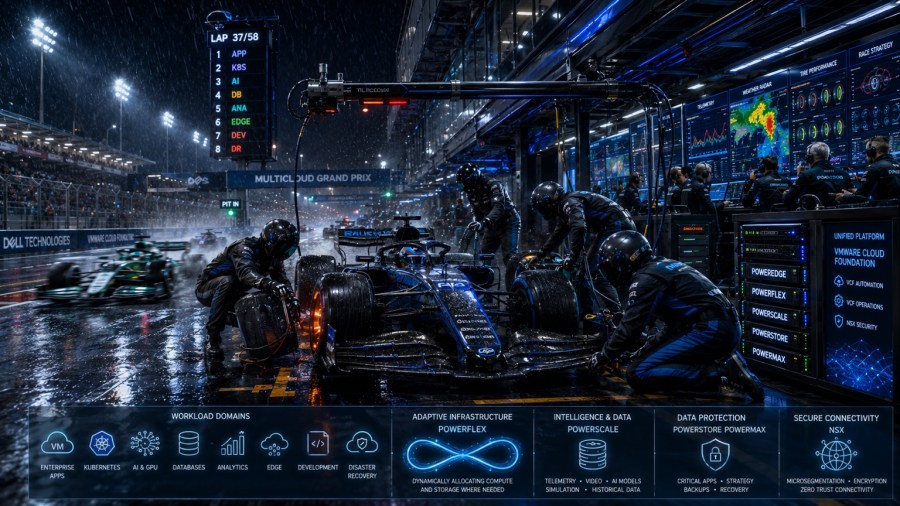
PowerScale represents scale-out file and unstructured-data services. In the race metaphor, it is the data-intelligence feed supporting telemetry archives, analytics, content repositories, model data, and other workloads that need shared access to large data sets.
VMware Cloud Foundation provides the race-control structure. VCF Automation governs repeatable release. VCF Operations turns telemetry into decisions. NSX defines communication boundaries. PowerEdge supplies compute. PowerFlex, PowerScale, PowerStore, and PowerMax provide differentiated data-service profiles. Independent recovery controls ensure that availability problems do not become irreversible business events.
- what processor, memory, accelerator, and local-device profile does the workload require?
- how will hosts be grouped into clusters and failure domains?
- what capacity must remain available during maintenance or component failure?
- what firmware, driver, and platform compatibility baselines apply?
- how will hardware lifecycle align with VCF lifecycle activities?
- what telemetry is exposed to the operations layer?
- which workloads require GPU or other accelerator resources, and how will those resources be governed?
PowerStore and PowerMax appear together in the image, but they should not be flattened into interchangeable storage tiers.
PowerFlex Is the Adaptive Infrastructure Layer
These assumptions are not minor details. They determine whether the race-team model produces operational advantage or becomes a polished diagram layered over traditional silos.
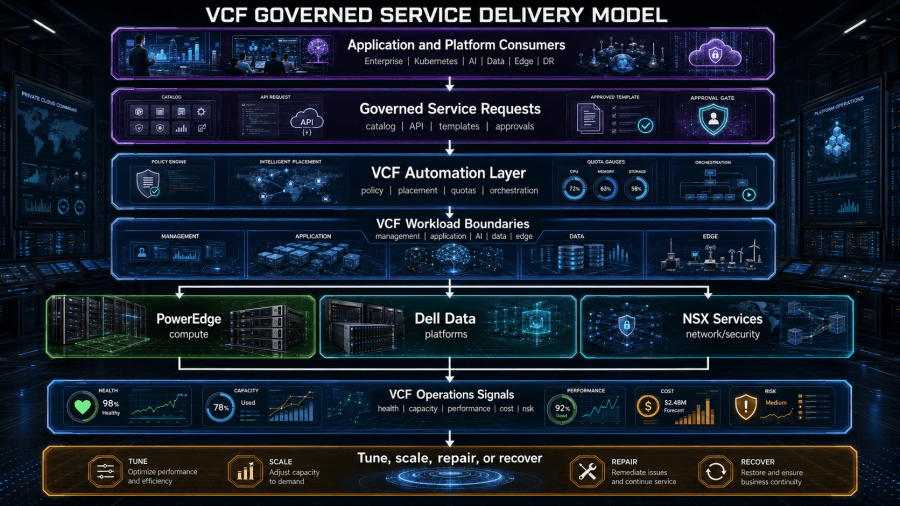
The image becomes more useful when every visual role is translated into a specific platform responsibility.
The most important detail in this model is the feedback loop. Application demand enters through a governed service interface. VCF places the request into an appropriate workload and policy boundary. Dell infrastructure supplies the required compute and data characteristics. NSX applies network and security intent. Operations telemetry then feeds capacity, health, risk, and optimization information back into the next decision.
PowerScale Feeds Data-Intensive Workloads
The most useful automation artifacts are not scripts that create resources. They are service contracts encoded as templates and policy. A strong template explains:
A pit crew becomes faster because it studies every stop. A platform team should do the same.
Before declaring the platform ready for the next lap, verify the following:
- how data is ingested, classified, retained, and deleted
- which workloads need concurrent access
- how namespace growth affects operations
- where data locality matters
- which protection and replication objectives apply
- how access is governed through identity and network policy
- which telemetry must be visible to platform and data owners
Each team may deliver a technically sound component, yet the resulting platform can still be slow to consume and difficult to operate. The handoffs become the bottleneck. Provisioning requires tickets. Policy is interpreted differently by each team. Capacity decisions are made from disconnected reports. Application owners receive infrastructure, but not a dependable service contract.
PowerStore and PowerMax Serve Different Critical Data Profiles
Receive new enterprise AI and hybrid platform articles when they are published.
Connect infrastructure and service telemetry to actionable ownership. Create service-level views that correlate compute, storage, network, security, application, and change signals. Add recovery evidence, including backup success and restore-test outcomes, to the operating picture.
Each profile should include performance expectations, availability design, protection method, lifecycle ownership, capacity policy, monitoring, and cost context. Application owners should choose an approved service outcome, not negotiate an array model during every project.
Highly utilized infrastructure may appear efficient until maintenance, failure, rebalance, recovery, or demand spikes occur. Capacity policy must account for degraded operations and planned change, not only steady-state averages.
- general-purpose virtualized application storage
- high-performance transactional storage
- large-scale software-defined block storage
- shared unstructured-data storage
- mission-critical enterprise storage
- recovery or archive storage
That is not merely a product collage. It is a useful architecture and operating-model prompt.
NSX Defines the Track Limits
The multicloud grand prix image succeeds because it reframes infrastructure as a coordinated operating system. The VCF car, Dell pit crew, NSX security boundary, automation controls, operations telemetry, and workload-domain scoreboard are valuable only when they behave as one service-delivery model.
The race-team model becomes actionable when platform changes are evaluated against explicit criteria. The following decision frame can be applied to capacity expansion, workload placement, storage selection, network policy, lifecycle activity, or recovery design.
Now introduce the equivalent of the storm shown in the image. Demand rises quickly. One storage pool approaches a protection threshold. A network policy change is waiting for approval. An AI service requests more capacity. A planned lifecycle activity is scheduled for the same evening. An application owner reports intermittent latency, but the infrastructure teams do not yet know whether the cause is compute contention, storage behavior, east-west traffic, or an application change.
A mature platform should treat every significant change as a controlled operating loop. The same sequence applies whether the trigger is a new service request, a capacity threshold, a security finding, a lifecycle event, or an incident.
- management-plane isolation
- workload east-west segmentation
- north-south routing and inspection
- administrative access paths
- service-to-service dependencies
- DNS, time, certificates, and identity dependencies
- logging and policy-change evidence
- break-glass access and expiration
- disaster-recovery network behavior
- policy migration during application change
Translate the service profiles into templates, APIs, quotas, approvals, placement logic, network policy, monitoring, backup assignment, tagging, and validation. Store configuration and policy artifacts in version control. Define how exceptions are requested, approved, expired, and reviewed.
Decision Criteria for Every Pit Stop
Select a manageable group of workload patterns such as general enterprise applications, development platforms, Kubernetes, AI or analytics, regulated services, and disaster recovery. Define the expected compute, network, security, storage, operations, lifecycle, and recovery characteristics for each.
| Decision Criterion | Question | Evidence Required |
|---|---|---|
| Service objective | What business or technical outcome must be preserved? | Availability, latency, recovery, throughput, data, and support requirements |
| Workload fit | Which approved platform pattern matches the demand profile? | Application dependencies, usage pattern, growth, compliance, and data characteristics |
| Failure domain | What can fail together, and how is service maintained? | Cluster, rack, site, network, storage, identity, and external-dependency analysis |
| Lifecycle compatibility | Can the full stack be patched and upgraded safely? | Compatibility baseline, sequencing, maintenance capacity, rollback, and support ownership |
| Security boundary | Which communications and administrative actions are permitted? | Dependency map, identity model, policy, logs, exception process, and review cadence |
| Observability | How will success, degradation, and risk be detected? | Metrics, logs, events, service indicators, thresholds, dashboards, and alert ownership |
| Recovery | Can the service be restored within its objectives? | Backup policy, restore evidence, replication design, DR test results, and dependency recovery order |
| Economics | Is the service profile justified by business value? | Capacity model, utilization, support cost, operational effort, growth, and consequence of failure |
| Reversibility | What happens if the change produces an unacceptable result? | Rollback point, data-consistency checks, fallback capacity, and decision authority |
Organizations should not attempt to create the entire race operation in one program. The operating model can be built in controlled phases with measurable exit criteria.
The Pit Stop Operating Loop
The relevant questions include: