TL;DR
Create a naming and tagging standard that can be enforced through provisioning workflows. Avoid group criteria based on informal names, temporary folder structures, or attributes that application teams can change without governance.
Traditional data center security was designed around strong outer walls. Traffic entered through a perimeter firewall, passed through a limited number of trusted zones, and moved relatively freely once it was inside. That model worked when applications were simpler, server populations changed slowly, and most meaningful traffic crossed a visible network boundary.
| Vault element | NSX implementation | Operational meaning |
|---|---|---|
| Outer door | North-south firewall and perimeter controls | Controls traffic entering or leaving the environment |
| Individual compartments | Distributed firewall policy applied to workload interfaces | Limits east-west access between workloads |
| Compartment labels | Groups, tags, attributes, and inventory context | Identifies workload role without relying only on IP addresses |
| Access rules | Layer 3 through Layer 7 policy, depending on capability and entitlement | Allows only required services and application flows |
| Security desk | NSX Manager and policy workflows | Defines, publishes, and governs policy |
| Cameras and logs | Flow visibility, rule logging, hit counts, analytics, and SIEM integration | Provides evidence, troubleshooting context, and drift detection |
| Emergency procedure | Emergency-category rules and controlled exceptions | Supports urgent containment or recovery without normalizing bypasses |
The vault model is a strong fit when the organization has:
Distributed Enforcement Changes the Traffic Model
A controlled emergency process should require:
Identity-aware policy should still be used carefully. User identity is one signal, not a replacement for workload identity, device posture, privileged access management, or application authorization. The operational team must understand how identity is learned, how stale mappings are handled, and what happens when dependent identity services are unavailable.
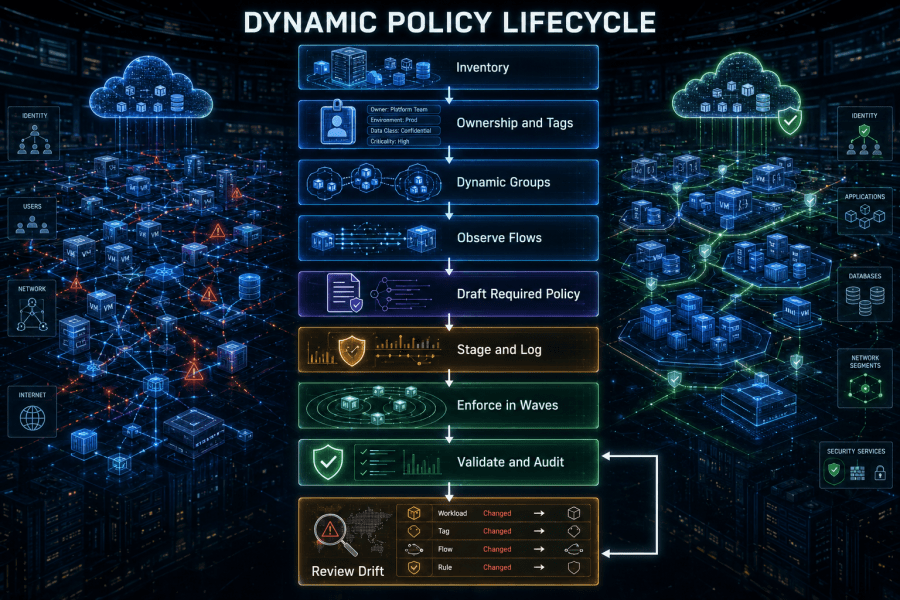
Introduce policy in controlled waves. Use logging and rule statistics selectively so the operations team can evaluate matches without overwhelming telemetry systems. Validate both expected success and expected failure.
Network and security teams can observe connections, but they cannot always determine business necessity. Owners must validate dependencies and participate in testing.
That changes both architecture and operations.
The Vault Is Built from Identity and Context
Logging every rule on every flow can overwhelm collectors, increase storage costs, and make important events harder to find. Logging should be aligned to risk, investigation needs, and retention requirements.
A short capture during a quiet period is not an application baseline.
- application name
- application tier
- environment
- business owner
- technical owner
- data classification
- compliance scope
- deployment source
- recovery tier
- management profile
The design should name the exact control being used instead of placing every advanced security function under the word microsegmentation.
Identity-Aware Policy
Emergency policy can be essential during ransomware containment, active exploitation, credential compromise, or a major application outage. It can also become a permanent bypass if the organization does not define ownership and expiration.
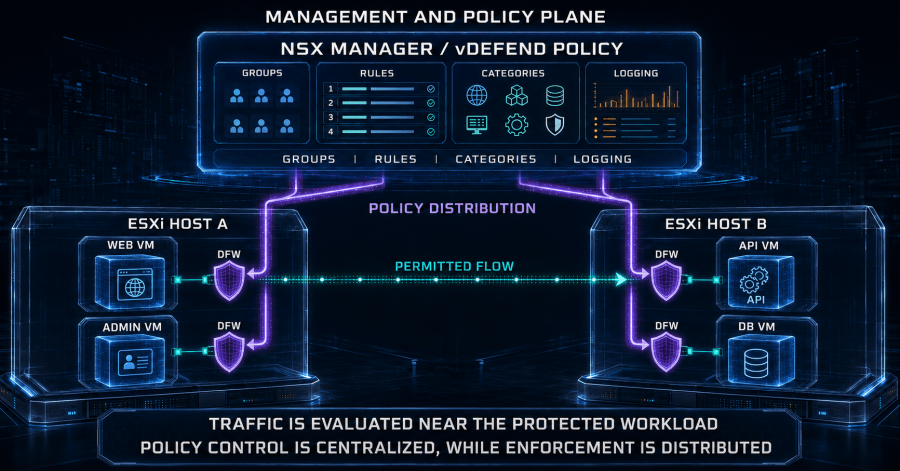
A centralized firewall scales by adding appliances, interfaces, routing paths, and throughput capacity. A distributed firewall scales enforcement across the hypervisor estate. The management plane defines intent, while the distributed enforcement plane applies that intent close to each protected workload.
Application-Aware Policy
That metadata is what turns a firewall rule into a governed control.
The operating model should define evidence retention, review cadence, alert ownership, and the relationship between technical policy objects and enterprise controls. A firewall rule named Allow-App-Traffic is not meaningful evidence. A rule tied to an application ID, owner, approved dependency, control objective, and validation result is.
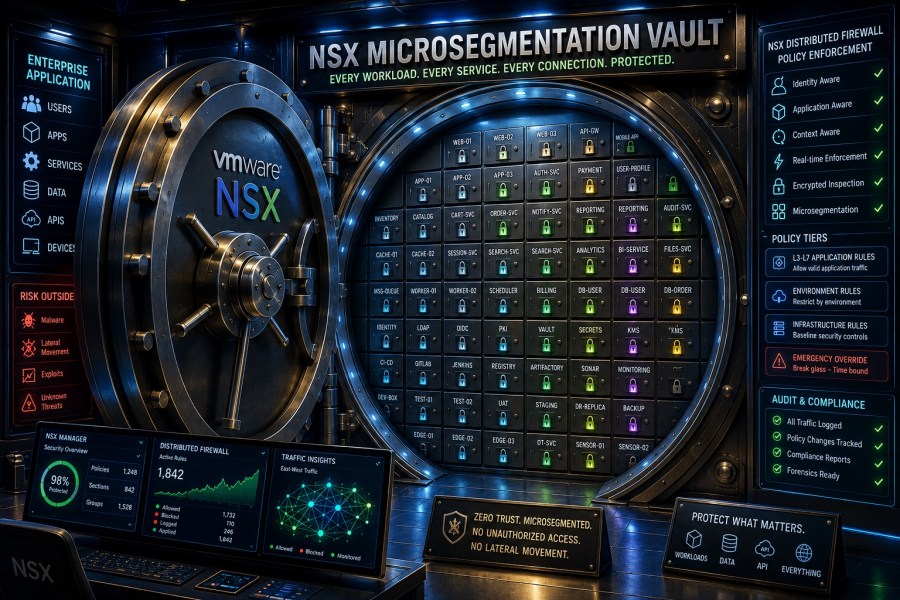
The critical design point is that the vault contains many compartments. A single perimeter rule does not protect the database from a compromised web server. A subnet boundary does not necessarily distinguish a production API from a test API. Microsegmentation becomes valuable when the workload itself is the policy subject.
Policy Tiers Turn Rules into an Architecture
NSX distributed firewall enforcement is implemented close to the virtual workload rather than being concentrated only at a centralized appliance. For protected east-west flows, policy can be evaluated at the workload interface without forcing traffic through a physical firewall or an NSX Edge solely for inspection.
Do not automatically convert every observed connection into an allow rule. Observation shows what happened. It does not prove that the traffic is required or safe.
| Policy tier | Typical purpose | Examples | Primary owner |
|---|---|---|---|
| Emergency | Urgent containment or tightly governed break-glass action | isolate a compromised group, block a malicious service | Security operations |
| Infrastructure | Shared services required by many workloads | DNS, NTP, identity, PKI, backup, monitoring | Platform and infrastructure teams |
| Environment | Boundaries between operational zones | production to non-production, regulated to general workloads | Security architecture |
| Application | Approved service-to-service communication | web to API, API to database, application to message queue | Application and platform teams |
| Default posture | Behavior after explicit policy has been evaluated | deny unapproved communication at the intended scope | Security governance |
Move from observation to enforcement only after application owners, security teams, and platform operators agree on the dependency model and rollback plan. Review rules after deployment to identify unused entries, broad groups, stale exceptions, shadowed logic, and policy that no longer matches the application.
Large NSX environments become difficult to operate when every rule is placed into one long application section. Policy categories provide a way to separate intent and ownership.
A Practical Application Policy Model
A weak design allows broad communication inside a production network. A stronger design expresses only the required application paths.
- internet-facing web tier
- API services
- authentication service
- payment processing service
- database tier
- message queue
- monitoring and backup services
- administrative jump hosts
A secure vault is not valuable because it has a heavy door. It is valuable because the contents are separated, access is controlled, activity is recorded, and emergency procedures are defined before an incident occurs.
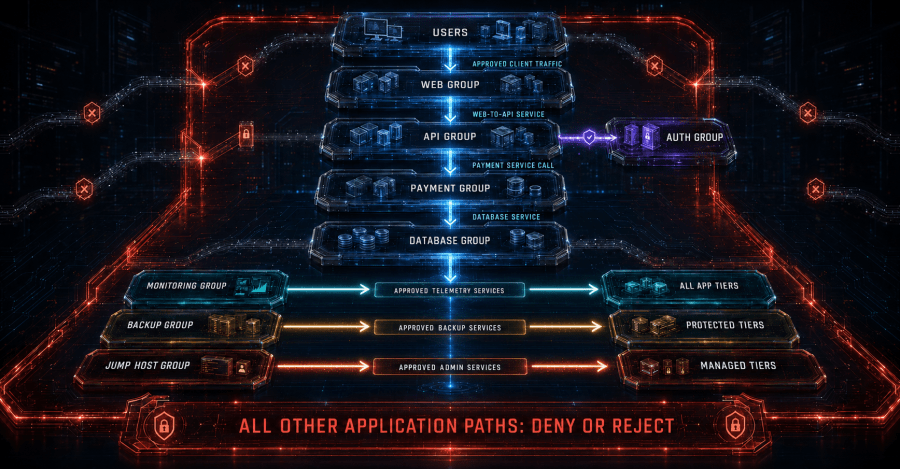
Consider a payment platform with the following components:
Identity Firewall extends the model by allowing rules to consider Active Directory user context in supported designs. That can be useful for administrative access, shared desktop environments, and user-to-application controls where network location alone is not enough.
Observe Real Traffic
A good test plan proves that approved communication works and unauthorized communication does not.
Exclusion lists, broad infrastructure groups, and emergency rules can bypass intended controls. These mechanisms require stricter governance than ordinary application rules.
Draft Rules Around Required Flows
The benefit is significant, but so is the dependency on accurate policy objects. A distributed mistake is still a mistake. An overly broad group, incorrect tag, or poorly scoped deny rule can be enforced everywhere that policy applies. Distribution improves scale and consistency. It does not remove the need for change control.
The same logic applies to NSX microsegmentation.
Stage, Log, and Validate
The model becomes difficult when workload inventory is unreliable, application ownership is unclear, tagging is unmanaged, or the organization expects the firewall team to infer every dependency alone. In those conditions, a pilot should focus first on metadata, ownership, and observability.
These attributes become the foundation for groups and policy scope. A virtual machine tagged as application Payments, tier API, and environment Production can be placed into the appropriate dynamic group. When another matching workload is deployed through an approved process, it can inherit the same policy intent without waiting for a manual firewall ticket tied to a new IP address.
Enforce and Review
Security architects define control intent and risk posture. NSX and virtualization teams operate the platform and enforcement plane. Application teams validate dependencies. Identity teams support user and service identity. Platform engineering teams standardize tags and deployment metadata. Security operations teams monitor alerts and execute containment. Governance teams map evidence to controls.
Application awareness can improve policy accuracy when a service cannot be safely identified by port alone. Layer 7 context can help distinguish supported applications and protocols even when they share common ports.